



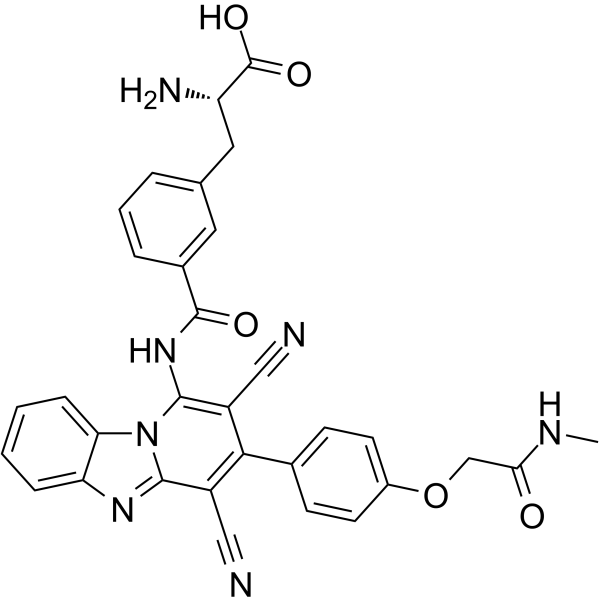
KMH-233
Based on 1 publication(s) in Google Scholar
KMH-233, a potent, reversible and selective inhibitor of l-type amino acid transporter LAT1/SLC7A5, inhibits the uptake of LAT1 substrate, l-leucin (IC50=18 μM) as well as cell growth. KMH-233 significantly potentiates the efficacy of Bestatin and Cisplatin even at low concentrations (25 μM).
For research use only. We do not sell to patients.
- Purity: 99.75%
- CAS No.: 1941174-13-5
- Formula: C32H25N7O5
- Molecular Weight:587.58
-
Storage:Powder -20°C, 3 years ; In solvent -80°C, 6 months , -20°C, 1 month

To place orders, for customer services and technical support, please contact: MedChemExpress USA
Tel: 609-228-6898 E-mail: [email protected] [email protected]


-
 Biological Activity
-
Chemical Information
-
Solvent & Solubility
- Purity & Documentation
- References
-
 Help & FAQs



Publications Citing Use of MedChemExpress (MCE) KMH-233
More

Biological Activity
|
Cell Line

|
Type | Value | Description | References |
|---|---|---|---|---|
| MCF7 | IC50 |
124 μM
Compound: 1; KMH-233
|
Antiproliferative activity against human MCF7 cells assessed as reduction in cell viability measured after 72 hrs by resazurin dye-based fluorimetric analysis
Antiproliferative activity against human MCF7 cells assessed as reduction in cell viability measured after 72 hrs by resazurin dye-based fluorimetric analysis
|
[PMID: 27253989] |
| MCF7 | IC50 |
18.2 μM
Compound: 1; KMH-233
|
Competitive inhibition of [14C]-L-leucine uptake at LAT1 in human MCF7 cells preincubated for 5 mins followed by addition of substrate measured during 5 mins by liquid scintillation counting
Competitive inhibition of [14C]-L-leucine uptake at LAT1 in human MCF7 cells preincubated for 5 mins followed by addition of substrate measured during 5 mins by liquid scintillation counting
|
[PMID: 27253989] |
KMH-233 is able to inhibit binding and transport of essential neutral amino acids and thus, inhibit the cell growth of cancer cells[1].
KMH-233 shows a significant reduction of cell growth with an IC50 of 124 μM[1].
KMH-233 is effective and able to potentiate the anti-proliferative efficacy of Bestatin (100 μM) and Cisplatin (100 μM) at a lower concentration of 25 μM, inhibiting cell growth 53% and 50%, respectively[1].
MedChemExpress (MCE) has not independently confirmed the accuracy of these methods. They are for reference only.
-
Cell Line:MCF-7 cells
-
Concentration:0.5-1000 μM
-
Incubation Time:72 hours
-
Result:Showed a significant reduction of cell growth with an IC50 of 124 µM.


Chemical Information
-
CAS No. 1941174-13-5
-
Appearance Solid
-
Molecular Weight 587.58
-
Formula C32H25N7O5
-
Color White to yellow
-
SMILES
O=C([C@H](CC1=CC=CC(C(NC2=C(C(C3=CC=C(C=C3)OCC(NC)=O)=C(C4=NC5=CC=CC=C5N24)C#N)C#N)=O)=C1)N)O
-
Shipping
Room temperature in continental US; may vary elsewhere.
-
Storage
Powder -20°C 3 years In solvent -80°C 6 months -20°C 1 month


Publications (1)
-
Journal Impact Factor
-
Most Recent
-
Mol Ther
BCKDK modification enhances the anticancer efficacy of CAR-T cells by reprogramming branched chain amino acid metabolism. [Abstract]2024 May 10:S1525-0016(24)00319-8. PMID: 38734897


Solvent & Solubility
DMSO : 100 mg/mL (170.19 mM; Need ultrasonic; Hygroscopic DMSO has a significant impact on the solubility of product, please use newly opened DMSO)
Please refer to the solubility information to select the appropriate solvent. Once prepared, please aliquot and store the solution to prevent product inactivation from repeated freeze-thaw cycles.
Storage method and period of stock solution: -80°C, 6 months; -20°C, 1 month. When stored at -80°C, please use it within 6 months. When stored at -20°C, please use it within 1 month.
Please refer to the solubility information to select the appropriate solvent. Once prepared, please aliquot and store the solution to prevent product inactivation from repeated freeze-thaw cycles.
Storage method and period of stock solution: -80°C, 6 months; -20°C, 1 month. When stored at -80°C, please use it within 6 months. When stored at -20°C, please use it within 1 month.
Concentration (start) × Volume (start) = Concentration (final) × Volume (final)
Select the appropriate dissolution method based on your experimental animal and administration route.
- For the following dissolution methods, please ensure to first prepare a clear stock solution using an In Vitro approach and then sequentially add co-solvents:
- To ensure reliable experimental results, the clarified stock solution can be appropriately stored based on storage conditions. As for the working solution for In Vivo experiments, it is recommended to prepare freshly and use it on the same day.
- The percentages shown for the solvents indicate their volumetric ratio in the final prepared solution. If precipitation or phase separation occurs during preparation, heat and/or sonication can be used to aid dissolution.
Add each solvent one by one: 10% DMSO 40% PEG300 5% Tween-80 45% Saline
Solubility: ≥ 2.5 mg/mL (4.25 mM); Clear solution
This protocol yields a clear solution of ≥ 2.5 mg/mL (saturation unknown).
Taking 1 mL working solution as an example, add 100 μL DMSO stock solution (25.0 mg/mL) to 400 μL PEG300, and mix evenly; then add 50 μL Tween-80 and mix evenly; then add 450 μL Saline to adjust the volume to 1 mL.
Preparation of Saline: Dissolve 0.9 g sodium chloride in ddH₂O and dilute to 100 mL to obtain a clear Saline solution.
Add each solvent one by one: 10% DMSO 90% (20% SBE-β-CD in Saline)
Solubility: 2.5 mg/mL (4.25 mM); Suspended solution; Need ultrasonic
This protocol yields a suspended solution of 2.5 mg/mL. Suspended solution can be used for oral and intraperitoneal injection.
Taking 1 mL working solution as an example, add 100 μL DMSO stock solution (25.0 mg/mL) to 900 μL 20% SBE-β-CD in Saline, and mix evenly.
Preparation of 20% SBE-β-CD in Saline (4°C, storage for one week): 2 g SBE-β-CD powder is dissolved in 10 mL Saline, completely dissolve until clear.
Please enter the basic information of animal experiments:
-
-
-
-
Recommended: Prepare an additional quantity of animals to account for potential losses during experiments.
Please enter your animal formula composition:
-
%DMSO +
Recommended: Keep the proportion of DMSO in working solution below 2% if your animal is weak.
-
%+
-
+%Tween-80 + +
-
%Saline +
The co-solvents required include: DMSO, . All of co-solvents are available by MedChemExpress (MCE). , Tween 80. All of co-solvents are available by MedChemExpress (MCE).
Working solution concentration: 0.22 mg/mL
Method for preparing stock solution: mg drug dissolved in μL DMSO. Stock solution concentration: mg/mL.
1. Take μL DMSO stock solution;
2. Add μL .
μL , mix evenly;
3. Then add μL Tween 80, mix evenly;
4. Then add μL
Please ensure that the stock solution in the first step is dissolved to a clear state, and add co-solvents in sequence. You can use ultrasonic heating (ultrasonic cleaner, recommended frequency 20-40 kHz), vortexing, etc. to assist dissolution.


Purity & Documentation
-
Data Sheet (281 KB)
-
SDS (251 KB)
- English - EN (251 KB)
- Français - FR (251 KB)
- Deutsch - DE (251 KB)
- Norwegian - NO (251 KB)
- Español - ES (251 KB)
- Swedish - SV (251 KB)
- Italian - IT (251 KB)
- Korean - KR (251 KB)
- Portuguese - PT (251 KB)
-
Handling Instructions (2659 KB)
References


Complete Stock Solution Preparation Table
Please refer to the solubility information to select the appropriate solvent. Once prepared, please aliquot and store the solution to prevent product inactivation from repeated freeze-thaw cycles.
Storage method and period of stock solution: -80°C, 6 months; -20°C, 1 month. When stored at -80°C, please use it within 6 months. When stored at -20°C, please use it within 1 month.
| Optional Solvent | Concentration Solvent Mass | 1 mg | 5 mg | 10 mg | 25 mg |
|---|---|---|---|---|---|
| DMSO | 1 mM | 1.7019 mL | 8.5095 mL | 17.0190 mL | 42.5474 mL |
| 5 mM | 0.3404 mL | 1.7019 mL | 3.4038 mL | 8.5095 mL | |
| 10 mM | 0.1702 mL | 0.8509 mL | 1.7019 mL | 4.2547 mL | |
| 15 mM | 0.1135 mL | 0.5673 mL | 1.1346 mL | 2.8365 mL | |
| 20 mM | 0.0851 mL | 0.4255 mL | 0.8509 mL | 2.1274 mL | |
| 25 mM | 0.0681 mL | 0.3404 mL | 0.6808 mL | 1.7019 mL | |
| 30 mM | 0.0567 mL | 0.2836 mL | 0.5673 mL | 1.4182 mL | |
| 40 mM | 0.0425 mL | 0.2127 mL | 0.4255 mL | 1.0637 mL | |
| 50 mM | 0.0340 mL | 0.1702 mL | 0.3404 mL | 0.8509 mL | |
| 60 mM | 0.0284 mL | 0.1418 mL | 0.2836 mL | 0.7091 mL | |
| 80 mM | 0.0213 mL | 0.1064 mL | 0.2127 mL | 0.5318 mL | |
| 100 mM | 0.0170 mL | 0.0851 mL | 0.1702 mL | 0.4255 mL |


KMH-233 Related Classifications
HY-120139 Related Classifications
 Powered by Bioz