



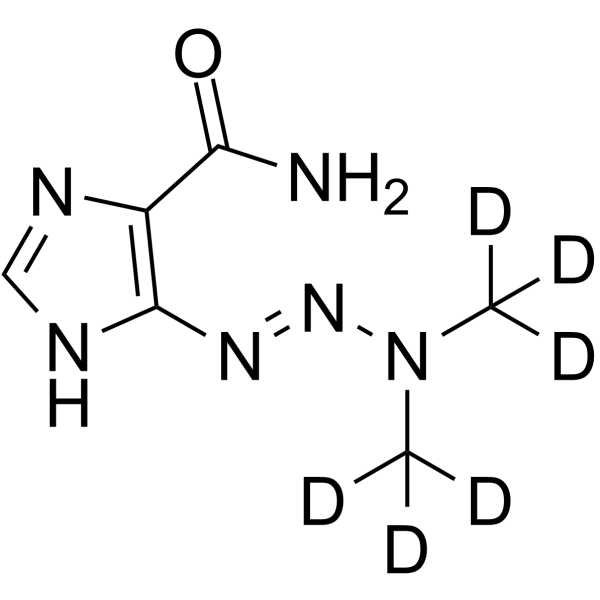
Dacarbazine-d6
Dacarbazine-d6 is the deuterium labeled Dacarbazine. Dacarbazine(DTIC-Dome; DTIC) is an antineoplastic agent. It has significant activity against melanomas.
연구목적의 판매만을 진행합니다. 환자를 대상으로 한 판매는 하지 않습니다.
- CAS No.: 1185241-28-4
- 화학식: C6H4D6N6O
- 분자량:188.22
-
보관:
Please store the product under the recommended conditions in the Certificate of Analysis.

To place orders, for customer services and technical support, please contact: MedChemExpress USA
Tel: 609-228-6898 E-mail: [email protected] [email protected]


-
 Biological Activity
-
Chemical Information
- 순도&문서
- References
-
 Help & FAQs




Biological Activity
Stable heavy isotopes of hydrogen, carbon, and other elements have been incorporated into drug molecules, largely as tracers for quantitation during the drug development process. Deuteration has gained attention because of its potential to affect the pharmacokinetic and metabolic profiles of drugs[1].
MedChemExpress (MCE) has not independently confirmed the accuracy of these methods. They are for reference only.
1. This compound can be used as a tracer
2. This compound can be used as an internal standard for quantitative analysis by NMR, GC-MS, or LC-MS.


Chemical Information
-
CAS No. 1185241-28-4
-
Unlabeled Cas 4342-03-4
-
분자량 188.22
-
화학식 C6H4D6N6O
-
SMILES
[2H]C([2H])([2H])N(C([2H])([2H])[2H])/N=N/C1=C(N=CN1)C(N)=O
-
Synonyms
Imidazole Carboxamide-d6
-
선적
Room temperature in continental US; may vary elsewhere.
-
보관
Please store the product under the recommended conditions in the Certificate of Analysis.


순도&문서
References
[1]. Russak EM, et al. Impact of Deuterium Substitution on the Pharmacokinetics of Pharmaceuticals. Ann Pharmacother. 2019;53(2):211-216. [Content Brief]
[2]. Serrone, L., et al., Dacarbazine-based chemotherapy for metastatic melanoma: thirty-year experience overview. J Exp Clin Cancer Res, 2000. 19(1): p. 21-34. [Content Brief]
[3]. Ramanathan, R.K., et al., Phase II trial of dacarbazine (DTIC) in advanced pancreatic islet cell carcinoma. Study of the Eastern Cooperative Oncology Group-E6282. Ann Oncol, 2001. 12(8): p. 1139-43. [Content Brief]
[4]. Middleton, M.R., et al., Randomized phase III study of temozolomide versus dacarbazine in the treatment of patients with advanced metastatic malignant melanoma. J Clin Oncol, 2000. 18(1): p. 158-66. [Content Brief]

Calculators
Concentration (start) × Volume (start) = Concentration (final) × Volume (final)


Dacarbazine-d6 Related Classifications
HY-B0078S Related Classifications
 Powered by Bioz