



L-Citrulline (GMP)
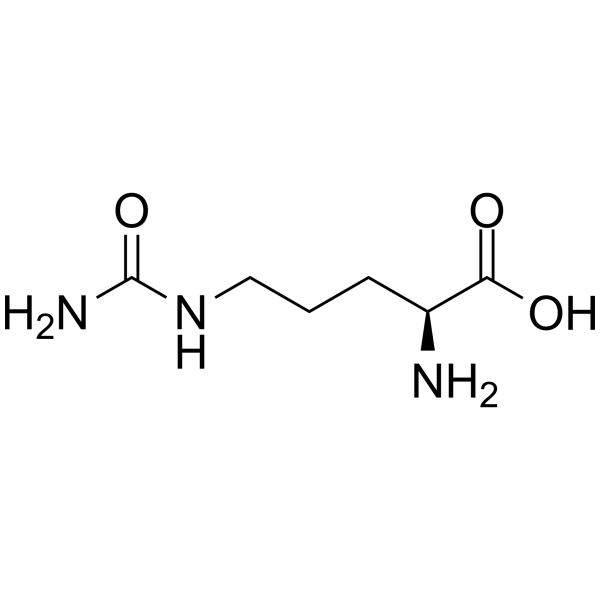
L-Citrulline GMP is an orally active, blood-brain barrier permeable neutral α-amino acid. L-Citrulline GMP inhibits the mitochondrial translocation of Drp1 and maintains mitochondrial homeostasis via a NO-dependent pathway, thereby reducing excessive ROS production. Consequently, L-Citrulline GMP protects sperm DNA integrity, stabilizes the blood-testis barrier and improves semen quality. L-Citrulline GMP can be used in research related to male infertility, mycobacterial infection (tuberculosis) and radiation combined injury.
For research use only. We do not sell to patients.
- CAS No.: 372-75-8
- Formula: C6H13N3O3
- Molecular Weight:175.19
-
Storage:
Please store the product under the recommended conditions in the Certificate of Analysis.


To place orders, for customer services and technical support, please contact: MedChemExpress USA
Tel: 609-228-6898 E-mail: [email protected] [email protected]


-
 Biological Activity
-
Chemical Information
- Purity & Documentation
- References
-
 Help & FAQs





Biological Activity
Description
In Vitro
L-Citrulline (GMP) (1-2 mM) protects mouse C2C12 myoblasts against 43 °C heat stress-induced mitochondrial dysfunction and cell injury via a nitric oxide-mediated inhibition of DRP1 activation[1].
L-Citrulline GMP maintains normal autophagic flux in primary human airway epithelial cells by mitigating asymmetric dimethylarginine-induced nitrative stress via restored nitric oxide bioavailability[1].
MedChemExpress (MCE) has not independently confirmed the accuracy of these methods. They are for reference only.
In Vivo
L-Citrulline GMP (1 g/kg; p.o.; once daily; 21 days post-irradiation), in combination with PEG-G-CSF, significantly increases 30-day survival (42% survival rate) in a mouse model of radiation combined injury, accelerates body weight recovery, improves bone marrow clonogenicity, and enhances intestinal crypt recovery[3].
L-Citrulline GMP (1 g/kg; p.o.; once daily; 21 days post-irradiation) does not significantly improve 30-day survival in mice with total-body irradiation alone, but improves bone marrow clonogenicity and partially reduces irradiation-induced splenomegaly[3].
L-Citrulline GMP (1 g/kg; p.o.; once daily; 21 days post-irradiation), in combination with PEG-G-CSF, does not significantly improve 30-day survival in mice with total-body irradiation alone, but improves bone marrow clonogenicity and fully inhibits irradiation-induced splenomegaly[3].
MedChemExpress (MCE) has not independently confirmed the accuracy of these methods. They are for reference only.
-
Animal Model:B6D2F1/J (female, 14-15 weeks old, average weight 24-25 g, radiation combined injury model)[3]
-
Dosage:1 g/kg
-
Administration:p.o.; once daily; 21 days post-irradiation
-
Result:Produced a non-significant trend toward enhanced 30-day survival (40% survival, median survival time 17.5 days, P=0.057 versus vehicle).
Significantly accelerated wound healing, resulting in smaller wound areas on day 14 (P=0.0436) and day 21 (P=0.0002), and higher percentage wound closure on day 14 (P=0.01) and day 21 (P<0.0001) compared to vehicle.
Significantly increased bone marrow colony-forming unit-granulocyte-monocyte (CFU-GM) counts (P=0.032) and total colony counts (CFU-Total, P=0.0491) on day 30 post-irradiation compared to vehicle.
Increased serum citrulline levels to a moderate degree (not statistically significant versus vehicle).\nSignificantly increased 30-day survival to 42% (median survival time 18 days, P=0.007 versus vehicle), and delayed onset of death to after day 13 post-irradiation (versus 6-10 days for other treatments).
Significantly increased body weight on day 21 post-irradiation (P=0.0071 versus vehicle).
Significantly increased bone marrow CFU-GM (P<0.0001), CFU-granulocyte-erythrocyte-monocyte-megakaryocyte (CFU-GEMM, P=0.0476), and CFU-Total (P=0.0029) counts on day 30 post-irradiation compared to vehicle.
Significantly increased serum citrulline levels (P=0.0388 versus vehicle), increased jejunal crypt depth (P=0.0277 versus vehicle), and restored jejunal crypt counts to levels comparable to sham-irradiated mice on day 30 post-irradiation.
-
Animal Model:B6D2F1/J (female, 14-15 weeks old, average weight 24-25 g, acute radiation syndrome model)[3]
-
Dosage:1 g/kg
-
Administration:p.o.; once daily; 21 days post-irradiation
-
Result:Resulted in 35% 30-day survival (median survival time 20 days), which was not significantly different from vehicle control (P=0.45).
Improved bone marrow cellularity and significantly increased bone marrow CFU-GM counts (P=0.0169) on day 30 post-irradiation compared to vehicle.
Partially inhibited irradiation-induced splenomegaly and reduced splenocyte counts in surviving mice.\nResulted in 50% 30-day survival (median survival time 26 days), which was not significantly different from vehicle control (P=0.19).
Significantly increased bone marrow CFU-GM counts (P=0.0207) on day 30 post-irradiation compared to vehicle.
Fully inhibited irradiation-induced splenomegaly and reduced splenocyte counts in surviving mice.


Chemical Information
-
CAS No. 372-75-8
-
Molecular Weight 175.19
-
Formula C6H13N3O3
-
SMILES
N[C@@H](CCCNC(N)=O)C(O)=O
-
Shipping
Room temperature in continental US; may vary elsewhere.
-
Storage
Please store the product under the recommended conditions in the Certificate of Analysis.


Purity & Documentation
References
[1]. Qin Y, et al.. Heat stress-mediated oxidative damage in male germ cells: potential protective effects of L-citrulline. Frontiers in endocrinology. 2026;17:1800681. [Content Brief]
[2]. Lange SM, et al.. l-Citrulline Metabolism in Mice Augments CD4 T Cell Proliferation and Cytokine Production , and Accumulation in the Mycobacteria-Infected Lung. Frontiers in immunology. 2017;8:1561. [Content Brief]
[3]. Wang L, et al.. PEG-G-CSF and L-Citrulline Combination Therapy for Mitigating Skin Wound Combined Radiation Injury in a Mouse Model. Radiation research. 2021 Jul 01;196(1):113-127. [Content Brief]

Calculators
Concentration (start) × Volume (start) = Concentration (final) × Volume (final)


L-Citrulline (GMP) Related Classifications
HY-N0391G Related Classifications
 Powered by Bioz