



Lesogaberan hydrochloride

Based on 1 Customer Validation
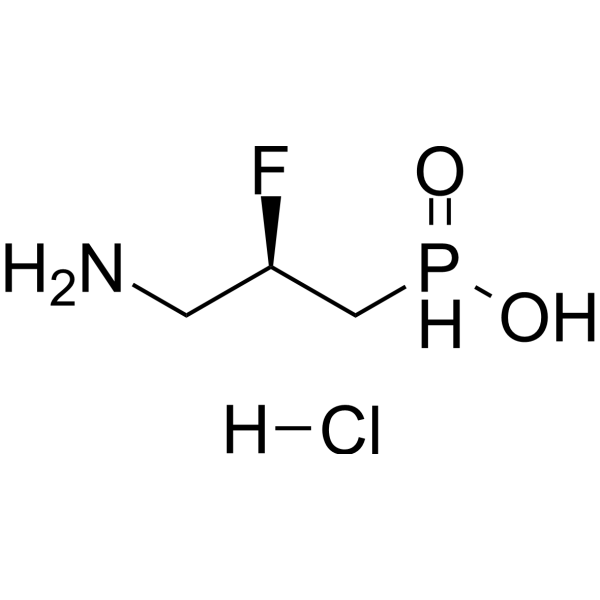
Lesogaberan (AZD-3355) hydrochloride is a potent and selective GABAB receptor agonist with an EC50 of 8.6 nM for human recombinant GABAB receptor. The affinity (Kis) of Lesogaberan hydrochloride for rat GABAB and GABAA receptors, as measured by displacement of [3H]GABA binding in brain membranes: 5.1 nM and 1.4 μM, respectively. Lesogaberan hydrochloride inhibits transient lower esophageal sphincter relaxation through a peripheral mode of action.
For research use only. We do not sell to patients.
- Purity : 98.0%
- CAS No.: 2925644-17-1
- Formula: C3H10ClFNO2P
- Molecular Weight:177.54
-
Storage:
4°C, stored under nitrogen, away from moisture
* In solvent : -80°C, 6 months; -20°C, 1 month (stored under nitrogen, away from moisture)

To place orders, for customer services and technical support, please contact: MedChemExpress USA
Tel: 609-228-6898 E-mail: [email protected] [email protected]


-
 Biological Activity
-
Chemical Information
-
Solvent & Solubility
- Purity & Documentation
- References
-
 Help & FAQs




Biological Activity
Description
IC50 & Target
Ki: 5.1±1.2 nM (rat GABAB), 1.4±0.3 μM (rat GABAA)[1]
EC50: 8.6±0.77 nM (human GABAB receptor)[1]
In Vitro
Lesogaberan hydrochloride (3-30 nM) enhances human islet cell proliferation in vitro[2].
MedChemExpress (MCE) has not independently confirmed the accuracy of these methods. They are for reference only. .
-
Cell Line:Human islet cells
-
Concentration:3, 10, and 30 nM
-
Incubation Time:4 days
-
Result:Had a small but nonsignificant promitotic effect at 3 nM, while treatment at higher dosages (10 and 30 nM) led to a 2-3-fold increase in proliferation relative to that of islets cultured in medium alone.
In Vivo
Oral Lesogaberan (0.08 mg/mL; 48 hours) hydrochloride protects human islet β-cells from apoptosis in islet grafts in mice[2].
Lesogaberan (7 μmol/kg) hydrochloride shows high oral availability (88% in the dog and 100% in the rat) and relatively low systemic clearance in female SpragueDawley rats[1].
MedChemExpress (MCE) has not independently confirmed the accuracy of these methods. They are for reference only.
-
Animal Model:Diabetic NOD/scid mice were implanted with human islets[2]
-
Dosage:0.08 mg/mL
-
Administration:48 hours
-
Result:Significantly reduced the percentages of apoptotic islet cells and increased the frequency of insulin+ β-cells in human islet grafts.
-
Animal Model:Female Sprague Dawley rats[1]
-
Dosage:7 μmol/kg (Pharmacokinetic Analysis)
-
Administration:Oral
-
Result:High oral availability (88% in the dog and 100% in the rat) and relatively low systemic clearance. Plasma protein binding was 1% in rat and human plasma.


Chemical Information
-
CAS No. 2925644-17-1
-
Appearance Viscous Liquid
-
Molecular Weight 177.54
-
Formula C3H10ClFNO2P
-
Color Colorless to light yellow
-
SMILES
O=P(C[C@H](F)CN)O.[H]Cl
-
Synonyms
AZD-3355 hydrochloride
-
Shipping
Room temperature in continental US; may vary elsewhere.
-
Storage
4°C, stored under nitrogen, away from moisture
* In solvent : -80°C, 6 months; -20°C, 1 month (stored under nitrogen, away from moisture)


Solvent & Solubility
In Vitro:
DMSO : 240 mg/mL (1351.81 mM; Need ultrasonic; Hygroscopic DMSO has a significant impact on the solubility of product, please use newly opened DMSO)
H2O : 100 mg/mL (563.25 mM; Need ultrasonic)
Please refer to the solubility information to select the appropriate solvent. Once prepared, please aliquot and store the solution to prevent product inactivation from repeated freeze-thaw cycles.
Storage method and period of stock solution: -80°C, 6 months; -20°C, 1 month (stored under nitrogen, away from moisture). When stored at -80°C, please use it within 6 months. When stored at -20°C, please use it within 1 month.
* Note: If you choose water as the stock solution, please dilute it to the working solution, then filter and sterilize it with a 0.22 μm filter before use.
Please refer to the solubility information to select the appropriate solvent. Once prepared, please aliquot and store the solution to prevent product inactivation from repeated freeze-thaw cycles.
Storage method and period of stock solution: -80°C, 6 months; -20°C, 1 month (stored under nitrogen, away from moisture). When stored at -80°C, please use it within 6 months. When stored at -20°C, please use it within 1 month.
* Note: If you choose water as the stock solution, please dilute it to the working solution, then filter and sterilize it with a 0.22 μm filter before use.
Concentration (start) × Volume (start) = Concentration (final) × Volume (final)
In Vivo:
Select the appropriate dissolution method based on your experimental animal and administration route.
- For the following dissolution methods, please ensure to first prepare a clear stock solution using an In Vitro approach and then sequentially add co-solvents:
- To ensure reliable experimental results, the clarified stock solution can be appropriately stored based on storage conditions. As for the working solution for In Vivo experiments, it is recommended to prepare freshly and use it on the same day.
- The percentages shown for the solvents indicate their volumetric ratio in the final prepared solution. If precipitation or phase separation occurs during preparation, heat and/or sonication can be used to aid dissolution.
Add each solvent one by one: 10% DMSO 40% PEG300 5% Tween-80 45% Saline
Solubility: ≥ 6 mg/mL (33.80 mM); Clear solution
This protocol yields a clear solution of ≥ 6 mg/mL (saturation unknown).
Taking 1 mL working solution as an example, add 100 μL DMSO stock solution (60.0 mg/mL) to 400 μL PEG300, and mix evenly; then add 50 μL Tween-80 and mix evenly; then add 450 μL Saline to adjust the volume to 1 mL.
Preparation of Saline: Dissolve 0.9 g sodium chloride in ddH₂O and dilute to 100 mL to obtain a clear Saline solution.
Add each solvent one by one: 10% DMSO 90% (20% SBE-β-CD in Saline)
Solubility: ≥ 6 mg/mL (33.80 mM); Clear solution
This protocol yields a clear solution of ≥ 6 mg/mL (saturation unknown).
Taking 1 mL working solution as an example, add 100 μL DMSO stock solution (60.0 mg/mL) to 900 μL 20% SBE-β-CD in Saline, and mix evenly.
Preparation of 20% SBE-β-CD in Saline (4°C, storage for one week): 2 g SBE-β-CD powder is dissolved in 10 mL Saline, completely dissolve until clear.
For the following dissolution methods, please prepare the working solution directly:
It is recommended to prepare fresh solutions and use them promptly within a short period of time.
The percentages shown for the solvents indicate their volumetric ratio in the final prepared solution. If precipitation or phase separation occurs during preparation, heat and/or sonication can be used to aid dissolution.
Add each solvent one by one: PBS
Solubility: 100 mg/mL (563.25 mM); Clear solution; Need ultrasonic
In Vivo Dissolution Calculator
Please enter the basic information of animal experiments:
-
-
-
-
Recommended: Prepare an additional quantity of animals to account for potential losses during experiments.
Working solution concentration: 0.22 mg/mL
This product has good water solubility, please refer to the measured solubility data in water/PBS/Saline for details.


Purity & Documentation
-
Data Sheet (275 KB)
-
SDS (252 KB)
- English - EN (252 KB)
- Français - FR (252 KB)
- Deutsch - DE (252 KB)
- Norwegian - NO (252 KB)
- Español - ES (252 KB)
- Swedish - SV (252 KB)
- Italian - IT (252 KB)
- Korean - KR (252 KB)
- Portuguese - PT (252 KB)
-
Handling Instructions (2659 KB)
References
[1]. Lehmann A, et al. (R)-(3-amino-2-fluoropropyl) phosphinic acid (AZD3355), a novel GABAB receptor agonist, inhibits transient lower esophageal sphincter relaxation through a peripheral mode of action. J Pharmacol Exp Ther. 2009 Nov;331(2):504-12. [Content Brief]
[2]. Tian J, et al. Repurposing Lesogaberan to Promote Human Islet Cell Survival and β-Cell Replication. J Diabetes Res. 2017;2017:6403539. [Content Brief]


Complete Stock Solution Preparation Table
Please refer to the solubility information to select the appropriate solvent. Once prepared, please aliquot and store the solution to prevent product inactivation from repeated freeze-thaw cycles.
Storage method and period of stock solution: -80°C, 6 months; -20°C, 1 month (stored under nitrogen, away from moisture). When stored at -80°C, please use it within 6 months. When stored at -20°C, please use it within 1 month.
| Optional Solvent | Concentration Solvent Mass | 1 mg | 5 mg | 10 mg | 25 mg |
|---|---|---|---|---|---|
| H2O / DMSO | 1 mM | 5.6325 mL | 28.1627 mL | 56.3253 mL | 140.8133 mL |
| 5 mM | 1.1265 mL | 5.6325 mL | 11.2651 mL | 28.1627 mL | |
| 10 mM | 0.5633 mL | 2.8163 mL | 5.6325 mL | 14.0813 mL | |
| 15 mM | 0.3755 mL | 1.8775 mL | 3.7550 mL | 9.3876 mL | |
| 20 mM | 0.2816 mL | 1.4081 mL | 2.8163 mL | 7.0407 mL | |
| 25 mM | 0.2253 mL | 1.1265 mL | 2.2530 mL | 5.6325 mL | |
| 30 mM | 0.1878 mL | 0.9388 mL | 1.8775 mL | 4.6938 mL | |
| 40 mM | 0.1408 mL | 0.7041 mL | 1.4081 mL | 3.5203 mL | |
| 50 mM | 0.1127 mL | 0.5633 mL | 1.1265 mL | 2.8163 mL | |
| 60 mM | 0.0939 mL | 0.4694 mL | 0.9388 mL | 2.3469 mL | |
| 80 mM | 0.0704 mL | 0.3520 mL | 0.7041 mL | 1.7602 mL | |
| 100 mM | 0.0563 mL | 0.2816 mL | 0.5633 mL | 1.4081 mL |
* Note: If you choose water as the stock solution, please dilute it to the working solution, then filter and sterilize it with a 0.22 μm filter before use.


Lesogaberan hydrochloride Related Classifications
HY-10061B Related Classifications
 Powered by Bioz