



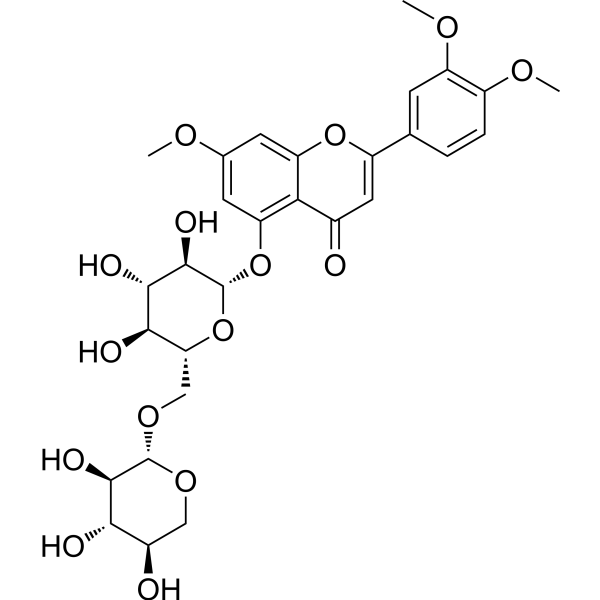
Lethedioside A
Lethedioside A is a Enhancer of split 1 (Hes1) inhibitor with an IC50 of 9.5 μM. Lethedioside A inhibits Hes1 dimer formation. Lethedioside A exhibits weak inhibition of TCF4/β-catenin complex formation. Lethedioside A inhibits nitric oxide production by activated immune cells.
For research use only. We do not sell to patients.
- CAS No.: 221289-31-2
- Formula: C29H34O15
- Molecular Weight:622.57
-
Storage:
Please store the product under the recommended conditions in the Certificate of Analysis.

To place orders, for customer services and technical support, please contact: MedChemExpress USA
Tel: 609-228-6898 E-mail: [email protected] [email protected]


-
 Biological Activity
-
Chemical Information
- Purity & Documentation
- References
-
 Help & FAQs




Biological Activity
Description
IC50 & Target
[1]|
Hes1 9.5 μM (IC50) |
Cellular Effect
|
Cell Line

|
Type | Value | Description | References |
|---|---|---|---|---|
| KB | IC50 |
>100 μg/mL
Compound: 4
|
Cytotoxicity against human KB cells after 72 hrs by neutral red assay
Cytotoxicity against human KB cells after 72 hrs by neutral red assay
|
[PMID: 10075750] |
In Vitro
Lethedioside A (compound 4) weakly inhibits purified hTCF4/β-catenin complex formation in a cell-free ELISA with an IC50 of 46.9 μM[1].
Lethedioside A binds directly to GST-Hes1 immobilized on Sepharose beads in a cell-free biochemical binding assay[1].
Lethedioside A (24 h) potently inhibits LPS (HY-D1056)-induced nitric oxide production in RAW 264.7 macrophages with an IC50 of 7.91 μM[2].
MedChemExpress (MCE) has not independently confirmed the accuracy of these methods. They are for reference only.


Chemical Information
-
CAS No. 221289-31-2
-
Molecular Weight 622.57
-
Formula C29H34O15
-
SMILES
O=C1C(C(OC(C2=CC(OC)=C(OC)C=C2)=C1)=CC(OC)=C3)=C3O[C@@H]4O[C@@H]([C@@H](O)[C@H](O)[C@H]4O)CO[C@H]5[C@@H]([C@H]([C@H](O)CO5)O)O
-
Structure Classification
-
Initial Source
-
Shipping
Room temperature in continental US; may vary elsewhere.
-
Storage
Please store the product under the recommended conditions in the Certificate of Analysis.


Purity & Documentation
References

Calculators
Concentration (start) × Volume (start) = Concentration (final) × Volume (final)


Lethedioside A Related Classifications
HY-N3393 Related Classifications
 Powered by Bioz