



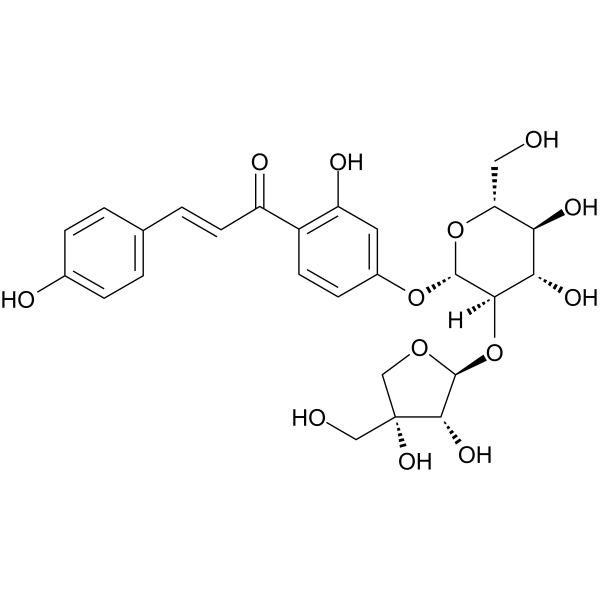
Licraside

Based on 1 Customer Validation
Licraside, found in Glycyrrhiza glabra, is a Farnesoid X receptor (FXR) activator. Licraside activates FXR to induce upregulation of SHP and BSEP, regulates bile acid homeostasis, reduces elevated biliary and serum TBA, serum ALT, AST, GGT, ALP, and TBIL levels, and attenuates liver histopathological damage. Licraside inhibits factor Xa with an IC50 of 48.54 mM. Licraside can be used for the research of cholestasis and thromboembolic diseases.
For research use only. We do not sell to patients.
- Purity : 99.95%
- CAS No.: 29913-71-1
- Formula: C26H30O13
- Molecular Weight:550.51
-
Storage:
4°C, protect from light
* In solvent : -80°C, 6 months; -20°C, 1 month (protect from light)

To place orders, for customer services and technical support, please contact: MedChemExpress USA
Tel: 609-228-6898 E-mail: [email protected] [email protected]


-
 Biological Activity
-
Chemical Information
-
Solvent & Solubility
- Protocols
- Purity & Documentation
- References
-
 Help & FAQs




Biological Activity
Description
In Vitro
Licraside (20-800 μM; 24-72 h) shows ;low hepatotoxicity profile in HepG2 cells[1].
Licraside (20-100 μM; 24 h) acts as a dose-dependent FXR agonist in transiently transfected HepG2 cells, increasing BSEP promoter-driven luciferase activity[1].
Licraside (40-80 μM; 24 h) activates FXR signaling in HepG2 cells, significantly upregulating downstream SHP protein expression and BSEP protein expression[1].
Licraside inhibits factor Xa with an IC50 of 48.54 mM[2].
MedChemExpress (MCE) has not independently confirmed the accuracy of these methods. They are for reference only. Further protocols information, click here.
-
Cell Line:HepG2 cells
-
Concentration:20, 40, 80, 100, 800 μM
-
Incubation Time:24 h; 72 h
-
Result:Did not reduce HepG2 cell viability after 24 h incubation at concentrations up to 800 μM.
Caused only a slight, non-significant decrease in cell viability at 20, 40, and 80 μM after 72 h incubation compared to 24 h treatment.
Caused significant hepatic cell death at 100 μM after 72 h incubation.
-
Cell Line:HepG2 cells
-
Concentration:40, 80 μM
-
Incubation Time:24 h
-
Result:Significantly increased SHP protein expression compared to the control group at both 40 μM and 80 μM.
Significantly upregulated BSEP protein expression at 80 μM.
Caused non-statistically significant increases in BSEP expression at 40 μM.
In Vivo
MedChemExpress (MCE) has not independently confirmed the accuracy of these methods. They are for reference only.
-
Animal Model:C57BL/6 J (male, 8-10 weeks old, 18-20 g, ANIT-induced cholestasis)[1]
-
Dosage:1 mg/kg; 5 mg/kg; 10 mg/kg
-
Administration:i.p.; daily; 7 days
-
Result:Significantly reduced biliary total bile acid (TBA) levels.
Significantly reduced serum levels of alanine aminotransferase (ALT), aspartate aminotransferase (AST), alkaline phosphatase (ALP), gamma-glutamyl transferase (GGT), total bilirubin (TBIL), and TBA compared to the ANIT model group at medium and high doses.
Reduced fat vacuole formation and eliminated bile duct area inflammatory cell infiltration at low dose.
Resulted in clear liver cell nuclei, minimal hepatocyte necrosis, and no fat vacuole formation at medium dose.
Produced hepatocytes uniform in size, morphology, and structure, arranged neatly in radial patterns similar to the control group at high dose.
Caused slightly less weight loss than the ANIT group.


Chemical Information
-
CAS No. 29913-71-1
-
Appearance Solid
-
Molecular Weight 550.51
-
Formula C26H30O13
-
Color Light yellow to yellow
-
SMILES
OC1=C(C(/C=C/C2=CC=C(O)C=C2)=O)C=CC(O[C@H](O[C@H](CO)[C@@H](O)[C@@H]3O)[C@]3([H])O[C@H]4[C@@H]([C@](CO)(O)CO4)O)=C1
-
Structure Classification
-
Initial Source
-
Shipping
Room temperature in continental US; may vary elsewhere.
-
Storage
4°C, protect from light
* In solvent : -80°C, 6 months; -20°C, 1 month (protect from light)


Solvent & Solubility
In Vitro:
DMSO : 100 mg/mL (181.65 mM; Need ultrasonic; Hygroscopic DMSO has a significant impact on the solubility of product, please use newly opened DMSO)
Please refer to the solubility information to select the appropriate solvent. Once prepared, please aliquot and store the solution to prevent product inactivation from repeated freeze-thaw cycles.
Storage method and period of stock solution: -80°C, 6 months; -20°C, 1 month (protect from light). When stored at -80°C, please use it within 6 months. When stored at -20°C, please use it within 1 month.
Please refer to the solubility information to select the appropriate solvent. Once prepared, please aliquot and store the solution to prevent product inactivation from repeated freeze-thaw cycles.
Storage method and period of stock solution: -80°C, 6 months; -20°C, 1 month (protect from light). When stored at -80°C, please use it within 6 months. When stored at -20°C, please use it within 1 month.
Concentration (start) × Volume (start) = Concentration (final) × Volume (final)
In Vivo:
Select the appropriate dissolution method based on your experimental animal and administration route.
- For the following dissolution methods, please ensure to first prepare a clear stock solution using an In Vitro approach and then sequentially add co-solvents:
- To ensure reliable experimental results, the clarified stock solution can be appropriately stored based on storage conditions. As for the working solution for In Vivo experiments, it is recommended to prepare freshly and use it on the same day.
- The percentages shown for the solvents indicate their volumetric ratio in the final prepared solution. If precipitation or phase separation occurs during preparation, heat and/or sonication can be used to aid dissolution.
Add each solvent one by one: 10% DMSO 40% PEG300 5% Tween-80 45% Saline
Solubility: ≥ 1 mg/mL (1.82 mM); Clear solution
This protocol yields a clear solution of ≥ 1 mg/mL (saturation unknown).
Taking 1 mL working solution as an example, add 100 μL DMSO stock solution (10.0 mg/mL) to 400 μL PEG300, and mix evenly; then add 50 μL Tween-80 and mix evenly; then add 450 μL Saline to adjust the volume to 1 mL.
Preparation of Saline: Dissolve 0.9 g sodium chloride in ddH₂O and dilute to 100 mL to obtain a clear Saline solution.
Add each solvent one by one: 10% DMSO 90% (20% SBE-β-CD in Saline)
Solubility: ≥ 1 mg/mL (1.82 mM); Clear solution
This protocol yields a clear solution of ≥ 1 mg/mL (saturation unknown).
Taking 1 mL working solution as an example, add 100 μL DMSO stock solution (10.0 mg/mL) to 900 μL 20% SBE-β-CD in Saline, and mix evenly.
Preparation of 20% SBE-β-CD in Saline (4°C, storage for one week): 2 g SBE-β-CD powder is dissolved in 10 mL Saline, completely dissolve until clear.
In Vivo Dissolution Calculator
Please enter the basic information of animal experiments:
-
-
-
-
Recommended: Prepare an additional quantity of animals to account for potential losses during experiments.
Please enter your animal formula composition:
-
%DMSO +
Recommended: Keep the proportion of DMSO in working solution below 2% if your animal is weak.
-
%+
-
+%Tween-80 + +
-
%Saline +
The co-solvents required include: DMSO, . All of co-solvents are available by MedChemExpress (MCE). , Tween 80. All of co-solvents are available by MedChemExpress (MCE).
Working solution concentration: 0.22 mg/mL
Method for preparing stock solution: mg drug dissolved in μL DMSO. Stock solution concentration: mg/mL. * In solvent : -80°C, 6 months; -20°C, 1 month (protect from light)
1. Take μL DMSO stock solution;
2. Add μL .
μL , mix evenly;
3. Then add μL Tween 80, mix evenly;
4. Then add μL
Please ensure that the stock solution in the first step is dissolved to a clear state, and add co-solvents in sequence. You can use ultrasonic heating (ultrasonic cleaner, recommended frequency 20-40 kHz), vortexing, etc. to assist dissolution.

Protocols
-
Cell Cytotoxicity Assay
Cytotoxicity assays are usually based on the assessment of cell membrane damage, which can also be indirectly detected by measuring cell viability. Detection methods include MTT assay, CKK-8 assay, LDH assay and ATP assay, etc.
-
Mesenchymal stromal/stem cell osteogenic differentiation
Mesenchymal stromal/stem cells can be induced toward an osteoblast-like lineage in vitro by culture in osteogenic medium containing dexamethasone, ascorbic acid or ascorbate-2-phosphate, and β-glycerophosphate; the differentiation process is commonly evaluated by alkaline phosphatase activity, osteogenic marker expression, collagenous matrix formation, and calcium-rich matrix mineralization. The main readouts are alkaline phosphatase activity as an early osteogenic marker and Alizarin Red S staining as a calcium-deposit readout for mineralized extracellular matrix; Alizarin Red S can be inspected microscopically or extracted and measured colorimetrically at 405 nm.
-
Hepatotoxicity Study
This protocol evaluates hepatotoxicity using complementary in vivo mouse APAP acute liver injury and in vitro hepatocyte-based cytotoxicity readouts. In vivo APAP injury is assessed by serum ALT/AST, liver histology, hepatic glutathione, protein adducts, necrosis, inflammation, and regeneration-related endpoints. In vitro hepatotoxicity is assessed by loss of viability, leakage of ALT/AST/LDH, oxidative-stress markers, mitochondrial function, nuclear morphology, intracellular calcium, and high-content imaging endpoints.


Purity & Documentation
-
Data Sheet (280 KB)
-
SDS (252 KB)
- English - EN (252 KB)
- Français - FR (252 KB)
- Deutsch - DE (252 KB)
- Norwegian - NO (252 KB)
- Español - ES (252 KB)
- Swedish - SV (252 KB)
- Italian - IT (252 KB)
- Korean - KR (252 KB)
- Portuguese - PT (252 KB)
-
Handling Instructions (2659 KB)
References
[1]. Xi L, et al. Licraside as novel potent FXR agonist for relieving cholestasis: structure-based drug discovery and biological evaluation studies. Front Pharmacol. 2023;14:1197856. Published 2023 Jun 15. [Content Brief]
[2]. Ibrahim R S, et al. Biologically guided isolation and ADMET profile of new factor Xa inhibitors from Glycyrrhiza glabra roots using in vitro and in silico approaches[J]. RSC advances, 2021, 11(17): 9995-10001. [Content Brief]


Complete Stock Solution Preparation Table
Please refer to the solubility information to select the appropriate solvent. Once prepared, please aliquot and store the solution to prevent product inactivation from repeated freeze-thaw cycles.
Storage method and period of stock solution: -80°C, 6 months; -20°C, 1 month (protect from light). When stored at -80°C, please use it within 6 months. When stored at -20°C, please use it within 1 month.
| Optional Solvent | Concentration Solvent Mass | 1 mg | 5 mg | 10 mg | 25 mg |
|---|---|---|---|---|---|
| DMSO | 1 mM | 1.8165 mL | 9.0825 mL | 18.1650 mL | 45.4124 mL |
| 5 mM | 0.3633 mL | 1.8165 mL | 3.6330 mL | 9.0825 mL | |
| 10 mM | 0.1816 mL | 0.9082 mL | 1.8165 mL | 4.5412 mL | |
| 15 mM | 0.1211 mL | 0.6055 mL | 1.2110 mL | 3.0275 mL | |
| 20 mM | 0.0908 mL | 0.4541 mL | 0.9082 mL | 2.2706 mL | |
| 25 mM | 0.0727 mL | 0.3633 mL | 0.7266 mL | 1.8165 mL | |
| 30 mM | 0.0605 mL | 0.3027 mL | 0.6055 mL | 1.5137 mL | |
| 40 mM | 0.0454 mL | 0.2271 mL | 0.4541 mL | 1.1353 mL | |
| 50 mM | 0.0363 mL | 0.1816 mL | 0.3633 mL | 0.9082 mL | |
| 60 mM | 0.0303 mL | 0.1514 mL | 0.3027 mL | 0.7569 mL | |
| 80 mM | 0.0227 mL | 0.1135 mL | 0.2271 mL | 0.5677 mL | |
| 100 mM | 0.0182 mL | 0.0908 mL | 0.1816 mL | 0.4541 mL |


Licraside Related Classifications
HY-N6987 Related Classifications
 Powered by Bioz