



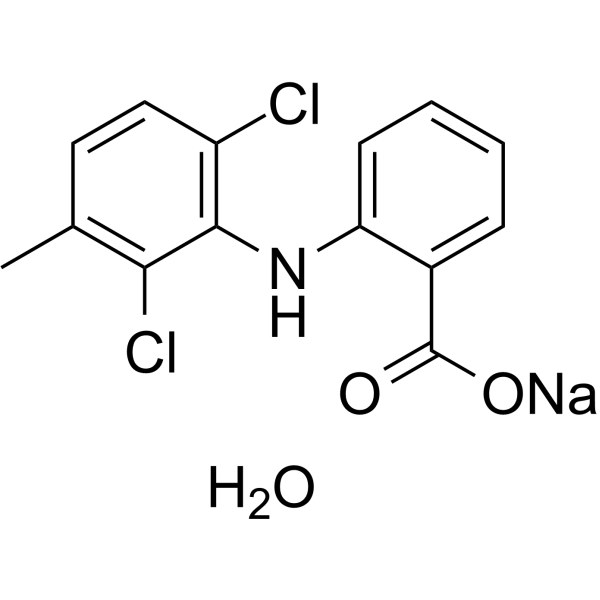
Meclofenamic acid sodium hydrate
Based on 2 publication(s) in Google Scholar
Meclofenamic acid (Meclofenamate) sodium hydrate is a non-steroidal anti-inflammatory agent. Meclofenamic acid sodium hydrate is a highly selective FTO (fat mass and obesity-associated) enzyme inhibitor. Meclofenamic acid sodium hydrate competes with FTO binding for the m(6)A-containing nucleic acid. Meclofenamic acid sodium hydrate is a non-selective gap-junction blocker. Meclofenamic acid sodium hydrate inhibits hKv2.1 and hKv1.1, with IC50 values of 56.0 and 155.9 μM, respectively.
For research use only. We do not sell to patients.
- Purity : 99.83%
- CAS No.: 67254-91-5
- Formula: C14H12Cl2NNaO3
- Molecular Weight:336.15
-
Storage:
4°C, sealed storage, away from moisture and light
* In solvent : -80°C, 6 months; -20°C, 1 month (sealed storage, away from moisture and light)

To place orders, for customer services and technical support, please contact: MedChemExpress USA
Tel: 609-228-6898 E-mail: [email protected] [email protected]


-
 Biological Activity
-
Chemical Information
- Protocols
- Purity & Documentation
- References
-
 Help & FAQs


Publications Citing Use of MedChemExpress (MCE) Meclofenamic acid sodium hydrate
MoreAll Endogenous Metabolite Isoforms
More

Biological Activity
Description
IC50 & Target
IC50: 1 μM (cyclooxygenase), 56.0 μM (hKv2.1), 155.9 μM (hKv1.1)[3]
Cellular Effect
|
Cell Line

|
Type | Value | Description | References |
|---|---|---|---|---|
| RBL-1 | IC50 |
0.1 μM
Compound: 4
|
Inhibition of Prostaglandin G/H synthase in intact RBL-1 cell line
Inhibition of Prostaglandin G/H synthase in intact RBL-1 cell line
|
[PMID: 2115586] |
| RBL-1 | IC50 |
0.1 μM
Compound: sodium meclofenamate
|
Inhibition of prostaglandin G/H synthase in intact rat basophilic leukemia cells stimulated with the calcium ionophore A-23187
Inhibition of prostaglandin G/H synthase in intact rat basophilic leukemia cells stimulated with the calcium ionophore A-23187
|
[PMID: 8295221] |
| RBL-1 | IC50 |
0.1 μM
Compound: Sodium Meclofenamate
|
Compound was tested for its inhibitory activity against PGF-2 alpha (CO) formation in RBL-1 cells stimulated with the calcium ionophore A-23187
Compound was tested for its inhibitory activity against PGF-2 alpha (CO) formation in RBL-1 cells stimulated with the calcium ionophore A-23187
|
10.1016/S0960-894X(00)80051-7 |
| RBL-1 | IC50 |
24 μM
Compound: 4
|
Inhibition of 5-lipoxygenase in intact RBL-1 cell line
Inhibition of 5-lipoxygenase in intact RBL-1 cell line
|
[PMID: 2115586] |
| RBL-1 | IC50 |
24 μM
Compound: sodium meclofenamate
|
Inhibition of 5-lipoxygenase in intact rat basophilic leukemia cells stimulated with the calcium ionophore A-23187
Inhibition of 5-lipoxygenase in intact rat basophilic leukemia cells stimulated with the calcium ionophore A-23187
|
[PMID: 8295221] |
| RBL-1 | IC50 |
24 μM
Compound: Sodium Meclofenamate
|
Compound was tested for its inhibitory activity against LTB4 (5-LO) formation in RBL-1 cells stimulated with the calcium ionophore A-23187
Compound was tested for its inhibitory activity against LTB4 (5-LO) formation in RBL-1 cells stimulated with the calcium ionophore A-23187
|
10.1016/S0960-894X(00)80051-7 |
In Vitro
Meclofenamic acid sodium hydrate (0-100 μM, 24 h) inhibits FTO demethylation in a dose-response manner[1].
Meclofenamic acid sodium hydrate inhibits enzyme cyclooxygenase, with an IC50 about 1 μM, thereby inhibiting the production of prostaglandins[2].
Meclofenamic acid sodium hydrate inhibits the release of 5-HETE and LTB4 from human neutrophils stimulated with calcium ionophore and antagonizes the response of tissues to certain prostaglandins[2].
MedChemExpress (MCE) has not independently confirmed the accuracy of these methods. They are for reference only. Further protocols information, click here.
-
Cell Line:HeLa cells
-
Concentration:0, 12.5, 25, 50, 100 μM
-
Incubation Time:24 h
-
Result:Inhibited FTO demethylation in a dose-response manner, and elevates the levels of cellular m6A in mRNA by targeting FTO.


Chemical Information
-
CAS No. 67254-91-5
-
Appearance Solid
-
Molecular Weight 336.15
-
Formula C14H12Cl2NNaO3
-
Color White to off-white
-
SMILES
O=C(O[Na])C1=CC=CC=C1NC2=C(Cl)C=CC(C)=C2Cl.O
-
Synonyms
Meclofenamate sodium hydrate
-
Structure Classification
-
Initial Source
-
Shipping
Room temperature in continental US; may vary elsewhere.
-
Storage
4°C, sealed storage, away from moisture and light
* In solvent : -80°C, 6 months; -20°C, 1 month (sealed storage, away from moisture and light)


Publications (2)
-
Journal Impact Factor
-
Most Recent
-
Biomed Opt Express
Investigating tunneling nanotubes in ovarian cancer based on two-photon excitation FLIM-FRET. [Abstract]2021 Mar 9;12(4):1962-1973. PMID: 33996210 -

Protocols
-
Cell Cytotoxicity Assay
Cytotoxicity assays are usually based on the assessment of cell membrane damage, which can also be indirectly detected by measuring cell viability. Detection methods include MTT assay, CKK-8 assay, LDH assay and ATP assay, etc.
-
Research Protocol for Inflammation-related Diseases
The NLRP3 inflammasome is a cytosolic innate immune signaling platform that integrates priming signals and danger-signal activation to promote caspase-1 activation, maturation of IL-1β and IL-18, and gasdermin D-mediated pyroptotic cell death. The core experimental logic is to determine whether inflammatory disease phenotypes are driven by increased NLRP3 expression, ASC-containing inflammasome assembly, caspase-1 cleavage, GSDMD cleavage, and extracellular release of IL-1β/IL-18 rather than by nonspecific cell injury alone. The pathway is strongly linked to inflammation-related disease phenotypes because monosodium urate crystals activate NALP3/NLRP3 inflammasome signaling in gout-like crystal inflammation, cholesterol crystals activate NLRP3 inflammasomes in atherogenesis models, and DSS-induced intestinal inflammation has been reported to involve NLRP3 inflammasome activity. However, experimental colitis studies also show context-dependent protective effects of NLRP3 inflammasome co
-
Research Protocol for Metabolic Diseases
AMP-activated protein kinase, AMPK, is a conserved cellular energy sensor that responds to reduced cellular energy status and coordinates metabolism by increasing ATP-generating catabolic pathways while suppressing ATP-consuming anabolic processes. In metabolic disease research, the AMPK pathway is experimentally relevant because it regulates hepatic lipid synthesis, fatty acid oxidation, glucose production, skeletal-muscle glucose disposal, mTORC1-linked biosynthesis, autophagy, mitochondrial homeostasis, and whole-body energy balance. The central pathway logic is that energy stress, metformin, exercise-like stimulation, or direct AMPK activators increase AMPKα Thr172 phosphorylation and downstream substrate phosphorylation, including ACC and RAPTOR. Phosphorylation of ACC suppresses lipogenesis and supports fatty acid oxidation, whereas phosphorylation of RAPTOR suppresses mTORC1 signaling and links cellular energy status to growth and protein synthesis control. The pathway is linked


Purity & Documentation
-
Data Sheet (277 KB)
-
SDS (252 KB)
- English - EN (252 KB)
- Français - FR (252 KB)
- Deutsch - DE (252 KB)
- Norwegian - NO (252 KB)
- Español - ES (252 KB)
- Swedish - SV (252 KB)
- Italian - IT (252 KB)
- Korean - KR (252 KB)
- Portuguese - PT (252 KB)
-
Handling Instructions (2659 KB)
References
[1]. Huang Y, et al. Meclofenamic acid selectively inhibits FTO demethylation of m6A over ALKBH5. Nucleic Acids Res. 2015 Jan;43(1):373-84. [Content Brief]
[2]. Conroy MC, et al. Pharmacology, pharmacokinetics, and therapeutic use of meclofenamate sodium. Clin J Pain. 1991;7 Suppl 1:S44-8. [Content Brief]
[3]. Lee YT, et al. Inhibition of hKv2.1, a major human neuronal voltage-gated K+ channel, by meclofenamic acid. Eur J Pharmacol. 1999 Aug 13;378(3):349-56. [Content Brief]
[4]. Eleftheriou CG, et al. Meclofenamic acid improves the signal to noise ratio for visual responses produced by ectopicexpression of human rod opsin. Mol Vis. 2017 Jun 16;23:334-345. eCollection 2017. [Content Brief]

Calculators
Concentration (start) × Volume (start) = Concentration (final) × Volume (final)


Meclofenamic acid sodium hydrate Related Classifications
HY-117275A Related Classifications
 Powered by Bioz