



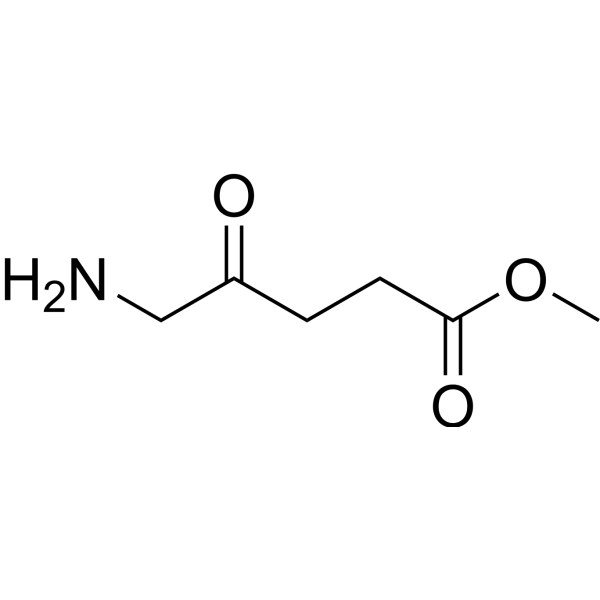
Methyl aminolevulinate
Based on 1 publication(s) in Google Scholar
Methyl aminolevulinate is a sensitizer used in photodynamic therapy (PDT). Methyl aminolevulinate penetrates the skin and induces the production of photoactive porphyrins including protoporphyrin IX in cells; upon exposure to appropriate light, it generates ROS, which triggers cellular oxidation and cell death. Methyl aminolevulinate acts as a photo-damage reversing agent through epidermal reconstruction, cytokine-mediated activation of dermal fibroblasts, elastin breakdown, new collagen formation, and compression of dilated capillaries. Methyl aminolevulinate reduces the expression of the proliferation marker Ki-67 and the early skin carcinogenesis marker TP53. Methyl aminolevulinate delays the onset of ultraviolet-induced skin tumors and reduces tumor burden in hairless mice. Methyl aminolevulinate is applicable to research related to actinic keratosis and basal cell carcinoma.
For research use only. We do not sell to patients.
- CAS No.: 33320-16-0
- Formula: C6H11NO3
- Molecular Weight:145.16
-
Storage:
Please store the product under the recommended conditions in the Certificate of Analysis.

To place orders, for customer services and technical support, please contact: MedChemExpress USA
Tel: 609-228-6898 E-mail: [email protected] [email protected]


-
 Biological Activity
-
Chemical Information
- Purity & Documentation
- References
-
 Help & FAQs


Publications Citing Use of MedChemExpress (MCE) Methyl aminolevulinate
More

Biological Activity
Description
Cellular Effect
|
Cell Line

|
Type | Value | Description | References |
|---|---|---|---|---|
| HeLa | IC50 |
763 μM
Compound: 5-ALA-OMe
|
Photosensitization activity against human HeLa cells assessed as reduction in cell viability incubated for 4 hrs followed by LED light array irradiation followed by further incubation for 24 hrs by MTT assay
Photosensitization activity against human HeLa cells assessed as reduction in cell viability incubated for 4 hrs followed by LED light array irradiation followed by further incubation for 24 hrs by MTT assay
|
[PMID: 31398615] |
In Vitro
Methyl aminolevulinate (0.0001-1.4 mmol/L) induces concentration-dependent formation of photoactive porphyrins in cultures of mouse adenocarcinoma LM2 cells, with the highest yield of 48 ng/105 cells observed at the concentration of 1.4 mmol/L; additionally, 90% of porphyrins remain intracellular at all tested concentrations[1].
Methyl aminolevulinate (1.2-1.8 mmol/L, 3 h) shows no intrinsic cytotoxicity against mouse adenocarcinoma LM2 cells at the concentration of 1.8 mmol/L, but induces 98% cell death when cells are treated with 1.2 mmol/L for 3 h followed by irradiation with 3 J/cm2[1].
MedChemExpress (MCE) has not independently confirmed the accuracy of these methods. They are for reference only.
-
Cell Line:murine adenocarcinoma LM2 cell
-
Concentration:1.8 mmol/L (intrinsic cytotoxicity); 1.2 mmol/L (photodynamic cytotoxicity)
-
Incubation Time:3 h (photodynamic cytotoxicity)
-
Result:Showed no cytotoxicity to LM2 cells at 1.8 mmol/L when used alone.
Induced 98% cell death when used at 1.2 mmol/L for 3 h followed by irradiation with 3 J/cm2 light.
In Vivo
MedChemExpress (MCE) has not independently confirmed the accuracy of these methods. They are for reference only.
-
Animal Model:Hairless mice (UV radiation-induced tumor model)[1]
-
Dosage:8-20%
-
Administration:topical; weekly; 26 weeks (UV-exposed mice); up to 36 weeks (non-UV-exposed mice)
-
Result:Delayed the appearance of UV-induced small tumors (AK or in situ SCC) by 2-3 weeks.
Delayed larger lesions (invasive SCC) by 5-7 weeks.
Caused an approximate 2- to 2.5-fold decrease in the number of UV-induced tumors per mouse after 26 weeks.
Significantly increased the tumor-free time on the methyl aminolevulinate-PDT side compared with the vehicle-PDT side in contralaterally treated mice.
Prevented tumor formation in non-UV-exposed mice treated for up to 36 weeks.
Induced higher levels of photoactive porphyrins (PAPs) in UV-induced tumors compared with normal skin of hairless mice.
Induced PAP formation only at the sites where it was applied.
Caused faster clearance of PAP than that formed by topical aminolevulinic acid.
Clinical Trial
| NCT Number | Sponsor | Condition | Start Date |
Phase
|
|---|---|---|---|---|
| NCT01329991 | Plexxikon| | 2011-05 | PHASE1 |


Chemical Information
-
CAS No. 33320-16-0
-
Molecular Weight 145.16
-
Formula C6H11NO3
-
SMILES
O=C(OC)CCC(CN)=O
-
Shipping
Room temperature in continental US; may vary elsewhere.
-
Storage
Please store the product under the recommended conditions in the Certificate of Analysis.


Publications (1)
-
Journal Impact Factor
-
Most Recent
-
Sci Data
High-throughput drug screening identifies novel therapeutics for Low Grade Serous Ovarian Carcinoma. [Abstract]2024 Sep 19;11(1):1024. PMID: 39300112


Purity & Documentation
References
[1]. Siddiqui MA, et al. Topical methyl aminolevulinate. Am J Clin Dermatol. 2004;5(2):127-37; discussion 138-40. [Content Brief]
[2]. Szeimies RM, et al. Photoaging and Cosmetic Result with Artificial Daylight Photo-dynamic Therapy Using Methyl Aminolevulinate. Acta Derm Venereol. 2025;105:adv43245. Published 2025 Apr 22. [Content Brief]

Calculators
Concentration (start) × Volume (start) = Concentration (final) × Volume (final)


Methyl aminolevulinate Related Classifications
HY-A0169 Related Classifications
 Powered by Bioz