



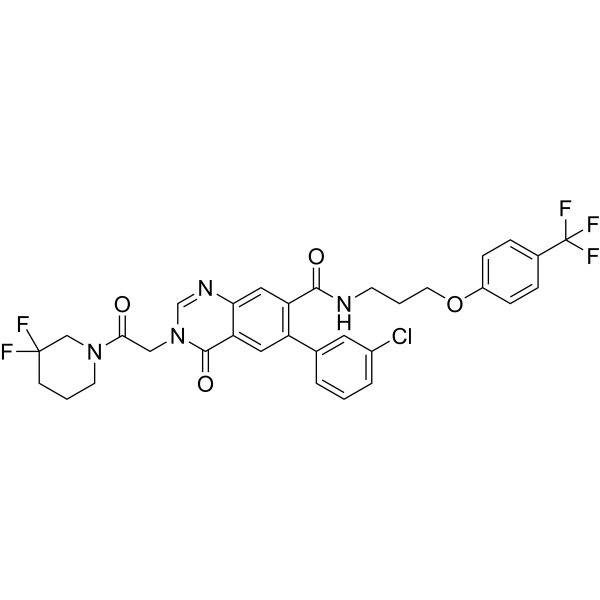
NOD1/2 antagonist-1
NOD1/2 antagonist-1 (compound 36b) is a potent NOD1/2 (nucleotide-binding oligomerization domain-like receptor 1/2) dual antagonist, with IC50 values of 1.13 (NOD1) and 0.77 μM (NOD2), respectively. NOD1/2 antagonist-1 has a acceptable T1/2 (67.6 min). NOD1/2 antagonist-1 (compound 36b) can improve the antitumor efficacy of Paclitaxel (PTX).
For research use only. We do not sell to patients.
- CAS No.: 2704623-69-6
- Formula: C32H28ClF5N4O4
- Molecular Weight:663.03
-
Storage:
Please store the product under the recommended conditions in the Certificate of Analysis.

To place orders, for customer services and technical support, please contact: MedChemExpress USA
Tel: 609-228-6898 E-mail: [email protected] [email protected]


-
 Biological Activity
-
Chemical Information
- Protocols
- Purity & Documentation
- References
-
 Help & FAQs




Biological Activity
Description
IC50 & Target
|
NOD1 1.13 μM (IC50) |
NOD2 0.77 μM (IC50) |
In Vitro
NOD1/2 antagonist-1 (compound 36b) (0-10 μM, 3 h) inhibits C12-iE-DAP-induced or MDP-induced NF-κB activation[1].
NOD1/2 antagonist-1 (0-10 μM, 1 h) suppresses inflammation via NOD1 and NOD2 activation[1].
NOD1/2 antagonist-1 (0-10 μM, 1 h) consistently and dose-dependently reduces the transcription of IL-6, TNF-α and IL-8, respectively[1].
MedChemExpress (MCE) has not independently confirmed the accuracy of these methods. They are for reference only. Further protocols information, click here.
-
Cell Line:HEK-Blue hNOD1 and HEK-Blue hNOD2 cells[1]
-
Concentration:0.001, 0.01, 0.1, 1, 10 μM
-
Incubation Time:3 h
-
Result:Inhibited C12-iE-DAP-induced or MDP-induced NF-κB activation, and had no or little effect on cell growth.
-
Cell Line:THP-1 cells[1]
-
Concentration:1, 10 μM
-
Incubation Time:1 h
-
Result:Prevented the increases in p-RIP2, p-IKKα/β, p-p65, p-p38, and p-JNK and the degradation of IκBα in a dose-dependent manner, and blocked NOD1-and NOD2-mediated inflammatory cytokine secretion in THP-1 cells.
-
Cell Line:THP-1 cells[1]
-
Concentration:1, 10 μM
-
Incubation Time:1 h
-
Result:Consistently and dose-dependently reduced the transcription of IL-6, TNF-α and IL-8 stimulated by C12-iE-DAP or MDP, respectively.
In Vivo
MedChemExpress (MCE) has not independently confirmed the accuracy of these methods. They are for reference only.
-
Animal Model:C57BL/6 mice (6-8 weeks old, male, B16 tumor-bearing model, 4 groups, n = 7 each group)[1]
-
Dosage:50 mg/kg (36b), 50 mg/kg (36b) + 12 mg/kg (PTX) (formulated in DMSO/Cremophor EL/saline at 5:5:90(v:v:v))
-
Administration:IV, once every other day (36b), once every 4 days (PTX), for 16 days
-
Result:Significantly reduced tumor growth compared with PTX treatment alone, and the tumor weight inhibitory rate increased from 64.07% to 85.46%.


Chemical Information
-
CAS No. 2704623-69-6
-
Molecular Weight 663.03
-
Formula C32H28ClF5N4O4
-
SMILES
O=C(C1=C(C=C2C(N(C=NC2=C1)CC(N3CCCC(F)(C3)F)=O)=O)C4=CC(Cl)=CC=C4)NCCCOC5=CC=C(C=C5)C(F)(F)F
-
Shipping
Room temperature in continental US; may vary elsewhere.
-
Storage
Please store the product under the recommended conditions in the Certificate of Analysis.

Protocols
-
Cell Cytotoxicity Assay
Cytotoxicity assays are usually based on the assessment of cell membrane damage, which can also be indirectly detected by measuring cell viability. Detection methods include MTT assay, CKK-8 assay, LDH assay and ATP assay, etc.
-
Patient-Derived Xenograft (PDX)
Patient-derived xenograft (PDX) models are generated by engrafting primary human tumor tissue directly into immunodeficient mice, allowing in vivo propagation of patient tumor biology without initial in vitro adaptation. These models are used to preserve key histopathological and molecular characteristics of the original tumor and enable assessment of tumor growth dynamics and therapeutic response in a living organism. The biological readout is tumor engraftment and subsequent growth in the murine host, which reflects the ability of human tumor cells to survive, vascularize, and expand in an immunocompromised microenvironment.


Purity & Documentation
References

Calculators
Concentration (start) × Volume (start) = Concentration (final) × Volume (final)


NOD1/2 antagonist-1 Related Classifications
HY-146034 Related Classifications
 Powered by Bioz