



IL-17F Protein, Human
Based on 1 Customer Validation
IL-17F is an inflammatory homodimeric cytokine that induces many proinflammatory cytokines and chemokines. IL-17F also induces antimicrobial peptides. IL-17F plays a protective role in colon cancer development and can be used for the research of autoimmune diseases, infection and cancer. IL-17F Protein, Human is a recombinant human IL-17F protein and is expressed in E. coli. It consists of 133 amino acids (R31-Q163).
- Species: Human
- Source: E. coli
-
Storage:Stored at -20°C for 2 years from date of receipt. After reconstitution, it is stable at 4°C for 1 week or -20°C for longer (with carrier protein). It is recommended to freeze aliquots at -20°C or -80°C for extended storage.


To place orders, for customer services and technical support, please contact: MedChemExpress USA
Tel: 609-228-6898 E-mail: [email protected] [email protected]


-
 Biological Activity
-
Technical Parameters
-
Product Properties
- Documentation
- References
- Help & FAQs




Biological Activity
Description
IL-17F is an inflammatory homodimeric cytokine that induces many proinflammatory cytokines and chemokines. IL-17F also induces antimicrobial peptides. IL-17F plays a protective role in colon cancer development and can be used for the research of autoimmune diseases, infection and cancer[1][2]. IL-17F Protein, Human is a recombinant human IL-17F protein and is expressed in E. coli. It consists of 133 amino acids (R31-Q163).
Background
Interleukin-17F (IL-17F) belongs to the IL-17 cytokine family. IL-17F is expressed in activated CD4 T cells, activated monocytes, basophils and mast cells. IL-17F can be produced by differentiated TH17 cells, lamina propria T cells, memory CD4+ T cells, γδ T cells and NKT cells[1].
The human IL-17F shares 55.90% amino acid sequence identity with mouse and 57.14% identity with rat.
IL-17F is an inflammatory cytokine that induces many proinflammatory cytokines and chemokines, including TGF-β, IL-2, ICAM1, GM-CSF, CCL2, CCL7, TSLP, MMP13, IL-6 and CXCL1. IL-17F also induces antimicrobial peptides including hBD-2, S100A7, S100A8 and S100A9 with IL-22 and can synergize with IL-23 in human eosinophils to promote the production of IL-1β and IL-6. IL-17F is a homodimeric cytokine. IL-17F shares the most similarities with IL-17A (50% homology) and can be produced as an IL-17AF heterodimer. IL-17A, IL-17F and IL-17A/F use the same receptor complex: IL-17RA and IL-17RC heterodimer. They trigger qualitatively similar signaling pathways, and IL-17F exhibits the lowest biological activity. IL-17F shows about 100–1000 times lower affinity to the IL-17RA subunit than IL-17A, and does not compete with IL-17A binding to IL-17RA[1][2].
IL-17F plays a protective role in colon cancer development and can be used for the research of autoimmune diseases, infection and cancer[1][3][4].
In Vivo
IL-17F (50 ng/mL; 16-24 h) induces GRO-α, IL-6, and IL-8 secretion in human primary foreskin fibroblast (BJ) cells[5].
IL-17F binds weakly to IL-17RA.Fc with an EC50 > 2000 ng/mL, whereas IL-17A binds IL-17RA.Fc with a value of 19 ng/mL, the IL-17F/IL-17A heterodimer has an EC50 of 329 ng/mL[5].
IL-17F (0-150 ng/mL; 0-72 h) increases the cell viability of PC-3 and DU145[6].
IL-17F (100 ng/mL; 24 h) stimulates the malignant phenotypes of PCa cells and activates PI3K/AKT signalling pathway in PCa cells[6].
Verified Bioactivity
Measured by its ability to induce the expression of IL-6 in NIH/3T3 mouse embryonic fibroblast cells. The ED50 is <40 ng/mL, corresponding to a specific activity of >5.0 × 10⁴ units/mg.
MCE Validation Data
-
Purity - SDS-PAGE
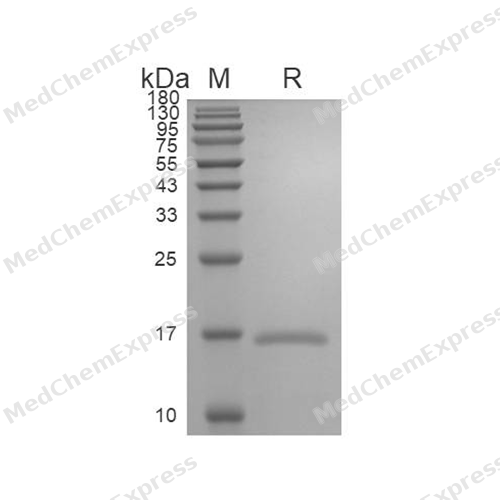
Purity - SDS-PAGE
-
Bioactivity - Cell-Based Assay
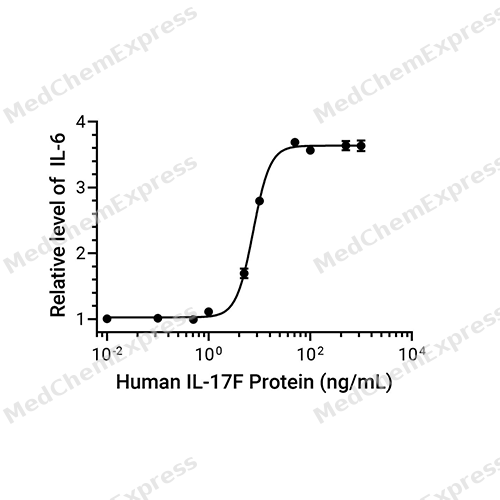
Bioactivity - Cell-Based Assay


Technical Parameters
-
Species Human
-
Source E. coli
-
Tag Tag Free
-
Accession
Q96PD4 (R31-Q163)
-
Molecular Construction
-
N-term
-
IL-17F (R31-Q163)
Accession # Q96PD4 -
C-term
-
-
Protein Length
Full Length of Mature Protein
-
Synonyms
IL17F; ML1; Interleukin 17F; Interleukin-17F; IL-17F; Cytokine ML-1; ML-1; CANDF6
-
AA Sequence
RKIPKVGHTFFQKPESCPPVPGGSMKLDIGIINENQRVSMSRNIESRSTSPWNYTVTWDPNRYPSEVVQAQCRNLGCINAQGKEDISMNSVPIQQETLVVRRKHQGCSVSFQLEKVLVTVGCTCVTPVIHHVQ
-
Predicted Molecular Mass
15 kDa
-
Molecular Weight
Approximately 15 kDa, based on SDS-PAGE under reducing conditions.
-
Structure/Form
Disulfide-linked homodimer
-
Purity
≥ 95%, as determined by reducing SDS-PAGE.


Product Properties
Lyophilized powder
1.Lyophilized from a 0.22 μm filtered solution of 20 mM PB, pH 7.4.
2.Lyophilized from a 0.22 μm filtered solution of PBS, pH 7.2 with trehalose.
Please refer to the lot-specific COA for specific buffer information.
<1 EU/μg, determined by LAL method.
It is not recommended to reconstitute to a concentration less than 100 μg/mL in 4 mM HCl. For long term storage it is recommended to add a carrier protein (0.1% BSA, 5% HSA, 10% FBS or 5% Trehalose).
Stored at -20°C for 2 years from date of receipt. After reconstitution, it is stable at 4°C for 1 week or -20°C for longer (with carrier protein). It is recommended to freeze aliquots at -20°C or -80°C for extended storage.
Room temperature in continental US; may vary elsewhere.


Documentation
-
Data Sheet (264 KB)
-
SDS (251 KB)
- English - EN (251 KB)
- Français - FR (251 KB)
- Deutsch - DE (251 KB)
- Norwegian - NO (251 KB)
- Español - ES (251 KB)
- Swedish - SV (251 KB)
- Italian - IT (251 KB)
- Korean - KR (251 KB)
- Portuguese - PT (251 KB)
-
Handling Instructions (2659 KB)


References
[1]. Chang SH, et al. IL-17F: regulation, signaling and function in inflammation. Cytokine. 2009 Apr;46(1):7-11. [Content Brief]
[2]. Oda N, et al. Interleukin-17F induces pulmonary neutrophilia and amplifies antigen-induced allergic response. Am J Respir Crit Care Med. 2005 Jan 1;171(1):12-8. [Content Brief]
[3]. McGeachy MJ, et al. The IL-17 Family of Cytokines in Health and Disease. Immunity. 2019 Apr 16;50(4):892-906. [Content Brief]
[4]. Tong Z, et al. A protective role by interleukin-17F in colon tumorigenesis. PLoS One. 2012;7(4):e34959. [Content Brief]
[5]. Ferreira N, et al. IL-17A and IL-17F orchestrate macrophages to promote lung cancer. Cell Oncol (Dordr). 2020 Aug;43(4):643-654. [Content Brief]
[6]. Tong Z, et al. A protective role by interleukin-17F in colon tumorigenesis. PLoS One. 2012;7(4):e34959. [Content Brief]
[7]. Wright JF, et al. The human IL-17F/IL-17A heterodimeric cytokine signals through the IL-17RA/IL-17RC receptor complex. J Immunol. 2008 Aug 15;181(4):2799-805. [Content Brief]
[8]. Zhu X, et al. IL-17F facilitates prostate cancer cell malignant phenotypes via activation of the PI3K/AKT signalling pathway. Andrologia. 2020 Nov;52(10):e13750. [Content Brief]

Calculators
Concentration (start) × Volume (start) = Concentration (final) × Volume (final)


 Powered by Bioz

