



Ritodrine
Based on 2 publication(s) in Google Scholar
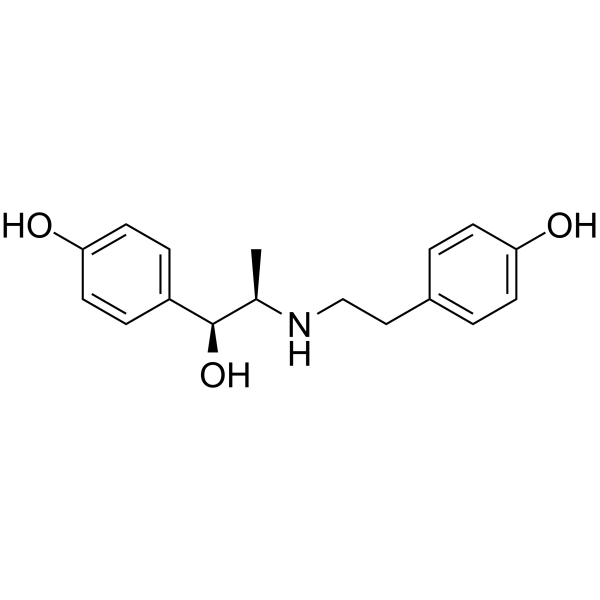
Ritodrine (DU21220) is a β-adrenergic agonist, also an effective smooth muscle and uterine relaxant. Ritodrine prolongs contraction interval, can be used for researching arrest premature labor.
For research use only. We do not sell to patients.
- CAS No.: 26652-09-5
- Formula: C17H21NO3
- Molecular Weight:287.35
-
Storage:
Please store the product under the recommended conditions in the Certificate of Analysis.

To place orders, for customer services and technical support, please contact: MedChemExpress USA
Tel: 609-228-6898 E-mail: [email protected] [email protected]


-
 Biological Activity
-
Chemical Information
- Purity & Documentation
- References
-
 Help & FAQs


Publications Citing Use of MedChemExpress (MCE) Ritodrine
MoreAll Adrenergic Receptor Isoforms
More

Biological Activity
Description
IC50 & Target
|
β adrenergic receptor |
In Vivo
-
Animal Model:9-10 weeks, C3HiHeNCrj female mice[2]
-
Dosage:1, 3, 10 mg/kg
-
Administration:P.o.
-
Result:Significantly decreased preterm delivery in a dose-dependent fashion lipopolysaccharide-induced preterm delivery in mice.


Chemical Information
-
CAS No. 26652-09-5
-
Molecular Weight 287.35
-
Formula C17H21NO3
-
SMILES
C[C@H]([C@H](C1=CC=C(O)C=C1)O)NCCC2=CC=C(O)C=C2
-
Synonyms
DU21220
-
Shipping
Room temperature in continental US; may vary elsewhere.
-
Storage
Please store the product under the recommended conditions in the Certificate of Analysis.


Publications (2)
-
Journal Impact Factor
-
Most Recent
-
Comput Struct Biotechnol J
Drug repurposing screens to identify potential drugs for chronic kidney disease by targeting prostaglandin E2 receptor. [Abstract]2023 Jul 7:21:3490-3502. PMID: 37484490 -
J Pharm Biomed Anal
Screening method of mildronate and over 300 doping agents by reversed-phase liquid chromatography-high resolution mass spectrometry. [Abstract]2021 Feb 20:195:113870. PMID: 33453569


Purity & Documentation
References
[1]. Canadian Preterm Labor Investigators Group. Treatment of preterm labor with the beta-adrenergic agonist ritodrine. N Engl J Med. 1992 Jul 30;327(5):308-12. [Content Brief]
[2]. Kaga N, et al. Preventive effect of ritodrine hydrochloride and/or urinary trypsin inhibitor against lipopolysaccharide-induced preterm delivery in mice. Acta Obstet Gynecol Scand. 1997 Oct;76(9):811-6. [Content Brief]

Calculators
Concentration (start) × Volume (start) = Concentration (final) × Volume (final)


Ritodrine Related Classifications
HY-B0452A Related Classifications
 Powered by Bioz