



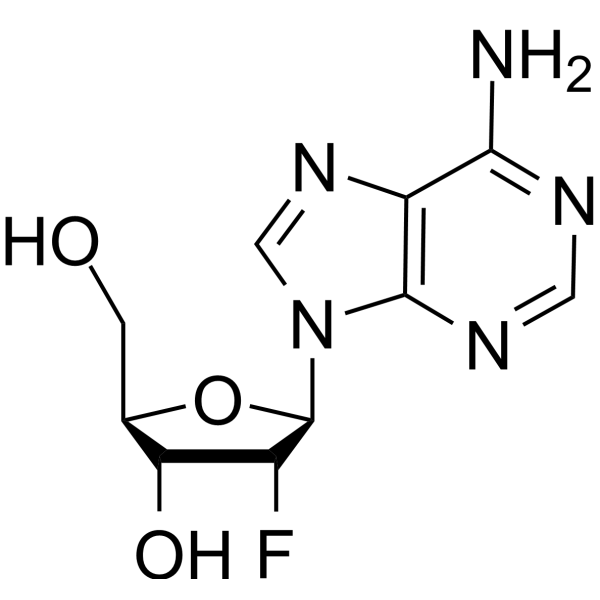
2′-Deoxy-2′-fluoroadenosine
Based on 1 publication(s) in Google Scholar
2′-Deoxy-2′-fluoroadenosine is a fluorinated deoxyadenosine with antitumor and antiviral activity, able to interfere with viral or cancer cell replication by being incorporated into DNA. 2′-Deoxy-2′-fluoroadenosine can be used for the synthesis of 2′-Deoxy-2′-fluoro-modified oligonucleotides hybridized with RNA. 2′-Deoxy-2′-fluoroadenosine can be cleaved efficiently by E. coli purine nucleoside phosphorylase (PNP) to the toxic agent 2-fluoroadenine (FAde). 2′-Deoxy-2′-fluoroadenosine shows excellent in vivo activity against tumors expressing E. coli PNP.
For research use only. We do not sell to patients.
- Purity: 99.71%
- CAS No.: 64183-27-3
- Formula: C10H12FN5O3
- Molecular Weight:269.24
-
Storage:
4°C, stored under nitrogen
* In solvent : -80°C, 6 months; -20°C, 1 month (stored under nitrogen)

To place orders, for customer services and technical support, please contact: MedChemExpress USA
Tel: 609-228-6898 E-mail: [email protected] [email protected]


-
 Biological Activity
-
Chemical Information
-
Solvent & Solubility
- Purity & Documentation
- References
-
 Help & FAQs
-


Anti-Infection Compound Library
HY-L002
-
Cell Cycle/DNA Damage Compound Library
HY-L004
-
Anti-Cancer Compound Library
HY-L025
-
Antiviral Compound Library
HY-L027
-
Anti-Aging Compound Library
HY-L034
-
Reprogramming Compound Library
HY-L039
-
Nucleotide Compound Library
HY-L044
-
Anti-Lung Cancer Compound Library
HY-L075
-
Anti-Blood Cancer Compound Library
HY-L079
-
Anti-Cancer Metabolism Compound Library
HY-L083
-
Anti-Hematopathy Compound Library
HY-L171
-
Bioactive Compound Library Max
HY-L181
-
MCE Bioactive Compound Library
HY-L001V
-
Bioactive Compound Library
HY-L001
-
High-Throughput Bioactive Compound Library
HY-L205
-
3D Diverse Fragment Library
HY-L903
-
MCE Kinase Hinge Binder Fragment Library
HY-L907


Publications Citing Use of MedChemExpress (MCE) 2′-Deoxy-2′-fluoroadenosine
More

Biological Activity
|
Cell Line

|
Type | Value | Description | References |
|---|---|---|---|---|
| CCRF-CEM | IC50 |
90 μM
Compound: 10
|
The cytotoxicity against CEM cells
The cytotoxicity against CEM cells
|
[PMID: 9276020] |
| HEp-2 | EC50 |
>50 μM
Compound: 2'd2'FA
|
Antiviral activity against RSV A2 infected in human Hep2 cells assessed as protection against virus-induced cytopathic effect after 4 days by Cell-Titer Glo assay
Antiviral activity against RSV A2 infected in human Hep2 cells assessed as protection against virus-induced cytopathic effect after 4 days by Cell-Titer Glo assay
|
[PMID: 25978965] |
| HEp-2 | IC50 |
7.7 μM
Compound: 2'd2'FA
|
Inhibition of RSV A2 RNA-dependent RNA polymerase expressed in human Hep2 cells using ATP, GTP, UTP, CTP and 1.5 uCi [alpha-32P] NTP as substrate assessed as reduction of total radiolabled transcript after 90 mins by agarose gel electrophoresis
Inhibition of RSV A2 RNA-dependent RNA polymerase expressed in human Hep2 cells using ATP, GTP, UTP, CTP and 1.5 uCi [alpha-32P] NTP as substrate assessed as reduction of total radiolabled transcript after 90 mins by agarose gel electrophoresis
|
[PMID: 25978965] |
| HepG2 | EC50 |
1.5 μM
Compound: 10
|
compound was tested in vitro for anti HBV activity in HepG2 2.2.15 cells
compound was tested in vitro for anti HBV activity in HepG2 2.2.15 cells
|
[PMID: 9276020] |
| HepG2 | IC50 |
>200 μM
Compound: 10
|
The cytotoxicity against HepG2 2.2.15 cells expressed as IC50
The cytotoxicity against HepG2 2.2.15 cells expressed as IC50
|
[PMID: 9276020] |
2′-Deoxy-2′-fluoroadenosine (2-fluoro-2′-deoxyadenosine (F-dAdo)) releases the highly parasite-toxic compound 2-fluoroadenine (without human toxicity) following phosphorolysis by T. vaginalis purine nucleoside phosphorylase[3].
Lines, and isolates are susceptible to 2′-Deoxy-2′-fluoroadenosine (F-dAdo), at around 1-3 μM except for isolate B7268 (MIC of 25-100 μM) and the ToyoR line F1623-T (MIC of 6.3-12.5 μM)[3].
MedChemExpress (MCE) has not independently confirmed the accuracy of these methods. They are for reference only.
MedChemExpress (MCE) has not independently confirmed the accuracy of these methods. They are for reference only.
-
Animal Model:D54 parental or D54/PNP tumor cells were injected subcutaneously into the flanks of NCr -nu mice[2]
-
Dosage:10, 20, 67, 100 mg/kg
-
Administration:Intraperitoneal injection (i.p.)
-
Result:Less effective than MeP - dR in treating the D54/PNP tumors.
Less active on the above schedule than F -araAMP against tumors that express E. coli PNP.
Resulted in much improved activity against D54/PNP tumors when treated with 10 mg/kg for five times a day for seven consecutive days.
There was some inhibition of tumor growth, all tumors subsequently regrew.


Chemical Information
-
CAS No. 64183-27-3
-
Appearance Solid
-
Molecular Weight 269.24
-
Formula C10H12FN5O3
-
Color White to off-white
-
SMILES
OC[C@@H]1[C@@H](O)[C@@H](F)[C@H](N2C(N=CN=C3N)=C3N=C2)O1
-
Shipping
Room temperature in continental US; may vary elsewhere.
-
Storage
4°C, stored under nitrogen
* In solvent : -80°C, 6 months; -20°C, 1 month (stored under nitrogen)


Publications (1)
-
Journal Impact Factor
-
Most Recent
-
ACS Infect Dis
Targeting the Rift Valley Fever Virus Polymerase: Resistance Mechanisms and Structural Insights. [Abstract]2025 Oct 30. PMID: 41166549


Solvent & Solubility
DMSO : 50 mg/mL (185.71 mM; Need ultrasonic; Hygroscopic DMSO has a significant impact on the solubility of product, please use newly opened DMSO)
Please refer to the solubility information to select the appropriate solvent. Once prepared, please aliquot and store the solution to prevent product inactivation from repeated freeze-thaw cycles.
Storage method and period of stock solution: -80°C, 6 months; -20°C, 1 month (stored under nitrogen). When stored at -80°C, please use it within 6 months. When stored at -20°C, please use it within 1 month.
Please refer to the solubility information to select the appropriate solvent. Once prepared, please aliquot and store the solution to prevent product inactivation from repeated freeze-thaw cycles.
Storage method and period of stock solution: -80°C, 6 months; -20°C, 1 month (stored under nitrogen). When stored at -80°C, please use it within 6 months. When stored at -20°C, please use it within 1 month.
Concentration (start) × Volume (start) = Concentration (final) × Volume (final)
Select the appropriate dissolution method based on your experimental animal and administration route.
- For the following dissolution methods, please ensure to first prepare a clear stock solution using an In Vitro approach and then sequentially add co-solvents:
- To ensure reliable experimental results, the clarified stock solution can be appropriately stored based on storage conditions. As for the working solution for In Vivo experiments, it is recommended to prepare freshly and use it on the same day.
- The percentages shown for the solvents indicate their volumetric ratio in the final prepared solution. If precipitation or phase separation occurs during preparation, heat and/or sonication can be used to aid dissolution.
Add each solvent one by one: 10% DMSO 40% PEG300 5% Tween-80 45% Saline
Solubility: ≥ 2.5 mg/mL (9.29 mM); Clear solution
This protocol yields a clear solution of ≥ 2.5 mg/mL (saturation unknown).
Taking 1 mL working solution as an example, add 100 μL DMSO stock solution (25.0 mg/mL) to 400 μL PEG300, and mix evenly; then add 50 μL Tween-80 and mix evenly; then add 450 μL Saline to adjust the volume to 1 mL.
Preparation of Saline: Dissolve 0.9 g sodium chloride in ddH₂O and dilute to 100 mL to obtain a clear Saline solution.
Add each solvent one by one: 10% DMSO 90% (20% SBE-β-CD in Saline)
Solubility: ≥ 2.5 mg/mL (9.29 mM); Clear solution
This protocol yields a clear solution of ≥ 2.5 mg/mL (saturation unknown).
Taking 1 mL working solution as an example, add 100 μL DMSO stock solution (25.0 mg/mL) to 900 μL 20% SBE-β-CD in Saline, and mix evenly.
Preparation of 20% SBE-β-CD in Saline (4°C, storage for one week): 2 g SBE-β-CD powder is dissolved in 10 mL Saline, completely dissolve until clear.
Please enter the basic information of animal experiments:
-
-
-
-
Recommended: Prepare an additional quantity of animals to account for potential losses during experiments.
Please enter your animal formula composition:
-
%DMSO +
Recommended: Keep the proportion of DMSO in working solution below 2% if your animal is weak.
-
%+
-
+%Tween-80 + +
-
%Saline +
The co-solvents required include: DMSO, . All of co-solvents are available by MedChemExpress (MCE). , Tween 80. All of co-solvents are available by MedChemExpress (MCE).
Working solution concentration: 0.22 mg/mL
Method for preparing stock solution: mg drug dissolved in μL DMSO. Stock solution concentration: mg/mL. * In solvent : -80°C, 6 months; -20°C, 1 month (stored under nitrogen)
1. Take μL DMSO stock solution;
2. Add μL .
μL , mix evenly;
3. Then add μL Tween 80, mix evenly;
4. Then add μL
Please ensure that the stock solution in the first step is dissolved to a clear state, and add co-solvents in sequence. You can use ultrasonic heating (ultrasonic cleaner, recommended frequency 20-40 kHz), vortexing, etc. to assist dissolution.


Purity & Documentation
-
Data Sheet (280 KB)
-
SDS (393 KB)
- English - EN (393 KB)
- Français - FR (393 KB)
- Deutsch - DE (393 KB)
- Norwegian - NO (393 KB)
- Español - ES (393 KB)
- Swedish - SV (393 KB)
- Italian - IT (393 KB)
- Korean - KR (393 KB)
- Portuguese - PT (393 KB)
-
Handling Instructions (2659 KB)
References
[1]. A E Hassan, et al. A convenient synthesis of 2'-deoxy-2-fluoroadenosine; a potential prodrug for suicide gene therapy. Nucleosides Nucleotides Nucleic Acids. 2000 Mar;19(3):559-65. [Content Brief]
[2]. Parker WB, et al. Antitumor activity of 2-fluoro-2'-deoxyadenosine against tumors that express Escherichia coli purine nucleoside phosphorylase. Cancer Gene Ther. 2003 Jan;10(1):23-9. [Content Brief]
[3]. Wright JM, et al. Susceptibility in vitro of clinically metronidazole-resistant Trichomonas vaginalis to nitazoxanide, toyocamycin, and 2-fluoro-2'-deoxyadenosine. Parasitol Res. 2010 Sep;107(4):847-53. [Content Brief]


Complete Stock Solution Preparation Table
Please refer to the solubility information to select the appropriate solvent. Once prepared, please aliquot and store the solution to prevent product inactivation from repeated freeze-thaw cycles.
Storage method and period of stock solution: -80°C, 6 months; -20°C, 1 month (stored under nitrogen). When stored at -80°C, please use it within 6 months. When stored at -20°C, please use it within 1 month.
| Optional Solvent | Concentration Solvent Mass | 1 mg | 5 mg | 10 mg | 25 mg |
|---|---|---|---|---|---|
| DMSO | 1 mM | 3.7142 mL | 18.5708 mL | 37.1416 mL | 92.8540 mL |
| 5 mM | 0.7428 mL | 3.7142 mL | 7.4283 mL | 18.5708 mL | |
| 10 mM | 0.3714 mL | 1.8571 mL | 3.7142 mL | 9.2854 mL | |
| 15 mM | 0.2476 mL | 1.2381 mL | 2.4761 mL | 6.1903 mL | |
| 20 mM | 0.1857 mL | 0.9285 mL | 1.8571 mL | 4.6427 mL | |
| 25 mM | 0.1486 mL | 0.7428 mL | 1.4857 mL | 3.7142 mL | |
| 30 mM | 0.1238 mL | 0.6190 mL | 1.2381 mL | 3.0951 mL | |
| 40 mM | 0.0929 mL | 0.4643 mL | 0.9285 mL | 2.3213 mL | |
| 50 mM | 0.0743 mL | 0.3714 mL | 0.7428 mL | 1.8571 mL | |
| 60 mM | 0.0619 mL | 0.3095 mL | 0.6190 mL | 1.5476 mL | |
| 80 mM | 0.0464 mL | 0.2321 mL | 0.4643 mL | 1.1607 mL | |
| 100 mM | 0.0371 mL | 0.1857 mL | 0.3714 mL | 0.9285 mL |


2′-Deoxy-2′-fluoroadenosine Related Classifications
HY-W039442 Related Classifications
 Powered by Bioz