
31 Results for "

AMPA-R

" in MedChemExpress (MCE) Product Catalog:
Products (31)

31 Results for "AMPA-R" in MCE Product Catalog:

Cat. No.: HY-178153
CAS No.: 1204572-46-2
Target:  

iGluR

Research Areas:  

Neurological Disease

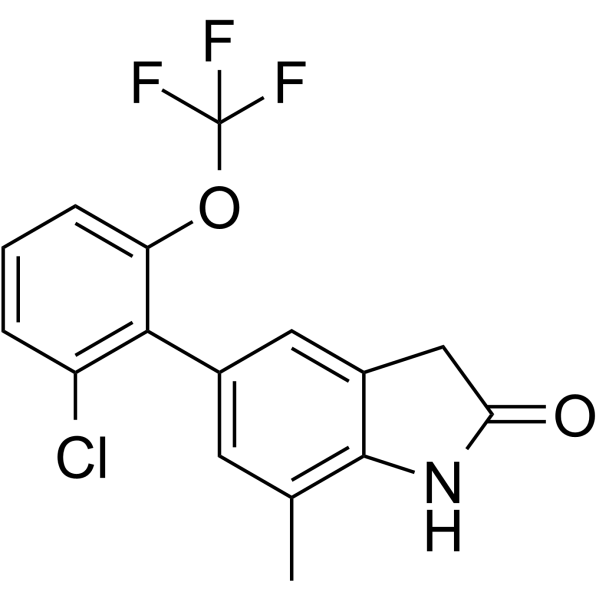
BPAM363 is an orally active, selective positive allosteric modulator (PAM) of AMPARs with blood-brain barrier penetration. BPAM363 selectively potentiates AMPAR activity in human and rat models, with an EC2x value of 0.96 μM in rat embryonic cortex primary neurons. BPAM363 upregulates BDNF protein expression in rat primary cortical neuronal cultures. BPAM363 enhances AMPA-mediated excitatory postsynaptic responses in rat and mice. BPAM363 can be used for the study of cognitive disorders .
loading...
    loading...
Cat. No.: HY-12503R
CAS No.: 178616-26-7
Target:  

iGluR

Research Areas:  

Neurological Disease Cancer

CFM-2 (Standard) is the analytical standard of CFM-2. This product is intended for research and analytical applications. CFM-2 is a potent and selective non-competitive AMPAR antagonist . CFM-2 possesses anticonvulsant activity in various models of seizures .
loading...
    loading...
Cat. No.: HY-112699
CAS No.: 2036074-41-4
Target:  

iGluR

Research Areas:  

Neurological Disease

AMPA receptor modulator-1 is a potent, orally active and selective AMPAR regulatory protein TARP γ-8 negative modulator with a pIC50 of 9.7, more selective over GluA1/γ-2 (pIC50=5) .
loading...
    loading...
Cat. No.: HY-P4106
CAS No.: 1404188-94-8
Research Areas:  

Neurological Disease

Tat-GluR23Y, scrambled is the scrambled peptide of Tat-GluR23Y (HY-P2259). Tat-GluR23Y is a synthetic peptide containing tyrosine residues that inhibit AMPAR endocytosis and is effective in the research of long-term depression (LTD) .
loading...
    loading...
Cat. No.: HY-149975
CAS No.: 2917551-59-6
Target:  

iGluR

Research Areas:  

Neurological Disease

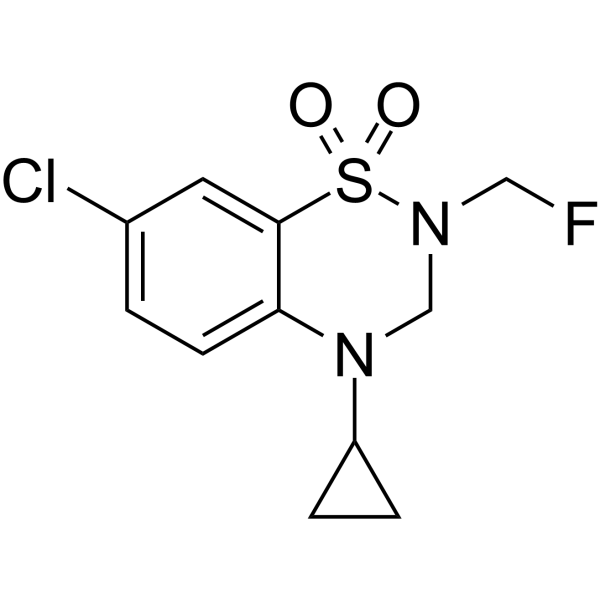
AMPA receptor modulator-4, a 3,4-dihydro-2H-1,2,4-benzothiadiazine 1,1-dioxide (BTD), is an orally active positive allosteric modulator of the AMPA receptors (AMPAR PAMs). AMPA receptor modulator-4 can cross the blood-brain barrier. AMPA receptor modulator-4 increases the cognition performance and improves working memory performance in mice .
loading...
    loading...
Cat. No.: HY-186183
CAS No.: 3080492-21-0
Normethyl-ZCAN262 (Normethyl-262) is a blood-brain barrier-permeable selective GluR2/AMPAR receptor modulator. Normethyl-ZCAN262 inhibits AMPA-mediated neurotoxicity, the formation of the GAPDH-GluR2 complex, and GluR2/AMPAR neurotoxicity. Normethyl-ZCAN262 enables in vivo imaging of brain AMPA receptors and is used in research related to multiple sclerosis, amyotrophic lateral sclerosis, neuroinflammation, stroke, epilepsy, Parkinson's disease, Alzheimer's disease, dementia, and Huntington's disease .
loading...
    loading...
Cat. No.: HY-182631
CAS No.: 1086378-73-5
Target:  

iGluR

Research Areas:  

Neurological Disease

CX1763 is an AMPAR allosteric modulator. CX1763 allosterically potentiates glutamate-evoked currents, accelerates channel opening, and increases the surface levels of AMPAR containing Glur2 (R). CX1763 enhances synaptic transmission in the rat hippocampus. CX1763 improves attention in rats and attenuates amphetamine-induced hyperactivity in mice. CX1763 can be used in studies related to attention deficit hyperactivity disorder and opioid-induced respiratory depression .
loading...
    loading...
Cat. No.: HY-111751R
CAS No.: 2035814-50-5
Research Areas:  

Neurological Disease

JNJ-61432059 (Standard) is the analytical standard of JNJ-61432059 (HY-111751). This product is intended for research and analytical applications. JNJ-61432059 is a blood-brain barrier-permeable, orally active TARP γ-8-associated AMPAR modulator with anticonvulsant activity. JNJ-61432059 negatively regulates GluA1 and positively modulates GluA2-containing AMPARs. JNJ-61432059 exerts potent protective effects in rodent epilepsy models without impairing motor function. JNJ-61432059 is applicable for epilepsy-related research .
loading...
    loading...
Cat. No.: HY-119781
CAS No.: 198710-92-8
Synonyms: PF1191
Target:  

iGluR

Research Areas:  

Neurological Disease

Kaitocephalin (PF1191) is an ionotropic glutamate receptor (NMDAR) antagonist with Ki values of 7.8, 590, and 14000 nM for NMDAR, AMPAR, and KAR, respectively. Kaitocephalin protects neurons by inhibiting excitotoxicity, exhibiting neuroprotective effects. Kaitocephalin can be used in research on neurological diseases such as Alzheimer's disease .
loading...
    loading...
Cat. No.: HY-P11892
c10c-G1V3 is a BRAG2 binder with a Kd value of 7.37 μM. c10c-G1V3 binds to BRAG2, thereby disrupting its interaction with GluA2 and blocking GluA2 endocytosis and AMPAR subunit switching. c10c-G1V3 reduces glutamate-induced intracellular reactive oxygen species (ROS) accumulation and cell apoptosis (apoptosis). c10c-G1V3 decreases infarct volume in the transient middle cerebral artery occlusion model. c10c-G1V3 can be used in studies related to ischemic stroke .
loading...
    loading...
Cat. No.: HY-L013
3,934 compounds

Neuronal Signaling is involved in the regulation of the mechanisms of the central nervous system (CNS) such as its structure, function, genetics and physiology as well as how this can be applied to understand diseases of the nervous system. Every information processing system in the CNS is composed of neurons and glia, neurons have evolved unique capabilities for intracellular signaling (communication within the cell) and intercellular signaling (communication between cells). G protein-coupled receptors (GPCRs), including 5-HT receptor, histamine receptor, opioid receptor, etc. are the largest class of sensory proteins and are important therapeutic targets in Neuronal Signaling. Besides, Notch signaling, such as β- and γ-secretase, also plays multiple roles in the development of the CNS including regulating neural stem cell (NSC) proliferation, survival, self-renewal and differentiation. GPCR dysfunction caused by receptor mutations and environmental challenges contributes to many neurological diseases. Notch signaling in neurons, glia, and NSCs is also involved in pathological changes that occur in disorders such as stroke, Alzheimer's disease and CNS tumors. Thus, targeting Neuronal Signaling, such as notch signaling and GPCRs, can be used as therapeutic interventions for several different CNS disorders.

MCE designs a unique collection of 3,934 Neuronal Signaling-related compounds that act as a useful tool for the research of neuronal regulation and neuronal diseases.

