13 Results for "

AUTAC Linker

" in MedChemExpress (MCE) Product Catalog:
Products (13)

13 Results for "AUTAC Linker" in MCE Product Catalog:

Cat. No.: HY-150408
CAS No.: 2241669-84-9
Purity:  98.85%
Target:  

AUTACs

Research Areas:  

Cancer

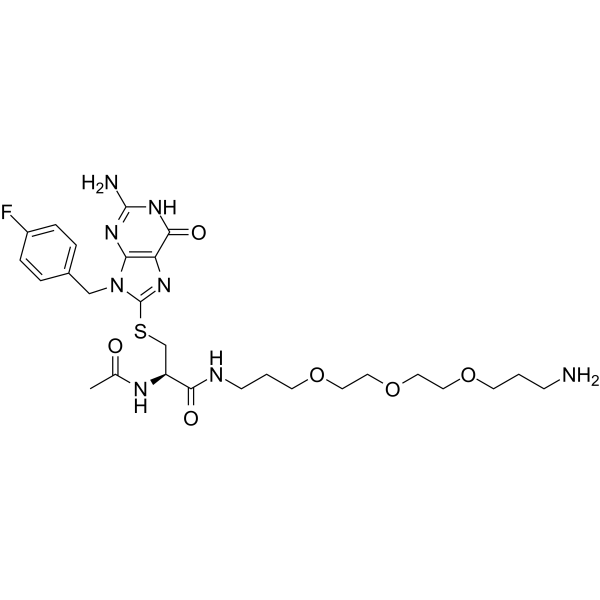
FBnG-(Cys-acetamide)-CH2-PEG3-CH2-CH2-CH2-NH2 is a tag-linker conjugate of AUTAC4 (HY-134640) that incorporates a degradation tag FBnG (HY-W073762) and a glycol linker. AUTAC4 contains an p-fluorobenzylguanine (FBnG) and a phenylindole moiety, which can induce K63-linked polyubiquitination and degradation of mitochondria in HeLa cells .
loading...
    loading...
Cat. No.: HY-147225
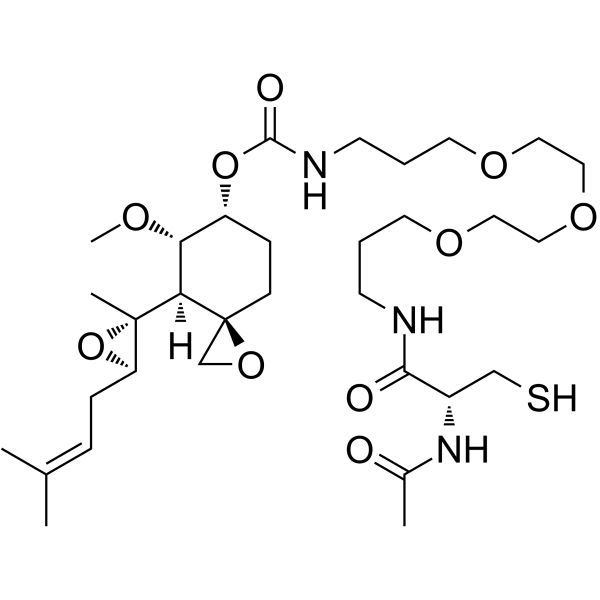
TSPO Ligand-Linker Conjugates 1 contains a ligand for translocator protein (TSPO) and a linker, which is used for the synthesis of mitochondria-targeting autophagy-targeting chimera (AUTAC). AUTAC can bind the TSPO on the outer mitochondrial membrane (OMM) of mitochondria and degrades impaired mitochondria and proteins via mitophagy, and improves mitochondrial activity. TSPO Ligand-Linker Conjugates 1 can be used in mitochondrial dysfunction related research, including neurodegenerative diseases, cancer, and diabetes .
loading...
    loading...
Cat. No.: HY-133869
Purity:  99.71%
Synonyms: cGMP-HaloTag-ligand
Target:  

Autophagy

Research Areas:  

Cancer

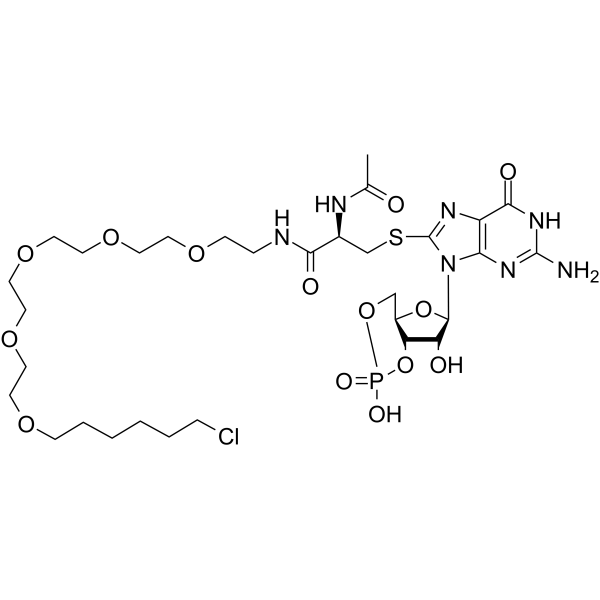
cGMP-HTL contains a HT-ligand, a linker and the Cys-S-cGMP (autophagy tag). cGMP-HTL increases the K63-linked ubiquitination of mitochondria. AUTAC (autophagy-targeting chimera) is a novel targeted-clearance strategy that contains a degradation tag (guanine derivatives) and a warhead to provide target specificity .
loading...
    loading...
Cat. No.: HY-160902
CAS No.: 2241668-58-4
Target:  

Autophagy AUTACs

Research Areas:  

Others

2G-HaloAUTAC (Compound tt44) is a Autophagy-targeting chimera (2G-HaloAUTAC) that improves the activity of AUTACs by replacing the L-Cysteine ​​(L-Cys) linker with other structures. 2G-HaloAUTAC exhibits degradation activity against EGFP-HaloTag protein through an Autophagic mechanism .
loading...
    loading...
Cat. No.: HY-158985A
Target:  

Autophagy AUTACs

Research Areas:  

Cancer

Amino-PEG3-2G degrader-1 hydrochloride is the hydrochloride salt form of Amino-PEG3-2G degrader-1 (HY-158985). Amino-PEG3-2G degrader-1 hydrochloride is a conjugate of a PEG Linker and a pyrazole-linked FBnG tag for ubiquitin-proteasome system (UPS) induction. Amino-PEG3-2G degrader-1 hydrochloride can be used to synthesize autophagy-targeting chimeras (AUTACs) .
loading...
    loading...
Cat. No.: HY-176220
CAS No.: 3060458-90-1
Research Areas:  

Cancer

GPX4-AUTAC is a GPX4-targeting autophagy-mediated degrader (AUTAC). GPX4-AUTAC consists of an inhibitor ML162-yne (HY-153748), a degradation tag FBnG (HY-W073762) and a glycol linker (HY-W021401). GPX4-AUTAC promotes the ubiquitination of GPX4 by E3 ligase TRAF6, and enhances the binding with GPX4 and p62, leading to the selective autophagy-dependent degradation of GPX4. GPX4-AUTAC significantly induces ferroptosis and shows a potent anti-cancer activity in breast cancer cells, breast cancer-derived organoids (PDOs) and MDA-MB-231 tumor xenograft mice model, with potent synergistic effects when combined with Sulfasalazine (SAS) (HY-14655) or chemotherapy drugs (Paclitaxel (HY-B0015) or Cisplatin (HY-17394)) .
loading...
    loading...
Cat. No.: HY-158985
CAS No.: 2267315-06-8
Target:  

AUTACs Autophagy

Research Areas:  

Cancer

Amino-PEG3-2G degrader-1 (compound ) is a conjugate of a PEG Linker and a pyrazole-linked FBnG tag for ubiquitin-proteasome system (UPS) induction. Amino-PEG3-2G degrader-1 can be used to synthesize autophagy-targeting chimeras (AUTACs) .
loading...
    loading...
Cat. No.: HY-175204
Research Areas:  

Cancer

SHP2 protein degrader-3 is a SHP2 AUTAC degrader. SHP2 protein degrader-3 shows dose-dependent SHP2 degradation ability (DC50 = 3.22 μM) and anti-tumor activity (IC50 = 5.59 μM) in HeLa cells. SHP2 protein degrader-3 induces degradation through the LC3-mediated autophagy pathway, which can be inhibited by lysosome inhibitors. SHP2 protein degrader-3 induces apoptosis in various cancer cells (HeLa cells, HepG2 cells, LoVo cells, Huh-7 cells) (SHP2 Ligand : (HY-100388); LC3 Ligand: (HY-10542); Linker : (HY-128834)) .
loading...
    loading...
Cat. No.: HY-169363
Research Areas:  

Cancer

PD-L1 degrader-2 (Compound B3) is an orally active AUTAC degrader, that degrades PD-L1 through autophagy-lysosome pathway with a DC50 of 0.5 μM. PD-L1 degrader-2 exhibits inhibitory activity against PD-1/PD-L1 interaction with an IC50 of 22.8 nM. PD-L1 degrader-2 upregulates the expressions of Atg9b, Lamp1 and Mitf, and activates the autophagy lysosome system. PD-L1 degrader- exhibits antitumor efficacy in CT26 mouse model . (Pink: autophagy-lysosome activator (HY-159894); Black: linker (HY-W015088); Blue: PD-L1 ligand (HY-169365))
loading...
    loading...
Cat. No.: HY-150411
CAS No.: 2241669-85-0
Target:  

AUTACs

Research Areas:  

Cancer

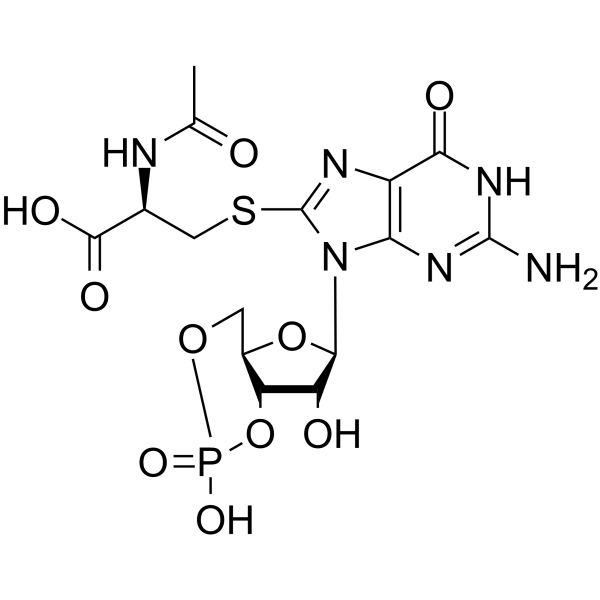
Cys-C-cGMP is a autophagy tag for AUTACs. Cys-C-cGMP can increase the K63-linked ubiquitination of mitochondria in HeLa cells .
loading...
    loading...
Cat. No.: HY-176240
CAS No.: 3085085-29-3
Target:  

AUTACs Autophagy

Research Areas:  

Cancer

FBnG-amino-PEG3-C2-azido is a tag-linker conjugate that incorporates a degradation tag FBnG (HY-W073762) and a glycol linker (Amino-PEG3-C2-Azido) (HY-W021401). FBnG-amino-PEG3-C2-azido can be used for synthesis of GPX4-AUTAC (HY-176220) .
loading...
    loading...
Cat. No.: HY-169364
Target:  

PD-1/PD-L1

Research Areas:  

Others

2-Methylbiphenyl-oxadiazole-NH-Ph-NH-PEG3-C2-NH-Boc is the PD-L1 ligand-linker conjugate part of AUTAC PD-L1 degrader-3 (HY-169363). 2-Methylbiphenyl-oxadiazole-NH-Ph-NH-PEG3-C2-NH-Boc can be utilized in AUTAC synthesis .
loading...
    loading...
Cat. No.: HY-184158
HATC is a HIF-1α AUTAC degrader. HATC links HIF-1α to LC3 to form a ternary complex that undergoes degradation via the autophagy-lysosome fusion pathway. HATC induces dose-dependent HIF-1α degradation in multiple cell types. HATC reduces visceral fat accumulation, hepatic lipid deposition, senescent cell aggregation, and bone loss; alleviates age-related intervertebral disc degeneration, liver dysfunction, kyphosis, and alveolar dilation; decreases circulating lactic acid levels; improves physical performance; and reverses age-related changes in granulocyte proportions. HATC extends median and maximum lifespan, reduces transcriptomic age, and causes no obvious persistent toxicity. HATC can be used in the research of age-related diseases (pink: LC3 ligand (HY-50759); blue: HIF-1α ligand (HY-P10426); Linker: (HY-W008264)) .
loading...
    loading...
  • 1

