
1. Search Result
Search Result
Results for "

Bioadhesives

" in MedChemExpress (MCE) Product Catalog:

15

Inhibitors & Agonists

12

Biochemical Assay Reagents

1

Peptides

1

Oligonucleotides

Cat. No. Product Name Target Research Areas Chemical Structure
  • HY-Y1310A

    Environmental Pollutants Biochemical Assay Reagents Others
    Sodium alginate is an anionic straight chain polysaccharide. Sodium alginate can be obtained from different species of algae. Sodium alginate has different properties, such as pH-sensitivity, nontoxicity, nonimmunogenicity. Sodium alginate has weak gelation, viscosity, and film-forming properties. Sodium alginate can be utilized to prepare gels and film materials for food preservation. Sodium alginate is a versatile functional biomaterial for viscosity enhancement, stabilizer, matrixing agent, encapsulation polymer, bioadhesive and film former .
    Sodium alginate (Viscosity 200±20mpa.s)
  • HY-Y0873A1

    Polyethylene glycol 100000

    Environmental Pollutants Biochemical Assay Reagents Others
    PEG100000 (Polyethylene glycol 100000) is a polymer compound with good biocompatibility and biodegradability, and is widely used in drug controlled release systems and bioadhesive materials .
    PEG100000
  • HY-B1325

    Bacterial Antibiotic Infection Inflammation/Immunology
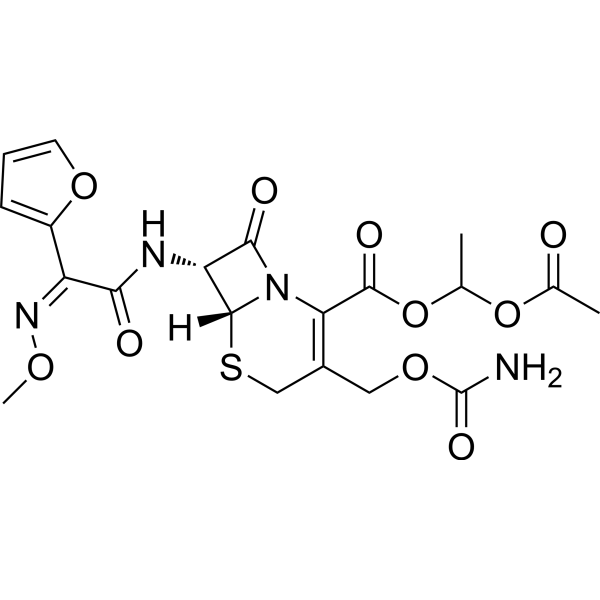
    Cefuroxime axetil is an orally effective broad-spectrum β-lactam antibiotic that targets bacterial penicillin-binding proteins (PBPs, such as PBP3 and PBP1). Cefuroxime axetil inhibits cell wall synthesis, leading to bacterial lysis and death, with a minimum inhibitory concentration (MIC) of 0.12-4 mg/L for non-typeable Haemophilus influenzae (NTHi). Cefuroxime axetil is hydrolyzed by esterase to the active ingredient Cefuroxime (HY-B1256A) after oral absorption. Topical administration of Cefuroxime via bioadhesive nanoparticles (BNPs) can prolong the drug's retention time in the middle ear (≥7 days). Cefuroxime axetil can be used in the study of otitis media (especially NTHi infection). Cefuroxime axetil can achieve precise antibacterial effects through oral or topical nano-delivery systems, reducing systemic exposure and the risk of antibiotic resistance .
    Cefuroxime axetil
  • HY-Y0873B1

    Polyethylene glycol 8000000

    Biochemical Assay Reagents Others
    PEG8000000 (Polyethylene glycol 8000000) is a polymer compound with good biocompatibility and biodegradability, and is widely used in drug controlled release systems and bioadhesive materials .
    PEG8000000
  • HY-Y0873A3

    Polyethylene glycol 1000000

    Biochemical Assay Reagents Others
    PEG1000000 (Polyethylene glycol 1000000) is a polymer compound with good biocompatibility and biodegradability, and is widely used in drug controlled release systems and bioadhesive materials .
    PEG1000000
  • HY-A0104K

    Hypromellose (Type II,Viscosity:3mPa.s); (Hydroxypropyl)methyl cellulose (Type II,Viscosity:3mPa.s); Celacol HPM 5000 (Type II,Viscosity:3mPa.s)

    Environmental Pollutants Biochemical Assay Reagents Others
    HPMC (Type II, Viscosity: 3 mPa.s) is a nonionic polymer prepared via synthetic modification of cellulose. As a hydrophilic matrix material, HPMC prolongs drug release through non-Fickian diffusion, which includes the diffusion of drugs in the hydrated matrix and the polymer relaxation process .
    HPMC (Type II,Viscosity:3mPa.s)
  • HY-W145493

    Tetraglycol; Poly(ethylene glycol) tetrahydrofurfuryl ether

    Biochemical Assay Reagents Others
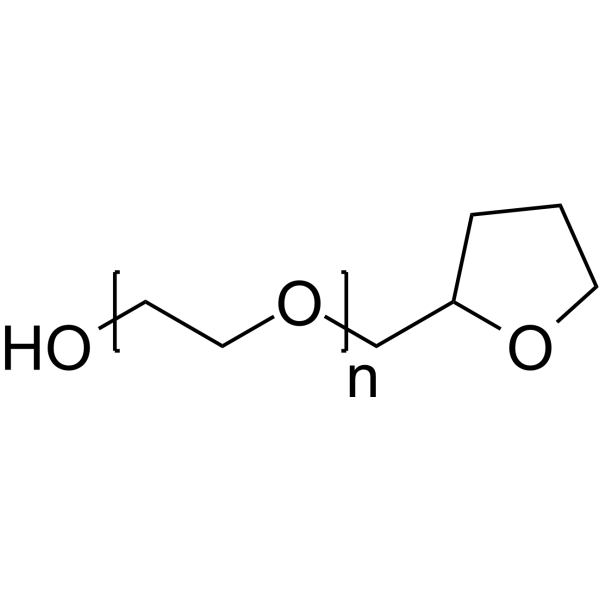
    Glycofurol (Tetraglycol) is a hydrophilic, water-miscible cosolvent and absorption enhancer with skin tolerance. Glycofurol can be used as a carrier-based gel for the topical delivery of drugs, including water-insoluble drugs. Glycofurol can form gels with bioadhesiveness, spreadability and suitable viscosity for topical administration .
    Glycofurol
  • HY-Y0873A5

    Polyethylene glycol 200000

    Biochemical Assay Reagents Others
    PEG200000 (Polyethylene glycol 200000) is a polymer compound with good biocompatibility and biodegradability, and is widely used in drug controlled release systems and bioadhesive materials .
    PEG200000
  • HY-Y0873A8

    Polyethylene glycol 5000000

    Biochemical Assay Reagents Others
    PEG5000000 (Polyethylene glycol 5000000) is a polymer compound with good biocompatibility and biodegradability, and is widely used in drug controlled release systems and bioadhesive materials .
    PEG5000000
  • HY-Y0873A6

    Polyethylene glycol 400000

    Biochemical Assay Reagents Others
    PEG400000 (Polyethylene glycol 400000) is a polymer compound with good biocompatibility and biodegradability, and is widely used in drug controlled release systems and bioadhesive materials .
    PEG400000
  • HY-Y0873A9

    Polyethylene glycol 2000000

    Biochemical Assay Reagents Others
    PEG2000000 (Polyethylene glycol 2000000) is a polymer compound with good biocompatibility and biodegradability, and is widely used in drug controlled release systems and bioadhesive materials .
    PEG2000000
  • HY-Y0873A2

    Polyethylene glycol 600000

    Biochemical Assay Reagents Others
    PEG600000 (Polyethylene glycol 600000) is a polymer compound with good biocompatibility and biodegradability, and is widely used in drug controlled release systems and bioadhesive materials .
    PEG600000
  • HY-Y0873A7

    Polyethylene glycol 900000

    Biochemical Assay Reagents Others
    PEG900000 (Polyethylene glycol 900000) is a polymer compound with good biocompatibility and biodegradability, and is widely used in drug controlled release systems and bioadhesive materials .
    PEG900000
  • HY-Y0873A4

    Polyethylene glycol 4000000

    Biochemical Assay Reagents Others
    PEG4000000 (Polyethylene glycol 4000000) is a polymer compound with good biocompatibility and biodegradability, and is widely used in drug controlled release systems and bioadhesive materials .
    PEG4000000
  • HY-W250721E

    Carboxy polymethylene (copolymer)

    Biochemical Assay Reagents Others
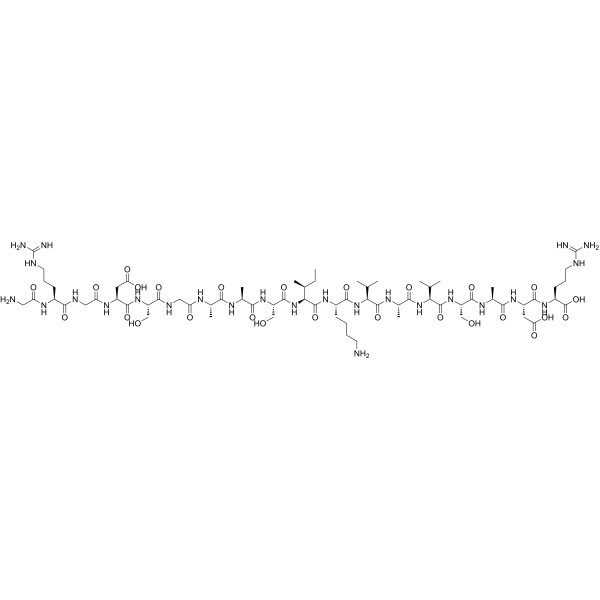
    Carbomer copolymer can be used as an excipient, such as Bioadhesives, emulsifiers, release modifiers, suspending agents, tablet binders, viscosity enhancers, etc. Pharmaceutical excipients, or pharmaceutical auxiliaries, refer to other chemical substances used in the pharmaceutical process other than pharmaceutical ingredients. Pharmaceutical excipients generally refer to inactive ingredients in pharmaceutical preparations, which can improve the stability, solubility and processability of pharmaceutical preparations. Pharmaceutical excipients also affect the absorption, distribution, metabolism, and elimination (ADME) processes of co-administered drugs .
    Carbomer copolymer

Inquiry Online

Your information is safe with us. * Required Fields.

Salutation


Country or Region *

Applicant Name *


Organization Name *

Department *


Email Address *


Product Name *

Cat. No.


Requested quantity *

Phone Number *


Remarks

Inquiry Online

Inquiry Information

Product Name:
Cat. No.:
Quantity:
MCE Japan Authorized Agent:

