8 Results for "

DNA+lesion

" in MedChemExpress (MCE) Product Catalog:
Products (8)

8 Results for "DNA+lesion" in MCE Product Catalog:

1
1 Cited Publications
Cat. No.: HY-128760
CAS No.: 906439-72-3
Purity:  99.92%
Research Areas:  

Cancer

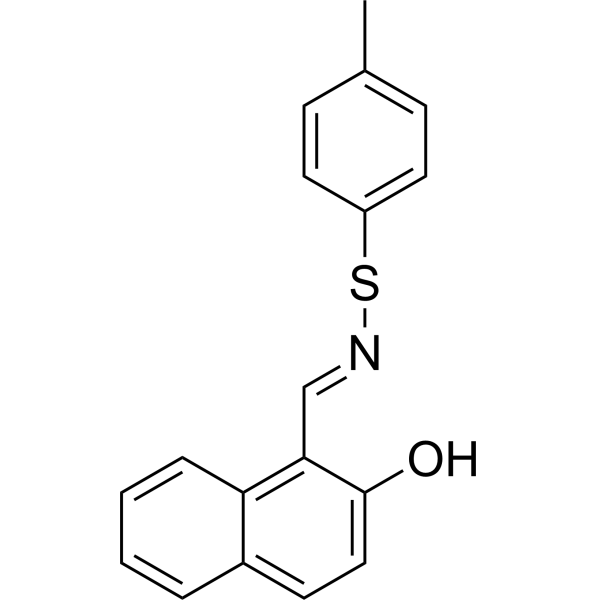
COH34 is a potent and specific poly(ADP-ribose) glycohydrolase (PARG) inhibitor with an IC50 of 0.37 nM. COH34 binds to the catalytic domain of PARG (Kd=0.547 μM), thereby prolonging PARylation at DNA lesions and trapping DNA repair factors .
loading...
    loading...
Cat. No.: HY-E70577
CAS No.: 63363-78-0
Target:  

Endonuclease

Research Areas:  

Others

DNA repair enzyme. Endonuclease IV has endonuclease activity at AP sites, 3' phosphodiesterase activity that can remove a variety of ligation-blocking lesions from the 3' end of DNA, endonuclease activity on oxidative DNA lesions, and 3' to 5' exonuclease activity .
loading...
    loading...
Cat. No.: HY-115567
CAS No.: 191421-10-0
Purity:  ≥98.0%
Synonyms: 1-(β-D-2-Deoxyribofuranosyl)-5-nitroindole
Target:  

Apoptosis

Research Areas:  

Cancer

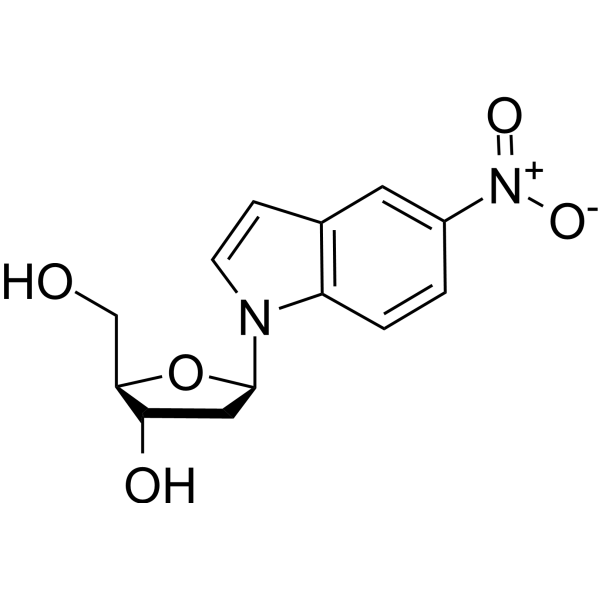
5-NIdR (1-(β-D-2-Deoxyribofuranosyl)-5-nitroindole), an artificial nucleoside, exhibits the ability to inhibit the replication of DNA lesions generated by Temozolomide (HY-17364). 5-NIdR induces cancer cells apoptosis and arrests cell cycle at G0 phase. 5-NIdR enhances Temozolomide anti-tumor efficacy in murine glioblastoma model .
loading...
    loading...
Cat. No.: HY-125209A
CAS No.: 2253744-57-7
Research Areas:  

Cancer

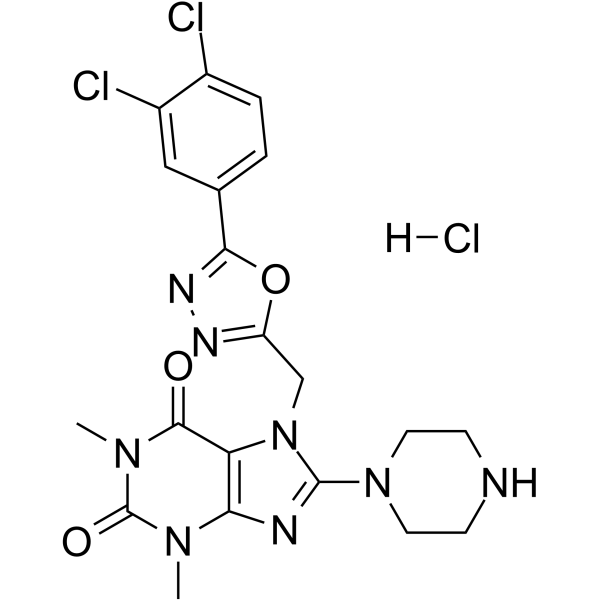
TH5427 hydrochloride is a NUDT5 inhibitor with a human target IC50 of 29 nM, ~690-fold selectivity over MTH1 in vitro, and selective functional inhibition over other NUDIX hydrolases including NUDT9 .TH5427 hydrochloride binds to the active site of NUDT5, blocking enzymatic activity related to ADP-ribose metabolism and PAR-derived ATP synthesis .TH5427 hydrochloride blocks progestin-dependent nuclear ATP synthesis, impairs progestin-induced chromatin remodeling, inhibits histone H1 displacement, disrupts progestin-dependent gene regulation, and abrogates progestin-dependent proliferation in breast cancer cells .TH5427 hydrochloride functions as a versatile probe to study nuclear ATP dynamics and ADP-ribose-related metabolism in cells .TH5427 hydrochloride engages NUDT5 at physiological temperatures, as demonstrated by Drug Affinity Responsive Target Stability (DARTS) assay .TH5427 hydrochloride stabilizes NUDT5 against thermal denaturation in cell lysates and intact cells, as shown by cellular thermal shift assay (CETSA) .TH5427 hydrochloride functionally inhibits NUDT5 activity, leading to downstream effects on oxidative DNA damage and DNA replication in triple-negative breast cancer (TNBC) cells .TH5427 hydrochloride suppresses proliferation of TNBC cells without inducing cell death or apoptosis, slows DNA replication in TNBC cells, promotes accumulation of oxidative DNA lesions, and triggers DNA damage response in TNBC cells .TH5427 hydrochloride suppresses growth of TNBC cells in vitro, inhibits growth of TNBC xenograft tumors in nude mice in vivo, and shows greater potency against TNBC cell lines compared to ER-positive and normal-like breast cell lines .TH5427 hydrochloride can be used for the research of breast cancer and triple-negative breast cancer .
loading...
    loading...
Cat. No.: HY-W144308
CAS No.: 87-87-6
Synonyms: TCHQ; Tetrachloroquinol
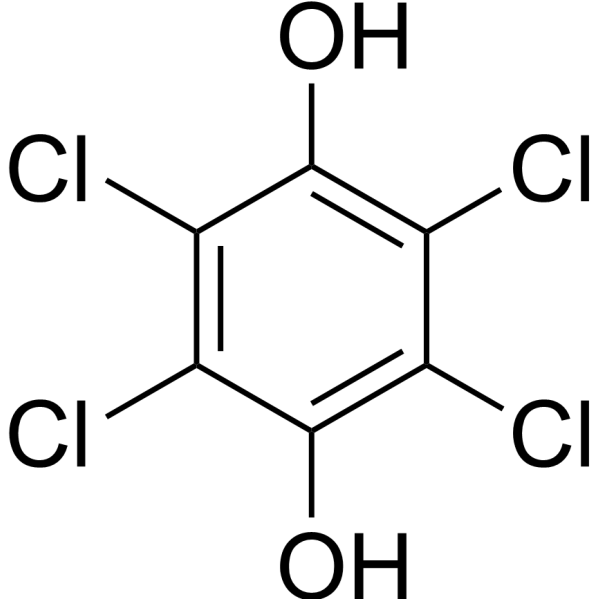
Tetrachlorohydroquinone (TCHQ) is a metabolite of Pentachlorophenol. Tetrachlorohydroquinone induces reactive oxidant stress (ROS), inhibits apoptosis and induces necrosis in primary mouse splenocytes. Tetrachlorohydroquinone increases DNA lesions and induces oxidative stress in rodents .
loading...
    loading...
Cat. No.: HY-175812
CAS No.: 1208829-24-6
Target:  

Endonuclease

Research Areas:  

Cancer

MU876 (Compound 32) is a MUS81 inhibitor with an IC50 of 0.5  μM. MU876 effectively inhibits MUS81-dependent homologous recombination (HR) and break-induced replication (BIR) pathways. MU876 sensitizes cancer cells to DNA-damaging agents, such as Cisplatin (HY-17394), through impairing their ability to repair DNA lesions. MU876 can be used for cancers chemotherapy research .
loading...
    loading...
Cat. No.: HY-133598
CAS No.: 56961-20-7
Target:  

DNA/RNA Synthesis

Research Areas:  

Cancer

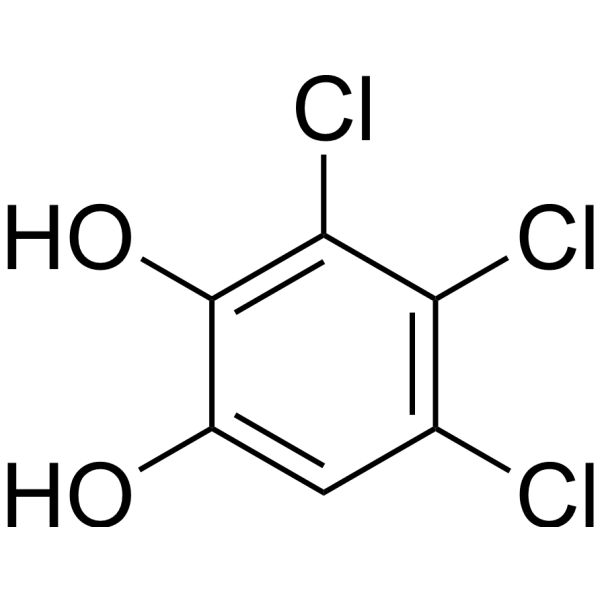
3,4,5-Trichlorocatechol is a catechol derivative of pentachlorophenol and induces oxidative DNA lesions .
loading...
    loading...
Cat. No.: HY-W144308R
CAS No.: 87-87-6
Synonyms: TCHQ (Standard); Tetrachloroquinol (Standard)
Tetrachlorohydroquinone (Standard) is the analytical standard of Tetrachlorohydroquinone (HY-W144308). This product is intended for research and analytical applications. Tetrachlorohydroquinone (TCHQ) is a metabolite of Pentachlorophenol. Tetrachlorohydroquinone induces reactive oxidant stress (ROS), inhibits apoptosis and induces necrosis in primary mouse splenocytes. Tetrachlorohydroquinone increases DNA lesions and induces oxidative stress in rodents .
loading...
    loading...

