10 Results for "

EVs

" in MedChemExpress (MCE) Product Catalog:
Products (10)

10 Results for "EVs" in MCE Product Catalog:

3
3 Cited Publications
Cat. No.: HY-107588
CAS No.: 916734-43-5
Purity:  99.94%
Target:  

Integrin

Research Areas:  

Cardiovascular Disease

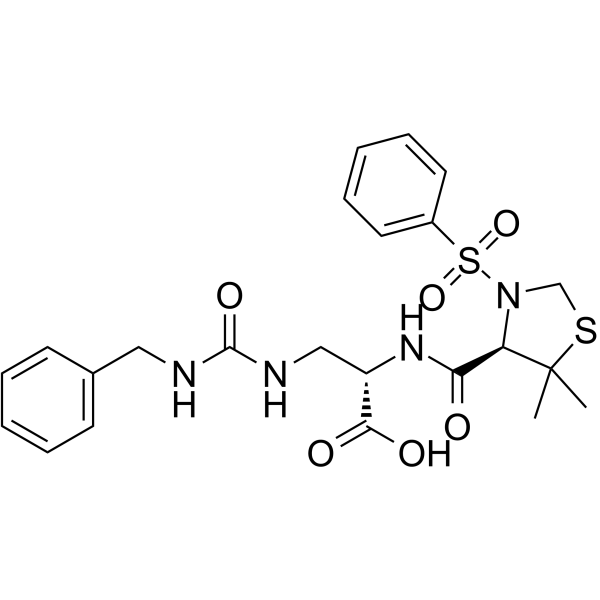
TC-I 15 (TC-I-15) is a type of allosteric collagen-binding integrin α2β1 inhibitor, and it also inhibits α1β1 and α11β1. TC-I 15 inhibits platelet adhesion to collagen and thrombus deposition. TC-I 15 prevents the formation of a pre-metastatic microenvironment by inhibiting the uptake of cancer-associated fibroblast (CAF) extracellular vesicles (EVs) by lung fibroblasts, which reduces the metastasis of salivary gland adenocystic carcinoma (SACC) to the lungs in mouse models, .
loading...
    loading...
Cat. No.: HY-P11024
CAS No.: 2852679-40-2
Target:  

Folate Receptor (FR)

Research Areas:  

Cancer

NVP-EVS459 is a Folate Receptor (FR)-targeting radioconjugate. NVP-EVS459 labeled with 177Lu can be used for tumor diagnosis and research .
loading...
    loading...
Cat. No.: HY-164390
CAS No.: 64364-50-7
Synonyms: Neu5Acα2-6Galβ1-4GlcNAc
Target:  

Endogenous Metabolite

Research Areas:  

Infection Cancer

6′SLN is a cancer-related extracellular vesicle (EVs) surface glycan that serves as a key form of protein glycosylation in EVs. 6′SLN is also a sialic acid derivative that can interact with hemagglutinins (HAs) from human and avian influenza virus strains, making it useful for research into anti-influenza drugs .
loading...
    loading...
Cat. No.: HY-174814
CAS No.: 827034-42-4
Target:  

Enterovirus

Research Areas:  

Infection

Jun15716 is an Enterovirus (EVs) 2C protein (EVs 2C) inhibitor with Kis of 15.9, 44.2 and 17.8 μM for EV-D68, EV-A71 and CVB3, respectively. Jun15716 has a potent antiviral activity against EV-D68 US/MO/14-18947 and CVB3 Nancy cells (EC50s of 1.0 and 0.7 μM, respectively). Jun15716 can be used for viral infections research, such as meningitis, hand, foot and mouth disease (HFMD) and viral myocarditis .
loading...
    loading...
Cat. No.: HY-174815
Target:  

Enterovirus

Research Areas:  

Infection

Jun15799 is an Enterovirus (EVs) 2C protein (EVs 2C) inhibitor with Kis of 0.8, 21.1 and 3.0 μM for EV-D68, EV-A71 and CVB3, respectively. Jun15799 has a significant antiviral activity against EV-D68 US/MO/14-18947, EV-A71 Tainan/4643/1998 and CVB3 Nancy cells (EC50s of 0.3, 11.4 and 0.3 μM, respectively). Jun15799 can be used for viral infections research, such as meningitis, hand, foot and mouth disease (HFMD) and viral myocarditis .
loading...
    loading...
Cat. No.: HY-169819
CAS No.: 882291-37-4
Research Areas:  

Inflammation/Immunology

Calcium influx inducer compound 634 is a calcium influx inducer. Calcium influx inducer compound 634 (10 µM) enhances the release of extracellular vesicles (EVs) from mouse bone marrow-derived dendritic cells (mBMDCs). Calcium influx inducer compound 634 (10 µM) also increases the levels of CD86 and CD80 on the surface of mBMDCs, an effect that can be blocked by the calcium release-activated calcium channel inhibitor YM-58483 (HY-100831) .
loading...
    loading...
Cat. No.: HY-182080
CAS No.: 710280-48-1
Target:  

Microtubule/Tubulin

Research Areas:  

Inflammation/Immunology

EVs inducer-1 is a release inducer of immunostimulatory extracellular vesicles (EVs). EVs inducer-1 inhibits tubulin polymerization. EVs inducer-1 enhances the release of immunostimulatory EVs by antigen-presenting cells, increases the release of EV particles from dendritic cells, and elevates CD63 reporter gene activity. EVs inducer-1 inhibits the viability of proliferating cells. EVs inducer-1 is applicable for research related to immune regulation .
loading...
    loading...
Cat. No.: HY-L168
690 compounds

Extracellular vesicles (EVs) are small membrane binding structures that are released from cells into the surrounding environment and play a crucial role in mediating and regulating intercellular communication related to physiological and pathological processes. EVs are lipid membrane vesicles composed of proteins, lipids, and nucleic acids. EVs can be divided into several types based on their source, such as extracellular vesicles, microcapsules, and apoptotic vesicles. The size range of exosomes is 30-150nm, which are endocrine in multi vesicular endosomes (MVEs); microvesicles (50-1000nm) are secreted directly through extracellular interactions, thereby releasing plasma membrane vesicles. In contrast, apoptotic bodies are usually larger, ranging in size from 1 to 5 μ m. This is generated during programmed cell death. EV plays a crucial role in transmitting information between cells and influencing the behavior and function of receptor cells.

MCE designs a unique collection of 690 small molecules related to extracellular vesicles (EVs). It is a good tool to be used for research on metabolize, cancer and other diseases.

Cat. No.: HY-P11232
CAS No.: 1969250-99-4
Research Areas:  

Infection

NAB815 is a specific inhibitor of the Stx2a (Kd = 0.01 μM)/TLR4 interaction. NAB815 inhibits the neutrophil/Stx2a interaction (IC50 = 0.057 μg/mL). NAB815 inhibits the formation of Stx2-containing extracellular vesicles (EVs) produced by leukocytes and platelets and reduces their toxic effects in cellular (Vero cells) and animal models (CD-1 mice). NAB815 reduces bacterial loads in the kidneys, urine, and bladders of Escherichia coli-infected mice. NAB815 is useful in the study of hemolytic uremic syndrome (HUS) .
loading...
    loading...
Cat. No.: HY-107588R
CAS No.: 916734-43-5
Research Areas:  

Cardiovascular Disease

TC-I 15 (Standard) is the analytical standard of TC-I 15 (HY-107588). This product is intended for research and analytical applications. TC-I 15 (TC-I-15) is a type of allosteric collagen-binding integrin α2β1 inhibitor, and it also inhibits α1β1 and α11β1. TC-I 15 inhibits platelet adhesion to collagen and thrombus deposition. TC-I 15 prevents the formation of a pre-metastatic microenvironment by inhibiting the uptake of cancer-associated fibroblast (CAF) extracellular vesicles (EVs) by lung fibroblasts, which reduces the metastasis of salivary gland adenocystic carcinoma (SACC) to the lungs in mouse models, .
loading...
    loading...

