8 Results for "

GTP hydrolysis

" in MedChemExpress (MCE) Product Catalog:
Products (8)

8 Results for "GTP hydrolysis" in MCE Product Catalog:

3
3 Cited Publications
Cat. No.: HY-113225B
CAS No.: 103192-46-7
Synonyms: GTP tritris solution (100 mM)
Research Areas:  

Cancer

Guanosine triphosphate tritris (GTP tritris) (100 mM) serves as a vital enhancer of myogenic cell differentiation and plays a critical role in modulating miRNA-myogenic regulator factors. It also facilitates the release of exosomes enriched with guanosine and guanosine-derived molecules, and is regarded as an activated precursor for RNA synthesis. In mitochondrial function, GTP participates in the import of proteins into the matrix, which is essential for various regulated pathways, and is involved in initiating peptide synthesis through the binding of formylmethionyl-tRNA to the ribosome, as well as polypeptide chain elongation. Additionally, GTP acts as a phosphate and pyrophosphate carrier that channels chemical energy into specific biosynthetic pathways. It activates signal transducing G proteins that regulate cellular processes such as proliferation and differentiation, and its hydrolysis by small GTPases, including Ras and Rho, is integral to both proliferation and apoptosis. Furthermore, the small GTPase Rab is instrumental in vesicle docking, fusion, and formation. Beyond signal transduction, GTP is an energy-rich precursor in the enzymatic biosynthesis of DNA and RNA.
loading...
    loading...
1
1 Cited Publications
Cat. No.: HY-P1376A
Research Areas:  

Endocrinology

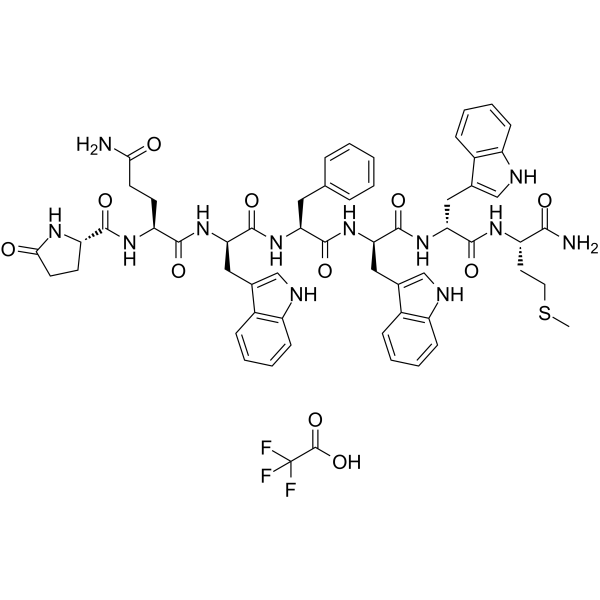
G-Protein antagonist peptide TFA is a truncated substance P-related peptide, competes with receptor for G protein binding. G-Protein antagonist peptide TFA inhibits the activation of Gi or Go by M2 muscarinic cholinergic receptor (M2 mAChR) or of Gs by beta-adrenergic receptor in the reconstituted phospholipid vesicles, assayed by receptor-promoted GTP hydrolysis .
loading...
    loading...
Cat. No.: HY-Y1766
CAS No.: 2103-57-3
Synonyms: 2,3,4-Trihydrooxy Benzaldehyde
2,3,4-Trimethoxybenzaldehyde (2,3,4-Trihydrooxy Benzaldehyde) can be used to study the effects on tubulin-dependent GTP hydrolysis .
loading...
    loading...
Cat. No.: HY-101989
CAS No.: 564468-51-5
Research Areas:  

Cancer

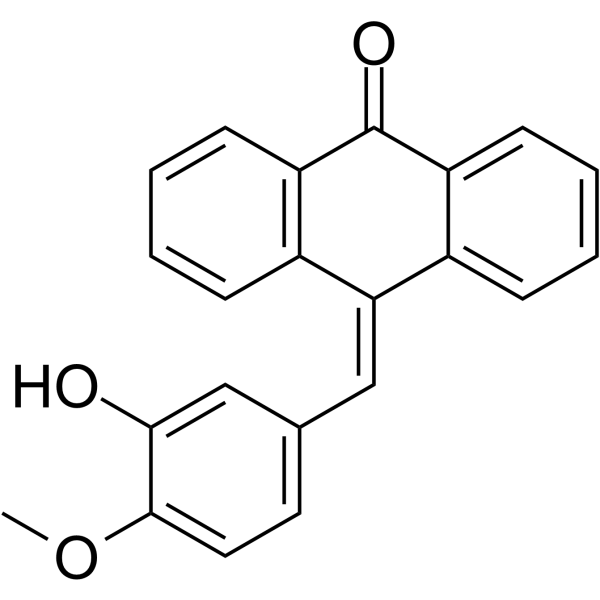
Tubulin polymerization-IN-24 (compound HMBA) is a potent tubulin polymerization inhibitor. Tubulin polymerization-IN-24 inhibits MCF-7 cells proliferation. Tubulin polymerization-IN-24 induces apoptosis and cell cycle arrest at G2/M phase. Tubulin polymerization-IN-24 increase the GTP hydrolysis rate and inhibits microtubule assembly .
loading...
    loading...
Cat. No.: HY-111396
CAS No.: 434910-94-8
Target:  

Bacterial

Research Areas:  

Infection

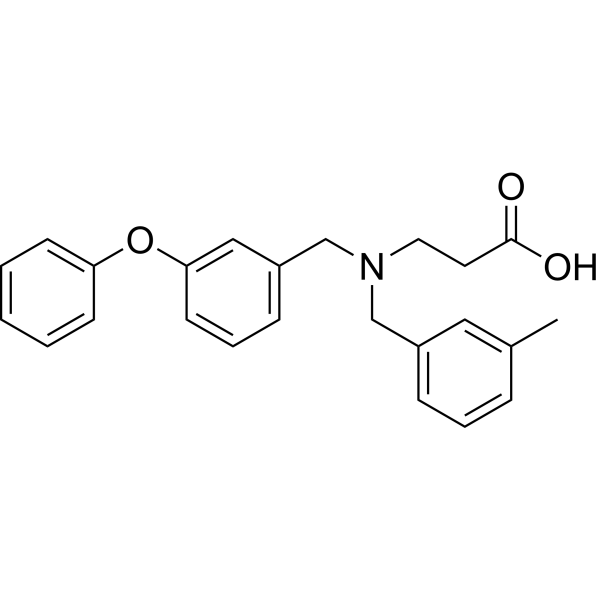
PC58538 is a cell division inhibitor, targeting to FtsZ. PC58538 shows moderate antibacterial activity, and inhibits cell division in vegetative cells of wild-type B. subtilis. PC58538 is also known to modulate the rate of GTP hydrolysis .
loading...
    loading...
Cat. No.: HY-157808
Target:  

Bacterial

Research Areas:  

Infection

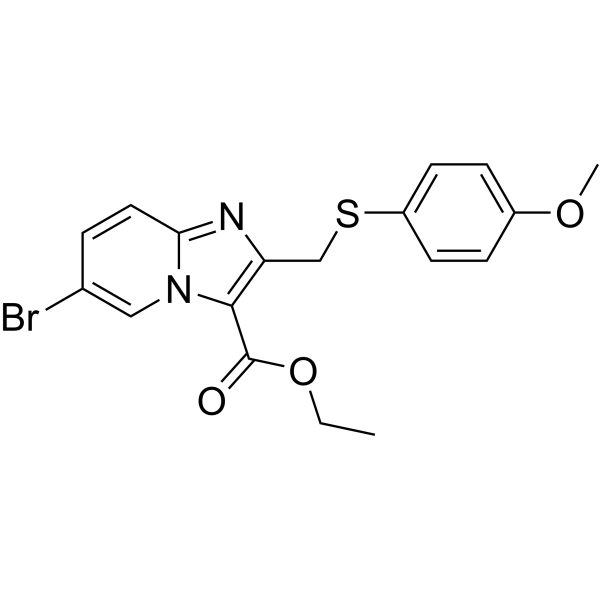
Antibacterial agent 185 (compound IP-01) is a potent antibacterial agent. Antibacterial agent 185 inhibits filamentous temperature-sensitive mutant Z (FtsZ) polymerization and bundling by increasing GTP hydrolysis. Antibacterial agent 185 inhibits Streptococcus pneumoniae and shows narrow-spectrum activity .
loading...
    loading...
Cat. No.: HY-Y1766R
CAS No.: 2103-57-3
2,3,4-Trimethoxybenzaldehyde (Standard) is the analytical standard of 2,3,4-Trimethoxybenzaldehyde. This product is intended for research and analytical applications. 2,3,4-Trimethoxybenzaldehyde (2,3,4-Trihydrooxy Benzaldehyde) can be used to study the effects on tubulin-dependent GTP hydrolysis .
loading...
    loading...
Cat. No.: HY-183772
Research Areas:  

Cancer

TBC1D2-IN-1 is a potent orally active and selective TBC1D2 inhibitor with a Kd of 1.1 μM. TBC1D2-IN-1 selectively inhibits TBC1D2-mediated GTP hydrolysis on RAB7A-GTP, promotes RAB7A accumulation on lysosomal membranes, and induces apoptosis and autophagy. TBC1D2-IN-1 exerts selective antiproliferative activity cancer cells. TBC1D2-IN-1 can be used for the research of cervical carcinoma .
loading...
    loading...

