13 Results for "

H2S probe

" in MedChemExpress (MCE) Product Catalog:
Products (13)

13 Results for "H2S probe" in MCE Product Catalog:

2
2 Cited Publications
Art. -Nr.: HY-119323
CAS. Nr.: 95633-27-5
Reinheit:  99.11%
Target:  

Fluorescent Dye

Forschungsgebiete:  

Others

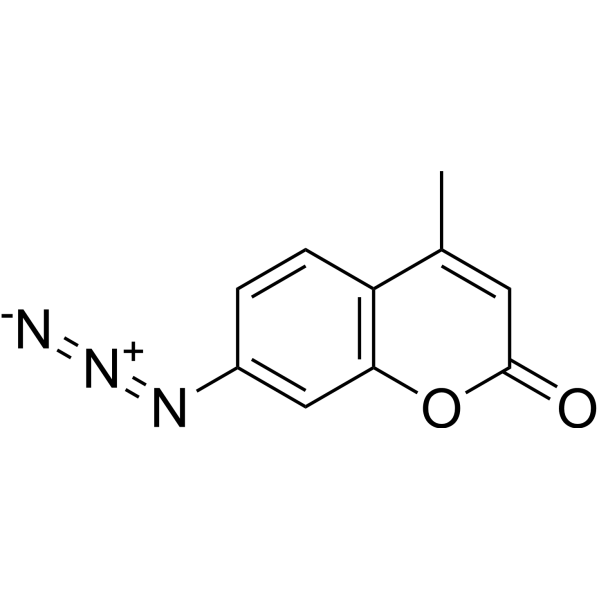
7-Azido-4-methylcoumarin is a selective coumarin-based fluorescent probe for hydrogen sulfide (H2S). In the presence of H2S, the aromatic azido group of 7-Azido-4-methylcoumarin is selectively reduced to produce the fluorescently active 7-amino-4-methylcoumarin (AMC). 7-Azido-4-methylcoumarin binds to the coumarin/phenol-binding site of BSA, the aglycone-binding site of UGT1A6, and the substrate-binding site of SULT1A1, respectively. 7-Azido-4-methylcoumarin retains its fluorescent properties after covalent binding, acts as a fluorescent H2S probe, and does not react with cysteine, homocysteine or glutathione (Ex/Em = 340/445 nm) .
loading...
    loading...
Art. -Nr.: HY-129420
CAS. Nr.: 1593024-78-2
Reinheit:  99.31%
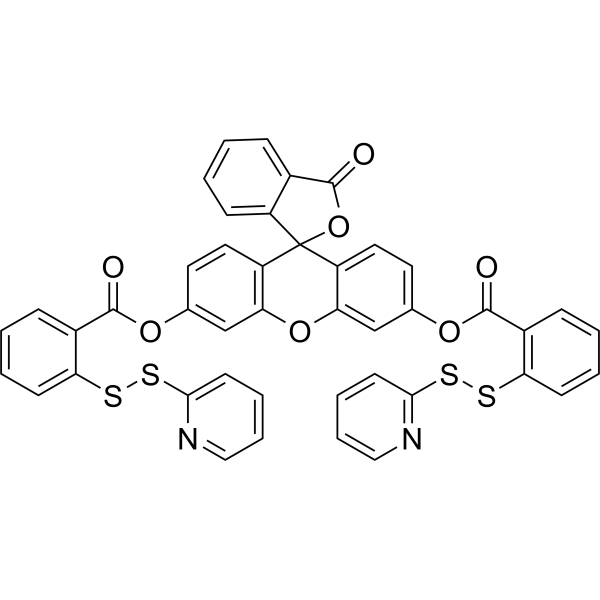
WSP-5 is a H2S-selective fluorescent probe (Ex/Em = 502/525 nm). WSP-5 enables visual monitoring of H2S released and accumulated from peptide-H2S donor conjugates in glioma cells. WSP-5 is applicable to glioma research .
loading...
    loading...
Art. -Nr.: HY-D2476
CAS. Nr.: 433254-36-5
H2S Fluorescent probe 1 (Compound 2) is a fluorescent probe that detects hydrogen sulfide (H2S) with almost no cytotoxicity. Upon the addition of increasing amounts of HS - to DMSO solution of H2S Fluorescent probe 1, a new absorption peak appears gradually at 485 nm. H2S Fluorescent probe 1, the fluorescence intensity notes at 434 nm increasing rapidly by titration of HS - .
loading...
    loading...
Art. -Nr.: HY-110128
CAS. Nr.: 1416872-50-8
Reinheit:  ≥99.0%
Synonyms: SF7-AM
Target:  

Fluorescent Dye

Forschungsgebiete:  

Others

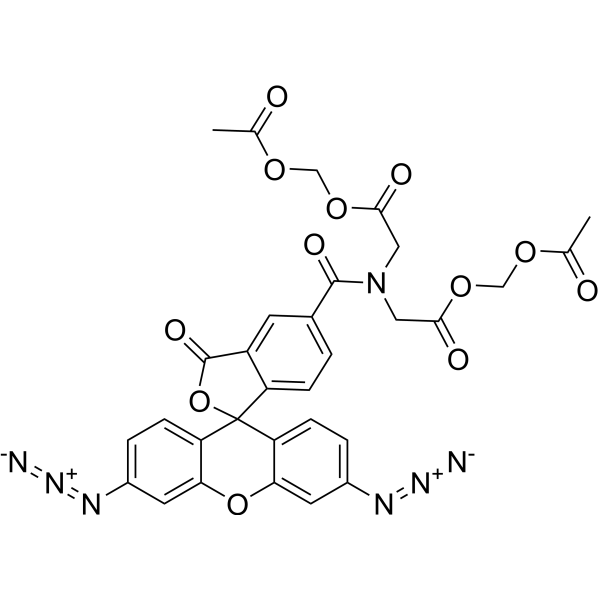
Sulfidefluor 7-AM is a stable hydrogen sulphide (H2S) fluorescent probe . Sulfidefluor 7-AM is a click chemistry reagent, it contains an Azide group and can undergo copper-catalyzed azide-alkyne cycloaddition reaction (CuAAc) with molecules containing Alkyne groups. It can also undergo strain-promoted alkyne-azide cycloaddition (SPAAC) reactions with molecules containing DBCO or BCN groups.
loading...
    loading...
Art. -Nr.: HY-174790
Target:  

mRNA

Forschungsgebiete:  

Cancer

Firefly Luciferase mRNA is a reporter mRNA that can be transfected into cells to express firefly luciferase protein. Firefly Luciferase mRNA induces cytotoxicity in cancer cells at low concentrations. In cancer cells, the expression level of luciferase shows a non-linear relationship with the dose of Firefly Luciferase mRNA. When combined with the H2S-responsive bioluminescent probe (H-Luc), Firefly Luciferase mRNA enables bioluminescence-based detection of endogenous hydrogen sulfide in non-transgenic NAFLD cell models and NAFLD mouse models. Firefly Luciferase mRNA can be used in studies related to non-alcoholic fatty liver disease .
loading...
    loading...
Art. -Nr.: HY-D1275
CAS. Nr.: 2119597-33-8
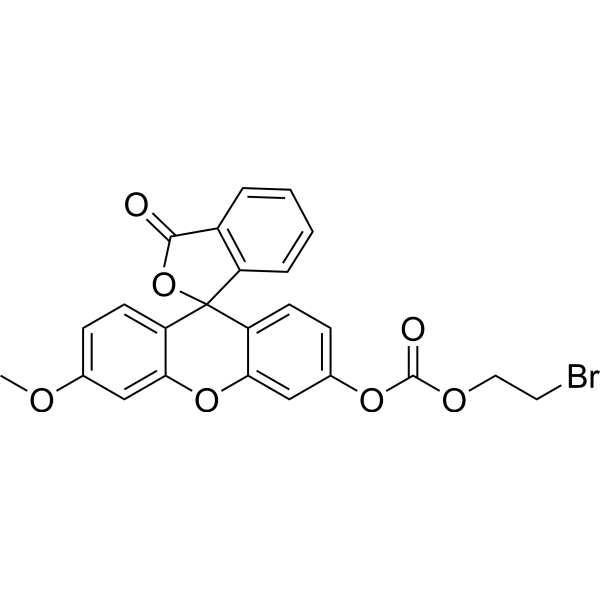
CAY10731 (compound 3) is a highly selective fluorescent probe for detection of hydrogen sulfide (H2S). CAY10731 is used to monitor exo- and endogenous H2S in both cancer and normal cells. CAY10731 is applied for imaging of H2S in living tissues at variable depths and in nematodes .
loading...
    loading...
Art. -Nr.: HY-D2380
H2S probe 1 (compound 1NND) is a derivative of nitrobenzoxadiazole (NBD) with antitumor activity. H2S probe 1 is cytotoxic to human pancreatic cancer cell MIA PaCa-2 (IC50=77.9 nM) and has a high affinity for human telomeric G-quadruplex (G4) (Kd=1.72 μM). H2S probe 1 can be used in cancer research .
loading...
    loading...
Art. -Nr.: HY-160240
CAS. Nr.: 210541-64-3
Target:  

Fluorescent Dye

Forschungsgebiete:  

Others Cancer

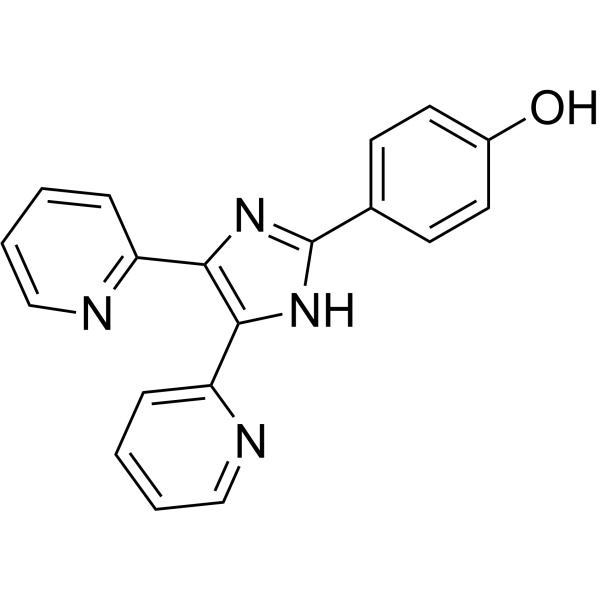
HPI is a HS - fluorescent probe (Ex/Em=280/410 nm). HPI can be used to detect the HS - form of hydrogen sulfide (H2S) gas in environmental water samples .
loading...
    loading...
Art. -Nr.: HY-D1400
Target:  

Fluorescent Dye

Forschungsgebiete:  

Others

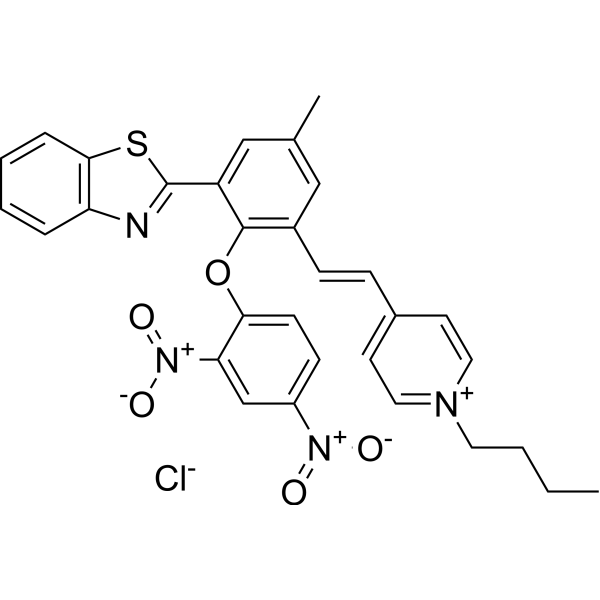
HBTP-H2S (chloride) is a NIR fluorescent probe for in situ bioimaging of endogenous H2S in rice roots under Al 3+ and flooding stresses.
loading...
    loading...
Art. -Nr.: HY-D3003
CAS. Nr.: 2522921-17-9
M-H2S is an endoplasmic reticulum-targeted ratio-type near-infrared fluorescent probe (Ex/Em : 480 nm/560 nm) specifically designed for the detection of hydrogen sulfide (H2S) in living cells and zebrafish. M-H2S exhibits detection limit for H2S of 39.1 nM, and the fluorescence intensity ratio (F₆₅₀/F₅₆₀) within the range of 0-40 μM shows a linear relationship with the H2S concentration. M-H2S responds best under pH = 7.2 (the normal physiological pH of the endoplasmic reticulum) conditions, making it suitable for the detection of the microenvironment of the endoplasmic reticulum. M-H2S can be used to study the role of H2S in endoplasmic reticulum function, stress response, and related diseases .
loading...
    loading...
Art. -Nr.: HY-172342
Target:  

Fluorescent Dye

Forschungsgebiete:  

Cardiovascular Disease

MitoA (bromide) is a mitochondria-targeted H2S probe, which can be used to assess relative changes in mitochondrial levels of H2S in vivo. MitoA (bromide) can accumulate inside mitochondria within tissues in vivo due to tryphenylphosphonium (TPP) cation. MitoA (bromide) can be studied in research on myocardial ischemia .
loading...
    loading...
Art. -Nr.: HY-D2997
CAS. Nr.: 2705175-73-9
1,2-Dimethylpyridinium iodide-Bodipy (Probe 1) is an H2S fluorescent probe. Self-assembled 1,2-Dimethylpyridinium iodide-Bodipy exhibits highly efficient responsiveness to H2S. The assembled form of 1,2-Dimethylpyridinium iodide-Bodipy emits near-infrared fluorescence at 718 nm upon H2S activation .
loading...
    loading...
Art. -Nr.: HY-W327027
CAS. Nr.: 314742-00-2
Target:  

Fluorescent Dye

Forschungsgebiete:  

Others

7-(2,4-Dinitrophenoxy)-4-methyl-2H-chromen-2-one (Compound 1) is a fluorescent probe for the detection of hydrogen sulfide (H2S). 7-(2,4-Dinitrophenoxy)-4-methyl-2H-chromen-2-one has a low detection limit (4×10 -6 mol/L), good selectivity and high sensitivity. 7-(2,4-Dinitrophenoxy)-4-methyl-2H-chromen-2-one shows almost no cytotoxicity at concentrations of 150 µg/mL. 7-(2,4-Dinitrophenoxy)-4-methyl-2H-chromen-2-one has the excitation peak of 331 nm, and the emission peak about 385 nm in DMSO solvent. Upon the addition of increasing amounts of HS -, the fluorescence intensity increases obviously at about 392 nm .
loading...
    loading...
  • 1

