4 Results for "

HAQ

" in MedChemExpress (MCE) Product Catalog:
Products (4)

4 Results for "HAQ" in MCE Product Catalog:

35
35 Cited Publications
製品番号: HY-136927
CAS 番号: 129425-81-6
純度:  99.81%
Target:  

STING

研究分野:  

Inflammation/Immunology Cancer

MSA-2, a potent and orally available non-nucleotide STING agonist, is bound to STING as a noncovalent dimer with nanomolar affinity. MSA-2 shows EC50s of 8.3 and 24 μM for human STING isoforms WT and HAQ, respectively. MSA-2 stimulates interferon-β secretion in tumors, induces tumor regression with durable antitumor immunity, and synergizes with anti-PD-1 in syngeneic mouse tumor models .
loading...
    loading...
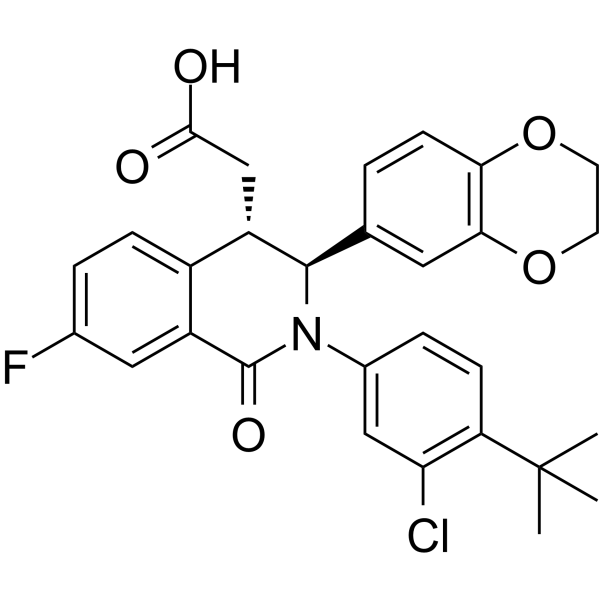
製品番号: HY-114399
CAS 番号: 2365039-41-2
純度:  99.79%
Target:  

STING

研究分野:  

Inflammation/Immunology

STING ligand-1 is a lead STING ligand with an IC50 of 68 nM for HAQ STING .
loading...
    loading...
製品番号: HY-173399
hSTING activator-1 (Compound 68) is a STING agonist. hSTING activator-1 can effectively activate multiple human STING variants (R232, H232, HAQ) with EC50 values of 56 nM, 89 nM and 51 nM, respectively. hSTING activator-1 activates the type I interferon pathway by directly binding to STING protein and stabilizing its conformation, promoting downstream IRF3 phosphorylation and cytokine release. hSTING activator-1 inhibits fibrosarcoma tumor growth and has potential in cancer research .
loading...
    loading...
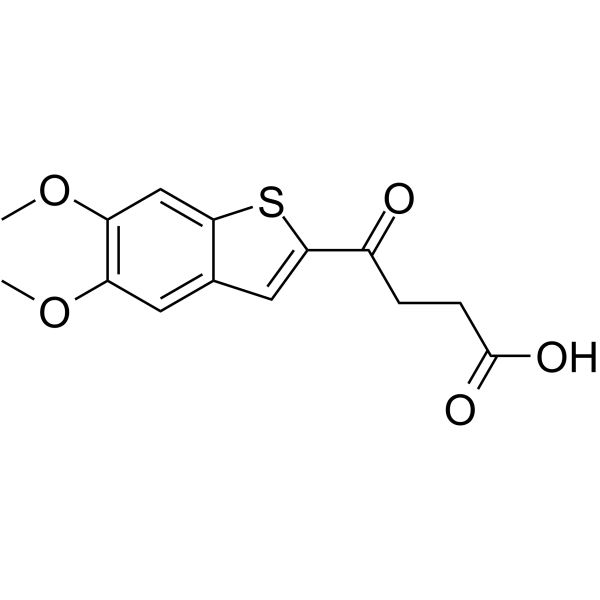
製品番号: HY-168384
CAS 番号: 875158-73-9
M04 is an agonist of STING. It induces the expression of the IFN reporter gene in HEK293T cells expressing wild-type human STING, but does not induce this expression in HEK293T cells expressing the R71H-G230A-R293Q (HAQ) STING variant or in mouse RAW 264.7 cells, indicating that its activity is dependent on allelic and species variations. M04 induces the production of TNF-α, IL-10, IL-1β, and IL-12p70 in human peripheral blood mononuclear cells (PBMCs). At a concentration of 50 µM, M04 stimulates dendritic cells isolated from PBMCs to express the MHC class II cell surface receptor HLA-DR and co-stimulatory molecules CD40, CD80, and CD86, and also enhances their ability to activate T cells in an ex vivo assay. M04 can be used in research on inflammatory immune diseases .
loading...
    loading...

