12 Results for "

HCC-1806

" in MedChemExpress (MCE) Product Catalog:
Products (12)

12 Results for "HCC-1806" in MCE Product Catalog:

110
110 Cited Publications
Cat. No.: HY-12248
CAS No.: 1439399-58-2
Purity:  99.82%
Synonyms: CB-839
Target:  

Glutaminase Autophagy

Research Areas:  

Cancer

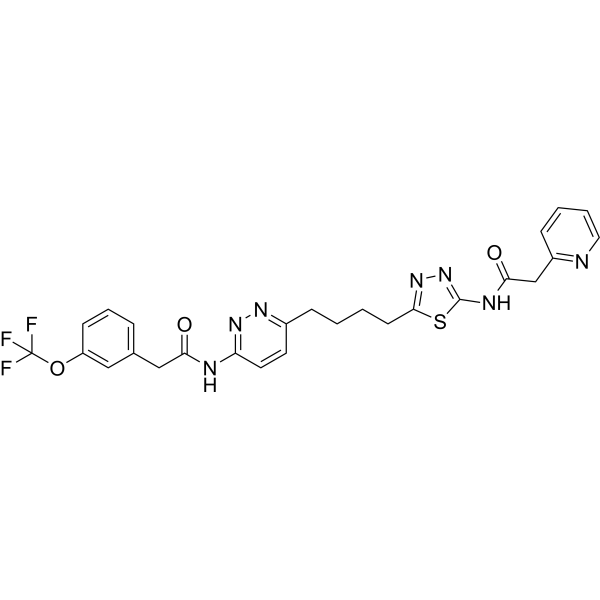
Telaglenastat (CB-839) is a first-in-class, selective, reversible and orally active glutaminase 1 (GLS1) inhibitor. Telaglenastat selectively inhibits GLS1 splice variants KGA (kidney-type glutaminase) and GAC (glutaminase C) compared to GLS2. The IC50s are 23 nM and 28 nM for endogenous glutaminase in mouse kidney and brain, respectively. Telaglenastat inuduces autophagy and has antitumor activity .
loading...
    loading...
110
110 Cited Publications
Cat. No.: HY-12248A
CAS No.: 1874231-60-3
Synonyms: CB-839 hydrochloride
Target:  

Glutaminase Autophagy

Research Areas:  

Cancer

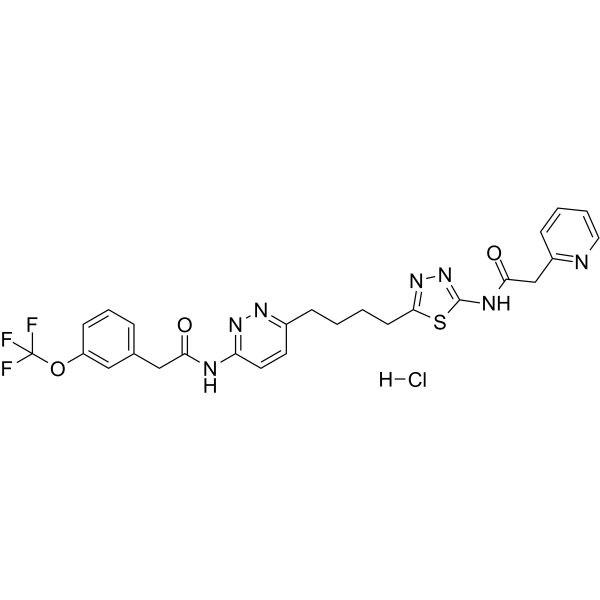
Telaglenastat (CB-839) hydrochloride is a first-in-class, selective, reversible and orally active glutaminase 1 (GLS1) inhibitor. Telaglenastat hydrochloride selectively inhibits GLS1 splice variants KGA (kidney-type glutaminase) and GAC (glutaminase C) compared to GLS2. The IC50s are 23 nM and 28 nM for endogenous glutaminase in mouse kidney and brain, respectively. Telaglenastat hydrochloride inudces autophagy and has antitumor activity .
loading...
    loading...
Cat. No.: HY-12248R
CAS No.: 1439399-58-2
Synonyms: CB-839 (Standard)
Research Areas:  

Cancer

Telaglenastat (Standard) is the analytical standard of Telaglenastat. This product is intended for research and analytical applications. Telaglenastat (CB-839) is a first-in-class, selective, reversible and orally active glutaminase 1 (GLS1) inhibitor. Telaglenastat selectively inhibits GLS1 splice variants KGA (kidney-type glutaminase) and GAC (glutaminase C) compared to GLS2. The IC50s are 23 nM and 28 nM for endogenous glutaminase in mouse kidney and brain, respectively. Telaglenastat inuduces autophagy and has antitumor activity .
loading...
    loading...
Cat. No.: HY-171789
CAS No.: 2632343-19-0
Research Areas:  

Cancer

PARG-IN-7 (Example 38) is a Poly ADP-ribose glycohydrolase (PARG) inhibitor (IC50: < 0.1 μM). PARG-IN-7 inhibits cell viability of HCC1806-XRCC1 KD (knock down) cells with an IC50 < 1 μM. PARG-IN-7 can be used for cancer research .
loading...
    loading...
Cat. No.: HY-145389
CAS No.: 2654003-68-4
Target:  

CDK

Research Areas:  

Cancer

SZ-015268 is a CDK7 inhibitor with an IC50 of 23.56 nM. SZ-015268 has extremely significant anti-tumor advantages. SZ-015268 inhibits HCC70, OVCAR-3, HCT116 and HCC1806 cells proliferation with IC50s of 33, 80.56, 12.53, and 61.55 nM, respectively .
loading...
    loading...
Cat. No.: HY-158439
Target:  

JAK STAT

Research Areas:  

Cancer

anti-TNBC agent-7 (Compound 13c) possesses anticancer activity, serving as a molecular probe to recognize and regulate the signal transduction of the USP21/JAK2/STAT3 axis, exhibiting nanomolar-level cytotoxicity against MDA-MB-231 and HCC-1806 cancer cells, effectively combating triple-negative breast cancer (TNBC) .
loading...
    loading...
Cat. No.: HY-P991328

Target:  

Notch

Research Areas:  

Cancer

MAb604.107 is a human monoclonal antibody (mAb) targeting NOTCH1. MAb604.107 inhibits the proliferation and CD34/CD44 expression of primary T-ALL cells. MAb604.107 has anti-tumor activity in four tumor xenograft mouse models: MDA-MB-231, HCC-1806, BT-474, and HCT-116. MAb604.107 can be used in T acute lymphoblastic leukemia research .
loading...
    loading...
Cat. No.: HY-162875
CAS No.: 2407163-44-2
Research Areas:  

Cancer

PROTAC BRD4 Degrader-27 is a selective cereblon-mediated BRD4 PROTAC degrader. PROTAC BRD4 Degrader-27 exhibits anticancer activity, induces G1 phase arrest, and inhibits DNA synthesis and colony formation. PROTAC BRD4 Degrader-27 suppresses HCC1806 tumor growth in xenograft mouse models. PROTAC BRD4 Degrader-27 can be used in breast cancer-related research .
loading...
    loading...
Cat. No.: HY-170549
CAS No.: 3116929-46-2
Target:  

VEGFR

Research Areas:  

Cancer

VEGFR-2-IN-60 (compound 5c) is a potent VEGFR-2 inhibitor with an IC50 of 1.07 nM. VEGFR-2-IN-60 exhibits cytotoxic activity against HCC1806, Hela, and A549 cell lines .
loading...
    loading...
Cat. No.: HY-172595
Research Areas:  

Cancer

Apoptosis inducer 48 (5d) is an apoptotic agent. Apoptosis inducer 48 inhibits the growth of triple-negative breast cancer cells. Apoptosis inducer 48 attenuates proteasomal degradation via the ubiquitin-proteasome pathway, leading to G2/M phase cell cycle arrest and the induction of apoptotic .
loading...
    loading...
Cat. No.: HY-155490
CAS No.: 2378780-25-5
Research Areas:  

Cancer

Nur77 antagonist 1(Compound ja) is a selective Nur77 antagonist(KD SPRNur77 = 91 nM). Nur77 antagonist 1 induces cancer cell apoptosis. ja displays excellent antitumor against triple-negative breast cancer (TNBC) cells .
loading...
    loading...
Cat. No.: HY-179480
G-quadruplex ligand 4 is a chromenone derivative and is a human telomerase reverse transcriptase (hTERT) G4 ligand. G-quadruplex ligand 4 downregulates hTERT expression and exhibits notable cytotoxicity towards triple-negative breast cancer (TNBC) cell lines. G-quadruplex ligand 4 can cause S/G2 cell cycle arrest and induce apoptosis. G-quadruplex ligand 4 downregulates the expression of hTERT, KRAS, and BCL-2. G-quadruplex ligand 4 can be used for the research of TNBC .
loading...
    loading...
  • 1

