10 Results for "

HSV strains

" in MedChemExpress (MCE) Product Catalog:
Products (10)

10 Results for "HSV strains" in MCE Product Catalog:

  • Targets Recommended:
2
2 Cited Publications
Cat. No.: HY-B1268
CAS No.: 577-11-7
Synonyms: Dioctyl sulfosuccinate sodium salt
Research Areas:  

Others

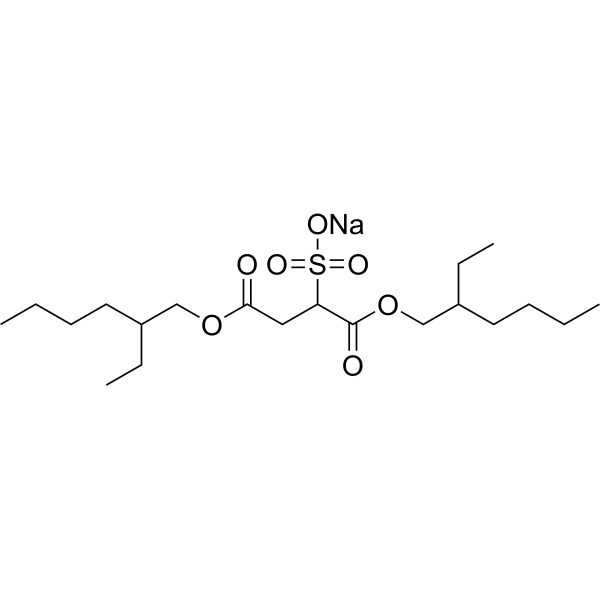
Docusate Sodium (Dioctyl sulfosuccinate sodium salt) is one of the main components in stool softeners. Docusate Sodium is a sulfated surfactant and may inactivate viral pathogens by disrupting viral envelopes and/or denaturing/disassociating proteins. Docusate Sodium is effective in vitro against wild type and drug-resistant strains of HSV type 1 and 2. Docusate Sodium is an obesogen. Docusate Sodium with developmental exposure leads to increased adult adiposity, inflammation, metabolic disorder and dyslipidemia in offspring fed a standard diet in mice .
loading...
    loading...
Cat. No.: HY-W141881
CAS No.: 97-78-9
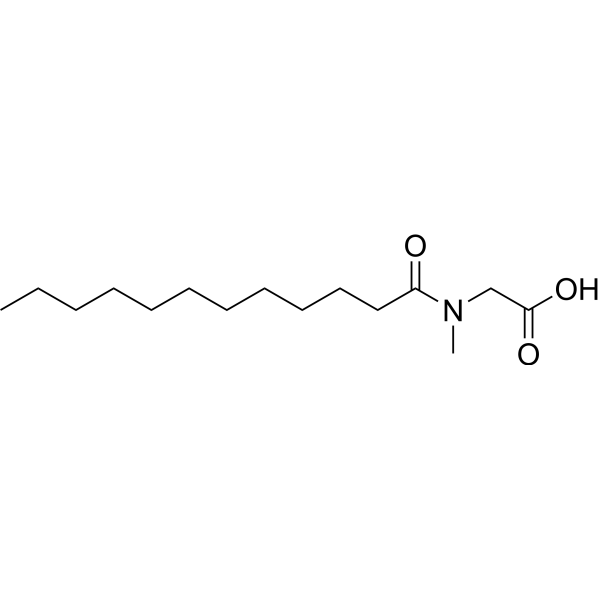
N-lauroylsarcosine is an anionic surfactant. N-lauroylsarcosine has antiviral activity against HSV-2 strain 333 and HSV-1 strain F. N-lauroylsarcosine synergistically increases skin permeability with 25-50% ethanol. N-lauroylsarcosine can be used to study HSV-2 infection .
loading...
    loading...
Cat. No.: HY-B1268R
CAS No.: 577-11-7
Synonyms: Dioctyl sulfosuccinate sodium salt (Standard)
Target:  

Reference Standards HSV

Research Areas:  

Others

Docusate (Sodium) (Standard) is the analytical standard of Docusate (Sodium). This product is intended for research and analytical applications. Docusate Sodium (Dioctyl sulfosuccinate sodium salt) is one of the main components in stool softeners. Docusate Sodium is a sulfated surfactant and may inactivate viral pathogens by disrupting viral envelopes and/or denaturing/disassociating proteins. Docusate Sodium is effective in vitro against wild type and drug-resistant strains of HSV type 1 and 2. Docusate Sodium is an obesogen. Docusate Sodium with developmental exposure leads to increased adult adiposity, inflammation, metabolic disorder and dyslipidemia in offspring fed a standard diet in mice .
loading...
    loading...
Cat. No.: HY-P11102
CAS No.: 1065010-73-2
Research Areas:  

Infection Cancer

Temporin-Sha is an antibacterial peptide with extensive biological activity. Temporin-Sha exhibits broad-spectrum antibacterial activity (e.g., against L. ivanovii, MIC = 6.25 μM), and is effective against Gram-negative bacteria (such as Escherichia coli, MIC = 10 μM), including drug-resistant strains (such as Methicillin (HY-121544)-resistant Staphylococcus aureus). Temporin-Sha also has inhibitory effects on Candida albicans (MIC = 25 μM), Saccharomyces cerevisiae (MIC = 12 μM), the pre-flagellated and non-flagellated forms of Leishmania infantum (IC50 = 5-20 μM), and Trypanosoma cruzi (IC50 = 17 μM). Temporin-Sha exhibits antiviral activity against HSV-1 and has anti-cancer effects (cytotoxicity against breast cancer cells MCF-7 and lung cancer cells H460, etc.) .
loading...
    loading...
Cat. No.: HY-174429
CAS No.: 3005978-16-2
Target:  

HSV

Research Areas:  

Infection

HSV-1-IN-3 (Compound A50) is a HSV inhibitor. HSV-1-IN-3 shows good antiviral efficacy against both Acyclovir (HY-17422) -sensitive and -resistant HSV strains .
loading...
    loading...
Cat. No.: HY-137985
CAS No.: 149598-70-9
Synonyms: Stachybotrydial; F 1839M; Stachybotrydial
Target:  

HSV Virus Protease

Research Areas:  

Infection

Mer-NF5003F (Stachybotrydial; F 1839M), a sesquiterpene isolated from Stachybotrys, inhibits avian medulloblastoma virus (AMV) protease (IC50=7.8 μM). Mer-NF5003F inhibits sialyltransferase 6N (ST6N), ST3O, and ST3N (IC50=0.61, 6.7, and 10 μg/mL, respectively), and fucosyltransferase (IC50=11.3 μg/mL). Mer-NF5003F has in vitro activity against herpes simplex virus HSV-1 (IC50=4.32 μg/mL) and multidrug-resistant Plasmodium falciparum K1 strain (IC50=0.85 μg/mL).
loading...
    loading...
Cat. No.: HY-184852
CAS No.: 151-41-7
Synonyms: Dodecyl hydrogen sulphate; Dodecyl sulfate
Lauryl sulfate (Dodecyl hydrogen sulphate) is an anionic chaotropic surfactant. Lauryl sulfate dissolves viral envelopes, denatures viral proteins, inhibits viral infectivity and HIV-1 syncytium formation. Lauryl sulfate potently inhibits the infectivity of HSV-1 strain F (ED50 = 17.9 μM) and HSV-2 strain 333 (ED50 = 32.7 μM). Lauryl sulfate induces environmental toxicity, disrupting environmental balance and physiological processes of organisms. As a contaminant, Lauryl sulfate is toxic to aquatic and terrestrial organisms. Lauryl sulfate can be used in studies related to sexually transmitted infections .
loading...
    loading...
Cat. No.: HY-150306B
CAS No.: 2305750-24-5
Synonyms: (R)-IM-250
Target:  

HSV DNA/RNA Synthesis

Research Areas:  

Infection

(R)-Adibelivir ((R)-IM-250) is a blood-brain barrier-permeable HSV helicase-primase inhibitor. (R)-Adibelivir specifically inhibits the activity of the HSV UL5-UL52-UL8 helicase-primase complex. (R)-Adibelivir affects viral reactivation and significantly reduces the reactivation capacity of latent neuronal HSV reservoirs. (R)-Adibelivir can be used in studies related to herpes simplex virus infection, herpes encephalitis, neonatal herpes, and other related conditions .
loading...
    loading...
Cat. No.: HY-150306A
CAS No.: 2137928-83-5
Synonyms: (Rac)-IM-250
Target:  

HSV DNA/RNA Synthesis

Research Areas:  

Infection

(Rac)-Adibelivir ((Rac)-IM-250) is a blood-brain barrier-penetrant HSV helicase-primase inhibitor and metabolic stabilizer with antiviral activity. (Rac)-Adibelivir is also effective against Acyclovir (HY-17422)-resistant strains, and its deuterated structure exhibits enhanced metabolic stability, reducing the formation of hydroxylated metabolites. (Rac)-Adibelivir prolongs in vivo half-life, reduces administration dosage, improves oral bioavailability, and achieves higher brain exposure in mice. (Rac)-Adibelivir can be used in the research of herpes simplex infection, herpes encephalitis and Alzheimer's disease .
loading...
    loading...
Cat. No.: HY-150306C
CAS No.: 2954725-84-7
Synonyms: (Rac)-IM-250 hydrochloride
Target:  

DNA/RNA Synthesis HSV

Research Areas:  

Infection

(Rac)-Adibelivir hydrochloride ((Rac)-IM-250 hydrochloride) is a blood-brain barrier-penetrant HSV helicase-primase inhibitor and metabolic stabilizer with antiviral activity. (Rac)-Adibelivir hydrochloride is also effective against Acyclovir (HY-17422)-resistant strains, and its deuterated structure exhibits enhanced metabolic stability, reducing the formation of hydroxylated metabolites. (Rac)-Adibelivir prolongs in vivo half-life, reduces administration dosage, improves oral bioavailability, and achieves higher brain exposure in mice. (Rac)-Adibelivir hydrochloride can be used in the research of herpes simplex infection, herpes encephalitis and Alzheimer's disease .
loading...
    loading...

