



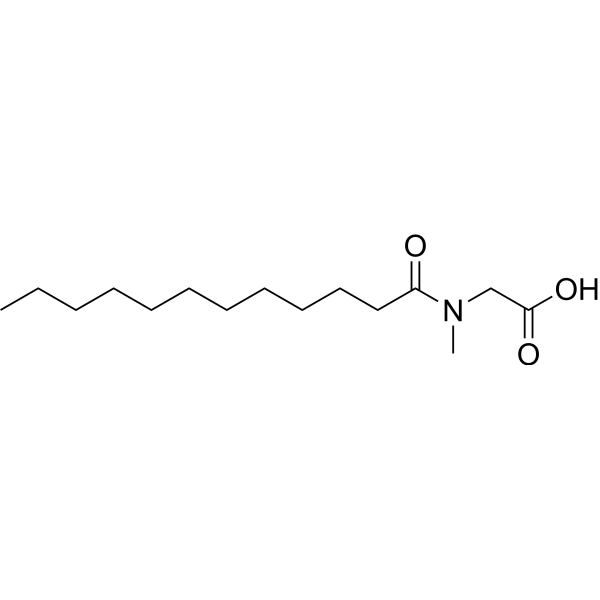
N-Lauroylsarcosine

Based on 1 Customer Validation
N-lauroylsarcosine is an anionic surfactant. N-lauroylsarcosine has antiviral activity against HSV-2 strain 333 and HSV-1 strain F. N-lauroylsarcosine synergistically increases skin permeability with 25-50% ethanol. N-lauroylsarcosine can be used to study HSV-2 infection.
For research use only. We do not sell to patients.
- Purity : 99.12%
- CAS No.: 97-78-9
- Formula: C15H29NO3
- Molecular Weight:271.40
-
Storage:
4°C, sealed storage, away from moisture
* In solvent : -80°C, 6 months; -20°C, 1 month (sealed storage, away from moisture)

To place orders, for customer services and technical support, please contact: MedChemExpress USA
Tel: 609-228-6898 E-mail: [email protected] [email protected]


-
 Biological Activity
-
Chemical Information
-
Solvent & Solubility
- Purity & Documentation
- References
-
 Help & FAQs




Biological Activity
Description
|
HSV-1 |
HSV-2 |
In Vitro
N-Lauroylsarcosine (50-250 μM; 1 h) inhibits the infectivity of HSV-2 strain 333 in a dose-dependent manner in Vero cells[1].
N-Lauroylsarcosine (0-400 μM; 1 h) inhibits the infectivities of HSV-1 strain F in a concentration-dependent manner in Vero cells[2].
N-Lauroylsarcosine (0-3% [w/v]) increases transdermal delivery of fluorescein across human cadaver epidermis in a concentration-dependent manner when combined with 25-50% ethanol[3].
MedChemExpress (MCE) has not independently confirmed the accuracy of these methods. They are for reference only.
In Vivo
Gel formulations containing N-lauroylsarcosine (2.5% [wt/wt] in gel formulation; intravaginal administration; once daily; 14 days) does not induce significant irritations to the genital mucosa in rabbits[1].
MedChemExpress (MCE) has not independently confirmed the accuracy of these methods. They are for reference only.


Chemical Information
-
CAS No. 97-78-9
-
Appearance Solid
-
Molecular Weight 271.40
-
Formula C15H29NO3
-
Color White to off-white
-
Shipping
Room temperature in continental US; may vary elsewhere.
-
Storage
4°C, sealed storage, away from moisture
* In solvent : -80°C, 6 months; -20°C, 1 month (sealed storage, away from moisture)


Solvent & Solubility
In Vitro:
DMSO : ≥ 200 mg/mL (736.92 mM; Hygroscopic DMSO has a significant impact on the solubility of product, please use newly opened DMSO)
H2O : < 0.1 mg/mL (insoluble)
* "≥" means soluble, but saturation unknown.
Please refer to the solubility information to select the appropriate solvent. Once prepared, please aliquot and store the solution to prevent product inactivation from repeated freeze-thaw cycles.
Storage method and period of stock solution: -80°C, 6 months; -20°C, 1 month (sealed storage, away from moisture). When stored at -80°C, please use it within 6 months. When stored at -20°C, please use it within 1 month.
Please refer to the solubility information to select the appropriate solvent. Once prepared, please aliquot and store the solution to prevent product inactivation from repeated freeze-thaw cycles.
Storage method and period of stock solution: -80°C, 6 months; -20°C, 1 month (sealed storage, away from moisture). When stored at -80°C, please use it within 6 months. When stored at -20°C, please use it within 1 month.
Concentration (start) × Volume (start) = Concentration (final) × Volume (final)
In Vivo:
Select the appropriate dissolution method based on your experimental animal and administration route.
- For the following dissolution methods, please ensure to first prepare a clear stock solution using an In Vitro approach and then sequentially add co-solvents:
- To ensure reliable experimental results, the clarified stock solution can be appropriately stored based on storage conditions. As for the working solution for In Vivo experiments, it is recommended to prepare freshly and use it on the same day.
- The percentages shown for the solvents indicate their volumetric ratio in the final prepared solution. If precipitation or phase separation occurs during preparation, heat and/or sonication can be used to aid dissolution.
Add each solvent one by one: 10% DMSO 40% PEG300 5% Tween-80 45% Saline
Solubility: ≥ 2.08 mg/mL (7.66 mM); Clear solution
This protocol yields a clear solution of ≥ 2.08 mg/mL (saturation unknown).
Taking 1 mL working solution as an example, add 100 μL DMSO stock solution (20.8 mg/mL) to 400 μL PEG300, and mix evenly; then add 50 μL Tween-80 and mix evenly; then add 450 μL Saline to adjust the volume to 1 mL.
Preparation of Saline: Dissolve 0.9 g sodium chloride in ddH₂O and dilute to 100 mL to obtain a clear Saline solution.
Add each solvent one by one: 10% DMSO 90% (20% SBE-β-CD in Saline)
Solubility: ≥ 2.08 mg/mL (7.66 mM); Clear solution
This protocol yields a clear solution of ≥ 2.08 mg/mL (saturation unknown).
Taking 1 mL working solution as an example, add 100 μL DMSO stock solution (20.8 mg/mL) to 900 μL 20% SBE-β-CD in Saline, and mix evenly.
Preparation of 20% SBE-β-CD in Saline (4°C, storage for one week): 2 g SBE-β-CD powder is dissolved in 10 mL Saline, completely dissolve until clear.
In Vivo Dissolution Calculator
Please enter the basic information of animal experiments:
-
-
-
-
Recommended: Prepare an additional quantity of animals to account for potential losses during experiments.
Please enter your animal formula composition:
-
%DMSO +
Recommended: Keep the proportion of DMSO in working solution below 2% if your animal is weak.
-
%+
-
+%Tween-80 + +
-
%Saline +
The co-solvents required include: DMSO, . All of co-solvents are available by MedChemExpress (MCE). , Tween 80. All of co-solvents are available by MedChemExpress (MCE).
Working solution concentration: 0.22 mg/mL
Method for preparing stock solution: mg drug dissolved in μL DMSO. Stock solution concentration: mg/mL. * In solvent : -80°C, 6 months; -20°C, 1 month (sealed storage, away from moisture)
1. Take μL DMSO stock solution;
2. Add μL .
μL , mix evenly;
3. Then add μL Tween 80, mix evenly;
4. Then add μL
Please ensure that the stock solution in the first step is dissolved to a clear state, and add co-solvents in sequence. You can use ultrasonic heating (ultrasonic cleaner, recommended frequency 20-40 kHz), vortexing, etc. to assist dissolution.


Purity & Documentation
-
Data Sheet (272 KB)
-
SDS (642 KB)
- English - EN (642 KB)
- Français - FR (642 KB)
- Deutsch - DE (642 KB)
- Norwegian - NO (642 KB)
- Español - ES (642 KB)
- Swedish - SV (642 KB)
- Italian - IT (642 KB)
- Korean - KR (642 KB)
- Portuguese - PT (642 KB)
-
Handling Instructions (2659 KB)
References
[1]. Roy S, et al. Thermoreversible gel formulations containing sodium lauryl sulfate or n-Lauroylsarcosine as potential topical microbicides against sexually transmitted diseases. Antimicrob Agents Chemother. 2001 Jun;45(6):1671-81. [Content Brief]
[2]. Piret J, et al. Comparative study of mechanisms of herpes simplex virus inactivation by sodium lauryl sulfate and n-lauroylsarcosine. Antimicrob Agents Chemother. 2002 Sep;46(9):2933-42. [Content Brief]
[3]. Kim YC, et al. Synergistic enhancement of skin permeability by N-lauroylsarcosine and ethanol. Int J Pharm. 2008 Mar 20;352(1-2):129-38. [Content Brief]
[4]. Ishibashi T, et al. Contrasting effects of SM-9018, a potential atypical antipsychotic, and haloperidol on c-fos mRNA expression in the rat striatum. Eur J Pharmacol. 1996 May 15;303(3):247-51. [Content Brief]


Complete Stock Solution Preparation Table
Please refer to the solubility information to select the appropriate solvent. Once prepared, please aliquot and store the solution to prevent product inactivation from repeated freeze-thaw cycles.
Storage method and period of stock solution: -80°C, 6 months; -20°C, 1 month (sealed storage, away from moisture). When stored at -80°C, please use it within 6 months. When stored at -20°C, please use it within 1 month.
| Optional Solvent | Concentration Solvent Mass | 1 mg | 5 mg | 10 mg | 25 mg |
|---|---|---|---|---|---|
| DMSO | 1 mM | 3.6846 mL | 18.4230 mL | 36.8460 mL | 92.1150 mL |
| 5 mM | 0.7369 mL | 3.6846 mL | 7.3692 mL | 18.4230 mL | |
| 10 mM | 0.3685 mL | 1.8423 mL | 3.6846 mL | 9.2115 mL | |
| 15 mM | 0.2456 mL | 1.2282 mL | 2.4564 mL | 6.1410 mL | |
| 20 mM | 0.1842 mL | 0.9211 mL | 1.8423 mL | 4.6057 mL | |
| 25 mM | 0.1474 mL | 0.7369 mL | 1.4738 mL | 3.6846 mL | |
| 30 mM | 0.1228 mL | 0.6141 mL | 1.2282 mL | 3.0705 mL | |
| 40 mM | 0.0921 mL | 0.4606 mL | 0.9211 mL | 2.3029 mL | |
| 50 mM | 0.0737 mL | 0.3685 mL | 0.7369 mL | 1.8423 mL | |
| 60 mM | 0.0614 mL | 0.3070 mL | 0.6141 mL | 1.5352 mL | |
| 80 mM | 0.0461 mL | 0.2303 mL | 0.4606 mL | 1.1514 mL | |
| 100 mM | 0.0368 mL | 0.1842 mL | 0.3685 mL | 0.9211 mL |


N-Lauroylsarcosine Related Classifications
HY-W141881 Related Classifications
 Powered by Bioz