9 Results for "

HTM cells

" in MedChemExpress (MCE) Product Catalog:
Products (9)

9 Results for "HTM cells" in MCE Product Catalog:

Cat. No.: HY-16758
CAS No.: 1414854-42-4
Synonyms: AR-12286
Target:  

ROCK

Research Areas:  

Neurological Disease

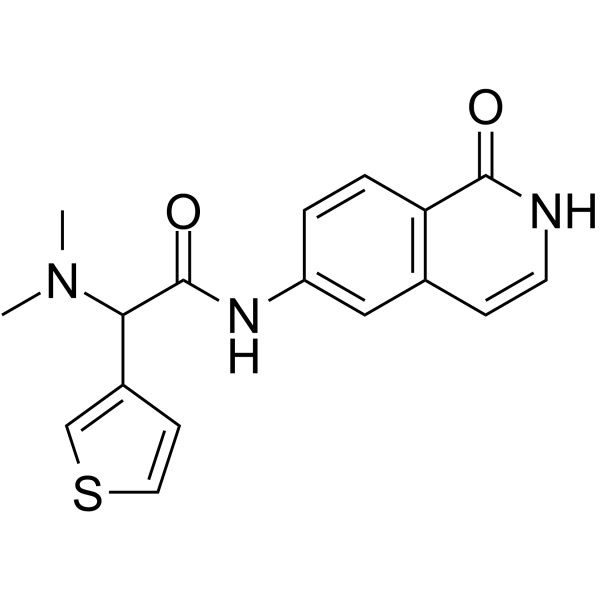
Verosudil (AR-12286) is a ROCK inhibitor. Verosudil has equal inhibitory activity against ROCK1 and ROCK2 (Ki: 2 nM). Verosudil is less selective for PKA, PKCT, MRCKA, and CAM2A (Ki: 69 nM, 9322 nM, 28 nM, 5855 nM, respectively). Verosudil increases trabecular outflow capacity to reduce intraocular pressure. Verosudil is useful in the study of glaucoma and ocular hypertension .
loading...
    loading...
Cat. No.: HY-151189
CAS No.: 2488395-07-7
Target:  

ROCK

Research Areas:  

Others

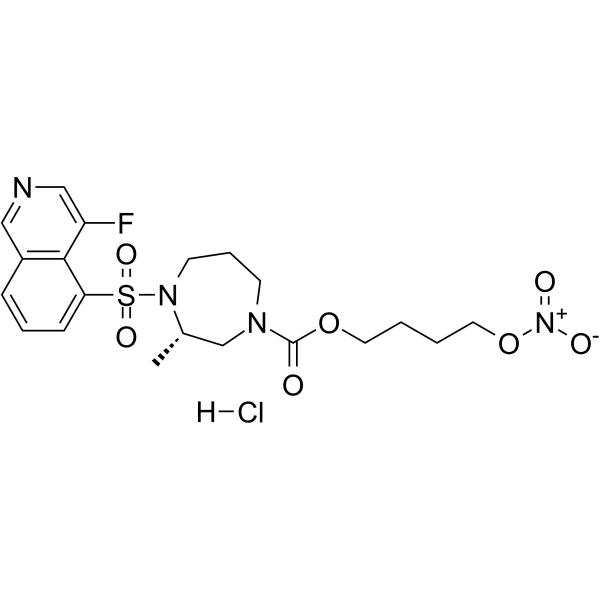
ROCK-IN-4 is a potent ROCK inhibitor maintaining NO releasing ability. ROCK-IN-4 reversibly depolymerizes F-actin, and suppresses mitochondrial respiration in human trabecular meshwork (HTM) cells. ROCK-IN-4 can be used for glaucoma or ocular hypertension research .
loading...
    loading...
Cat. No.: HY-114793
CAS No.: 748816-43-5
Research Areas:  

Endocrinology

AL-12180 is a potent and selective FP-receptor agonist with a Ki of 143 nM. AL-12180 stimulates the mobilization of intracellular Ca 2+ in h-TM and h-CM cells with EC50s of 111 and 11 nM, respectively .
loading...
    loading...
Cat. No.: HY-125641A
Target:  

5-HT Receptor

Research Areas:  

Neurological Disease

AL-34662 (formate) is a 5-HT2 receptor agonist (IC50: 0.8-1.5 nM). AL-34662 (formate) stimulates inositol phosphate turnover and Ca 2+ release in human ciliary muscle cells (h-CM) (E50: 289 nM) and human trabecular meshwork cells (h-TM) (E50: 254 nM). AL-34662 (formate) can be used in studies to lower intraocular pressure (IOP) .
loading...
    loading...
Cat. No.: HY-16758A
CAS No.: 1414854-44-6
Synonyms: AR-12286 hydrochloride
Target:  

ROCK

Research Areas:  

Neurological Disease

Verosudil (AR-12286) hydrochloride is the hydrochloride form of Verosudil (HY-16758). Verosudil hydrochloride is a ROCK inhibitor. Verosudil hydrochloride has equal inhibitory activity against ROCK1 and ROCK2 (Ki: 2 nM). Verosudil hydrochloride is less selective for PKA, PKCT, MRCKA, and CAM2A (Ki: 69 nM, 9322 nM, 28 nM, 5855 nM, respectively). Verosudil hydrochloride increases trabecular outflow capacity to reduce intraocular pressure. Verosudil hydrochloride is useful in the study of glaucoma and ocular hypertension .
loading...
    loading...
Cat. No.: HY-N15301
Nocarnickelamide B (Compound 2) is a linear peptide and ROCK1/2 inhibitor. Nocarnickelamide B exhibits dual inhibitory activity against ROCK1 and ROCK2 with IC50s of 14.9 μM and 21.9 μM, respectively. Nocarnickelamide B binds to the ATP-binding site. Nocarnickelamide B inhibits the activation of ROCK-regulated cytoskeletal contraction markers such as the myosin light chain. Nocarnickelamide B is potential for glaucoma reasearch .
loading...
    loading...
Cat. No.: HY-176133
Target:  

ROCK

Research Areas:  

Inflammation/Immunology

ROCK-IN-12 (compound R3) is a selective ROCK inhibitor. ROCK-IN-12 can be used in the study of glaucoma .
loading...
    loading...
Cat. No.: HY-123958
CAS No.: 785774-34-7
SB772077B is a ROCK inhibitor. SB772077B has an anti-inflammatory activity and enhances aqueous outflow facility (OF) by inactivating RhoA/ROCK signal pathway. SB772077B significantly reduces the mRNA level of β-catenin and protein level of fibrotic markers, such as vinculin, fibronectin, collagen 1 A and vimentin. SB772077B also has vasodialatory activity and decreases pulmonary and systemic blood pressure. SB772077B can be used for glaucoma research and pulmonary hypertensive disorder research .
loading...
    loading...
Cat. No.: HY-187204
Target:  

ROCK

Research Areas:  

Neurological Disease

RX-044 is a ROCK1/ROCK2 inhibitor with ROCK1 IC50 10.01 nM and ROCK2 IC50 9.68 nM, and demonstrates kinase selectivity. RX-044 induces reversible cell retraction, modulates cytoskeletal organization via F-actin depolymerization, inhibits cell contractility, and attenuates TGF-β2-induced cell migration. RX-044 preserves retinal ganglion cell survival, restores electroretinography responses, and ameliorates histopathological changes. RX-044 lowers intraocular pressure in a mouse ocular hypertension model. RX-044 shows no cytotoxicity in target cells. RX-044 exhibits initial ocular irritation that subsides with extended dosing. RX-044 can be used for the research of glaucoma .
loading...
    loading...

