5 Results for "

KB-Vin cells

" in MedChemExpress (MCE) Product Catalog:
Products (5)

5 Results for "KB-Vin cells" in MCE Product Catalog:

Cat. No.: HY-N15297
CAS No.: 10092-04-3
Isotenulin inhibits the efflux function of P-glycoprotein by stimulation of P-glycoprotein ATPase, thereby overcoming the multidrug resistance (MDR) of cancer cells. Isotenulin exhibits cytotoxicity in multidrug-resistant cancer cell KB-vin and sensitive cancer cell HeLaS3. Isotenulin exhibits synergistic effect with Paclitaxel (HY-B0015), Vinblastine (HY-13780) and Doxorubicin (HY-15142) .
loading...
    loading...
Cat. No.: HY-N13163
CAS No.: 74409-90-8
2-Epitripdiolide is a diterpenoid compound derived from Tripterygium hypoglaucum with significant antitumor activity. Its IC50 values against A549, KB, KBvin, and MDA-MB-231 cells are 1.34, 0.4, 4.4, and 1.2 nM, respectively .
loading...
    loading...
Cat. No.: HY-150565
CAS No.: 2451298-06-7
Target:  

P-glycoprotein

Research Areas:  

Cancer

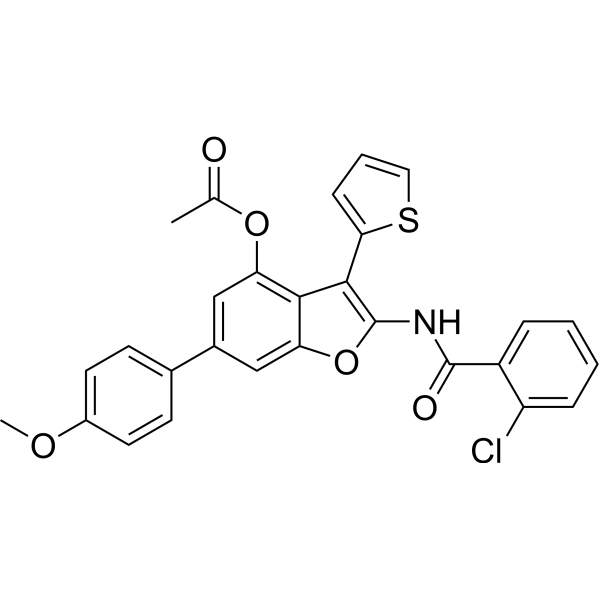
P-gp inhibitor 5 is a potent P-glycoprotein (P-gp) inhibitor. P-gp inhibitor 5 has antiproliferative activity against certain cancer cell lines. P-gp inhibitor 5 is effective in reversing the multidrug resistance (MDR) phenotype in ABCB1/Flp-In TM-293 and KBvin cells by restoring their sensitivity to Vincristine (HY-N0488A) and Paclitaxel (HY-B0015) .
loading...
    loading...
Cat. No.: HY-175522
Research Areas:  

Cancer

P-gp-IN-31 is a P-glycoprotein (P-gp) inhibitor with IC50 values of 0.42 μM for KB cells and 0.43 μM for MDR KBvin cells. P-gp-IN-31 can pass P-gp-mediated drug efflux mechanisms and shows collateral sensitivity via P-gp downregulation. P-gp-IN-31 inhibits cell proliferation, induces apoptosis and arrests the cell cycle at G2/M phase. P-gp-IN-31 can be used for the research of cancer, such as multidrug-resistant (MDR) malignancies .
loading...
    loading...
Cat. No.: HY-146392
CAS No.: 2414046-33-4
Research Areas:  

Cancer

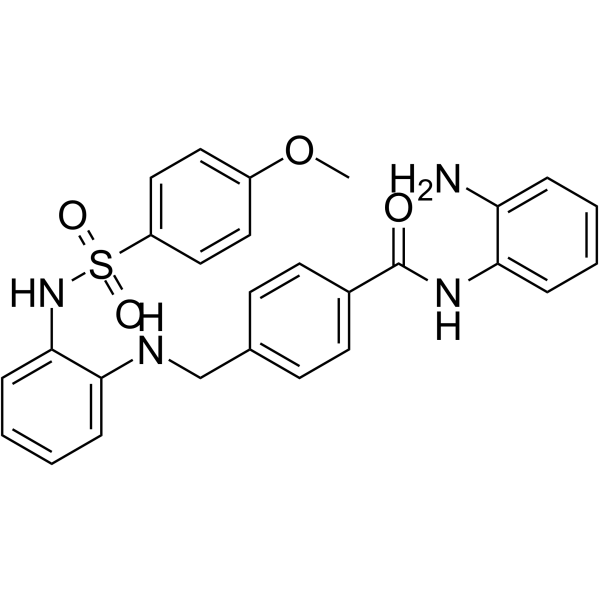
HDAC-IN-39 (compound 16c) is a potent HDAC inhibitor, with IC50 values of 1.07 μM (HDAC1), 1.47 μM (HDAC2), and 2.27 μM (HDAC3), respectively. HDAC-IN-39 also significantly inhibits microtubule polymerization. HDAC-IN-39 induces cell cycle arrest at the G2/M phase. HDAC-IN-39 displays promising anticancer activity against resistant cancer cells .
loading...
    loading...

