4 Results for "

PC3 cell lysate

" in MedChemExpress (MCE) Product Catalog:
Products (4)

4 Results for "PC3 cell lysate" in MCE Product Catalog:

Cat. No.: HY-123733A
Purity:  99.76%
Synonyms: RPS-001 TFA
MIP-1095 TFA (RPS-001 TFA) is a PSMA inhibitor with a Ki value of 0.24 nM. MIP-1095 TFA binds to PSMA with high affinity and can be internalized into PSMA-expressing cancer cells. When radiolabeled with 123I, 124I or 131I, MIP-1095 TFA enables SPECT/CT imaging, PET/CT imaging or targeted radiation delivery, respectively. 131I-MIP-1095 TFA can alter serum PSA levels and relieve bone pain. MIP-1095 TFA can be used in research related to metastatic castration-resistant prostate cancer .
loading...
    loading...
Cat. No.: HY-123733
CAS No.: 949575-22-8
Synonyms: RPS-001
MIP-1095 (RPS-001) is a PSMA inhibitor with a Ki value of 0.24 nM. MIP-1095 binds to PSMA with high affinity and can be internalized into PSMA-expressing cancer cells. When radiolabeled with 123I, 124I or 131I, MIP-1095 enables SPECT/CT imaging, PET/CT imaging or targeted radiation delivery, respectively. 131I-MIP-1095 can alter serum PSA levels and relieve bone pain. MIP-1095 can be used in research related to metastatic castration-resistant prostate cancer .
loading...
    loading...
Cat. No.: HY-148200A
Purity:  99.28%
Target:  

G-quadruplex Telomerase

Research Areas:  

Inflammation/Immunology

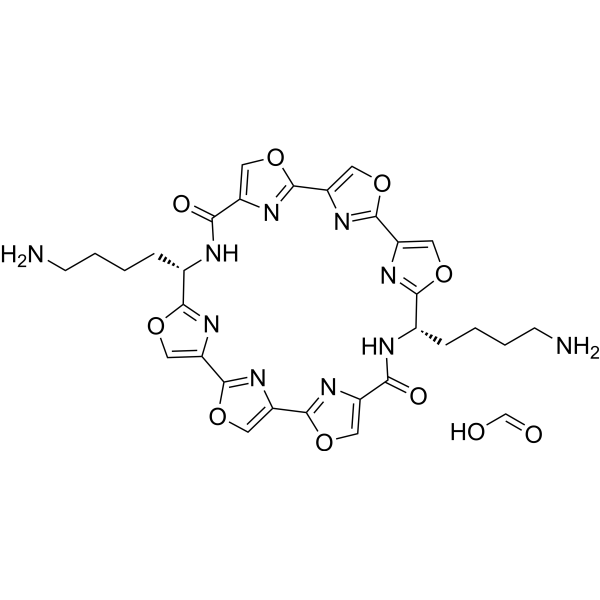
L2H2-6OTD diformic is a G-quadruplex (G-quadruplex, G4) ligand and telomerase (telomerase) inhibitor, with an IC50 of 15 nM against human telomerase. L2H2-6OTD diformic induces the formation of antiparallel G-quadruplex structures in long telomeric DNA. L2H2-6OTD diformic stabilizes the G4 structure of GD3 and enhances the immunological activity of CpG ODN. L2H2-6OTD diformic is applicable to research related to the development of G4-CpG immune adjuvants .
loading...
    loading...
Cat. No.: HY-D3189
CAS No.: 2370825-44-6
5GluAF-2MeTG is an activatable fluorescent probe targeting the glutamate carboxypeptidase (CP) activity of PSMA (Ex/Em=490/500-600 nm). After being hydrolyzed by PSMA, 5GluAF-2MeTG releases a cell membrane-permeable fluorescent product, and achieves fluorescence activation by disrupting donor-excited photoinduced electron transfer (d-PeT). 5GluAF-2MeTG enables fluorescence imaging of live PSMA-expressing prostate cancer cells in vitro and visualizes the carboxypeptidase activity of PSMA. 5GluAF-2MeTG can be used to detect prostate cancer regions in preclinical excised tissue specimens .
loading...
    loading...

