



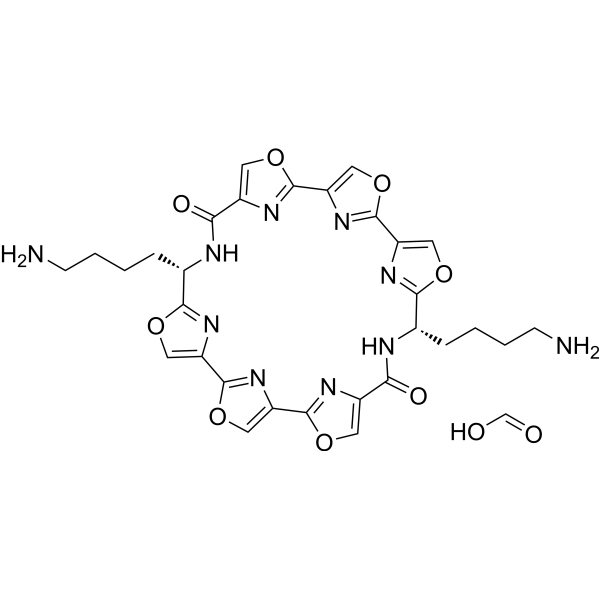
L2H2-6OTD diformic
Based on 1 publication(s) in Google Scholar
L2H2-6OTD diformic is a G-quadruplex (G-quadruplex, G4) ligand and telomerase (telomerase) inhibitor, with an IC50 of 15 nM against human telomerase. L2H2-6OTD diformic induces the formation of antiparallel G-quadruplex structures in long telomeric DNA. L2H2-6OTD diformic stabilizes the G4 structure of GD3 and enhances the immunological activity of CpG ODN. L2H2-6OTD diformic is applicable to research related to the development of G4-CpG immune adjuvants.
For research use only. We do not sell to patients.
- Purity : 99.28%
- Formula: C32H34N10O12
- Molecular Weight:750.67
-
Storage:
4°C, stored under nitrogen
* In solvent : -80°C, 6 months; -20°C, 1 month (stored under nitrogen)

To place orders, for customer services and technical support, please contact: MedChemExpress USA
Tel: 609-228-6898 E-mail: [email protected] [email protected]


-
 Biological Activity
-
Chemical Information
-
Solvent & Solubility
- Protocols
- Purity & Documentation
- References
-
 Help & FAQs


Publications Citing Use of MedChemExpress (MCE) L2H2-6OTD diformic
More

Biological Activity
Description
In Vitro
L2H2-6OTD diformic induces anti-parallel G-quadruplex topology in telo24, telo48, telo72, and telo96 DNAs, with each 24-base segment forming one anti-parallel G-quadruplex unit[1].
L2H2-6OTD (4:1 molar ratio; 24 h) diformic maintains the native hybrid monomeric G4 topology of GD3 and supports partial cation-independent G4 formation[2].
L2H2-6OTD (4:1 molar ratio; 24 h) diformic forms a complex with GD3 that binds efficiently to mouse TLR9, with slightly lower binding affinity than uncomplexed GD3, while GD3 in complex with L2G2-2M2EG-6OTD binds poorly to mouse TLR9[2].
L2H2-6OTD (4:1 molar ratio; 48 h) diformic enhances the immunostimulatory activity of GD3 in RAW264 cells, inducing significantly higher production of IL-6, IL-12p40, IL-10, and TNF-α compared to uncomplexed GD3[2].
MedChemExpress (MCE) has not independently confirmed the accuracy of these methods. They are for reference only. Further protocols information, click here.
-
Cell Line:mouse macrophage-like RAW264 cells
-
Concentration:4:1 molar ratio of L2H2-6OTD to GD3; 4 μM final GD3/L2H2-6OTD complex
-
Incubation Time:24 h (complex formation); 24 h (cell incubation)
-
Result:Showed no cytotoxicity to RAW264 cells when used alone.
Induced significantly higher relative mRNA levels of IL-6, IL-12p40, and IL-10 via RT/RQ-PCR, compared to uncomplexed GD3.
Induced higher protein secretion levels of IL-6, IL-12p40, and TNF-α via ELISA, compared to uncomplexed GD3.
Showed comparable IFN-β mRNA levels to uncomplexed GD3, with low-level IFN-β protein secretion observed.


Chemical Information
-
Appearance Solid
-
Molecular Weight 750.67
-
Formula C32H34N10O12
-
Color White to off-white
-
SMILES
O=CO.NCCCC[C@H](NC(C1=COC(C2=COC3=N2)=N1)=O)C4=NC(C5=NC(C6=NC(C(N[C@H](C7=NC3=CO7)CCCCN)=O)=CO6)=CO5)=CO4.O=CO
-
Shipping
Room temperature in continental US; may vary elsewhere.
-
Storage
4°C, stored under nitrogen
* In solvent : -80°C, 6 months; -20°C, 1 month (stored under nitrogen)


Publications (1)
-
Journal Impact Factor
-
Most Recent


Solvent & Solubility
In Vitro:
H2O : ≥ 100 mg/mL (133.21 mM)
* "≥" means soluble, but saturation unknown.
Please refer to the solubility information to select the appropriate solvent. Once prepared, please aliquot and store the solution to prevent product inactivation from repeated freeze-thaw cycles.
Storage method and period of stock solution: -80°C, 6 months; -20°C, 1 month (stored under nitrogen). When stored at -80°C, please use it within 6 months. When stored at -20°C, please use it within 1 month.
* Note: If you choose water as the stock solution, please dilute it to the working solution, then filter and sterilize it with a 0.22 μm filter before use.
Please refer to the solubility information to select the appropriate solvent. Once prepared, please aliquot and store the solution to prevent product inactivation from repeated freeze-thaw cycles.
Storage method and period of stock solution: -80°C, 6 months; -20°C, 1 month (stored under nitrogen). When stored at -80°C, please use it within 6 months. When stored at -20°C, please use it within 1 month.
* Note: If you choose water as the stock solution, please dilute it to the working solution, then filter and sterilize it with a 0.22 μm filter before use.
Concentration (start) × Volume (start) = Concentration (final) × Volume (final)

Protocols
-
Cell Cytotoxicity Assay
Cytotoxicity assays are usually based on the assessment of cell membrane damage, which can also be indirectly detected by measuring cell viability. Detection methods include MTT assay, CKK-8 assay, LDH assay and ATP assay, etc.


Purity & Documentation
-
Data Sheet (278 KB)
-
SDS (252 KB)
- English - EN (252 KB)
- Français - FR (252 KB)
- Deutsch - DE (252 KB)
- Norwegian - NO (252 KB)
- Español - ES (252 KB)
- Swedish - SV (252 KB)
- Italian - IT (252 KB)
- Korean - KR (252 KB)
- Portuguese - PT (252 KB)
-
Handling Instructions (2659 KB)
References
[1].
Iida K, et al. Evaluation of the interaction between long telomeric DNA and macrocyclic hexaoxazole (6OTD) dimer of a G-quadruplex ligand. Molecules. 2013 Apr 12;18(4):4328-41.
[Content Brief]
[2]. Tu ATT, et al. Effects of G-Quadruplex Ligands on the Topology, Stability, and Immunostimulatory Properties of G-Quadruplex-Based CpG Oligodeoxynucleotides. ACS chemical biology. 2022 Jul 15;17(7):1703-1713. [Content Brief]


Complete Stock Solution Preparation Table
Please refer to the solubility information to select the appropriate solvent. Once prepared, please aliquot and store the solution to prevent product inactivation from repeated freeze-thaw cycles.
Storage method and period of stock solution: -80°C, 6 months; -20°C, 1 month (stored under nitrogen). When stored at -80°C, please use it within 6 months. When stored at -20°C, please use it within 1 month.
| Optional Solvent | Concentration Solvent Mass | 1 mg | 5 mg | 10 mg | 25 mg |
|---|---|---|---|---|---|
| H2O | 1 mM | 1.3321 mL | 6.6607 mL | 13.3214 mL | 33.3036 mL |
| 5 mM | 0.2664 mL | 1.3321 mL | 2.6643 mL | 6.6607 mL | |
| 10 mM | 0.1332 mL | 0.6661 mL | 1.3321 mL | 3.3304 mL | |
| 15 mM | 0.0888 mL | 0.4440 mL | 0.8881 mL | 2.2202 mL | |
| 20 mM | 0.0666 mL | 0.3330 mL | 0.6661 mL | 1.6652 mL | |
| 25 mM | 0.0533 mL | 0.2664 mL | 0.5329 mL | 1.3321 mL | |
| 30 mM | 0.0444 mL | 0.2220 mL | 0.4440 mL | 1.1101 mL | |
| 40 mM | 0.0333 mL | 0.1665 mL | 0.3330 mL | 0.8326 mL | |
| 50 mM | 0.0266 mL | 0.1332 mL | 0.2664 mL | 0.6661 mL | |
| 60 mM | 0.0222 mL | 0.1110 mL | 0.2220 mL | 0.5551 mL | |
| 80 mM | 0.0167 mL | 0.0833 mL | 0.1665 mL | 0.4163 mL | |
| 100 mM | 0.0133 mL | 0.0666 mL | 0.1332 mL | 0.3330 mL |
* Note: If you choose water as the stock solution, please dilute it to the working solution, then filter and sterilize it with a 0.22 μm filter before use.


L2H2-6OTD diformic Related Classifications
HY-148200A Related Classifications
 Powered by Bioz