
12 Results for "

PD-L1 ADC

" in MedChemExpress (MCE) Product Catalog:
Products (12)

12 Results for "PD-L1 ADC" in MCE Product Catalog:

Cat. No.: HY-177439
Research Areas:  

Cancer

HLX43 is an antibody-drug conjugate (ADC) targeting PD-L1. HLX43 consists of a human monoclonal antibody anti-PD-L1 antibody Opucolimab (HY-P99785) with the drug-linker conjugate being DL-01 (HY-155870A). HLX43 exerts superior anticancer efficacy with safety profile in vivo. HLX43 can be used for non-small cell lung cancer (NSCLC), head and neck squamous cell carcinoma (HNSCC), esophageal squamous cell carcinoma (ESCC), melanoma (MEL), ovarian cancer (Ovc) research .
loading...
    loading...
Cat. No.: HY-P991097
Synonyms: PM-8002; BNT-327

Target:  

VEGFR PD-1/PD-L1

Research Areas:  

Cancer

Pumitamig (PM-8002, BNT-327) is a bispecific antibody targeting PD-L1 and VEGF-A, with immune activation and anti-angiogenic activities. By binding to PD-L1, Pumitamig restores the function of effector T cells, while neutralizing VEGF-A in the tumor microenvironment to reverse its inhibition on the infiltration and activation of immune cells and normalize tumor blood vessels. Pumitamig can also be combined with various ADCs targeting TROP2, B7H3, HER2, HER3 for the research of advanced/metastatic solid tumors, including non-small cell lung cancer, ovarian cancer, triple-negative breast cancer, cervical cancer, etc. Pumitamig also exhibits potential efficacy in "cold" tumors with low PD-L1 expression that are insensitive to immunotherapy .
loading...
    loading...
Cat. No.: HY-171821
Synonyms: SGN-PDL1V
PF-08046054 (SGN-PDL1V) is a PD-L1-directed Antibody-drug conjugate (ADC), which is comprised of an anti-PD-L1 antibody conjugated to VcMMAE (HY-15575). PF-08046054 is direct cytotoxicity to PD-L1-expressing tumor cells via the intracellular delivery of MMAE. PF-08046054 can be used for the study of solid tumors
loading...
    loading...
Cat. No.: HY-P991506
CAS No.: 3028439-63-3
Synonyms: SGN-PDL1V Antibody; PF-08046054 Antibody

Target:  

ADC Antibodies

Research Areas:  

Cancer

Fetrastobart (SGN-PDL1V Antibody; PF-08046054 Antibody) is a PD-L1 targeting antibody. Fetrastobart can be used for synthesis of ADC SGN-PDL1V (HY-171821) .
loading...
    loading...
Cat. No.: HY-P99785
CAS No.: 2251771-79-4
Synonyms: HLX20; HLX43 antibody

Research Areas:  

Cancer

Opucolimab (HLX20) is an engineered anti-PD-L1 humanised IgG1 antibody. Opucolimab, when conjugated with camptothecin toxoid, yields the PD-L1-targeting ADC, HLX43 (HY-177439). HLX43 can be used for non-small cell lung cancer (NSCLC), head and neck squamous cell carcinoma (HNSCC), esophageal squamous cell carcinoma (ESCC), melanoma (MEL), ovarian cancer (Ovc) research .
loading...
    loading...
Cat. No.: HY-171572
Atezolizumab-MMAE is an anti-PD-L1 antibody-drug conjugate (ADC) with an EC50 of 1.1 nM. Atezolizumab-MMAE is composed of a humanized anti-PD-L1 antibody (Atezolizumab) (HY-P9904), a lysosomally cleavable dipeptide linker (valine-citrulline), a tubulin inhibitor (MMAE) (HY-15162), and the drug-linker conjugate for ADC is VcMMAE (HY-15575). Atezolizumab-MMAE has a potent cytotoxicity (EC50: 9.75-11.94 nM) and immune activation effect. Atezolizumab-MMAE has a significantly anti-tumor activity in MC38 xenograft PD-1-humanized immune system mice model .
loading...
    loading...
Cat. No.: HY-144501
CAS No.: 2230218-36-5
Purity:  98.14%
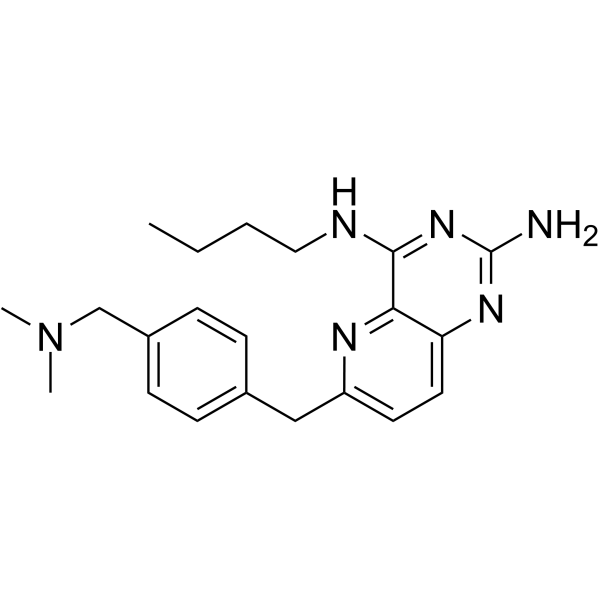
D18 is an immune modulator. D18 acts as a TLR7/8 dual agonist (EC50 = 24 nM for hTLR7 and 10 nM for hTLR8, respectively). D18 increases PD-L1 expression through epigenetic regulation, thus sensitizing tumors to PD-1/PD-L1 blockade. D18 is a ADC cytotoxin uesd for the systhesis of ADC HE-S2 (HY-144497). D18 has strong immune activation and anti-tumor activity. D18 commonly used in cancer research, such as colon cancer .
loading...
    loading...
Cat. No.: HY-173070
CAS No.: 2275612-76-3
TLR7 agonist 29 (Compound 1) is the agonist for TLR7 with an EC50 of 5.2 nM for human TLR7 (EC50 for mouse TLR7 is 48.2 nM). TLR7 agonist 29 activates bone marrow-derived macrophages (BMDMs), stimulates myeloid cells in the tumor microenvironment, promotes the expression of PD-L1, CD86 and IFN-α. TLR7 agonist 29 can be used as payload for synthesis of ADC .
loading...
    loading...
Cat. No.: HY-177414
BB-1701 is an anti-HER2 antibody-drug conjugate (ADC). BB-1701 is composed of a humanized anti-HER2 antibody (Trastuzumab) (HY-P9907), a linker (Mal-PEG2-VCP), a microtubule inhibitor (Eribulin) (HY-13442), and the drug-linker conjugate for ADC is Mal-PEG2-VCP-Eribulin (HY-128870). BB-1701 has a potent cytotoxicity and bystander effects on tumors with heterogeneous target expression. BB-1701 significantly induces immunogenic cell death and the activation of the immune .
loading...
    loading...
Cat. No.: HY-W457085
CAS No.: 59859-77-7
Target:  

PD-1/PD-L1

Research Areas:  

Cancer

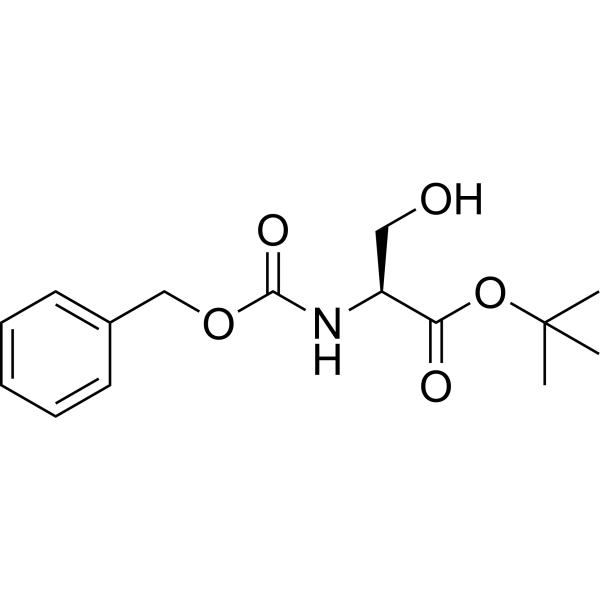
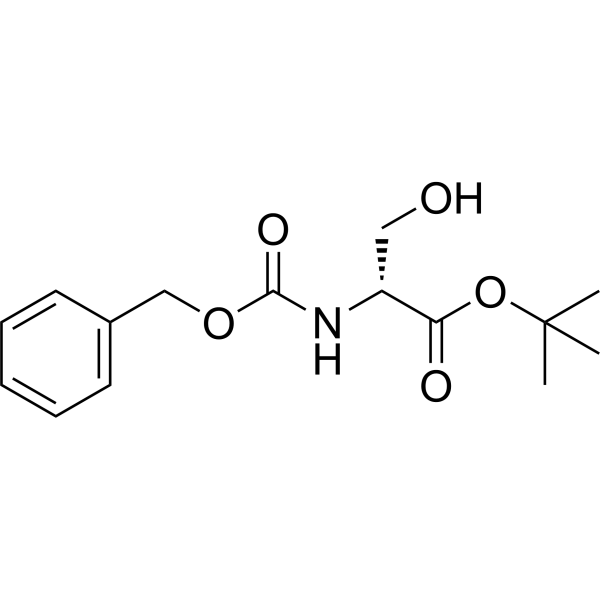
PD-1/PD-L1-IN-29 intermediate-2 is an intermediate of PD-1/PD-L1 inhibitors and can be used to synthesize Antibody-Drug Conjugates (ADCs).
loading...
    loading...
Cat. No.: HY-48934
CAS No.: 220095-93-2
Target:  

PD-1/PD-L1

Research Areas:  

Cancer

PD-1/PD-L1-IN-29 intermediate-1 is an intermediate of PD-1/PD-L1 inhibitors and can be used to synthesize Antibody-Drug Conjugates (ADCs).
loading...
    loading...
Cat. No.: HY-P992518

Target:  

VEGFR PD-1/PD-L1

Research Areas:  

Cancer

Pumitamig (Mouse IgG2a) is the Mouse IgG2a control antibody for Pumitamig (HY-P991097). Pumitamig (PM-8002, BNT-327) is a bispecific antibody targeting PD-L1 and VEGF-A, with immune activation and anti-angiogenic activities. By binding to PD-L1, Pumitamig restores the function of effector T cells, while neutralizing VEGF-A in the tumor microenvironment to reverse its inhibition on the infiltration and activation of immune cells and normalize tumor blood vessels. Pumitamig can also be combined with various ADCs targeting TROP2, B7H3, HER2, HER3 for the research of advanced/metastatic solid tumors, including non-small cell lung cancer, ovarian cancer, triple-negative breast cancer, cervical cancer, etc. Pumitamig also exhibits potential efficacy in "cold" tumors with low PD-L1 expression that are insensitive to immunotherapy .
loading...
    loading...
  • 1

