16 Results for "

PDX1

" in MedChemExpress (MCE) Product Catalog:
Products (16)

16 Results for "PDX1" in MCE Product Catalog:

3
3 Cited Publications
Cat. No.: HY-N0777
CAS No.: 5041-82-7
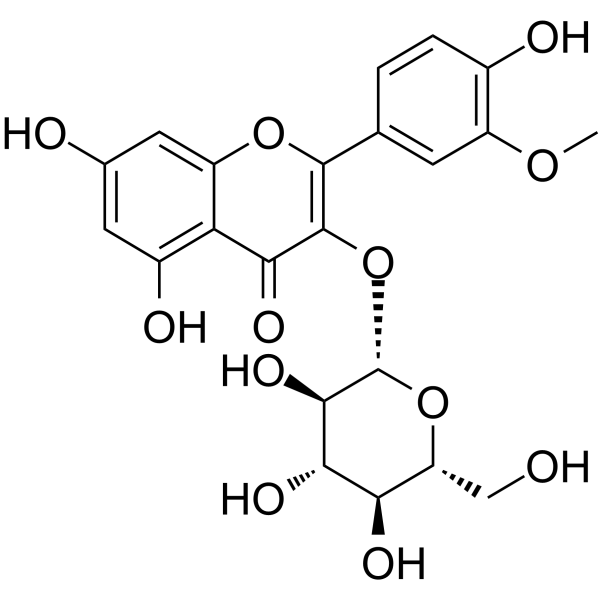
Isorhamnetin-3-O-glucoside is an orally active natural compound. Isorhamnetin 3-O-glucoside increases P-ERK, ERK, P-Akt (Ser473), P-PI3K, and PDX-1. Isorhamnetin 3-O-glucoside downregulates C/EBPα and inhibits lipase. Isorhamnetin 3-O-glucoside reduces lipids and inhibits obesity [1] .
Cat. No.: HY-133668
CAS No.: 2306-33-4
Purity:  96.78%
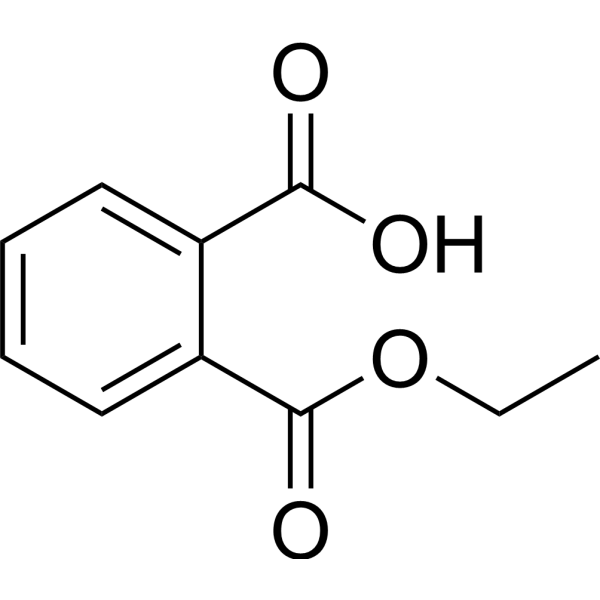
Monoethyl phthalate is an orally active PDX-1 activator and the major hydrolytic metabolite of Diethyl phthalate (HY-Y0284) in vivo, with reproductive toxicity. Monoethyl phthalate targets aromatase (aromatase/CYP19A1) and PPAR to induce cell proliferation. The plasma protein binding rate of Monoethyl phthalate in rats and humans is lower than that of Diethyl phthalate. It exhibits significant enterohepatic circulation in rats and mainly accumulates in liver tissues. Monoethyl phthalate shows no estrogenic activity in estrogen-dependent human breast cancer cells. Monoethyl phthalate can be used in studies of reproductive toxicity and related environmental endocrine disruption mechanisms [1] .
Cat. No.: HY-19694
CAS No.: 1137359-47-7
Target:  

Insulin Receptor

Research Areas:  

Endocrinology

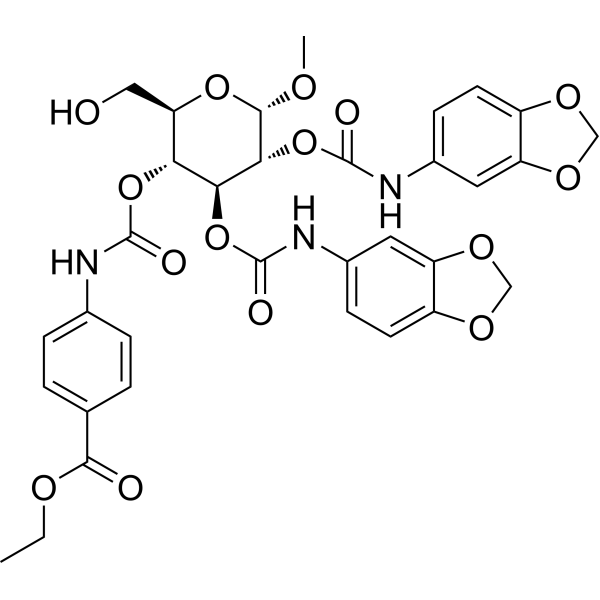
BRD7552, a potent PDX1 transcription factor inducer, upregulates PDX1 expression in both primary human islets and ductal cells, and induces epigenetic changes in the PDX1 promoter consistent with transcriptional activation. BRD7552 increases insulin expression. PDX1 is a key transcription factor involved in pancreas development and β cell function [1].
Cat. No.: HY-RS10295
Research Areas:  

Others

PDX1 Human Pre-designed siRNA Set A contains three designed siRNAs for PDX1 gene (Human), as well as a negative control, a positive control, and a FAM-labeled negative control.

Cat. No.: HY-174547
Target:  

mRNA

Research Areas:  

Metabolic Disease

Human PDX1 mRNA encodes the human pancreatic and duodenal homeobox 1 (PDX1) protein, a transcriptional activator of several genes, including insulin, somatostatin, glucokinase, islet amyloid polypeptide, and glucose transporter type 2. PDX1 may be involved in the early development of the pancreas. It also plays a major role in glucose-dependent regulation of insulin gene expression.
Cat. No.: HY-RS27306
Research Areas:  

Others

Pdx1 Rat Pre-designed siRNA Set A contains three designed siRNAs for Pdx1 gene (Rat), as well as a negative control, a positive control, and a FAM-labeled negative control.

Cat. No.: HY-RS20792
Research Areas:  

Others

Pdx1 Mouse Pre-designed siRNA Set A contains three designed siRNAs for Pdx1 gene (Mouse), as well as a negative control, a positive control, and a FAM-labeled negative control.

Cat. No.: HY-133668S
CAS No.: 1219806-03-7
Purity:  98.27%
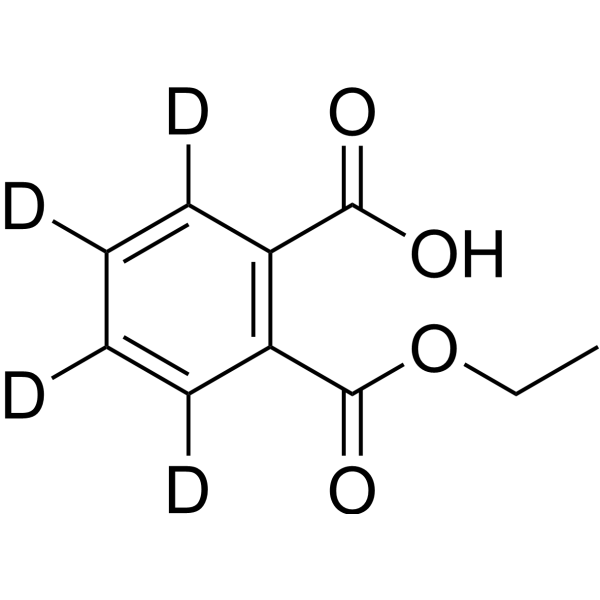
Monoethyl phthalate-d4 is the deuterium labeled Monoethyl phthalate. Monoethyl phthalate is an orally active PDX-1 activator and the major hydrolytic metabolite of Diethyl phthalate (HY-Y0284) in vivo, with reproductive toxicity. Monoethyl phthalate targets aromatase (aromatase/CYP19A1) and PPAR to induce cell proliferation. The plasma protein binding rate of Monoethyl phthalate in rats and humans is lower than that of Diethyl phthalate. It exhibits significant enterohepatic circulation in rats and mainly accumulates in liver tissues. Monoethyl phthalate shows no estrogenic activity in estrogen-dependent human breast cancer cells. Monoethyl phthalate can be used in studies of reproductive toxicity and related environmental endocrine disruption mechanisms [1] .
Cat. No.: HY-P80274

Host:  

Rabbit

Application:  

WB, IHC-P, ICC/IF

Reactivity:  

Human

Cat. No.: HY-P89405
Synonyms: IPF1, STF1, PDX1, Pancreas/duodenum homeobox protein 1, PDX-1, Glucose-sensitive factor, Insulin promoter factor 1, Insulin upstream factor 1, Islet/duodenum homeobox-1, Somatostatin-transactivating factor 1, GSF, IPF-1, IUF-1, IDX-1, STF-1

Host:  

Rabbit

Application:  

WB, IHC-P, ICC/IF

Reactivity:  

Human, Mouse

Cat. No.: HY-N19830
CAS No.: 585527-12-4
Guavenoic acid is a triterpenoid compound that can be isolated from fresh leaves of Psidium guajava. Guavenoic acid protects cells in cellular oxidative damage models, inhibits intracellular ROS production, and suppresses cell apoptosis. Guavenoic acid significantly enhances cellular proliferation, promotes insulin synthesis and secretion, and upregulates the messenger RNA expression of insulin gene, PDX-1 and MafA. Guavenoic acid can be used in the research of diseases such as pancreatic islet β-cell tumors [1].
Cat. No.: HY-P89405A
Synonyms: IPF1, STF1, PDX1, Pancreas/duodenum homeobox protein 1, PDX-1, Glucose-sensitive factor, Insulin promoter factor 1, Insulin upstream factor 1, Islet/duodenum homeobox-1, Somatostatin-transactivating factor 1, GSF, IPF-1, IUF-1, IDX-1, STF-1

Host:  

Rabbit

Application:  

WB, IHC-P, ICC/IF

Reactivity:  

Human, Mouse

Cat. No.: HY-RS10264
Research Areas:  

Others

PDHX Human Pre-designed siRNA Set A contains three designed siRNAs for PDHX gene (Human), as well as a negative control, a positive control, and a FAM-labeled negative control.

Cat. No.: HY-P991294

Target:  

ADC Antibodies

Research Areas:  

Cancer

MGTA-117 is a humanized monoclonal antibody targeting CD117. MGTA-117 can be used for synthesis of antibody-drug conjugate (ADC), utilizing an amanitin payload. MGTA-117 has potent anti-tumor activity and increases survival in three acute myeloid leukemia (AML) xenograft hNSG mice models (Kasumi-1, AML PDX 1 and AML PDX 2). MGTA-117 enables hematopoietic stem cell transplantation (HSCT) preprocessing in AML, myelodysplasia with excess blasts (MDS-EB) and gene therapy [1] .
Cat. No.: HY-RS21404
Research Areas:  

Others

Pdhx Mouse Pre-designed siRNA Set A contains three designed siRNAs for Pdhx gene (Mouse), as well as a negative control, a positive control, and a FAM-labeled negative control.

Cat. No.: HY-W1130459
CAS No.: 1226777-45-2
Target:  

Liposome

Research Areas:  

Cancer

(R)-C12-200 is the (R)-isomer of C12-200 (HY-145405), an ionizable cationic lipid and helper lipid. (R)-C12-200 enables functional mRNA delivery to head and neck squamous cell carcinoma xenograft tumor cells in NU/J immunocompromised mice, with minimal off-target delivery to liver or spleen. (R)-C12-200 can be utilized in the formation of lipid nanoparticles and mRNA delivery [1].
  • 1

