Search Result
Results for "
PEG1000
" in MedChemExpress (MCE) Product Catalog:
285
Biochemical Assay Reagents
| Cat. No. |
Product Name |
Target |
Research Areas |
Chemical Structure |
-
- HY-Y0873G
-
|
Polyethylene glycol 1000
|
Environmental Pollutants
Biochemical Assay Reagents
|
Others
|
|
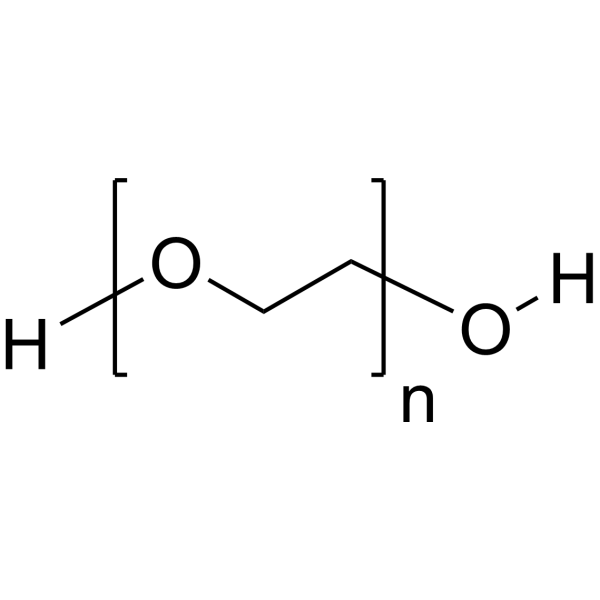
PEG1000 can be used as an excipient, such as Ointment base, lubricant, etc. Pharmaceutical excipients, or pharmaceutical auxiliaries, refer to other chemical substances used in the pharmaceutical process other than pharmaceutical ingredients. Pharmaceutical excipients generally refer to inactive ingredients in pharmaceutical preparations, which can improve the stability, solubility and processability of pharmaceutical preparations. Pharmaceutical excipients also affect the absorption, distribution, metabolism, and elimination (ADME) processes of co-administered drugs .
|
-
-
- HY-W441013
-
|
|
Liposome
|
Others
|
|
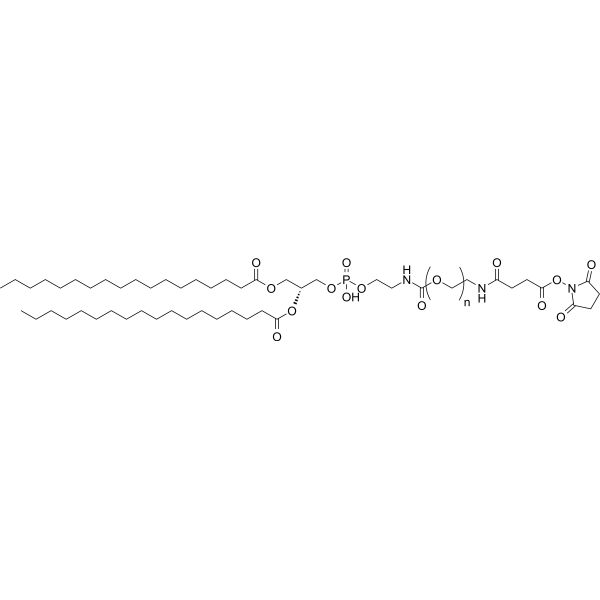
DSPE-PEG1000-NHS is a PEG-modified phospholipid derivative that can be used to prepare liposomes. DSPE-PEG1000-NHS is commonly employed as a linker molecule for the surface modification of liposomes to confer targeting capabilities. DSPE-PEG1000-NHS can be used in the study of drug delivery .
|
-
-
- HY-155927
-
|
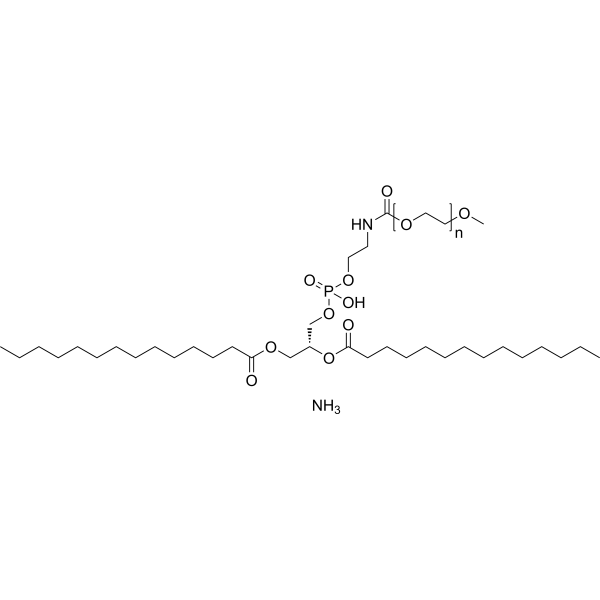
14:0 PEG1000 PE ammonium; 1,2-Dimyristoyl-sn-glycero-3-phosphoethanolamine-N-[methoxy(polyethylene glycol)-1000] ammonium
|
Liposome
|
Others
|
|
DMPE-PEG1000 ammonium (14:0 PEG1000 PE ammonium) is a PEG lipid functional end group used in the synthesis of liposomes (LPs) for the design of conjugated polymer nanoparticles. Through biotin modification and carboxyl terminus, lipid nanoparticles (LNPs) further coupling with other biomolecules can be achieved. Functionalized nanoparticles can be used for targeted labeling of specific cellular proteins. With streptavidin as a linker, biotinylated PEG lipid-conjugated polymer nanoparticles are able to bind to biotinylated antibodies on cell surface receptors, yielding the utility of fluorescence-based imaging and sensing.
|
-
-
- HY-D2599
-
|
|
Fluorescent Dye
|
Others
|
|
ICG PEG1000 NH2 is a polyethylene glycol derivative containing Indocyanine green (ICG) (HY-D0711) fluorescent dye and polyethylene glycol (PEG) and an amino group. The Indocyanine green fluorophore is commonly used in applications such as immunolabeling, nucleic acid labeling, fluorescence microscopy, and flow cytometry. ICG PEG1000 NH2 can be used for fluorescence imaging, fluorescence tracing and fluorescence labeling (Ex/Em=785/813 nm).
|
-
-
- HY-D2604
-
|
|
Fluorescent Dye
|
Others
|
|
ICG PEG1000 N3 is a Indocyanine green (ICG) (HY-D0711)-azide fluorescent dye used to label for protein and nucleic acid. ICG PEG1000 N3 is a click chemistry reagent, it contains an Azide group and can undergo copper-catalyzed azide-alkyne cycloaddition reaction (CuAAc) with molecules containing Alkyne groups. It can also undergo strain-promoted alkyne-azide cycloaddition (SPAAC) reactions with molecules containing DBCO or BCN groups (Ex/Em=785/813 nm).
|
-
-
- HY-W1123933B
-
|
CLS-PEG1000-CLS
|
Biochemical Assay Reagents
|
Others
|
|
Cholesterol-PEG1000-Cholesterol (CLS-PEG1000-CLS) is a cholesterol-modified PEG derivative. Cholesterol-PEG1000-Cholesterol can be combined with liposomes to form nanolipid carriers for drug delivery .
|
-
-
- HY-155932
-
|
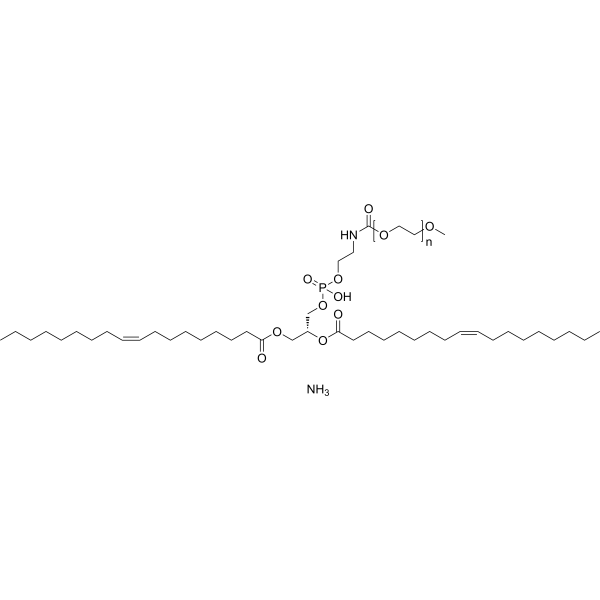
DOPE-PEG1000 ammonium; 1,2-Dioleoyl-sn-glycero-3-phosphoethanolamine-N-[methoxy(polyethylene glycol)-1000] ammonium
|
Liposome
|
Others
|
|
18:1 PEG1000 PE ammonium (DOPE-PEG1000 ammonium) is a PEG lipid functional end group used in the synthesis of liposomes (LPs) for the design of conjugated polymer nanoparticles. Through biotin modification and carboxyl terminus, lipid nanoparticles (LNPs) further coupling with other biomolecules can be achieved. Functionalized nanoparticles can be used for targeted labeling of specific cellular proteins. With streptavidin as a linker, biotinylated PEG lipid-conjugated polymer nanoparticles are able to bind to biotinylated antibodies on cell surface receptors, yielding the utility of fluorescence-based imaging and sensing.
|
-
-
- HY-D2609
-
|
|
Fluorescent Dye
|
Others
|
|
ICG PEG1000 DSPE is a PEG phospholipid with Indocyanine green (ICG) (HY-D0711) dye used in protein/nucelic acid labeling and fluorescence microscopy. ICG PEG1000 DSPE can self-assemble in aqueous solution to form micelles/lipid bilayer and used to prepare liposomes or nanoparticles for nutrients delivery such as mRNA or DNA vaccine (Ex/Em=785/813 nm).
|
-
-
- HY-144012D
-
|
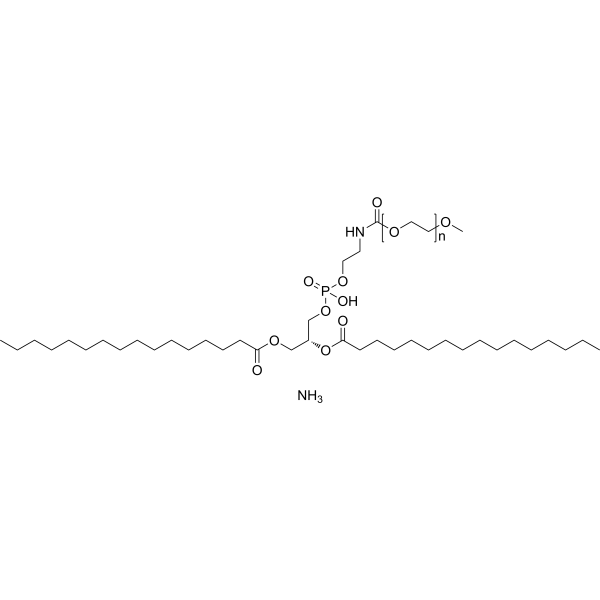
16:0 PEG1000 PE; 1,2-Dipalmitoyl-sn-glycero-3-phosphoethanolamine-N-[methoxy(polyethylene glycol)-1000] ammonium
|
Liposome
|
Others
|
|
DPPE-PEG1000 is a PEG lipid functional end group used in the synthesis of liposomes (LPs) for the design of conjugated polymer nanoparticles. Through biotin modification and carboxyl terminus, lipid nanoparticles (LNPs) further coupling with other biomolecules can be achieved. Functionalized nanoparticles can be used for targeted labeling of specific cellular proteins. With streptavidin as a linker, biotinylated PEG lipid-conjugated polymer nanoparticles are able to bind to biotinylated antibodies on cell surface receptors, yielding the utility of fluorescence-based imaging and sensing.
|
-
-
- HY-174965B
-
|
DBCO-PEG1000-Thiol
|
Biochemical Assay Reagents
|
Others
|
|
DBCO-PEG1000-SH (DBCO-PEG1000-Thiol) is a DBCO-modified PEG derivative. DBCO-PEG1000-SH contains a DBCO group and can undergo a strain-promoted alkyne-azide cycloaddition reaction (SPAAC) with molecules containing an azide group .
|
-
-
- HY-W1048572C
-
|
Azide-PEG1000-Amine
|
Biochemical Assay Reagents
|
Others
|
|
N3-PEG1000-NH2 (Azide-PEG1000-Amine) is a hetero-bifunctional PEG product with an azide and an amine group at the PEG terminus. N3-PEG1000-NH2 is an important cross-linker with PEG chains. The azide can be used for molecular conjugation through chemical reactions, and the amine can react with carboxylic acid or NHS ester .
|
-
-
- HY-174902B
-
-
-
- HY-W1048533H
-
|
Biotin-PEG1000-Thiol
|
Biochemical Assay Reagents
|
Others
|
|
Biotin-PEG1000-SH (Biotin-PEG1000-Thiol) is a biotin PEG polymer containing a thiol (-SH). Biotin-labeled compounds can then be linked to avidin or streptavidin for further purification or detection .
|
-
-
- HY-W1049024E
-
|
Azide PEG1000 Succinimidyl Carboxymethyl Ester
|
Biochemical Assay Reagents
|
Others
|
|
N3-PEG1000-SCM (Azide PEG1000 Succinimidyl Carboxymethyl Ester) is a linear heteroterminal bifunctional PEG product with succinimidyl carbonate and azide groups.
|
-
-
- HY-N16234
-
|
|
Fluorescent Dye
|
Others
|
|
Chol-PEG1000 fluorescein is a fluorescent lipid that consists of a cholesterol-PEG1000 unit conjugated to fluorescein. Chol-PEG1000 fluorescein can be used to prepare lipid nanoparticles for drug delivery research (Ex/Em = 480/520 nm).
|
-
-
- HY-167384
-
|
|
Biochemical Assay Reagents
|
Others
|
|
PLLA1000-PEG1000-BIO is a polylactic acid derivative that can form micelles in water. In addition, PLLA1000-PEG1000-BIO can bind tightly to avidin or streptavidin for protein labeling. PLLA1000-PEG1000-BIO can be used in drug delivery research .
|
-
-
- HY-167047
-
|
PLLA5000-PEG1000-Vinylsulfone
|
Biochemical Assay Reagents
|
Others
|
|
PLLA5000-PEG1000-VS (PLLA5000-PEG1000-Vinylsulfone) is an amphiphilic polymer. Amphiphilic polymers can be used in drug delivery studies due to their ability to self-assemble into discrete aggregates .
|
-
-
- HY-140232A
-
|
Boc-NH-PEG1000-Amine
|
Biochemical Assay Reagents
|
Others
|
|
BOC-NH-PEG1000-NH2 (Boc-NH-PEG1000-Amine) is a linear hetero-bifunctional PEG product with one Boc-protected amine and one amino group. BOC-NH-PEG1000-NH2 is an important cross-linker with PEG chains .
|
-
-
- HY-174927C
-
|
DBCO-PEG1000-Mal
|
Biochemical Assay Reagents
|
Others
|
|
DBCO-PEG1000-Maleimide (DBCO-PEG1000-Mal) is a PEG derivative composed of DBCO, PEG units and Maleimide (HY-W007324). Maleimide forms a stable thioether bond with sulfhydryl (-SH) groups. DBCO-PEG1000-Maleimide contains a DBCO group and can undergo strain-promoted alkyne-azide cycloaddition (SPAAC) with molecules containing an azide group .
|
-
-
- HY-W1123941B
-
|
Dopamine-PEG1000-Azide
|
Biochemical Assay Reagents
|
Others
|
|
Dopamine-PEG1000-N3 (Dopamine-PEG1000-Azide) is a compound composed of dopamine, PEG segments and an azide group (-N3). Dopamine-PEG1000-N3 can be used as a crosslinker to connect different materials together to build new composite materials and improve the performance of materials. Dopamine-PEG1000-N3 is a click chemistry reagent. It contains an azide group and can undergo copper-catalyzed azide-alkyne cycloaddition reaction (CuAAc) with molecules containing an alkyne group.
|
-
-
- HY-W1048552
-
|
|
Biochemical Assay Reagents
|
Others
|
|
Mal-PEG1000-mal is a linear bifunctional PEG reagent with reactive maleimide groups. Mal-PEG1000-mal can be used for drug delivery .
|
-
-
- HY-147207
-
|
|
Liposome
|
Others
|
|
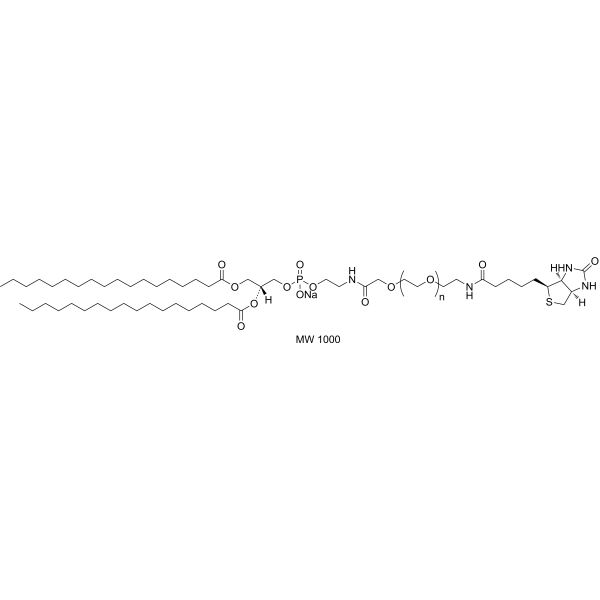
Phospholipid-PEG1000-Biotin is a phospholipid PEG derivative that has a biotin and a phospholipid bridged by a linear PEG linker. Phospholipid-PEG1000-Biotin can interact with avidinylated antibodies. Phospholipid-PEG1000-Biotin can be used to modify liposome and cells surface, and pancreatic islets for cell transplantation .
|
-
-
- HY-172278
-
|
|
Liposome
|
Cancer
|
|
DSPE-PEG1000-CGKRK is a PEG compound which composed of DSPE and a cell-penetrating peptide (CGKRK). DSPE-PEG1000-CGKRK can be used for drug delivery .
|
-
-
- HY-D2892C
-
|
|
Fluorescent Dye
|
Others
|
|
Rhodamine-PEG1000 a fluorescent PEG derivative composed of Rhodamine B (HY-Y0016) and PEG. Rhodamine-PEG1000 can be used for fluorescent labeling and imaging (Ex/Em=546/610 nm) .
|
-
-
- HY-W591891
-
|
|
Biochemical Assay Reagents
|
Others
|
|
Cholesterol-PEG1000-acid is a cholesterol PEG derivative that can form micelles through molecular self-assembly and has a longer half-life in vivo. Cholesterol-PEG1000-acid can be used in drug delivery research .
|
-
-
- HY-W1052262D
-
|
|
Biochemical Assay Reagents
|
Others
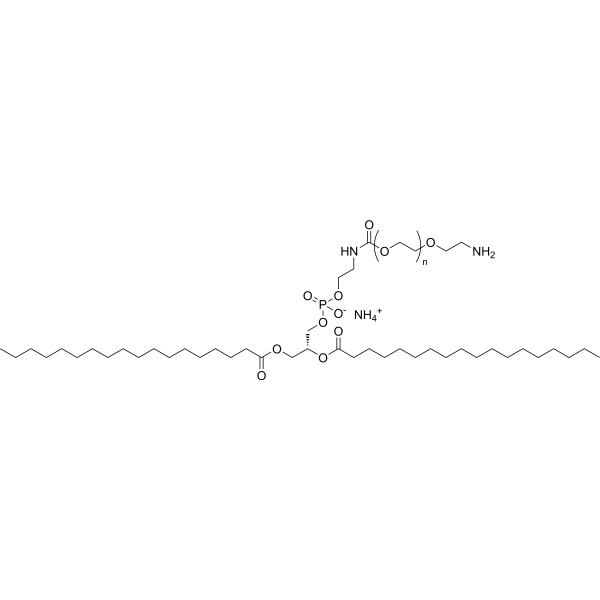
|
|
Silane-PEG1000-Mal is a PEG derivative that can be used to modify proteins, peptides and other materials. Silane-PEG1000-Mal can be used for peptide modification and drug delivery .
|
-
-
- HY-167442
-
|
|
Biochemical Assay Reagents
|
Others
|
|
PLLA10000-PEG1000-NH2 is a block copolymer based on polylactic acid derivatives that can self-assemble in water. PLLA10000-PEG1000-NH2 can be used in drug delivery research .
|
-
-
- HY-W1048574H
-
|
OHC-PEG1000-carboxyl
|
Biochemical Assay Reagents
|
Others
|
|
OHC-PEG1000-COOH (OHC-PEG1000-carboxyl) is a PEG derivative with a linear heteroterminal bifunctional structure of aldehyde and carboxylic acid groups. OHC-PEG1000-COOH can be used for drug delivery .
|
-
-
- HY-W1052051D
-
|
DPPE-PEG1000-Azide
|
Biochemical Assay Reagents
|
Others
|
|
DPPE-PEG1000-N3 (DPPE-PEG1000-Azide) is a conjugate composed of DPPE, PEG chains, and terminal azido groups (-N3). DPPE-PEG1000-Azide is a click chemistry reagent used for the targeted modification of liposomes/nanoparticles.
|
-
-
- HY-182836
-
|
DMPE-PEG1000-Azide
|
Biochemical Assay Reagents
|
Others
|
|
DMPE-PEG1000-N3 (DMPE-PEG1000-Azide) is a conjugate composed of DMPE, PEG chains, and terminal azido groups (-N3). DMPE-PEG1000-Azide is a click chemistry reagent used for the targeted modification of liposomes/nanoparticles.
|
-
-
- HY-182882
-
|
DPPE-PEG1000-Thiol
|
Biochemical Assay Reagents
|
Others
|
|
DPPE-PEG1000-SH (DPPE-PEG1000-Thiol) is a conjugate composed of DPPE, a PEG chain, and a terminal thiol group (-SH). The thiol group in DPPE-PEG1000-SH exhibits strong chemical reactivity and can participate in various bioconjugation reactions for targeted modification of liposomes/nanoparticles.
|
-
-
- HY-183055
-
|
DSG-PEG1000-Thiol
|
Biochemical Assay Reagents
|
Others
|
|
DSE-PEG1000-SH (DSE-PEG1000-Thiol) is a conjugate composed of DSE, a PEG chain, and a terminal thiol group (-SH). The thiol group in DSE-PEG1000-SH exhibits strong chemical reactivity and can participate in various bioconjugation reactions for targeted modification of liposomes/nanoparticles.
|
-
-
- HY-182841
-
|
DMPE-PEG1000-Thiol
|
Biochemical Assay Reagents
|
Others
|
|
DMPE-PEG1000-SH (DMPE-PEG1000-Thiol) is a conjugate composed of DMPE, a PEG chain, and a terminal thiol group (-SH). The thiol group in DMPE-PEG1000-SH exhibits strong chemical reactivity and can participate in various bioconjugation reactions for targeted modification of liposomes/nanoparticles.
|
-
-
- HY-167381
-
|
|
Biochemical Assay Reagents
|
Others
|
|
PLLA2000-PEG1000-BIO is a polylactic acid derivative that can form micelles in water. In addition, PLLA2000-PEG1000-BIO can bind tightly to avidin or streptavidin for protein labeling. PLLA2000-PEG1000-BIO can be used in drug delivery research .
|
-
-
- HY-167372
-
|
|
Biochemical Assay Reagents
|
Others
|
|
PLLA5000-PEG1000-BIO is a polylactic acid derivative that can form micelles in water. In addition, PLLA5000-PEG1000-BIO can bind tightly to avidin or streptavidin for protein labeling. PLLA5000-PEG1000-BIO can be used in drug delivery research .
|
-
-
- HY-167378
-
|
|
Biochemical Assay Reagents
|
Others
|
|
PLLA3000-PEG1000-BIO is a polylactic acid derivative that can form micelles in water. In addition, PLLA3000-PEG1000-BIO can bind tightly to avidin or streptavidin for protein labeling. PLLA3000-PEG1000-BIO can be used in drug delivery research .
|
-
-
- HY-167387
-
|
|
Biochemical Assay Reagents
|
Others
|
|
PLLA10000-PEG1000-BIO is a polylactic acid derivative that can form micelles in water. In addition, PLLA10000-PEG1000-BIO can bind tightly to avidin or streptavidin for protein labeling. PLLA10000-PEG1000-BIO can be used in drug delivery research .
|
-
-
- HY-167375
-
|
|
Biochemical Assay Reagents
|
Others
|
|
PLLA4000-PEG1000-BIO is a polylactic acid derivative that can form micelles in water. In addition, PLLA4000-PEG1000-BIO can bind tightly to avidin or streptavidin for protein labeling. PLLA4000-PEG1000-BIO can be used in drug delivery research .
|
-
-
- HY-167052
-
|
PLLA2000-PEG1000-Vinylsulfone
|
Biochemical Assay Reagents
|
Others
|
|
PLLA2000-PEG1000-VS (PLLA2000-PEG1000-Vinylsulfone) is an amphiphilic polymer. Amphiphilic polymers can be used in drug delivery studies due to their ability to self-assemble into discrete aggregates .
|
-
-
- HY-167020
-
|
PLGA3000-PEG1000-Vinylsulfone
|
Biochemical Assay Reagents
|
Others
|
|
PLGA3000-PEG1000-VS (PLGA3000-PEG1000-Vinylsulfone) is an amphiphilic polymer. Amphiphilic polymers can be used in drug delivery studies due to their ability to self-assemble into discrete aggregates .
|
-
-
- HY-167040
-
|
PLLA10000-PEG1000-Vinylsulfone
|
Biochemical Assay Reagents
|
Others
|
|
PLLA10000-PEG1000-VS (PLLA10000-PEG1000-Vinylsulfone) is an amphiphilic polymer. Amphiphilic polymers can be used in drug delivery studies due to their ability to self-assemble into discrete aggregates .
|
-
-
- HY-167008
-
|
PLGA1000-PEG1000-Vinylsulfone
|
Biochemical Assay Reagents
|
Others
|
|
PLGA1000-PEG1000-VS (PLGA1000-PEG1000-Vinylsulfone) is an amphiphilic polymer. Amphiphilic polymers can be used in drug delivery studies due to their ability to self-assemble into discrete aggregates .
|
-
-
- HY-167046
-
|
PLLA1000-PEG1000-Vinylsulfone
|
Biochemical Assay Reagents
|
Others
|
|
PLLA1000-PEG1000-VS (PLLA1000-PEG1000-Vinylsulfone) is an amphiphilic polymer. Amphiphilic polymers can be used in drug delivery studies due to their ability to self-assemble into discrete aggregates .
|
-
-
- HY-167029
-
|
PLGA4000-PEG1000-Vinylsulfone
|
Biochemical Assay Reagents
|
Others
|
|
PLGA4000-PEG1000-VS (PLGA4000-PEG1000-Vinylsulfone) is an amphiphilic polymer. Amphiphilic polymers can be used in drug delivery studies due to their ability to self-assemble into discrete aggregates .
|
-
-
- HY-167034
-
|
PLGA5000-PEG1000-Vinylsulfone
|
Biochemical Assay Reagents
|
Others
|
|
PLGA5000-PEG1000-VS (PLGA5000-PEG1000-Vinylsulfone) is an amphiphilic polymer. Amphiphilic polymers can be used in drug delivery studies due to their ability to self-assemble into discrete aggregates .
|
-
-
- HY-167060
-
|
PLLA3000-PEG1000-Vinylsulfone
|
Biochemical Assay Reagents
|
Others
|
|
PLLA3000-PEG1000-VS (PLLA3000-PEG1000-Vinylsulfone) is an amphiphilic polymer. Amphiphilic polymers can be used in drug delivery studies due to their ability to self-assemble into discrete aggregates .
|
-
-
- HY-167014
-
|
PLGA2000-PEG1000-Vinylsulfone
|
Biochemical Assay Reagents
|
Others
|
|
PLGA2000-PEG1000-VS (PLGA2000-PEG1000-Vinylsulfone) is an amphiphilic polymer. Amphiphilic polymers can be used in drug delivery studies due to their ability to self-assemble into discrete aggregates .
|
-
-
- HY-167056
-
|
PLLA4000-PEG1000-Vinylsulfone
|
Biochemical Assay Reagents
|
Others
|
|
PLLA4000-PEG1000-VS (PLLA4000-PEG1000-Vinylsulfone) is an amphiphilic polymer. Amphiphilic polymers can be used in drug delivery studies due to their ability to self-assemble into discrete aggregates .
|
-
-
- HY-D2882B
-
|
Rhodamine B-PEG1000-OH
|
Fluorescent Dye
|
Others
|
|
RB-PEG1000-OH (Rhodamine B-PEG1000-OH) is a fluorescent dye composed of Rhodamine B (HY-Y0016), PEG and a Hydroxyl group. RB-PEG1000-OH can be used for fluorescent labeling and imaging (Ex/Em=546/610 nm) .
|
-
-
- HY-179205
-
|
|
Biochemical Assay Reagents
|
Others
|
|
PLA5000-PEG1000-MAL is a PEG derivative with a maleimide group at the end. PLA5000-PEG1000-MAL can be used for drug delivery .
|
-
- HY-179198
-
|
|
Biochemical Assay Reagents
|
Others
|
|
PLA2000-PEG1000-MAL is a PEG derivative with a maleimide group at the end. PLA2000-PEG1000-MAL can be used for drug delivery .
|
-
- HY-179206
-
|
|
Biochemical Assay Reagents
|
Others
|
|
PLA10000-PEG1000-MAL is a PEG derivative with a maleimide group at the end. PLA10000-PEG1000-MAL can be used for drug delivery .
|
-
- HY-D2893B
-
|
Rhodamine B-PEG1000-Rhodamine B
|
Fluorescent Dye
|
Others
|
|
RB-PEG1000-RB (Rhodamine B-PEG1000-Rhodamine B) a fluorescent dye composed of two Rhodamine B (HY-Y0016) and PEG. RB-PEG1000-RB can be used for fluorescent labeling and imaging (Ex/Em=546/610 nm) .
|
-
- HY-167391
-
|
|
Biochemical Assay Reagents
|
Others
|
|
PLLA5000-PEG1000-ALK is a polylactic acid derivative that can form micelles in water. PLLA5000-PEG1000-ALK can be used in drug delivery research .
|
-
- HY-167403
-
|
|
Biochemical Assay Reagents
|
Others
|
|
PLLA2000-PEG1000-ALK is a polylactic acid derivative that can form micelles in water. PLLA2000-PEG1000-ALK can be used in drug delivery research .
|
-
- HY-167407
-
|
|
Biochemical Assay Reagents
|
Others
|
|
PLLA1000-PEG1000-ALK is a polylactic acid derivative that can form micelles in water. PLLA1000-PEG1000-ALK can be used in drug delivery research .
|
-
- HY-167395
-
|
|
Biochemical Assay Reagents
|
Others
|
|
PLLA4000-PEG1000-ALK is a polylactic acid derivative that can form micelles in water. PLLA4000-PEG1000-ALK can be used in drug delivery research .
|
-
- HY-167399
-
|
|
Biochemical Assay Reagents
|
Others
|
|
PLLA3000-PEG1000-ALK is a polylactic acid derivative that can form micelles in water. PLLA3000-PEG1000-ALK can be used in drug delivery research .
|
-
- HY-D2885B
-
|
Rhodamine B-PEG1000-Mal
|
Fluorescent Dye
|
Others
|
|
RB-PEG1000-Mal (Rhodamine B-PEG1000-Mal) is a fluorescent dye composed of Rhodamine B (HY-Y0016), PEG and Maleimide (HY-W007324) (Mal). RB-PEG1000-Mal can be used for fluorescent labeling and imaging (Ex/Em=546/610 nm) .
|
-
- HY-W440990
-
|
DOPE-PEG1000-NH2
|
Biochemical Assay Reagents
|
Others
|
|
DOPE-PEG1000-Amine (DOPE-PEG1000-NH2) is a conjugate composed of dioleoylphosphatidylethanolamine (DOPE), a PEG chain, and a terminal amino group (-NH2). The amino group in DOPE-PEG1000-Amine can chemically react with carboxyl groups, activated esters, etc., participating in various bioconjugation reactions for targeted modification of liposomes/nanoparticles.
|
-
- HY-D2888B
-
|
Rhodamine B-PEG1000-FA
|
Fluorescent Dye
|
Others
|
|
RB-PEG1000-FA (Rhodamine B-PEG1000-FA) is a fluorescent dye composed of Rhodamine B (HY-Y0016), PEG and Folic acid (FA) (HY-16637). RB-PEG1000-FA can be used for cell imaging, folate receptor targeting and detection (Ex/Em=546/610 nm) .
|
-
- HY-D2884B
-
|
Rhodamine B-PEG1000-NHS
|
Fluorescent Dye
|
Others
|
|
RB-PEG1000-NHS (Rhodamine B-PEG1000-NHS) is a fluorescent dye composed of Rhodamine B (HY-Y0016), PEG and a hydroxysuccinimide (NHS) group. The NHS group can react with amine-containing groups. RB-PEG1000-NHS can be used for fluorescent labeling and imaging (Ex/Em=546/610 nm) .
|
-
- HY-179207B
-
|
|
Biochemical Assay Reagents
|
Others
|
|
6-arm PEG1000-NCO is a multi-arm PEG derivative that can be used to modify proteins, peptides and other materials. 6-arm PEG1000-NCO can be used for peptide modification and drug delivery.
|
-
- HY-167492
-
|
|
Biochemical Assay Reagents
|
Others
|
|
PLLA10000-PEG1000-RhB is a terminal rhodamine-labeled polylactic acid derivative. PLLA10000-PEG1000-RhB can be used to label nanomicelles for real-time monitoring of drug release in vivo .
|
-
- HY-167480
-
|
|
Biochemical Assay Reagents
|
Others
|
|
PLLA3000-PEG1000-RhB is a terminal rhodamine-labeled polylactic acid derivative. PLLA3000-PEG1000-RhB can be used to label nanomicelles for real-time monitoring of drug release in vivo .
|
-
- HY-167488
-
|
|
Biochemical Assay Reagents
|
Others
|
|
PLLA1000-PEG1000-RhB is a terminal rhodamine-labeled polylactic acid derivative. PLLA1000-PEG1000-RhB can be used to label nanomicelles for real-time monitoring of drug release in vivo .
|
-
- HY-167484
-
|
|
Biochemical Assay Reagents
|
Others
|
|
PLLA2000-PEG1000-RhB is a terminal rhodamine-labeled polylactic acid derivative. PLLA2000-PEG1000-RhB can be used to label nanomicelles for real-time monitoring of drug release in vivo .
|
-
- HY-D2889B
-
|
Rhodamine B-PEG1000-Biotin
|
Fluorescent Dye
|
Others
|
|
RB-PEG1000-Biotin (Rhodamine B-PEG1000-Biotin) is a fluorescent dye composed of Rhodamine B (HY-Y0016), PEG and a Biotin. Biotin can bind with high affinity to streptavidin or avidin. RB-PEG1000-Biotin plays an important role in the specific capture and detection of biomolecules (Ex/Em=546/610 nm) .
|
-
- HY-W1052298C
-
|
DMPE-PEG1000-Amine
|
Biochemical Assay Reagents
|
Others
|
|
DMPE-PEG1000-NH2 (DMPE-PEG1000-Amine) is a conjugate composed of DMPE, a PEG chain, and a terminal primary amino group (-NH2). The primary amino group in DMPE-PEG1000-NH2 can be covalently linked to functional groups such as carboxylic acids, NHS esters, and isocyanates for targeted modification of liposomes/nanoparticles.
|
-
- HY-167341
-
|
|
Biochemical Assay Reagents
|
Others
|
|
PLLA10000-PEG1000-SPDP is a polylactic acid derivative that can form micelles in water and the SPDP moiety can react with thiols. PLLA10000-PEG1000-SPDP can be used in drug delivery research .
|
-
- HY-167305
-
|
|
Biochemical Assay Reagents
|
Others
|
|
PLLA3000-PEG1000-Thiol is a polylactic acid derivative that forms micelles in water and initiates biodegradation by attacking ester bonds through hydrolysis. PLLA3000-PEG1000-Thiol can be used in drug delivery research .
|
-
- HY-167333
-
|
|
Biochemical Assay Reagents
|
Others
|
|
PLLA2000-PEG1000-SPDP is a polylactic acid derivative that can form micelles in water and the SPDP moiety can react with thiols. PLLA2000-PEG1000-SPDP can be used in drug delivery research .
|
-
- HY-167301
-
|
|
Biochemical Assay Reagents
|
Others
|
|
PLLA4000-PEG1000-Thiol is a polylactic acid derivative that forms micelles in water and initiates biodegradation by attacking ester bonds through hydrolysis. PLLA4000-PEG1000-Thiol can be used in drug delivery research .
|
-
- HY-167309
-
|
|
Biochemical Assay Reagents
|
Others
|
|
PLLA2000-PEG1000-Thiol is a polylactic acid derivative that forms micelles in water and initiates biodegradation by attacking ester bonds through hydrolysis. PLLA2000-PEG1000-Thiol can be used in drug delivery research .
|
-
- HY-167321
-
|
|
Biochemical Assay Reagents
|
Others
|
|
PLLA5000-PEG1000-SPDP is a polylactic acid derivative that can form micelles in water and the SPDP moiety can react with thiols. PLLA5000-PEG1000-SPDP can be used in drug delivery research .
|
-
- HY-167297
-
|
|
Biochemical Assay Reagents
|
Others
|
|
PLLA5000-PEG1000-Thiol is a polylactic acid derivative that forms micelles in water and initiates biodegradation by attacking ester bonds through hydrolysis. PLLA5000-PEG1000-Thiol can be used in drug delivery research .
|
-
- HY-167317
-
|
|
Biochemical Assay Reagents
|
Others
|
|
PLLA10000-PEG1000-Thiol is a polylactic acid derivative that forms micelles in water and initiates biodegradation by attacking ester bonds through hydrolysis. PLLA10000-PEG1000-Thiol can be used in drug delivery research .
|
-
- HY-167325
-
|
|
Biochemical Assay Reagents
|
Others
|
|
PLLA4000-PEG1000-SPDP is a polylactic acid derivative that can form micelles in water and the SPDP moiety can react with thiols. PLLA4000-PEG1000-SPDP can be used in drug delivery research .
|
-
- HY-167313
-
|
|
Biochemical Assay Reagents
|
Others
|
|
PLLA1000-PEG1000-Thiol is a polylactic acid derivative that forms micelles in water and initiates biodegradation by attacking ester bonds through hydrolysis. PLLA1000-PEG1000-Thiol can be used in drug delivery research .
|
-
- HY-167337
-
|
|
Biochemical Assay Reagents
|
Others
|
|
PLLA1000-PEG1000-SPDP is a polylactic acid derivative that can form micelles in water and the SPDP moiety can react with thiols. PLLA1000-PEG1000-SPDP can be used in drug delivery research .
|
-
- HY-167329
-
|
|
Biochemical Assay Reagents
|
Others
|
|
PLLA3000-PEG1000-SPDP is a polylactic acid derivative that can form micelles in water and the SPDP moiety can react with thiols. PLLA3000-PEG1000-SPDP can be used in drug delivery research .
|
-
- HY-183161
-
|
Glucose-PEG1000-Azide
|
Biochemical Assay Reagents
|
Others
|
|
Glucose-PEG1000-N3 (Glucose-PEG1000-Azide) is a conjugate composed of glucose, PEG chains, and an azide group (-N3). Glucose-PEG1000-N3 combines the targeted recognition ability of glucose with the azide group that can undergo click chemistry, making it suitable for applications such as constructing targeted drug delivery systems and nanoparticle modification.
|
-
- HY-179193B
-
|
N3-PEG1000-OPSS
|
Biochemical Assay Reagents
|
Others
|
|
Azide-PEG1000-OPSS (N3-PEG1000-OPSS) is a compound composed of an azide group, PEG, and o-dithiopyridine (OPSS) and can be used for drug delivery. Azide-PEG1000-OPSS is a click chemistry reagent. It contains an Azide group and can undergo a copper-catalyzed azido-yne cycloaddition reaction (CuAAc) with molecules containing an Alkyne group. It can also undergo ring-strain-driven acetylene-azidocycloaddition (SPAAC) reactions with molecules containing DBCO or BCN groups.
|
-
- HY-172680
-
|
|
Liposome
|
Inflammation/Immunology
|
|
DSPE-PEG1000-VIP is a PEG compound which composed of DSPE and a vasoactive intestinal peptide (VIP). DSPE-PEG1000-VIP can be used for drug delivery .
|
-
- HY-167462
-
|
|
Biochemical Assay Reagents
|
Others
|
|
PLLA1000-PEG1000-N3 is a polylactic acid derivative used for encapsulating hydrophobic drugs. PLLA1000-PEG1000-N3 can be used in drug delivery research .
|
-
- HY-167450
-
|
|
Biochemical Assay Reagents
|
Others
|
|
PLLA4000-PEG1000-N3 is a polylactic acid derivative used for encapsulating hydrophobic drugs. PLLA4000-PEG1000-N3 can be used in drug delivery research .
|
-
- HY-167458
-
|
|
Biochemical Assay Reagents
|
Others
|
|
PLLA2000-PEG1000-N3 is a polylactic acid derivative used for encapsulating hydrophobic drugs. PLLA2000-PEG1000-N3 can be used in drug delivery research .
|
-
- HY-167454
-
|
|
Biochemical Assay Reagents
|
Others
|
|
PLLA3000-PEG1000-N3 is a polylactic acid derivative used for encapsulating hydrophobic drugs. PLLA3000-PEG1000-N3 can be used in drug delivery research .
|
-
- HY-167466
-
|
|
Biochemical Assay Reagents
|
Others
|
|
PLLA10000-PEG1000-N3 is a polylactic acid derivative used for encapsulating hydrophobic drugs. PLLA10000-PEG1000-N3 can be used in drug delivery research .
|
-
- HY-167446
-
|
|
Biochemical Assay Reagents
|
Others
|
|
PLLA5000-PEG1000-N3 is a polylactic acid derivative used for encapsulating hydrophobic drugs. PLLA5000-PEG1000-N3 can be used in drug delivery research .
|
-
- HY-D2514
-
|
|
Fluorescent Dye
|
Others
|
|
Cy3-PEG1000-DSPE is a compound for the labeling and visualization of nanoparticles or other materials. Cy3-PEG1000-DSPE has a variety of applications including drug delivery, cellular imaging, tracing of bioprocesses, and the study of interactions at the molecular level.
|
-
- HY-120761A
-
|
H2N-PEG1000-OH
|
Biochemical Assay Reagents
|
Others
|
|
Amine-PEG1000-OH (H2N-PEG1000-OH) is a heteroterminal bifunctional PEG crosslinker that can be used to attach functional PEG to biomolecules, particles, and other material surfaces .
|
-
- HY-179189B
-
|
Folate-PEG1000-ACA
|
Biochemical Assay Reagents
|
Others
|
|
FA-PEG1000-ACA (Folate-PEG1000-ACA) is a compound composed of Folic acid (HY-16637), PEG, and acrylamide. Folic acid (-FA) has a high affinity for folic acid receptors and can be used to target cell membrane receptors for drug delivery.
|
-
- HY-143209A
-
-
- HY-167428
-
|
|
Biochemical Assay Reagents
|
Others
|
|
PLLA3000-PEG1000-NH2 is a block copolymer based on polylactic acid derivatives that can self-assemble in water. PLLA3000-PEG1000-NH2 can be used in drug delivery research .
|
-
- HY-167424
-
|
|
Biochemical Assay Reagents
|
Others
|
|
PLLA4000-PEG1000-NH2 is a block copolymer based on polylactic acid derivatives that can self-assemble in water. PLLA4000-PEG1000-NH2 can be used in drug delivery research .
|
-
- HY-167433
-
|
|
Biochemical Assay Reagents
|
Others
|
|
PLLA2000-PEG1000-NH2 is a block copolymer based on polylactic acid derivatives that can self-assemble in water. PLLA2000-PEG1000-NH2 can be used in drug delivery research .
|
-
- HY-167420
-
|
|
Biochemical Assay Reagents
|
Others
|
|
PLLA5000-PEG1000-NH2 is a block copolymer based on polylactic acid derivatives that can self-assemble in water. PLLA5000-PEG1000-NH2 can be used in drug delivery research .
|
-
- HY-167438
-
|
|
Biochemical Assay Reagents
|
Others
|
|
PLLA1000-PEG1000-NH2 is a block copolymer based on polylactic acid derivatives that can self-assemble in water. PLLA1000-PEG1000-NH2 can be used in drug delivery research .
|
-
- HY-W440825
-
|
|
Biochemical Assay Reagents
|
Others
|
|
DSPE-PEG1000-COOH is a PEG lipid that can improve the delivery efficiency and tissue specificity of poorly soluble drugs. DSPE-PEG1000-COOH can be used in drug delivery research .
|
-
- HY-W440922
-
|
|
Biochemical Assay Reagents
|
Others
|
|
m-PEG1000-DSPE sodium is a PEG lipid that can improve the delivery efficiency and tissue specificity of poorly soluble drugs. m-PEG1000-DSPE sodium can be used in drug delivery research .
|
-
- HY-D2795A
-
|
|
Fluorescent Dye
|
Others
|
|
FITC-PEG1000-COOH is a fluorescent dye composed of polyethylene glycol (PEG), FITC (HY-66019) and a COOH. FITC-PEG1000-COOH can be used for fluorescent labeling and imaging .
|
-
- HY-166807
-
|
|
Biochemical Assay Reagents
|
Others
|
|
Palmitate-PEG1000-Mal is a PEG lipid that can improve the delivery efficiency and tissue specificity of poorly soluble drugs. Palmitate-PEG1000-Mal can be used in drug delivery research .
|
-
- HY-167028A
-
|
|
Biochemical Assay Reagents
|
Others
|
|
DSPE-PEG1000-alkyne is a PEG lipid that can improve the delivery efficiency and tissue specificity of poorly soluble drugs. DSPE-PEG1000-alkyne can be used in drug delivery research .
|
-
- HY-W1048545H
-
|
Amine-PEG1000-Thiol hydrochloride
|
Biochemical Assay Reagents
|
Others
|
|
H2N-PEG1000-SH (Amine-PEG1000-Thiol) hydrochloride is a linear heterobifunctional PEGylated product containing thiol and amine. H2N-PEG1000-SH hydrochloride is an important cross-linking or bioconjugation reagent with PEG chains. Thiol or SH, sulfhydryl or thiol selectively reacts with maleimide, OPSS, vinyl sulfone and transition metal surfaces (including gold, silver, etc.) .
|
-
- HY-W440823A
-
|
DSPE-PEG1000-NH2 ammonium
|
Liposome
|
Cancer
|
|
DSPE-PEG1000-Amine (DSPE-PEG1000-NH2) ammonium is a 1,2-distearoyl-sn-glycero-3-phosphoethanolamine-polyethylene glycol conjugate with a terminal amino group. DSPE-PEG1000-Amine ammonium can functionalize the surface of PLGA-lecithin-PEG core-shell nanoparticles to introduce positive surface charges. The amino group of DSPE-PEG1000-Amine ammonium can be converted into an aromatic aldehyde to react with the acetone-protected aromatic hydrazide on the surface of bovine carbonic anhydrase (BCA) molecules .
|
-
- HY-172274
-
|
|
Liposome
|
Cancer
|
|
DSPE-PEG1000-APRPG is a PEG compound which composed of DSPE and a APRPG peptide. DSPE-PEG1000-APRPG can be used for drug delivery .
|
-
- HY-173385
-
|
|
Biochemical Assay Reagents
|
Metabolic Disease
|
|
Cholesteryl-PEG1000-Azide is a lipid that can be used for drug delivery. Cholesteryl-PEG1000-Azide is attached to the cholesterol backbone with a PEG unit on one side and an azide unit on the other side of the PEG. Cholesteryl-PEG1000-Azide contains an azide group that can undergo copper-catalyzed azide-alkyne cycloaddition reaction (CuAAc) with molecules containing an alkyne group .
|
-
- HY-174969
-
|
|
Biochemical Assay Reagents
|
Others
|
|
Alkyne-PEG1000-Silane is a PEG derivative composed of silane, PEG, and alkynyl groups. Alkyne-PEG1000-Silane is a click chemistry reagent. It contains an Alkyne group, which can undergo copper-catalyzed azide-alkyne cycloaddition reaction (CuAAc) with molecules containing an Azide group. The Silane group enables Alkyne-PEG1000-Silane to modify surfaces such as glass and silicon .
|
-
- HY-D2796A
-
|
|
Fluorescent Dye
|
Others
|
|
FITC-PEG1000-OH is a fluorescent dye composed of polyethylene glycol (PEG), FITC (HY-66019) and a Hydroxyl group. FITC-PEG1000-OH can be used for fluorescent labeling and imaging .
|
-
- HY-172279
-
|
|
Liposome
|
Infection
|
|
DSPE-PEG1000-TAT is a PEG compound which composed of DSPE and a cell-penetrating peptide (TAT) (HY-P0281). DSPE-PEG1000-TAT can be used for drug delivery .
|
-
- HY-D2798A
-
|
|
Fluorescent Dye
|
Others
|
|
FITC-PEG1000-SH is a fluorescent dye composed of polyethylene glycol (PEG), FITC (HY-66019) and a sulfhydryl (SH). FITC-PEG1000-SH can be used for fluorescent labeling and imaging .
|
-
- HY-167357
-
|
|
Biochemical Assay Reagents
|
Others
|
|
PLLA3000-PEG1000-PLLA3000 is an amphiphilic triblock polymer based on polylactic acid derivatives that improves the specificity and cell affinity of PLA-based biomaterials. PLLA3000-PEG1000-PLLA3000 can be used in drug delivery research .
|
-
- HY-167363
-
|
|
Biochemical Assay Reagents
|
Others
|
|
PLLA2000-PEG1000-PLLA2000 is an amphiphilic triblock polymer based on polylactic acid derivatives that improves the specificity and cell affinity of PLA-based biomaterials. PLLA2000-PEG1000-PLLA2000 can be used in drug delivery research .
|
-
- HY-167139
-
|
|
Biochemical Assay Reagents
|
Others
|
|
PLLA8000-PEG1000-PLLA8000 is an amphiphilic triblock polymer based on polylactic acid derivatives that improves the specificity and cell affinity of PLA-based biomaterials. PLLA8000-PEG1000-PLLA8000 can be used in drug delivery research .
|
-
- HY-167345
-
|
|
Biochemical Assay Reagents
|
Others
|
|
PLLA5000-PEG1000-PLLA5000 is an amphiphilic triblock polymer based on polylactic acid derivatives that improves the specificity and cell affinity of PLA-based biomaterials. PLLA5000-PEG1000-PLLA5000 can be used in drug delivery research .
|
-
- HY-167120
-
|
|
Biochemical Assay Reagents
|
Others
|
|
PLLA6000-PEG1000-PLLA6000 is an amphiphilic triblock polymer based on polylactic acid derivatives that improves the specificity and cell affinity of PLA-based biomaterials. PLLA6000-PEG1000-PLLA6000 can be used in drug delivery research .
|
-
- HY-167369
-
|
|
Biochemical Assay Reagents
|
Others
|
|
PLLA1000-PEG1000-PLLA1000 is an amphiphilic triblock polymer based on polylactic acid derivatives that improves the specificity and cell affinity of PLA-based biomaterials. PLLA1000-PEG1000-PLLA1000 can be used in drug delivery research .
|
-
- HY-167351
-
|
|
Biochemical Assay Reagents
|
Others
|
|
PLLA4000-PEG1000-PLLA4000 is an amphiphilic triblock polymer based on polylactic acid derivatives that improves the specificity and cell affinity of PLA-based biomaterials. PLLA4000-PEG1000-PLLA4000 can be used in drug delivery research .
|
-
- HY-145396A
-
-
- HY-W441009B
-
|
|
Liposome
|
Others
|
|
DSPE-PEG1000-Maleimide ammonium has DSPE phospholipid and maleimide to prepare nanostructured lipid carrier. DSPE-PEG1000-Maleimide ammonium can be used in drug delivery research .
|
-
- HY-172481
-
|
|
Liposome
|
Cancer
|
|
DSPE-PEG1000-TAASGVRSMH is a PEG compound which composed of DSPE and TAASGVRSMH. TAASGVRSMH has a strong affinity for the NG2 proteoglycan on the PC membrane. DSPE-PEG1000-TAASGVRSMH can be used for drug delivery .
|
-
- HY-W1048542
-
|
|
Biochemical Assay Reagents
|
Others
|
|
Fmoc-NH-PEG1000-COOH is a PEG product containing two Fmoc-protected amines and a carboxylic acid. Fmoc-NH-PEG1000-COOH is an important cross-linking agent with PEG chains .
|
-
- HY-172686
-
|
|
Liposome
|
Cardiovascular Disease
|
|
DSPE-PEG1000-CSTSMLKAC is a PEG compound which composed of DSPE and a peptide (CSTSMLKAC). CSTSMLKAC is capable of mediating selective homing of phage to ischemic heart tissue. DSPE-PEG1000-CSTSMLKAC can be used for drug delivery .
|
-
- HY-W440718
-
|
|
Biochemical Assay Reagents
|
Others
|
|
Cholesterol-PEG1000-Mal is a cholesterol PEG derivative that can form micelles through molecular self-assembly and has a longer half-life in vivo. Cholesterol-PEG1000-Mal can be used in drug delivery research .
|
-
- HY-W440726
-
|
|
Biochemical Assay Reagents
|
Others
|
|
Cholesterol-PEG1000-Vinylsulfone is a cholesterol PEG derivative that can form micelles through molecular self-assembly and has a longer half-life in vivo. Cholesterol-PEG1000-Vinylsulfone can be used in drug delivery research .
|
-
- HY-W591912
-
|
|
Biochemical Assay Reagents
|
Others
|
|
Cholesterol-PEG1000-methoxy is a cholesterol PEG derivative that can form micelles through molecular self-assembly and has a longer half-life in vivo. Cholesterol-PEG1000-methoxy can be used in drug delivery research .
|
-
- HY-W440697
-
|
|
Biochemical Assay Reagents
|
Others
|
|
Cholesterol-PEG1000-NHS is a cholesterol PEG derivative that can form micelles through molecular self-assembly and has a longer half-life in vivo. Cholesterol-PEG1000-NHS can be used in drug delivery research .
|
-
- HY-W440693
-
|
|
Biochemical Assay Reagents
|
Others
|
|
Cholesterol-PEG1000-azide is a cholesterol PEG derivative that can form micelles through molecular self-assembly and has a longer half-life in vivo. Cholesterol-PEG1000-azide can be used in drug delivery research .
|
-
- HY-W440705
-
|
|
Biochemical Assay Reagents
|
Others
|
|
Cholesterol-PEG1000-alcohol is a cholesterol PEG derivative that can form micelles through molecular self-assembly and has a longer half-life in vivo. Cholesterol-PEG1000-alcohol can be used in drug delivery research .
|
-
- HY-D2842A
-
|
|
Fluorescent Dye
|
Others
|
|
FITC-PEG1000-biotin is a fluorescent dye composed of polyethylene glycol (PEG), FITC (HY-66019) and a Biotin (HY-B0511). FITC-PEG1000-biotin can be used for fluorescent labeling and imaging .
|
-
- HY-174966B
-
|
BOC-NH-PEG1000-Folate
|
Biochemical Assay Reagents
|
Others
|
|
BOC-NH-PEG1000-FA (BOC-NH-PEG1000-Folate) is a PEG derivative modified with Folic acid (HY-16637). Folic acid (-FA) has a high affinity for folate receptors and can be used for cell membrane receptors for targeted drug delivery .
|
-
- HY-182100
-
|
|
Liposome
|
Others
|
|
DSPE-PEG1000-MTP is a PEG compound which composed of DSPE and a muscle-targeting peptide (MTP). MTP is a muscle-targeting peptide with the property of targeting muscle tissue. DSPE-PEG1000-MTP can be used for drug delivery .
|
-
- HY-D2800A
-
|
|
Fluorescent Dye
|
Others
|
|
FITC-PEG1000-MAL is a fluorescent dye composed of polyethylene glycol (PEG), FITC (HY-66019) and Maleimide (HY-W007324) (MAL). FITC-PEG1000-MAL can be used for fluorescent labeling and imaging .
|
-
- HY-182947
-
|
|
Biochemical Assay Reagents
|
Others
|
|
DSG-PEG1000-Mannose is a conjugate composed of DSG, a PEG chain, and terminal mannose. DSG-PEG1000-Mannose combines the membrane compatibility of phospholipids with the targeted recognition capabilities of mannose, making it suitable for research in biomaterial construction and drug delivery.
|
-
- HY-183174
-
|
|
Biochemical Assay Reagents
|
Others
|
|
DSG-PEG1000-Galactose is a conjugate composed of DSG, a PEG chain, and terminal galactose. DSG-PEG1000-Galactose combines the membrane compatibility of phospholipids with the targeted recognition capabilities of galactose, making it suitable for research in biomaterial construction and drug delivery.
|
-
- HY-W1051916
-
|
|
Biochemical Assay Reagents
|
Others
|
|
NH2-PEG1000-DBCO is a compound composed of an amino group, PEG, and DBCO, and can be used for drug delivery. NH2-PEG1000-DBCO contains clickable functional groups DBCO and PEG, and can undergo a ring-strain-driven acetylene-azide cycloaddition reaction (SPAAC) with molecules containing an azide group.
|
-
- HY-W1048828E
-
-
- HY-183171
-
|
|
Biochemical Assay Reagents
|
Others
|
|
DSG-PEG1000-CHO is a conjugate composed of DSG, a PEG chain, and a terminal aldehyde group (-CHO). DSG-PEG1000-CHO combines the membrane compatibility of phospholipids with the flexibility of hydroxyl modification, making it suitable for research in biomaterial construction and drug delivery.
|
-
- HY-183170
-
|
|
Biochemical Assay Reagents
|
Others
|
|
DSG-PEG1000-Biotin is a conjugate composed of DSG, PEG chains, and biotin. DSG-PEG1000-Biotin combines the membrane compatibility of phospholipids with the high affinity of biotin for avidin/streptavidin, enabling applications such as targeted drug delivery systems and nanoparticle modification.
|
-
- HY-174963B
-
|
|
Biochemical Assay Reagents
|
Others
|
|
DBCO-PEG1000-OH is a PEG derivative composed of DBCO, PEG, and hydroxyl groups. DBCO-PEG1000-OH contains a DBCO group that can undergo strain-promoted alkyne-azide cycloaddition (SPAAC) with molecules containing Azide groups .
|
-
- HY-182903
-
|
|
Biochemical Assay Reagents
|
Others
|
|
DMG-PEG1000-Mannose is a conjugate composed of dimyristoylglycerol (DMG), a PEG chain, and terminal mannose. DMG-PEG1000-Mannose combines the membrane compatibility of phospholipids with the targeted recognition capabilities of mannose, making it suitable for research in biomaterial construction and drug delivery.
|
-
- HY-W1049061E
-
|
|
Biochemical Assay Reagents
|
Others
|
|
Boc-NH-PEG1000-COOH is a linear hetero-bifunctional PEG product with one Boc-protected amine and one carboxyl group. Boc-NH-PEG1000-COOH is an important cross-linker with PEG chains .
|
-
- HY-W1123943B
-
|
|
Biochemical Assay Reagents
|
Others
|
|
8-Arm-PEG1000-Biotin is a multiarmed PEG derivative with biotin at each terminal of the eight arms. 8-Arm-PEG1000-Biotin is for PEGylation by binding to streptavidin and avidin with high affinity and specificity .
|
-
- HY-183175
-
|
|
Biochemical Assay Reagents
|
Others
|
|
DSG-PEG1000-N3 is a conjugate composed of DSG, PEG chains, and terminal azido groups (-N3). DSG-PEG1000-Azide is a click chemistry reagent used for the targeted modification of liposomes/nanoparticles.
|
-
- HY-D2541
-
|
|
Fluorescent Dye
|
Others
|
|
Cy5-PEG1000-DSPE is a PEG phospholipid with Cy5 (HY-D0821) dye used in protein/nucelic acid labeling and fluorescence microscopy. Cy5-PEG1000-DSPE can self-assemble in aqueous solution to form micelles/lipid bilayer and used to prepare liposomes or nanoparticles for nutrients delivery such as mRNA or DNA vaccine.
|
-
- HY-174948
-
|
NHS-PEG1000-Aldehyde
|
Biochemical Assay Reagents
|
Others
|
|
NHS-PEG1000-CHO (NHS-PEG1000-Aldehyde) is a PEG derivative consisting of an aldehyde group (-CHO), a PEG unit, and an NHS ester. NHS esters can be conjugated to amino acids or other molecules containing amino groups. Aldehyde groups are reactive functional groups that can react with compounds containing amino or hydroxyl groups .
|
-
- HY-182101
-
|
|
Liposome
|
Others
|
|
DSPE-PEG1000-GNYTCEVTELTREGETIIELK is a PEG compound which composed of DSPE and a muscle-targeting peptide VHPKQHRGGSKGC (HY-P11088). GNYTCEVTELTREGETIIELK is a peptide that can bind to VCAM1. DSPE-PEG1000-GNYTCEVTELTREGETIIELK can be used for drug delivery .
|
-
- HY-183196
-
|
|
Biochemical Assay Reagents
|
Others
|
|
DMG-PEG1000-Galactose is a conjugate composed of dimyristic glycerol (DMG), a PEG chain, and terminal galactose. DMG-PEG1000-Galactose combines the membrane compatibility of phospholipids with the targeted recognition capabilities of galactose, making it suitable for research in biomaterial construction and drug delivery.
|
-
- HY-172472
-
|
|
Liposome
|
Cancer
|
|
DSPE-PEG1000-NGR is a PEG compound which composed of DSPE and an Asn-Gly-Arg (NGR) peptide. NGR peptide can target tumor vascular antigen CD13. DSPE-PEG1000-NGR can be used for drug delivery .
|
-
- HY-172683
-
|
|
Liposome
|
Others
|
|
DSPE-PEG1000-GRGDS is a PEG compound which composed of DSPE and an anti-adhesion peptide (GRGDS). GRGDS can block the binding and adhesion of extracellular matrix to cell surface integrins. DSPE-PEG1000-GRGDS can be used for drug delivery .
|
-
- HY-172725
-
|
|
Liposome
|
Cancer
|
|
DSPE-PEG1000-EB1 is a PEG compound which composed of DSPE and pH responsive membrane-penetrating peptide (EB1). DSPE-PEG1000-EB1 can be used for drug delivery .
|
-
- HY-172277
-
|
|
Liposome
|
Neurological Disease
|
|
DSPE-PEG1000-R9 is a PEG compound which composed of DSPE and a poly-arginine-9 peptide (R9). DSPE-PEG1000-R9 can be used for drug delivery .
|
-
- HY-183172
-
|
|
Biochemical Assay Reagents
|
Others
|
|
DSG-PEG1000-Alkyne is a conjugate composed of DSG, a PEG chain, and a terminal alkyne group. DSG-PEG1000-Alkyne combines the membrane compatibility of phospholipids with the high reactivity of the alkyne group in click chemistry, making it suitable for research in biomaterial construction and drug delivery.
|
-
- HY-183164
-
|
|
Biochemical Assay Reagents
|
Others
|
|
Glucose-PEG1000-OH is a conjugate composed of glucose, PEG chains, and hydroxyl groups (-OH). Glucose-PEG1000-OH combines the targeted recognition capability of glucose with the modification flexibility of hydroxyl groups, enabling applications such as targeted drug delivery systems and nanoparticle modification.
|
-
- HY-D2801A
-
|
|
Fluorescent Dye
|
Others
|
|
FITC-PEG1000-NHS is a fluorescent dye composed of polyethylene glycol (PEG), FITC (HY-66019) and a hydroxysuccinimide (NHS) group. The NHS group can react with amine-containing groups. FITC-PEG1000-NHS can be used for fluorescent labeling and imaging .
|
-
- HY-183398
-
|
|
Biochemical Assay Reagents
|
Others
|
|
DMG-PEG1000-CHO is a conjugate composed of dimyristic glycerol (DMG), a PEG chain, and a terminal aldehyde group (-CHO). DMG-PEG1000-CHO combines the membrane compatibility of phospholipids with the flexibility of hydroxyl modification, making it suitable for research in biomaterial construction and drug delivery.
|
-
- HY-183132
-
|
|
Biochemical Assay Reagents
|
Others
|
|
DSG-PEG1000-OH is a conjugate composed of dimyristic glycerol (DMG), a PEG chain, and terminal hydroxyl groups (-OH). DSG-PEG1000-OH combines the membrane compatibility of phospholipids with the flexibility of hydroxyl modification, making it suitable for research in biomaterial construction and drug delivery.
|
-
- HY-172276
-
|
|
Liposome
|
Cancer
|
|
DSPE-PEG1000-R8 is a PEG compound which composed of DSPE and a cell-penetrating peptide (R8). pDSPE-PEG1000-R8 can be used for drug delivery .
|
-
- HY-174970B
-
|
Silane-PEG1000-azide
|
Biochemical Assay Reagents
|
Others
|
|
Silane-PEG1000-N3 (Silane-PEG1000-azide) is a PEG derivative composed of silane, PEG units, and azide groups, which can be used to modify glass, silicon, or other surfaces by reacting hydroxyl groups with ethoxy (methoxy) silanes. Silane-PEG1000-N3 contains an azide group and can undergo copper-catalyzed azide-alkyne cycloaddition (CuAAc) with molecules containing alkyne groups. It can also undergo ring strain-driven alkyne-azide cycloaddition (SPAAC) with molecules containing DBCO or BCN groups .
|
-
- HY-183127
-
|
|
Biochemical Assay Reagents
|
Others
|
|
BOC-NH-PEG1000-DMG is a conjugate composed of a Boc-protected primary amine (-NH2), a PEG chain, and terminal dimyristoylglycerol (DMG). BOC-NH-PEG1000-DMG can be used for research in biomaterial construction and drug delivery.
|
-
- HY-D2794A
-
|
|
Fluorescent Dye
|
Others
|
|
FITC-PEG1000-NH2 is a fluorescent dye composed of polyethylene glycol (PEG), FITC (HY-66019) and an amino group. FITC-PEG1000-NH2 can be used for fluorescent labeling and imaging .
|
-
- HY-W1048603E
-
-
- HY-D2883B
-
|
Rhodamine B-PEG1000-SH
|
Fluorescent Dye
|
Others
|
|
RB-PEG1000-SH (Rhodamine B-PEG1000-SH) is a fluorescent dye composed of Rhodamine B (HY-Y0016), PEG and sulfhydryl (SH). SH is highly reactive and can react with a variety of functional groups (such as maleimide) to form stable thioether bonds (Ex/Em=546/610 nm) .
|
-
- HY-W1052873C
-
|
|
Biochemical Assay Reagents
|
Others
|
|
DPPE-PEG1000-COOH is a conjugate composed of DPPE, a PEG chain, and a terminal carboxyl group (-COOH). The carboxyl group in DPPE-PEG1000-COOH can form an amide bond with a primary amine via EDC/NHS activation, enabling targeted modification of liposomes/nanoparticles.
|
-
- HY-W1052117C
-
|
|
Biochemical Assay Reagents
|
Others
|
|
DMPE-PEG1000-COOH is a conjugate composed of DMPE, a PEG chain, and a terminal carboxyl group (-COOH). The carboxyl group in DMPE-PEG1000-COOH can form an amide bond with a primary amine via EDC/NHS activation, enabling targeted modification of liposomes/nanoparticles.
|
-
- HY-183160
-
|
|
Biochemical Assay Reagents
|
Others
|
|
Glucose-PEG1000-Biotin is a conjugate composed of glucose, PEG chains, and biotin. Glucose-PEG1000-Biotin combines the targeted recognition capabilities of glucose with the high-affinity binding ability of biotin to avidin/streptavidin, enabling applications such as targeted drug delivery systems and nanoparticle modification.
|
-
- HY-183159
-
|
|
Biochemical Assay Reagents
|
Others
|
|
DSG-PEG1000-Glucose is a conjugate composed of DSG, a PEG chain, and terminal glucose. DSG-PEG1000-Glucose combines the membrane compatibility of phospholipids with glucose as an active site for sugar recognition or subsequent coupling reactions, making it suitable for research in biomaterial construction and drug delivery.
|
-
- HY-183173
-
|
|
Biochemical Assay Reagents
|
Others
|
|
DSG-PEG1000-COOH is a conjugate composed of DSG, a PEG chain, and a terminal carboxyl group (-COOH). The carboxyl group in DSG-PEG1000-COOH can form an amide bond with a primary amine via EDC/NHS activation, enabling targeted modification of liposomes/nanoparticles.
|
-
- HY-172695
-
|
|
Liposome
|
Inflammation/Immunology
|
|
DSPE-PEG1000-WYRGRL is a PEG compound which composed of DSPE and a cartilage-targeting peptide (WYRGRL). WYRGRL is a collagen II-targeting peptide that can bind to collagen II α1. DSPE-PEG1000-WYRGRL can be used for drug delivery .
|
-
- HY-200288A
-
|
|
Biochemical Assay Reagents
|
Others
|
|
DMG-PEG1000-COOH is a conjugate composed of DMG, a PEG chain, and a terminal carboxyl group (-COOH). The carboxyl group in DMG-PEG1000-COOH can form an amide bond with a primary amine via EDC/NHS activation, enabling targeted modification of liposomes/nanoparticles.
|
-
- HY-W1052981E
-
|
|
Biochemical Assay Reagents
|
Others
|
|
DSPE-PEG1000-Glucose is a conjugate composed of DSPE, a PEG chain, and terminal glucose. DSPE-PEG1000-Glucose combines the membrane compatibility of phospholipids with glucose as an active site for sugar recognition or subsequent coupling reactions, making it suitable for research in biomaterial construction and drug delivery.
|
-
- HY-W591618C
-
|
4-Arm-PEG1000-Mal
|
Biochemical Assay Reagents
|
Others
|
|
4-Arm-PEG1000-Maleimide (4-Arm-PEG1000-Mal) is a PEG derivative modified with Maleimide (HY-W007324), which forms a stable thioether bond with sulfhydryl (-SH). PEG modification can improve solubility and stability and reduce the immunogenicity of proteins and peptides .
|
-
- HY-W1123950B
-
|
|
Biochemical Assay Reagents
|
Others
|
|
8-Arm-PEG1000-Cholesterol is a PEG derivative that attaches cholesterol (Cholesterol) to the end of eight-arm polyethylene glycol (8-Arm PEG). 8-Arm-PEG1000-Cholesterol can be used for drug delivery .
|
-
- HY-W451406B
-
|
|
Drug Intermediate
Biochemical Assay Reagents
|
Metabolic Disease
|
|
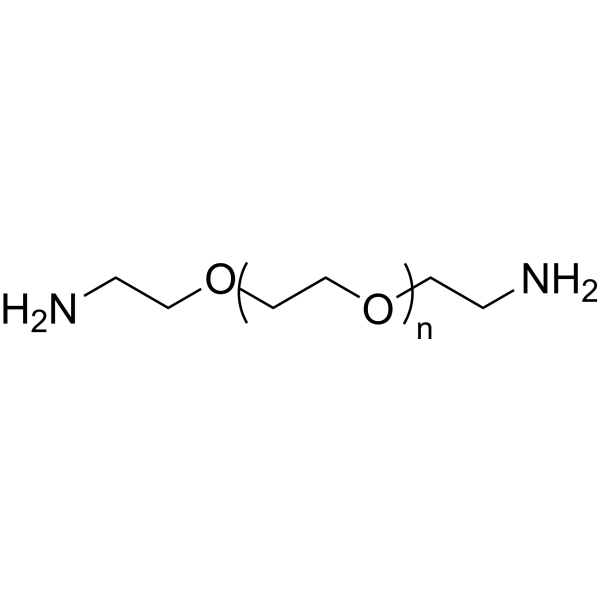
NH2-PEG1000-NH2 is a double-ended amino polyethylene glycol with a number-average molecular weight of 1000, which serves as a synthetic raw material for adamantyl polyethylene glycol amine. NH2-PEG1000-NH2 can be used for the preparation of reduction-responsive liver-targeted polymeric micelles .
|
-
- HY-183191
-
|
|
Biochemical Assay Reagents
|
Others
|
|
DMG-PEG1000-Alkyne is a conjugate composed of dimyristic glycerol (DMG), a PEG chain, and a terminal alkyne group. DMG-PEG1000-Alkyne combines the membrane compatibility of phospholipids with the high reactivity of the alkyne group in click chemistry, making it suitable for research in biomaterial construction and drug delivery.
|
-
- HY-174358
-
|
|
Biochemical Assay Reagents
|
Others
|
|
HOOC-PEG1000-COOH has two active carboxyl groups at both ends, which can selectively react with the amino groups in peptide coupling agents. HOOC-PEG1000-COOH is a good cross-linking agent for PEGylation of proteins and peptides, nanoparticles and surface modification .
|
-
- HY-172484
-
|
|
Liposome
|
Cancer
|
|
DSPE-PEG1000-LTLRWVGLMS is a PEG compound which composed of DSPE and a decapeptide (LTLRWVGLMS). The chondroitin sulfate proteoglygan NG2 is a receptor for LTLRWVGLMS. LLRWVGLMS shows the homing of pericytes associated with tumor blood vessels. DSPE-PEG1000-LTLRWVGLMS can be used for drug delivery .
|
-
- HY-174912B
-
|
|
Biochemical Assay Reagents
|
Others
|
|
DBCO-PEG1000-LA is a PEG derivative consisting of DBCO, PEG units, and Lipoic Acid (HY-18733). DBCO-PEG1000-LA contains a DBCO group and can undergo a strain-promoted alkyne-azide cycloaddition reaction (SPAAC) with molecules containing an azide group .
|
-
- HY-167036A
-
|
|
Biochemical Assay Reagents
|
Others
|
|
DMG-PEG1000-Mal is a PEG derivative composed of N,N-Dimethylglycine (DMG), PEG units and Maleimide (HY-W007324). Maleimide forms a stable thioether bond with sulfhydryl (-SH) groups. DMG-PEG1000-Mal can be used for drug delivery .
|
-
- HY-W1052227C
-
|
|
Biochemical Assay Reagents
|
Others
|
|
DMPE-PEG1000-Mal is a conjugate composed of DMPE, PEG chains, and maleimide (Mal). The maleimide group in DMPE-PEG1000-Mal can undergo a specific Michael addition reaction with thiol-containing (-SH) biomolecules (such as peptides, antibodies, and aptamers), enabling targeted modification of liposomes/nanoparticles.
|
-
- HY-W1052492C
-
|
|
Biochemical Assay Reagents
|
Others
|
|
DPPE-PEG1000-Mal is a conjugate composed of DPPE, PEG chains, and maleimide (Mal). The maleimide group in DPPE-PEG1000-Mal can undergo a specific Michael addition reaction with thiol-containing (-SH) biomolecules (such as peptides, antibodies, and aptamers), enabling targeted modification of liposomes/nanoparticles.
|
-
- HY-W591448
-
|
|
Biochemical Assay Reagents
|
Others
|
|
DOPE-PEG1000-Azide is a phospholipid. Phospholipids have good biocompatibility and significant amphiphilic characteristics, making them the main and suitable dosage form or excipient in drug formulations, thereby achieving better therapeutic effects. DOPE-PEG1000-Azidecan be used in drug delivery research .
|
-
- HY-W440826
-
|
|
Biochemical Assay Reagents
|
Others
|
|
DOPE-PEG1000-COOH is a phospholipid. Phospholipids have good biocompatibility and significant amphiphilic characteristics, making them the main and suitable dosage form or excipient in drug formulations, thereby achieving better therapeutic effects. DOPE-PEG1000-COOHcan be used in drug delivery research .
|
-
- HY-183126
-
|
|
Biochemical Assay Reagents
|
Others
|
|
DSG-PEG1000-Mal is a conjugate composed of DSG, PEG chains, and maleimide (Mal). The maleimide group in DSG-PEG1000-Mal can undergo a specific Michael addition reaction with thiol-containing (-SH) biomolecules (such as peptides, antibodies, and aptamers), enabling targeted modification of liposomes/nanoparticles.
|
-
- HY-174957B
-
|
|
Biochemical Assay Reagents
|
Others
|
|
6-Arm-PEG1000-DSPE is a PEG cross-linking reagent that links six PEG branches to one DSPE phospholipid. 6-Arm-PEG1000-DSPE can be used for drug delivery, gene transfection, and vaccine delivery .
|
-
- HY-W1123922B
-
|
|
Biochemical Assay Reagents
|
Others
|
|
4-Arm-PEG1000-DSPE is a PEG cross-linking reagent that links four PEG branches to one DSPE phospholipid. 4-Arm-PEG1000-DSPE can be used for drug delivery, gene transfection, and vaccine delivery .
|
-
- HY-172707
-
|
|
Liposome
|
Neurological Disease
|
|
DSPE-PEG1000-PP1 is a PEG compound which composed of DSPE and a PP1 peptide. PP1 peptide targets the inflammatory atherosclerotic plaque. DSPE-PEG1000-PP1 can be used for drug delivery .
|
-
- HY-174964B
-
|
|
Biochemical Assay Reagents
|
Others
|
|
8-Arm-PEG1000-DSPE is a PEG cross-linking reagent that links eight PEG branches to one DSPE phospholipid. 8-Arm-PEG1000-DSPE can be used for drug delivery, gene transfection, and vaccine delivery .
|
-
- HY-W1052215
-
|
Folate-PEG1000-NH2
|
Biochemical Assay Reagents
|
Others
|
|
FA-PEG1000-NH2 (Folate-PEG1000-NH2) is a multifunctional drug delivery system composed of Folic acid (HY-16637), polyethylene glycol (PEG), and NH2. Folic acid (FA) has a high affinity for folic acid receptors and can be used to target cell membrane receptors for drug delivery.
|
-
- HY-W1123945B
-
|
8-Arm-PEG1000-Folate
|
Biochemical Assay Reagents
|
Others
|
|
8-Arm-PEG1000-FA (8-Arm-PEG1000-Folate) is a PEG derivative with one Folic acid (HY-16637) molecule attached to each end of the PEG chain. Folic acid has a high affinity for folate receptors and can be used for targeted drug delivery to cell membrane receptors .
|
-
- HY-W1123921B
-
|
4-Arm-PEG1000-Folate
|
Biochemical Assay Reagents
|
Others
|
|
4-Arm-PEG1000-FA (4-Arm-PEG1000-Folate) is a PEG derivative with one Folic acid (HY-16637) molecule attached to each end of the PEG chain. Folic acid has a high affinity for folate receptors and can be used for targeted drug delivery to cell membrane receptors .
|
-
- HY-174906
-
|
|
Biochemical Assay Reagents
|
Others
|
|
Bis-PEG1000-COOH is a disubstituted PEG derivative with the same functional group. The carboxylic acid group in Bis-PEG1000-COOH can react with other compounds containing amino, hydroxyl and other functional groups to form stable chemical bonds, which can be used for drug delivery .
|
-
- HY-182099
-
|
|
Liposome
|
Cancer
|
|
DSPE-PEG1000-DHLASLWWGTEL is a PEG compound which composed of DSPE and a GPC3 targeting peptide DHLASLWWGTEL. The DHLASLWWGTEL peptide partially and specifically binds to GPC3-positive cells, achieving precise targeting. DSPE-PEG1000-DHLASLWWGTEL can be used for drug delivery .
|
-
- HY-183156
-
|
|
Biochemical Assay Reagents
|
Others
|
|
DMG-PEG1000-Glucose is a conjugate composed of dimyristic glycerol (DMG), a PEG chain, and terminal glucose. DMG-PEG1000-Glucose combines the membrane compatibility of phospholipids with glucose as an active site for sugar recognition or subsequent coupling reactions, making it suitable for research in biomaterial construction and drug delivery.
|
-
- HY-172270
-
|
|
Liposome
|
Cancer
|
|
DSPE-PEG1000-PTP is synthesised by conjugating the amino group of plectin-1 peptide (PTP) with DSPE-PEG-NHS ester via amide bonds. DSPE-PEG1000-PTP can be used to construct drug delivery vectors .
|
-
- HY-172701
-
|
|
Liposome
|
Cancer
|
|
DSPE-PEG1000-NYZL1 is a PEG compound which composed of DSPE and a NYZL1 peptide. NYZL1 can specifically bind to bladder cancer tissues and cells. DSPE-PEG1000-NYZL1 can be used for drug delivery .
|
-
- HY-D2564
-
|
|
Fluorescent Dye
|
Others
|
|
Cy5.5-PEG1000-DSPE is a PEG phospholipid with Cy5.5 (HY-D0924) dye used in protein/nucelic acid labeling and fluorescence microscopy. Cy5.5-PEG1000-DSPE can self-assemble in aqueous solution to form micelles/lipid bilayer and used to prepare liposomes or nanoparticles for nutrients delivery such as mRNA or DNA vaccine.
|
-
- HY-183163
-
|
|
Biochemical Assay Reagents
|
Others
|
|
Glucose-PEG1000-COOH is a conjugate composed of glucose, PEG chains, and carboxyl groups (COOH). Glucose-PEG1000-COOH combines the targeting recognition ability of glucose with the carboxyl groups capable of condensation or esterification reactions with amino and hydroxyl groups, making it suitable for applications such as targeted drug delivery systems and nanoparticle modification.
|
-
- HY-172280
-
|
|
Liposome
|
Cancer
|
|
DSPE-PEG1000-Octreotide is a PEG compound which composed of DSPE and a Octreotide (HY-P0036). Octreotide is a somatostatin receptor agonist. Octreotide has antitumor activity, mediates apoptosis and may also be used in disease studies in acromegaly. DSPE-PEG1000-Octreotide can be used for drug delivery .
|
-
- HY-176206
-
|
|
Biochemical Assay Reagents
|
Others
|
|
Biotin-PEG1000-COOH is a linear heterobifunctional PEG compound with biotin and carboxylic acid functional groups. Biotin can bind to avidin and streptavidin with high specificity and affinity. Biotin-PEG1000-COOH can be used to biotin-label antibodies, proteins and other macromolecules containing primary amines in the presence of a condensing agent .
|
-
- HY-172698
-
|
|
Liposome
|
Cancer
|
|
DSPE-PEG1000-ANG is a PEG compound which composed of DSPE and a dual-targeting ligand (Angiopep-2, ANG). ANG exhibits high LRP1 binding efficiency and has been used for glioma-targeting delivery. DSPE-PEG1000-ANG can be used for drug delivery .
|
-
- HY-W440835C
-
|
|
Biochemical Assay Reagents
|
Others
|
|
DSPE-PEG1000-DBCO is a phospholipid-PEG polymer that can be used to form micelles as lipid nanoparticles for drug delivery . DSPE-PEG1000-DBCO is a click chemistry reagent, it contains a DBCO group that can undergo strain-promoted alkyne-azide cycloaddition (SPAAC) with molecules containing Azide groups.
|
-
- HY-W1123940
-
-
- HY-W1123934
-
-
- HY-168374A
-
-
- HY-174264A
-
-
- HY-172466
-
|
|
Liposome
|
Cancer
|
|
DSPE-PEG1000-CTT2 is a PEG compound which composed of DSPE and a gelatinase inhibitor (CTT2 (CTTHWGFTLC)). CTT2 (CTTHWGFTLC) has the ability to specifically target tumors. DSPE-PEG1000-CTT2 can be used for drug delivery .
|
-
- HY-172469
-
|
|
Liposome
EGFR
|
Cancer
|
|
DSPE-PEG1000-GE11 is a PEG compound which composed of DSPE and an EGFR targeting peptide (GE11). GE11 can be used for EGFR overexpressed cancer cells. DSPE-PEG1000-GE11 can be used for drug delivery .
|
-
- HY-172502
-
|
|
Liposome
|
Cancer
|
|
DSPE-PEG1000-KAA is a PEG compound which composed of DSPE and a CKAAKNK peptide (KAA). KAA specifically binds to tumor vessels in RIP-Tag2 transgenic mice. DSPE-PEG1000-KAA can be used for drug delivery .
|
-
- HY-W888710C
-
|
Folate-PEG1000-COOH
|
Biochemical Assay Reagents
|
Others
|
|
FA-PEG1000-COOH (Folate-PEG1000-COOH) is a Folic acid (HY-16637)-modified PEG derivative containing a carboxyl group (-COOH). The carboxyl group can easily form a stable amide bond with an amino group, or an ester bond with a hydroxyl group. Folic acid (-FA) has a high affinity for the folate receptor and can be used to target cell membrane receptors for drug delivery .
|
-
- HY-W1052178D
-
|
Folate-PEG1000-Cholesterol
|
Biochemical Assay Reagents
|
Others
|
|
FA-PEG1000-Cholesterol (Folate-PEG1000-Cholesterol) is a multifunctional drug delivery system composed of Folic acid (HY-16637), polyethylene glycol (PEG), and Cholesterol (HY-N0322). Folic acid (FA) has a high affinity for folic acid receptors and can be used to target cell membrane receptors for drug delivery. Cholesterol can improve the circulation time of encapsulated drugs .
|
-
- HY-182092
-
|
|
Liposome
|
Others
|
|
DSPE-PEG1000-Asp6 is a PEG compound which composed of DSPE and a Asp6 peptide. DSPE-PEG1000-Asp6 achieves bone-targeted delivery of drugs or imaging agents by binding to bone tissue with the Asp6 peptide through high affinity .
|
-
- HY-172722
-
|
|
Liposome
|
Cancer
|
|
DSPE-PEG1000-T7 is a PEG compound which composed of DSPE and a transferrin receptor (TfR) peptide (T7). T7 (HAIYPRH) specifically binds to TfR (transferrin receptor). DSPE-PEG1000-T7 can be used for drug delivery .
|
-
- HY-144000B
-
-
- HY-D2886B
-
|
Rhodamine B-PEG1000-N3
|
Fluorescent Dye
|
Others
|
|
RB-PEG1000-N3 (Rhodamine B-PEG1000-N3) is a fluorescent dye composed of Rhodamine B (HY-Y0016), PEG and azide group (N3). RB-PEG1000-N3 is a click chemistry reagent, it contains an Azide group and can undergo copper-catalyzed azide-alkyne cycloaddition reaction (CuAAc) with molecules containing Alkyne groups. It can also undergo strain-promoted alkyne-azide cycloaddition (SPAAC) reactions with molecules containing DBCO or BCN groups (Ex/Em=546/610 nm) .
|
-
- HY-173381A
-
|
Cholesteryl biotinyl(polyethyleneglycol)-1000 carbamate
|
Biochemical Assay Reagents
|
Others
|
|
Cholesteryl-PEG1000-Biotin is a lipid product. Cholesteryl-PEG1000-Biotin is a cholesterol backbone attached to one side of a PEG unit and a Biotin unit on the other side. Biotin is an enzyme cofactor that can be used to label proteins, and PEG is a low-toxic, hydrophilic, water-soluble polymer. Cholesteryl-PEG1000-Biotin can be used for drug circulation time studies .
|
-
- HY-177204A
-
|
|
Liposome
|
Cardiovascular Disease
|
|
DSPE-PEG1000-WLSEAGPVVTVRALRGTGSW is a PEG compound which composed of DSPE and a cardiomyocyte specific peptide (WLSEAGPVVTVRALRGTGSW) (HY-P3436). WLSEAGPVVTVRALRGTGSW exhibits high cardiomyocyte targeting primarily through selective binding to specific receptors or molecules on the surface of cardiomyocytes. DSPE-PEG1000-WLSEAGPVVTVRALRGTGSW can be used for drug delivery .
|
-
- HY-W1048661
-
|
|
Biochemical Assay Reagents
|
Others
|
|
Biotin-PEG1000-maleimide is a PEG derivative consisting of a linear PEG chain with biotin attached to one end and maleimide modified to the other end. Biotin-PEG1000-maleimide anchors drugs or targeting ligands to liposomes or polymer nanocarriers through the maleimide end, and the biotin end is used for in vitro purification or in vivo targeted release .
|
-
- HY-172463
-
|
|
Liposome
Integrin
|
Cancer
|
|
DSPE-PEG1000-cRGD is a PEG compound which composed of DSPE and an αvβ3 targeting peptide (cRGD). cRGD peptide can specifically bind to αvβ3 on the surface of many cancer cells and neovascular cells. DSPE-PEG1000-cRGD can be used for drug delivery .
|
-
- HY-140736A
-
|
|
Liposome
|
Others
|
|
DSPE-PEG1000-Biotin is a PEG-based PROTAC linker that can be used in the synthesis of PROTACs .
|
-
- HY-140657
-
|
|
PROTAC Linkers
|
Cancer
|
|
Biotin-PEG1000-triethoxysilane is a PEG-based PROTAC linker that can be used in the synthesis of PROTACs .
|
-
- HY-140656
-
|
|
PROTAC Linkers
|
Cancer
|
|
Biotin-PEG1000-Biotin is a PEG-based PROTAC linker that can be used in the synthesis of PROTACs .
|
-
- HY-140713
-
|
|
PROTAC Linkers
|
Cancer
|
|
HO-PEG1000-amine is a PEG-based PROTAC linker that can be used in the synthesis of PROTACs .
|
-
- HY-140702
-
|
|
PROTAC Linkers
|
Cancer
|
|
m-PEG1000-triethoxysilane is a PEG-based PROTAC linker that can be used in the synthesis of PROTACs .
|
-
- HY-147205
-
|
|
PROTAC Linkers
|
Others
|
|
Biotin-PEG1000-OH is a PEG-based PROTAC linker that can be used in the synthesis of PROTACs .
|
-
- HY-172496
-
|
|
Liposome
|
Cancer
|
|
DSPE-PEG1000-CREKA is a PEG compound which composed of DSPE and a fibrin-targeting peptide (CREKA). CREKA peptide can be used to target tumor cells and tumor vasculature, exhibiting antitumor activity. DSPE-PEG1000-CREKA can be used for drug delivery .
|
-
- HY-172281
-
|
|
Liposome
|
Cardiovascular Disease
|
|
DSPE-PEG1000-CCK8 is a PEG compound which composed of DSPE and a Cholecystokinin-8 (CCK8). Cholecystokinin-8 has the activity of peptide regulating gallbladder contraction and digestive system function. DSPE-PEG1000-CCK8 can be used for drug delivery .
|
-
- HY-172475
-
|
|
Liposome
|
Cancer
|
|
DSPE-PEG1000-YIGSR is a PEG compound which composed of DSPE and a biomimetic peptide YIGSR. YIGSR interacts with the 67 kDa laminin binding protein (LBP) and promotes adhesion and spreading of a large number of cell types including endothelial cells, fibroblasts and smooth muscle cells. DSPE-PEG1000-YIGSR can be used for drug delivery .
|
-
- HY-183104
-
|
|
Biochemical Assay Reagents
|
Others
|
|
DSG-PEG1000-NHS is a conjugate composed of DSG, PEG chains, and terminal active esters (NHS). The NHS ester in DSG-PEG1000-NHS can rapidly covalently react with molecules containing primary amines (such as proteins, peptides, and small molecules modified with amino groups) to form stable amide bonds, enabling targeted modification of liposomes/nanoparticles.
|
-
- HY-183016
-
|
|
Biochemical Assay Reagents
|
Others
|
|
DMPE-PEG1000-NHS is a conjugate composed of DMPE, PEG chains, and terminal active esters (NHS). The NHS ester in DMPE-PEG1000-NHS can rapidly covalently react with molecules containing primary amines (such as proteins, peptides, and small molecules modified with amino groups) to form stable amide bonds, enabling targeted modification of liposomes/nanoparticles.
|
-
- HY-182833
-
|
|
Biochemical Assay Reagents
|
Others
|
|
DPPE-PEG1000-NHS is a conjugate composed of DPPE, PEG chains, and terminal active esters (NHS). The NHS ester in DMPE-PEG1000-NHS can rapidly covalently react with molecules containing primary amines (such as proteins, peptides, and small molecules modified with amino groups) to form stable amide bonds, enabling targeted modification of liposomes/nanoparticles.
|
-
- HY-D2844A
-
|
|
Fluorescent Dye
|
Neurological Disease
|
|
FITC-PEG1000-FA is a fluorescent dye composed of Folic acid (HY-16637) (FA), polyethylene glycol (PEG) and FITC (HY-66019). Fluorescent dye is linked to PEG and Folic acid through a specific chemical reaction to form a molecule with special properties. FITC-PEG1000-FA can be used for fluorescent labeling and imaging .
|
-
- HY-174928
-
|
|
Biochemical Assay Reagents
|
Others
|
|
HO-PEG1000-AS is a PEG derivative with a hydroxyl (OH) functional group and a thioacetate (AS) and can be used for drug delivery.
|
-
- HY-D2592
-
|
|
Fluorescent Dye
|
Others
|
|
Cy7.5-PEG1000-DSPE is a PEG phospholipid with CY7.5 (HY-D0926) dye used in protein/nucelic acid labeling and fluorescence microscopy. Cy7.5-PEG1000-DSPE can self-assemble in aqueous solution to form micelles/lipid bilayer and used to prepare liposomes or nanoparticles for nutrients delivery such as mRNA or DNA vaccine (Ex/Em=770/820 nm).
|
-
- HY-W1052523C
-
|
|
Biochemical Assay Reagents
|
Others
|
|
DPPE-PEG1000-NH2 is a conjugate composed of DPPE, a PEG chain, and a terminal primary amino group (-NH2). The primary amino group in DPPE-PEG1000-NH2 can be covalently linked to functional groups such as carboxylic acids, NHS esters, and isocyanates for targeted modification of liposomes/nanoparticles.
|
-
- HY-182097
-
|
|
Liposome
|
Inflammation/Immunology
|
|
DSPE-PEG1000-GNYTCEVTELTREGETIIELK is a PEG compound which composed of DSPE and a peptide mimicking the function of CD47 (GNYTCEVTELSREGKTVIELK). Modifying the surface of LNPs with GNYTCEVTELSREGKTVIELK significantly reduced the recognition and clearance of LNPs by the mononuclear phagocytic system (MPS), and decreased their accumulation in non-target tissues such as the liver and spleen. DSPE-PEG1000-GNYTCEVTELTREGETIIELK can be used for drug delivery .
|
-
- HY-172493
-
|
|
Liposome
Integrin
|
Cancer
|
|
DSPE-PEG1000-iRGD is a PEG compound which composed of DSPE and an αv-integrins targeting peptide (iRGD). iRGD peptide binds to αv-integrins, and then proteolytically cleaved in the tumor to produce CRGDK/R to interact with neuropilin-1, and has tumor-targeting and tumor-penetrating properties. DSPE-PEG1000-iRGD can be used for drug delivery .
|
-
- HY-172478
-
|
|
Liposome
|
Cancer
|
|
DSPE-PEG1000-F3 is a PEG compound which composed of DSPE and a nucleolin targeting peptide (F3). F3 peptide can specifically bind to cell surface nucleolin and undergo an effective cell surface to nucleus transport. DSPE-PEG1000-F3 can be used for drug delivery .
|
-
- HY-D2895B
-
|
Rhodamine B-PEG1000-NH2
|
Fluorescent Dye
|
Others
|
|
RB-PEG1000-NH2 (Rhodamine B-PEG1000-NH2) is a fluorescent dye composed of Rhodamine B (HY-Y0016), PEG and an amino group. The reactive primary amine or NH2 groups can react rapidly with activated carboxylic acids such as NHS esters to form stable amide bonds (Ex/Em=546/610 nm) .
|
-
- HY-W1123944B
-
-
- HY-W1048555
-
|
|
Biochemical Assay Reagents
|
Others
|
|
Mal-PEG1000-SCM is a linear hetero-bifunctional PEG product with maleimide and succinimidyl NHS ester groups. Mal-PEG1000-SCM is an important cross-linker with PEG chains. Maleimide reacts with thiols, SH, sulfhydryls or sulfhydryls, and SCM stands for succinimidyl carboxymethyl ester, which reacts with primary amines. Maleimide contains a reactive C=C double bond and is sensitive to light or oxygen .
|
-
- HY-174951
-
-
- HY-174950
-
|
|
Biochemical Assay Reagents
|
Others
|
|
DSPE-PEG1000-Pyrene is a lipid-containing PEG derivative that can be used to form micelles as nanoparticles for drug delivery .
|
-
- HY-174901
-
|
|
Biochemical Assay Reagents
|
Others
|
|
DSPE-PEG1000-Furan is a lipid-containing PEG derivative that can be used to form micelles as nanoparticles for drug delivery .
|
-
- HY-174960B
-
|
6-Arm-PEG1000-Folate
|
Biochemical Assay Reagents
|
Others
|
|
6-Arm-PEG1000-FA (6-Arm-PEG1000-Folate) is a PEG derivative modified with Folic acid (HY-16637). Polyethylene glycol can increase solubility and stability and reduce the immunogenicity of peptides and proteins. It can also inhibit the nonspecific binding of charged molecules to modified surfaces. Folic acid (-FA) has a high affinity for folate receptors and can be used for cell membrane receptors for targeted drug delivery .
|
-
- HY-174949
-
|
FMOC-NH-PEG1000-Thiol
|
Biochemical Assay Reagents
|
Others
|
|
FMOC-NH-PEG1000-SH (FMOC-NH-PEG1000-Thiol) is a PEG derivative with an Fmoc protecting group and a thiol (-SH) reactive group. The thiol group is a highly reactive chemical group that can react specifically with a variety of molecules to form stable covalent bonds. Fmoc is a commonly used amino protecting group that protects the amino group from unwanted reactions until it is removed when a specific coupling reaction is required.
|
-
- HY-172499
-
|
|
Liposome
|
Cancer
|
|
DSPE-PEG1000-Mal-CLPLIPTHIISFS is a PEG compound composed of DSPE and the liver cancer targeting peptide SP94 (HY-P11050A) (sequence SFSIIHTPILPL). SP94 exhibits specific binding to hepatocellular carcinoma (HCC) cells. DSPE-PEG1000-Mal-CLPLIPTHIISFS can be used to prepare lipid nanoparticles to form liver cancer-targeting nanocarriers.
|
-
- HY-183162
-
|
|
Biochemical Assay Reagents
|
Others
|
|
Glucose-PEG1000-NHS is a conjugate composed of glucose, PEG chains, and an active ester (NHS). Glucose-PEG1000-NHS combines the targeted recognition capabilities of glucose with the ability to rapidly covalently react with molecules containing primary amines (such as proteins, peptides, and amino-modified small molecules) to form stable amide bonds in an NHS ester. This allows for applications such as constructing targeted drug delivery systems and modifying nanoparticles.
|
-
- HY-177205A
-
|
|
Liposome
|
Cardiovascular Disease
|
|
DSPE-PEG1000-CRPPR is a PEG compound which composed of DSPE and a?Heart-homing peptide?(CRPPR) (HY-P10641). CRPPR is a linear peptide containing arginine that has the ability to specifically bind to the cardiac endothelium and uses cysteine-rich protein-2 (CRIP-2) as its receptor. DSPE-PEG1000-CGKRK can be used for drug delivery .
|
-
- HY-W1048547H
-
|
HOOC-PEG1000-Amine
|
Biochemical Assay Reagents
|
Others
|
|
HOOC-PEG1000-NH2 (HOOC-PEG1000-Amine) is a heterobifunctional PEG crosslinker that can be used to attach functional PEG to biomolecules, particles, and other surface materials. The carboxyl group reacts with the amine group to form a stable amide bond. It can also react with the hydroxyl group to form an unstable ester bond. On the other hand, the amine group can be used to react with many amine-reactive groups, such as succinimidyl NHS esters, aldehydes, etc .
|
-
- HY-174961
-
|
Fmoc-NH-PEG1000-Mal
|
Biochemical Assay Reagents
|
Others
|
|
Fmoc-PEG1000-Maleimide (Fmoc-NH-PEG1000-Mal) is a PEG derivative with an Fmoc protecting group and a Maleimide (HY-W007324) reactive group. Fmoc is a commonly used amino protecting group that protects the amino group from unwanted reactions until it is removed for a specific coupling reaction. Maleimide forms a stable thioether bond with sulfhydryl (-SH) groups. PEG modification can improve solubility and stability and reduce the immunogenicity of proteins and peptides .
|
-
- HY-D2505
-
|
|
Fluorescent Dye
|
Others
|
|
Cy3-PEG1000-NH2 is a polyethylene glycol derivative containing Cy3 (HY-D0822) fluorescent dye and polyethylene glycol (PEG) and an amino group. The Cy3 fluorophore is commonly used in applications such as immunolabeling, nucleic acid labeling, fluorescence microscopy, and flow cytometry. Cy3 has an emission maximum around 562-570 nm. Cy3-PEG1000-NH2 can be used for fluorescence imaging, fluorescence tracing and fluorescence labeling .
|
-
- HY-172487
-
|
|
Liposome
|
Cancer
|
|
DSPE-PEG1000-K237 is a PEG compound which composed of DSPE and a KDR targeting peptide (K237). K237 can functionally disrupt the interaction between VEGF and the KDR receptor and cause potent biological effects that include the inhibition of angiogenesis and tumor growth. DSPE-PEG1000-K237 can be used for drug delivery .
|
-
- HY-203300A
-
|
|
Biochemical Assay Reagents
|
Others
|
|
DOPE-PEG1000-NHS is a conjugate composed of DOPE, PEG chains, and terminal active ester (NHS). The NHS ester in DOPE-PEG1000-NHS can rapidly covalently react with molecules containing primary amines (such as proteins, peptide chains, and small molecules modified with amino groups) to form stable amide bonds, suitable for the construction of carriers requiring membrane fusion properties or pH-sensitive release (such as gene delivery systems).
|
-
- HY-176509
-
|
|
Liposome
|
Others
|
|
DSPE-PEG1000-CHO is a linear heterobifunctional PEGylation reagent with DSPE phospholipids and aldehyde groups. PEG linkers have good hydrophilicity and water solubility. Aldehyde-polyethylene glycol (DSPE) is one of the most commonly used reactive phospholipids to bind antibodies, peptides or other ligands to the surface of liposomes and other lipid-polyethylene glycol nanoparticles. DSPE-PEG1000-CHO can be used for drug delivery .
|
-
- HY-174952B
-
-
- HY-182094
-
|
|
Liposome
|
Metabolic Disease
|
|
DSPE-PEG1000-KTP is a PEG compound which composed of DSPE and a Kidney-targeting peptide KTP (HY-P11069). KTP can interact with specific proteins on the surface of renal tubular epithelial cells or exhibit higher affinity in the specific renal microenvironment, tending to aggregate or be internalized within the renal tubular epithelium. DSPE-PEG1000-KTP can actively guide carriers such as nanomedicines, liposomes, and microspheres to the kidney .
|
-
- HY-182095
-
|
|
Liposome
|
Cardiovascular Disease
|
|
DSPE-PEG1000-CTP is a PEG compound which composed of DSPE and a Cardiac-targeting peptide CTP (HY-P4094). CTP molecules that specifically recognize cardiac tissue and is primarily used for targeted drug delivery. CTP effectively recognizes and binds to specific receptors on the surface of cardiac cells, thereby achieving precise localization of drug molecules. DSPE-PEG1000-CTP can be used for drug delivery .
|
-
- HY-174959B
-
-
- HY-W591485
-
|
|
Biochemical Assay Reagents
|
Others
|
|
Acrylate-PEG1000-acrylate is a linear polymer formed by connecting acrylate groups at both ends of a PEG molecule and can be used for drug delivery .
|
-
- HY-W1123936B
-
|
DBCO-PEG1000-Folate
|
Folate Receptor (FR)
|
Cancer
|
|
DBCO-PEG1000-FA (DBCO-PEG1000-Folate) is a multifunctional bioconjugation reagent, which is a copolymer of DBCO and Folic acid (FA) (HY-16637) and can target folate receptors (FR). Folate receptors are highly overexpressed on the surface of many cancer cells (such as lung cancer, nasopharyngeal cancer, ovarian cancer, etc.), but exhibit extremely low expression levels in normal tissues. DBCO-PEG-FA can be used for click chemistry conjugation via its DBCO terminal, and thus applies to various bioconjugation and drug delivery applications .
|
-
- HY-174885
-
|
|
Biochemical Assay Reagents
|
Others
|
|
Acrylate-PEG1000-Maleimide is a PEG derivative containing an acrylate functional group, a PEG chain, and a maleimide group, which can be used for drug delivery .
|
-
- HY-130809A
-
|
|
Biochemical Assay Reagents
|
Others
|
|
DBCO-PEG1000-Biotin is a click chemistry biotinylation that can enable copper-free click chemistry with azide molecules to form a stable triazole linkage .
|
-
- HY-W591476
-
|
mPEG1000-SH
|
Biochemical Assay Reagents
|
Others
|
|
m-PEG1000-thiol is a surface modifier that can modify DNA thiolation and is used in the synthesis of gold nanorods (AuNR). m-PEG1000-thiol can load thiolated DNA onto AuNR, form a covalent bond with the surface of gold nanoparticles through the thiol group, and stabilize the nanoparticles by the steric hindrance effect of the polyethylene glycol chain, preventing aggregation and enhancing its biocompatibility. m-PEG1000-thiol can also provide a platform for the subsequent coupling of biomolecules (such as DNA, antibodies) by replacing surfactants (such as CTAB) on the surface of nanoparticles, thereby exerting its activity in promoting the functionalization of nanomaterials [2].
|
-
- HY-172275
-
|
|
Liposome
|
Inflammation/Immunology
|
|
DSPE-PEG1000-pPB is a PEG compound which composed of DSPE and a cyclic oligopeptide (pPB). pPB has a strong binding affinity with PDGFRβ, which is overexpressed on activated hepatic stellate cells (HSC). DSPE-PEG1000-pPB can be used for drug delivery .
|
-
- HY-D2552
-
|
|
Fluorescent Dye
|
Others
|
|
Cy5.5-PEG1000-NH2 is a polyethylene glycol derivative containing Cy5.5 (HY-D0924) fluorescent dye and polyethylene glycol (PEG) and an amino group. The Cy5.5 fluorophore is commonly used in applications such as immunolabeling, nucleic acid labeling, fluorescence microscopy, and flow cytometry. Cy5.5 has an emission maximum around 710 nm. Cy5.5-PEG1000-NH2 can be used for fluorescence imaging, fluorescence tracing and fluorescence labeling.
|
-
- HY-138312
-
|
|
PROTAC Linkers
|
Cancer
|
|
m-PEG1000-CH2COOH is a PEG-based PROTAC linker that can be used in the synthesis of PROTACs .
|
-
- HY-W1048669E
-
|
|
Biochemical Assay Reagents
|
Others
|
|
Biotin-PEG1000-DMG is a compound composed of biotin, PEG, and myristoyl-sn-glycerol, used for drug delivery. Biotin forms a stable non-covalent bond with streptavidin.
|
-
- HY-174910B
-
-
- HY-W1051944H
-
|
|
Biochemical Assay Reagents
|
Others
|
|
4-arm PEG1000-LA is a multifunctional drug delivery system composed of lipoic acid (HY-18733) and polyethylene glycol (PEG). The lipoic acid group has a high affinity for metal surfaces and is widely used in gold nanoparticles and quantum dot surfaces.
|
-
- HY-W1048549H
-
|
HOOC-PEG1000-Thiol
|
Biochemical Assay Reagents
|
Others
|
|
HOOC-PEG1000-SH (HOOC-PEG1000-Thiol) is a reactive thiol PEG derivative with a terminal carboxyl group. The carboxyl group can react with amine or hydroxyl groups to form a stable amide bond or an unstable ester bond. The reaction of the carboxyl group allows the amine or hydroxyl group to be converted into a free thiol with a linear PEG linkage. The generated thiol group can be used to modify the surface of gold nanoparticles or participate in other PEGylation reactions. The PEG linkage between the thiol and carboxyl groups has good water solubility, flexible linker distance and higher stability .
|
-
- HY-172273
-
|
|
Liposome
|
Cancer
|
|
DSPE-PEG1000-Mal-Cys-YEQDPWGVKWWY is a PEG compound which composed of DSPE and a M2-polarized macrophages targeting peptide (M2pep, YEQDPWGVKWWY). M2pep is conjugated to a proapoptotic peptide as monovalent or multivalent ligands to concentrate the toxic effect of the peptide to M2 macrophages. DSPE-PEG1000-Mal-Cys-YEQDPWGVKWWY can be used for drug delivery .
|
-
- HY-W1049071E
-
|
|
Biochemical Assay Reagents
|
Others
|
|
HO-PEG1000-SCM is a hetero-bifunctional hydroxy PEG succinimidyl carboxymethyl ester product, which is commonly used as a cross-linker or spacer between two different chemical entities.
|
-
- HY-147206A
-
|
|
Fluorescent Dye
|
Others
|
|
Biotin-PEG1000-Alk is a biotin labeled PEG derivative. Biotin is an enzyme co-factor, can be used for labeling protein; PEG is a hydrophilic and water-soluble polymer with low toxicity; Alk (Alkyne), acyclic (branched or unbranched) aliphatic hydrocarbon, can react with azido, which improve the efficiency of biotin binding targets. Biotin-PEG1000-Alk is a click chemistry reagent, it contains an Alkyne group and can undergo copper-catalyzed azide-alkyne cycloaddition (CuAAc) with molecules containing Azide groups.
|
-
- HY-174884A
-
|
|
Biochemical Assay Reagents
|
Others
|
|
Acrylate-PEG1000-Biotin is a PEG derivative that contains an acrylate functional group, a PEG chain, and a biotin group. The biotin group can be used for specific binding to streptavidin, etc .
|
-
- HY-172689
-
|
|
Liposome
|
Cancer
|
|
DSPE-PEG1000-THRPPMWSPVWP is a PEG compound which composed of DSPE and a transferrin receptor (TfR) peptide (THRPPMWSPVWP). THRPPMWSPVWP binds to the TfR and is subsequently internalized into TfR-expressing cells .
|
-
- HY-D2802A
-
|
|
Fluorescent Dye
|
Others
|
|
FITC-PEG1000-N3 is an azide fluorescent dye containing polyethylene glycol (PEG) and FITC (HY-66019). FITC-PEG1000-N3 is a click chemistry reagent, it contains an Azide group and can undergo copper-catalyzed azide-alkyne cycloaddition reaction (CuAAc) with molecules containing Alkyne groups. It can also undergo strain-promoted alkyne-azide cycloaddition (SPAAC) reactions with molecules containing DBCO or BCN groups.
|
-
- HY-182096
-
|
|
Liposome
|
Neurological Disease
|
|
DSPE-PEG1000-MG1 is a PEG compound which composed of DSPE and a MG1 peptide (HY-P11315). MG1 peptide is a M1 Microglia-targeting peptide. MG1 peptide can conjugate to anoparticles, crossing the BBB to precisely M1 microglia recognition and achieving controlled release and specific accumulation of drugs through intelligent molecular switching. DSPE-PEG1000-KTP can be used for drug delivery .
|
-
- HY-172710
-
|
|
Liposome
|
Cancer
|
|
DSPE-PEG1000-R6H4 is a PEG compound which composed of DSPE and pH responsive membrane-penetrating peptide (R6H4). R6H4 can be used for pH responsive anticancer drug delivery purposes. DSPE-PEG1000-R6H4 can be used for drug delivery .
|
-
- HY-W440831
-
|
|
Liposome
|
Others
|
|
DSPE-PEG1000-azide is a phospholipid with covalently attached polydisperse PEG. This polymer is commonly used for the preparation of long circulating liposomes. The azide moiety is reactive with alkyne to form a stable triazole bond.
|
-
- HY-N16237
-
|
|
Biochemical Assay Reagents
|
Others
|
|
Chol-PEG1000-maleimide is a PEG derivative composed of Cholesterol, PEG units and Maleimide (HY-W007324). Maleimide forms a stable thioether bond with sulfhydryl (-SH) groups .
|
-
- HY-174953
-
|
|
Biochemical Assay Reagents
|
Others
|
|
TPP-PEG1000-Mal is a PEG derivative composed of triphenyl phosphate (TPP), PEG units, and Maleimide (HY-W007324). Maleimide forms a stable thioether bond with sulfhydryl (-SH) groups .
|
-
- HY-W440722
-
|
|
Liposome
|
Others
|
|
Cholesterol-PEG1000-Thiol is a PEGylated lipid that forms micelles in water and can be used to prepare liposomes or nanoparticles as drug delivery systems. The thiol moiety reacts with maleimide to form a stable thioether bond .
|
-
- HY-W440949
-
|
|
Biochemical Assay Reagents
|
Others
|
|
Stearic acid-PEG1000-Mal enables surface modification of various substrate through reaction between hydroxyl and ethoxyl silane. The polymer can be used for click chemistry with alkyne containing molecule.
|
-
- HY-174364
-
|
|
Biochemical Assay Reagents
|
Others
|
|
Alkyne-PEG1000-COOH is a heterobifunctional PEG crosslinker that can be used to attach functional PEG to biomolecules, particles, and other material surfaces. The carboxyl group can react with the amine group to form a stable amide bond .
|
-
- HY-172490
-
|
|
Liposome
|
Cancer
|
|
DSPE-PEG1000-ESBP is a PEG compound which composed of DSPE and a E-selectin-binding peptide (ESBP). As a tumor-targeting peptide, ESBP can specifically recognize and bind to receptors or markers on the surface of tumor cells .
|
-
- HY-W1123937
-
|
|
Biochemical Assay Reagents
|
Others
|
|
Biotin-PEG1000-CHO is a biotin-conjugated PEG derivative that can be used to biotinylate biomolecules or other surfaces. Biotin can be easily detected by biotin/streptavidin binding assay and is widely used in molecular targeted detection .
|
-
- HY-D2509
-
|
|
Fluorescent Dye
|
Others
|
|
Cy3-PEG1000-SH is a fluorescent labeling reagent that combines Cy3 (HY-D0822) fluorescent dye, polyethylene glycol (PEG) and sulfhydryl (SH) derivatives, and is suitable for molecular coupling. SH is highly reactive and can react with a variety of functional groups (such as maleimide) to form stable thioether bonds .
|
-
- HY-W440895
-
|
|
Biochemical Assay Reagents
|
Others
|
|
DSPE-PEG1000-SH is an amphiphilic poly-PEG that can form lipid bilayers in water. This amphiphilic polymer can form lipid bilayers in aqueous solution and can be used to embed active molecules for drug delivery systems such as mRNA vaccines.
|
-
- HY-W440891
-
|
|
Biochemical Assay Reagents
|
Others
|
|
DSPE-PEG1000-OH is a hydroxyl terminated phospholipid PEG polymer. The hydrophobic tails allow for the encapsulation and congregation of other hydrophobic drugs. The polymer can be used to prepare liposomes or lipid nanoparticles. Hydroxyl terminal can further derivatize the compound.
|
-
- HY-140696E
-
|
mPEG1000-Hydroxy; Polyethylene glycol monomethyl ether 1000
|
Environmental Pollutants
Biochemical Assay Reagents
|
Cancer
|
|
m-PEG1000-OH (mPEG1000-Hydroxy) is a monomethoxypolyethylene glycol and also a macroinitiator for organocatalytic ring-opening polymerization of aliphatic cyclic carbonate monomers. m-PEG1000-OH can participate in the synthesis of amphiphilic block copolymers. Amphiphilic block copolymers can be used to prepare nanoscale micelles for active drug delivery .
|
-
- HY-174954B
-
|
|
Biochemical Assay Reagents
|
Others
|
|
6-Arm-PEG1000-DA is a polymer consisting of a four-arm PEG core structure with acrylate groups attached to the ends of each PEG chain by chemical reaction, which can be used for drug delivery .
|
-
- HY-W440899
-
|
|
Liposome
|
Others
|
|
DSPE-PEG1000-SPDP is a thiol reactive PEG lipid. The polymer is amphiphilic and spontaneously forms lipid bilayer in water. It can be used to encapsulate nutrients or therapeutics for targeted drug delivery, for example mRNA or DNA vaccine, liposomal doxorubicin for anti tumor.
|
-
- HY-W440914
-
|
|
Fluorescent Dye
|
Others
|
|
DSPE-PEG1000-FITC is an amphiphile PEG polymer which has unsaturated lipid tails. The polymer can form micelles in an aqueous solution and can be used to prepare liposome/nano particles for drug nanocarriers. . Reagent grade, for research use only.
|
-
- HY-172692
-
|
|
Liposome
|
Cancer
|
|
DSPE-PEG1000-TH is a PEG compound which composed of DSPE and a pH-responsive cell penetrating peptide (TH). TH is activated in an acidic environment (such as the tumor microenvironment) and can selectively carry small molecules, oligonucleotides, proteins, etc. into tumor cells .
|
-
- HY-174958B
-
|
|
Biochemical Assay Reagents
|
Others
|
|
6-Arm-PEG1000-Silane is a silane-modified PEG derivative that can be used to modify glass, silicon or other surfaces by reacting hydroxyl groups with ethoxy (methoxy) silane. PEG can inhibit nonspecific surface binding .
|
-
- HY-182098
-
|
|
Liposome
|
Cancer
|
|
DSPE-PEG1000-GALA is a PEG compound which composed of DSPE and a lung endothelium-targeting peptide GALA (HY-P5423). GALA is a pH-responsive amphipathic peptide consisting of 30 amino acids, which acts as a lung endothelium-targeting ligand. GALA undergoes a conformational transition from random coil to α-helix in an acidic environment at pH 5.0, thereby inducing endosomal membrane destabilization and fusion. GALA-modified liposomes traverse lung endothelial cells via clathrin-dependent endocytosis and transcytosis, and specifically accumulate in the lungs after intravenous injection. DSPE-PEG1000-GALA can be used for drug delivery .
|
-
- HY-D2856
-
|
|
Fluorescent Dye
|
Others
|
|
FITC-PEG1000-Br is a fluorescent dye composed of FITC (HY-66019), PEG and chlorine (-Cl). The chlorine group is an electrophilic active group that can be used for nucleophilic substitution reactions and facilitate subsequent chemical modification (Ex/Em=488/525 nm).
|
-
- HY-D2854A
-
|
|
Fluorescent Dye
|
Others
|
|
FITC-PEG1000-CL is a fluorescent dye composed of FITC (HY-66019), PEG and chlorine (-Cl). The chlorine group is an electrophilic active group that can be used for nucleophilic substitution reactions and facilitate subsequent chemical modification (Ex/Em=488/525 nm).
|
-
- HY-D2556
-
|
|
Fluorescent Dye
|
Others
|
|
Cy5.5-PEG1000-SH is a fluorescent labeling reagent that combines Cy5.5 (HY-D0924) fluorescent dye, polyethylene glycol (PEG) and sulfhydryl (SH) derivatives, and is suitable for molecular coupling. SH is highly reactive and can react with a variety of functional groups (such as maleimide) to form stable thioether bonds.
|
-
- HY-W1049136E
-
|
|
Biochemical Assay Reagents
|
Others
|
|
N3-PEG1000-N3 is a click chemistry reagent, it contains an Azide group and can undergo copper-catalyzed azide-alkyne cycloaddition reaction (CuAAc) with molecules containing Alkyne groups. It can also undergo strain-promoted alkyne-azide cycloaddition (SPAAC) reactions with molecules containing DBCO or BCN groups .
|
-
- HY-174931
-
|
|
Biochemical Assay Reagents
|
Others
|
|
HO-PEG1000-NH-Fmoc is a PEG derivative with an Fmoc protecting group and a hydroxyl (OH) reactive group. Fmoc is a commonly used amino protecting group that protects the amino group from unwanted reactions until it is removed for a specific coupling reaction.
|
-
- HY-182981
-
|
|
Biochemical Assay Reagents
|
Others
|
|
Mannose-PEG1000-Biotin is a conjugate composed of mannose, PEG chains, and biotin. Mannose-PEG-Biotin combines the targeting recognition ability of mannose with the high affinity of biotin to bind avidin/link avidin, and is used for applications such as constructing targeted drug delivery systems and nanoparticle modification.
|
-
- HY-W440888A
-
|
|
Biochemical Assay Reagents
|
Others
|
|
DSPE-PEG1000-Folate is a PEG derivative containing folic acid. DSPE-PEG-Folate has a targeting effect and bind to folate receptors in cancer cells. DSPE-PEG-Folate form micelles/lipid bilayer and can be used to targeted drug delivery system research .
|
-
- HY-174809B
-
|
|
Biochemical Assay Reagents
|
Others
|
|
6-Arm-PEG1000-Mal is a PEG derivative modified with Maleimide (HY-W007324), which forms a stable thioether bond with sulfhydryl (-SH). PEG modification can improve solubility and stability and reduce the immunogenicity of proteins and peptides .
|
-
- HY-174896
-
|
|
Biochemical Assay Reagents
|
Others
|
|
DSPE-PEG1000-Fmoc is a lipid-containing PEG derivative that can be used to form micelles as nanoparticles for drug delivery . Fmoc is a commonly used amino protecting group that protects the amino group from unwanted reactions until it is removed when a specific coupling reaction is required.
|
-
- HY-174921
-
|
|
Biochemical Assay Reagents
|
Others
|
|
Maleimide-PEG1000-COOH is a PEG derivative composed of Maleimide (HY-W007324), PEG units and carboxyl (-COOH). Carboxyl can easily form a stable amide bond with amino groups or an ester bond with hydroxyl groups. Maleimide forms a stable thioether bond with sulfhydryl (-SH) .
|
-
- HY-172704
-
|
|
Liposome
nAChR
|
Cancer
|
|
DSPE-PEG1000-RVG29 is a PEG compound which composed of DSPE and a Rabies virus glycoprotein 29 (RVG29). RVG29 can bind specifically to the nicotinic acetylcholine receptor (nAChR) at the blood-brain barrier (BBB) and cross over the BBB .
|
-
- HY-155902B
-
|
Maleimide-PEG1000-Hydroxy
|
Biochemical Assay Reagents
|
Others
|
|
Mal-PEG1000-OH was used as a macroinitiator to obtain amphiphilic diblock copolymers by ring-opening polymerization of LA. Nanoparticles prepared using amphiphilic block copolymers can form active drug delivery systems. Nanoparticles encapsulate Triptolide (HY-32735), which can avoid the disadvantage of Triptolide’s poor water solubility and reduce its toxicity.
|
-
- HY-W1048553
-
|
|
Biochemical Assay Reagents
|
Others
|
|
Mal-PEG1000-NH2TFA is a linear heterobifunctional PEG product with maleimide and NH2 groups. The maleimide can react with thiols, SH, sulfhydryls or sulfhydryls, and the amine can react with carboxylic acids or activated NHS esters .
|
-
- HY-W440904
-
|
|
Biochemical Assay Reagents
|
Others
|
|
DSPE-PEG1000-Vinylsulfone is a viniyl sulfone PEG lipid which can be used for bioconjugation with cysteine or other thiol molecule through thiol-ene reaction. The polymer is a self-assembling reagetn which forms lipid bilayer in water and can be used as drug carrier to delivery therapeutic agents, such as mRNA or DNA vaccine.
|
-
- HY-183003
-
|
|
Biochemical Assay Reagents
|
Others
|
|
Mannose-PEG1000-COOH is a conjugate composed of mannose, PEG chains, and carboxyl groups (COOH). Mannose-PEG-COOH combines the targeting recognition ability of mannose with the carboxyl group, which can undergo condensation or esterification reactions with amino and hydroxyl groups, for applications such as targeted drug delivery systems and nanoparticle modification.
|
-
- HY-172283
-
|
|
Liposome
|
Cancer
|
|
DSPE-PEG1000-BR2 is a PEG compound which composed of DSPE and a BR2. BR2 is a targeting peptide composed of 17 amino acids with the sequence RAGLQFPVGRLLRRLLR. It has the ability to assist cells to penetrate the membrane and can specifically target certain cells or tissues .
|
-
- HY-172272
-
|
|
Liposome
VEGFR
|
Cancer
|
|
DSPE-PEG1000-A7R is a PEG compound which composed of DSPE and a tumor vascular targeting peptide (A7R). A7R exhibits high affinity and specificity for VEGFR-2, which is overexpressed in various tumors .
|
-
- HY-174359
-
|
|
Biochemical Assay Reagents
|
Others
|
|
Alkyne-PEG1000-NH2 is an alkyne-functionalized bifunctional PEG derivative that can be used to modify proteins, peptides, and other materials. The alkyne group reacts with azides in aqueous solution in a copper-catalyzed manner. PEGylation can increase solubility and stability and reduce the immunogenicity of peptides and proteins .
|
-
- HY-183015
-
|
|
Biochemical Assay Reagents
|
Others
|
|
Mannose-PEG1000-NH2 is composed of mannose, PEG chains, and terminal amino groups (–NH2). Mannose-PEG-NH2 combines the targeting recognition ability of mannose with the chemical modifiability of amino groups, making it suitable for applications such as targeted drug delivery systems and nanoparticle modification.
|
-
- HY-W250928B
-
|
|
PROTAC Linkers
|
Cancer
|
|
Biotin-PEG1000-azide is a PEG-based PROTAC linker can be used in the synthesis of PROTAC . It contains an azide group and can undergo copper-catalyzed azide-alkyne cycloaddition (CuAAc) with molecules containing alkyne groups. It can also undergo ring strain-promoted alkyne-azide cycloaddition (SPAAC) with molecules containing DBCO or BCN groups.
|
-
- HY-172713
-
|
|
Liposome
|
Infection
|
|
DSPE-PEG1000-MPG is a PEG compound which composed of DSPE and a peptide vector (MPG). MPG is derived from both the nuclear localisation sequence (NLS) of SV40 large T antigen and the fusion peptide domain of HIV-1 gp41. MPG could deliver short oligonucleotides into cells efficiently and independently of the endosomal pathway .
|
-
- HY-D2843
-
|
|
Fluorescent Dye
|
Others
|
|
FITC-PEG1000-FITC is a fluorescent dye composed of two FITC (HY-66019) molecules and one PEG. FITC-PEG-FITC is connected to each end of the two FITC (HY-66019) molecules to form a dual-labeling structure, which is suitable for high-sensitivity fluorescence detection and imaging (Ex/Em=488/525 nm) .
|
-
- HY-174935
-
|
|
Biochemical Assay Reagents
|
Others
|
|
DBCO-PEG1000-NHS is a dibenzocyclooctyne-conjugated polyethylene glycol derivative bearing an NHS group. DBCO-PEG-NHS forms a stable covalent linkage with the amino group of target molecules via the NHS ester at one end, while introducing a DBCO group at the other end, thus preparing for subsequent click chemical conjugation with any azide-bearing molecule or material .
|
-
- HY-W440926
-
|
|
Liposome
|
Others
|
|
Stearic acid-PEG1000-NHS is a cyclooctyne containing phospholipid PEG polymer. The polymer can self-assemble spontaneously in water to form micelles/lipid bilayer. It can be used to prepare nanoparticles or liposomes as drug carrier in targeted drug delivery system. The DBCO can react with azide molecule via copper free click chemistry to form a stable triazole bond.
|
-
- HY-155909A
-
|
mPEG1000-SC; mPEG1000-Succinimidyl ester
|
Biochemical Assay Reagents
|
Others
|
|
m-PEG1000-NHS ester can be used to modify active molecules and improve their antigenicity, immunogenicity, and help prepare injection preparations. The modification of serine protease lumbrokinase (LK) by m-PEG-NHS ester does not affect its strong fibrinolytic and thrombolytic activities, and has good application prospects.
|
-
- HY-W440953
-
|
|
Biochemical Assay Reagents
|
Others
|
|
Stearic acid-PEG1000-CH2CO2H is an amphiphilic PEG polymer which forms micelles in an aqueous solution. The aliphatic chain of stearic acid can be used to encapsulate or congregate hydrophobic therapeutic agents while the PEG chain enhances overall solubility of the polymer.
|
-
- HY-172270D
-
|
|
Liposome
|
Cancer
|
|
DSPE-PEG1000-PTP is synthesised by conjugating the amino group of plectin-1 peptide (PTP) with DSPE-PEG-NHS ester via amide bonds. DSPE-PEG1000-PTP can be used to construct drug delivery vectors .
|
-
- HY-172270C
-
|
|
Liposome
|
Cancer
|
|
DSPE-PEG1000-PTP is synthesised by conjugating the amino group of plectin-1 peptide (PTP) with DSPE-PEG-NHS ester via amide bonds. DSPE-PEG1000-PTP can be used to construct drug delivery vectors .
|
-
- HY-172270A
-
|
|
Liposome
|
Cancer
|
|
DSPE-PEG1000-PTP is synthesised by conjugating the amino group of plectin-1 peptide (PTP) with DSPE-PEG-NHS ester via amide bonds. DSPE-PEG1000-PTP can be used to construct drug delivery vectors .
|
-
- HY-183174A
-
|
|
Biochemical Assay Reagents
|
Others
|
|
DSG-PEG1000-Galactose is a conjugate composed of DSG, a PEG chain, and terminal galactose. DSG-PEG1000-Galactose combines the membrane compatibility of phospholipids with the targeted recognition capabilities of galactose, making it suitable for research in biomaterial construction and drug delivery.
|
-
- HY-183132C
-
|
|
Biochemical Assay Reagents
|
Others
|
|
DSG-PEG1000-OH is a conjugate composed of dimyristic glycerol (DMG), a PEG chain, and terminal hydroxyl groups (-OH). DMG-PEG1000-Glucose combines the membrane compatibility of phospholipids with the flexibility of hydroxyl modification, making it suitable for research in biomaterial construction and drug delivery.
|
-
- HY-W1052117D
-
|
|
Biochemical Assay Reagents
|
Others
|
|
DMPE-PEG1000-COOH is a conjugate composed of DMPE, a PEG chain, and a terminal carboxyl group (-COOH). The carboxyl group in DMPE-PEG1000-COOH can form an amide bond with a primary amine via EDC/NHS activation, enabling targeted modification of liposomes/nanoparticles.
|
-
- HY-172466A
-
|
|
Liposome
|
Cancer
|
|
DSPE-PEG1000-CTT2 is a PEG compound which composed of DSPE and a gelatinase inhibitor (CTT2 (CTTHWGFTLC)). CTT2 (CTTHWGFTLC) has the ability to specifically target tumors. DSPE-PEG1000-CTT2 can be used for drug delivery .
|
-
- HY-172271
-
|
|
Liposome
|
Cancer
|
|
DSPE-PEG1000-Mal-Cys-CGNKRTRGC (Disulfide bridge: Cys2-Cys10) is a PEG compound which composed of DSPE and a nine residue peptide (LyP-1) (HY-P2526). LyP-1 is a cyclic 9-amino-acids tumor homing peptide and selectively bind to p32 receptors overexpressed in various tumor-associated cells .
|
-
- HY-203300D
-
|
|
Biochemical Assay Reagents
|
Others
|
|
DOPE-PEG1000-NHS is a conjugate composed of DOPE, PEG chains, and terminal active ester (NHS). The NHS ester in DOPE-PEG1000-NHS can rapidly covalently react with molecules containing primary amines (such as proteins, peptide chains, and small molecules modified with amino groups) to form stable amide bonds, suitable for the construction of carriers requiring membrane fusion properties or pH-sensitive release (such as gene delivery systems).
|
-
- HY-140697
-
|
mPEG5000-Hydroxy; Polyethylene glycol monomethyl ether 5000
|
Environmental Pollutants
PROTAC Linkers
|
Cancer
|
|
m-PEG5000-OH (mPEG5000-Hydroxy) is a monomethoxypolyethylene glycol and also a macroinitiator for organocatalytic ring-opening polymerization of aliphatic cyclic carbonate monomers. m-PEG1000-OH can participate in the synthesis of amphiphilic block copolymers. Amphiphilic block copolymers can be used to prepare nanoscale micelles for active drug delivery .
|
-
- HY-W1053112B
-
|
DOPE-PEG10000-NH2
|
Biochemical Assay Reagents
|
Others
|
|
DOPE-PEG10000-Amine (DOPE-PEG1000-NH2) is a conjugate composed of dioleoylphosphatidylethanolamine (DOPE), a PEG chain, and a terminal amino group (-NH2). The amino group in DOPE-PEG10000-Amine can chemically react with carboxyl groups, activated esters, etc., participating in various bioconjugation reactions for targeted modification of liposomes/nanoparticles.
|
-
- HY-D2835
-
|
|
Fluorescent Dye
|
Others
|
|
mPEG-PEI-Cy5 (MW 1000) is a fluorescent dye composed of polyethylene glycol (PEG), FITC (HY-66019) and a Biotin (HY-B0511). mPEG-PEI-Cy5 (MW 1000) can be used for fluorescent labeling and imaging .
|
-
| Cat. No. |
Product Name |
Type |
-
- HY-D2801A
-
|
|
Fluorescent Dyes
|
|
FITC-PEG1000-NHS is a fluorescent dye composed of polyethylene glycol (PEG), FITC (HY-66019) and a hydroxysuccinimide (NHS) group. The NHS group can react with amine-containing groups. FITC-PEG1000-NHS can be used for fluorescent labeling and imaging .
|
-
- HY-W440914
-
|
|
Fluorescent Dyes
|
|
DSPE-PEG1000-FITC is an amphiphile PEG polymer which has unsaturated lipid tails. The polymer can form micelles in an aqueous solution and can be used to prepare liposome/nano particles for drug nanocarriers. . Reagent grade, for research use only.
|
-
- HY-D2599
-
|
|
Fluorescent Dyes
|
|
ICG PEG1000 NH2 is a polyethylene glycol derivative containing Indocyanine green (ICG) (HY-D0711) fluorescent dye and polyethylene glycol (PEG) and an amino group. The Indocyanine green fluorophore is commonly used in applications such as immunolabeling, nucleic acid labeling, fluorescence microscopy, and flow cytometry. ICG PEG1000 NH2 can be used for fluorescence imaging, fluorescence tracing and fluorescence labeling (Ex/Em=785/813 nm).
|
-
- HY-D2604
-
|
|
Fluorescent Dyes
|
|
ICG PEG1000 N3 is a Indocyanine green (ICG) (HY-D0711)-azide fluorescent dye used to label for protein and nucleic acid. ICG PEG1000 N3 is a click chemistry reagent, it contains an Azide group and can undergo copper-catalyzed azide-alkyne cycloaddition reaction (CuAAc) with molecules containing Alkyne groups. It can also undergo strain-promoted alkyne-azide cycloaddition (SPAAC) reactions with molecules containing DBCO or BCN groups (Ex/Em=785/813 nm).
|
-
- HY-D2794A
-
|
|
Fluorescent Dyes
|
|
FITC-PEG1000-NH2 is a fluorescent dye composed of polyethylene glycol (PEG), FITC (HY-66019) and an amino group. FITC-PEG1000-NH2 can be used for fluorescent labeling and imaging .
|
-
- HY-D2556
-
|
|
Fluorescent Dyes
|
|
Cy5.5-PEG1000-SH is a fluorescent labeling reagent that combines Cy5.5 (HY-D0924) fluorescent dye, polyethylene glycol (PEG) and sulfhydryl (SH) derivatives, and is suitable for molecular coupling. SH is highly reactive and can react with a variety of functional groups (such as maleimide) to form stable thioether bonds.
|
-
- HY-D2609
-
|
|
Fluorescent Dyes
|
|
ICG PEG1000 DSPE is a PEG phospholipid with Indocyanine green (ICG) (HY-D0711) dye used in protein/nucelic acid labeling and fluorescence microscopy. ICG PEG1000 DSPE can self-assemble in aqueous solution to form micelles/lipid bilayer and used to prepare liposomes or nanoparticles for nutrients delivery such as mRNA or DNA vaccine (Ex/Em=785/813 nm).
|
-
- HY-D2795A
-
|
|
Fluorescent Dyes
|
|
FITC-PEG1000-COOH is a fluorescent dye composed of polyethylene glycol (PEG), FITC (HY-66019) and a COOH. FITC-PEG1000-COOH can be used for fluorescent labeling and imaging .
|
-
- HY-D2800A
-
|
|
Fluorescent Dyes
|
|
FITC-PEG1000-MAL is a fluorescent dye composed of polyethylene glycol (PEG), FITC (HY-66019) and Maleimide (HY-W007324) (MAL). FITC-PEG1000-MAL can be used for fluorescent labeling and imaging .
|
-
- HY-D2552
-
|
|
Fluorescent Dyes
|
|
Cy5.5-PEG1000-NH2 is a polyethylene glycol derivative containing Cy5.5 (HY-D0924) fluorescent dye and polyethylene glycol (PEG) and an amino group. The Cy5.5 fluorophore is commonly used in applications such as immunolabeling, nucleic acid labeling, fluorescence microscopy, and flow cytometry. Cy5.5 has an emission maximum around 710 nm. Cy5.5-PEG1000-NH2 can be used for fluorescence imaging, fluorescence tracing and fluorescence labeling.
|
-
- HY-D2892C
-
|
|
Fluorescent Dyes
|
|
Rhodamine-PEG1000 a fluorescent PEG derivative composed of Rhodamine B (HY-Y0016) and PEG. Rhodamine-PEG1000 can be used for fluorescent labeling and imaging (Ex/Em=546/610 nm) .
|
-
- HY-D2798A
-
|
|
Fluorescent Dyes
|
|
FITC-PEG1000-SH is a fluorescent dye composed of polyethylene glycol (PEG), FITC (HY-66019) and a sulfhydryl (SH). FITC-PEG1000-SH can be used for fluorescent labeling and imaging .
|
-
- HY-D2842A
-
|
|
Fluorescent Dyes
|
|
FITC-PEG1000-biotin is a fluorescent dye composed of polyethylene glycol (PEG), FITC (HY-66019) and a Biotin (HY-B0511). FITC-PEG1000-biotin can be used for fluorescent labeling and imaging .
|
-
- HY-D2886B
-
|
Rhodamine B-PEG1000-N3
|
Fluorescent Dyes
|
|
RB-PEG1000-N3 (Rhodamine B-PEG1000-N3) is a fluorescent dye composed of Rhodamine B (HY-Y0016), PEG and azide group (N3). RB-PEG1000-N3 is a click chemistry reagent, it contains an Azide group and can undergo copper-catalyzed azide-alkyne cycloaddition reaction (CuAAc) with molecules containing Alkyne groups. It can also undergo strain-promoted alkyne-azide cycloaddition (SPAAC) reactions with molecules containing DBCO or BCN groups (Ex/Em=546/610 nm) .
|
-
- HY-D2844A
-
|
|
Fluorescent Dyes
|
|
FITC-PEG1000-FA is a fluorescent dye composed of Folic acid (HY-16637) (FA), polyethylene glycol (PEG) and FITC (HY-66019). Fluorescent dye is linked to PEG and Folic acid through a specific chemical reaction to form a molecule with special properties. FITC-PEG1000-FA can be used for fluorescent labeling and imaging .
|
-
- HY-D2592
-
|
|
Fluorescent Dyes
|
|
Cy7.5-PEG1000-DSPE is a PEG phospholipid with CY7.5 (HY-D0926) dye used in protein/nucelic acid labeling and fluorescence microscopy. Cy7.5-PEG1000-DSPE can self-assemble in aqueous solution to form micelles/lipid bilayer and used to prepare liposomes or nanoparticles for nutrients delivery such as mRNA or DNA vaccine (Ex/Em=770/820 nm).
|
-
- HY-D2895B
-
|
Rhodamine B-PEG1000-NH2
|
Fluorescent Dyes
|
|
RB-PEG1000-NH2 (Rhodamine B-PEG1000-NH2) is a fluorescent dye composed of Rhodamine B (HY-Y0016), PEG and an amino group. The reactive primary amine or NH2 groups can react rapidly with activated carboxylic acids such as NHS esters to form stable amide bonds (Ex/Em=546/610 nm) .
|
-
- HY-D2505
-
|
|
Fluorescent Dyes
|
|
Cy3-PEG1000-NH2 is a polyethylene glycol derivative containing Cy3 (HY-D0822) fluorescent dye and polyethylene glycol (PEG) and an amino group. The Cy3 fluorophore is commonly used in applications such as immunolabeling, nucleic acid labeling, fluorescence microscopy, and flow cytometry. Cy3 has an emission maximum around 562-570 nm. Cy3-PEG1000-NH2 can be used for fluorescence imaging, fluorescence tracing and fluorescence labeling .
|
-
- HY-D2802A
-
|
|
Fluorescent Dyes
|
|
FITC-PEG1000-N3 is an azide fluorescent dye containing polyethylene glycol (PEG) and FITC (HY-66019). FITC-PEG1000-N3 is a click chemistry reagent, it contains an Azide group and can undergo copper-catalyzed azide-alkyne cycloaddition reaction (CuAAc) with molecules containing Alkyne groups. It can also undergo strain-promoted alkyne-azide cycloaddition (SPAAC) reactions with molecules containing DBCO or BCN groups.
|
-
- HY-D2509
-
|
|
Fluorescent Dyes
|
|
Cy3-PEG1000-SH is a fluorescent labeling reagent that combines Cy3 (HY-D0822) fluorescent dye, polyethylene glycol (PEG) and sulfhydryl (SH) derivatives, and is suitable for molecular coupling. SH is highly reactive and can react with a variety of functional groups (such as maleimide) to form stable thioether bonds .
|
-
- HY-D2856
-
|
|
Fluorescent Dyes
|
|
FITC-PEG1000-Br is a fluorescent dye composed of FITC (HY-66019), PEG and chlorine (-Cl). The chlorine group is an electrophilic active group that can be used for nucleophilic substitution reactions and facilitate subsequent chemical modification (Ex/Em=488/525 nm).
|
-
- HY-D2843
-
|
|
Fluorescent Dyes
|
|
FITC-PEG1000-FITC is a fluorescent dye composed of two FITC (HY-66019) molecules and one PEG. FITC-PEG-FITC is connected to each end of the two FITC (HY-66019) molecules to form a dual-labeling structure, which is suitable for high-sensitivity fluorescence detection and imaging (Ex/Em=488/525 nm) .
|
-
- HY-D2882B
-
|
Rhodamine B-PEG1000-OH
|
Fluorescent Dyes
|
|
RB-PEG1000-OH (Rhodamine B-PEG1000-OH) is a fluorescent dye composed of Rhodamine B (HY-Y0016), PEG and a Hydroxyl group. RB-PEG1000-OH can be used for fluorescent labeling and imaging (Ex/Em=546/610 nm) .
|
-
- HY-D2893B
-
|
Rhodamine B-PEG1000-Rhodamine B
|
Fluorescent Dyes
|
|
RB-PEG1000-RB (Rhodamine B-PEG1000-Rhodamine B) a fluorescent dye composed of two Rhodamine B (HY-Y0016) and PEG. RB-PEG1000-RB can be used for fluorescent labeling and imaging (Ex/Em=546/610 nm) .
|
-
- HY-D2885B
-
|
Rhodamine B-PEG1000-Mal
|
Fluorescent Dyes
|
|
RB-PEG1000-Mal (Rhodamine B-PEG1000-Mal) is a fluorescent dye composed of Rhodamine B (HY-Y0016), PEG and Maleimide (HY-W007324) (Mal). RB-PEG1000-Mal can be used for fluorescent labeling and imaging (Ex/Em=546/610 nm) .
|
-
- HY-D2888B
-
|
Rhodamine B-PEG1000-FA
|
Fluorescent Dyes
|
|
RB-PEG1000-FA (Rhodamine B-PEG1000-FA) is a fluorescent dye composed of Rhodamine B (HY-Y0016), PEG and Folic acid (FA) (HY-16637). RB-PEG1000-FA can be used for cell imaging, folate receptor targeting and detection (Ex/Em=546/610 nm) .
|
-
- HY-D2884B
-
|
Rhodamine B-PEG1000-NHS
|
Fluorescent Dyes
|
|
RB-PEG1000-NHS (Rhodamine B-PEG1000-NHS) is a fluorescent dye composed of Rhodamine B (HY-Y0016), PEG and a hydroxysuccinimide (NHS) group. The NHS group can react with amine-containing groups. RB-PEG1000-NHS can be used for fluorescent labeling and imaging (Ex/Em=546/610 nm) .
|
-
- HY-D2889B
-
|
Rhodamine B-PEG1000-Biotin
|
Fluorescent Dyes
|
|
RB-PEG1000-Biotin (Rhodamine B-PEG1000-Biotin) is a fluorescent dye composed of Rhodamine B (HY-Y0016), PEG and a Biotin. Biotin can bind with high affinity to streptavidin or avidin. RB-PEG1000-Biotin plays an important role in the specific capture and detection of biomolecules (Ex/Em=546/610 nm) .
|
-
- HY-D2514
-
|
|
Fluorescent Dyes
|
|
Cy3-PEG1000-DSPE is a compound for the labeling and visualization of nanoparticles or other materials. Cy3-PEG1000-DSPE has a variety of applications including drug delivery, cellular imaging, tracing of bioprocesses, and the study of interactions at the molecular level.
|
-
- HY-D2796A
-
|
|
Fluorescent Dyes
|
|
FITC-PEG1000-OH is a fluorescent dye composed of polyethylene glycol (PEG), FITC (HY-66019) and a Hydroxyl group. FITC-PEG1000-OH can be used for fluorescent labeling and imaging .
|
-
- HY-D2541
-
|
|
Fluorescent Dyes
|
|
Cy5-PEG1000-DSPE is a PEG phospholipid with Cy5 (HY-D0821) dye used in protein/nucelic acid labeling and fluorescence microscopy. Cy5-PEG1000-DSPE can self-assemble in aqueous solution to form micelles/lipid bilayer and used to prepare liposomes or nanoparticles for nutrients delivery such as mRNA or DNA vaccine.
|
-
- HY-D2883B
-
|
Rhodamine B-PEG1000-SH
|
Fluorescent Dyes
|
|
RB-PEG1000-SH (Rhodamine B-PEG1000-SH) is a fluorescent dye composed of Rhodamine B (HY-Y0016), PEG and sulfhydryl (SH). SH is highly reactive and can react with a variety of functional groups (such as maleimide) to form stable thioether bonds (Ex/Em=546/610 nm) .
|
-
- HY-D2564
-
|
|
Fluorescent Dyes
|
|
Cy5.5-PEG1000-DSPE is a PEG phospholipid with Cy5.5 (HY-D0924) dye used in protein/nucelic acid labeling and fluorescence microscopy. Cy5.5-PEG1000-DSPE can self-assemble in aqueous solution to form micelles/lipid bilayer and used to prepare liposomes or nanoparticles for nutrients delivery such as mRNA or DNA vaccine.
|
-
- HY-D2854A
-
|
|
Fluorescent Dyes
|
|
FITC-PEG1000-CL is a fluorescent dye composed of FITC (HY-66019), PEG and chlorine (-Cl). The chlorine group is an electrophilic active group that can be used for nucleophilic substitution reactions and facilitate subsequent chemical modification (Ex/Em=488/525 nm).
|
-
- HY-D2835
-
|
|
Fluorescent Dyes
|
|
mPEG-PEI-Cy5 (MW 1000) is a fluorescent dye composed of polyethylene glycol (PEG), FITC (HY-66019) and a Biotin (HY-B0511). mPEG-PEI-Cy5 (MW 1000) can be used for fluorescent labeling and imaging .
|
| Cat. No. |
Product Name |
Type |
-
- HY-W440823A
-
|
DSPE-PEG1000-NH2 ammonium
|
Biochemical Assay Reagents
|
|
DSPE-PEG1000-Amine (DSPE-PEG1000-NH2) ammonium is a 1,2-distearoyl-sn-glycero-3-phosphoethanolamine-polyethylene glycol conjugate with a terminal amino group. DSPE-PEG1000-Amine ammonium can functionalize the surface of PLGA-lecithin-PEG core-shell nanoparticles to introduce positive surface charges. The amino group of DSPE-PEG1000-Amine ammonium can be converted into an aromatic aldehyde to react with the acetone-protected aromatic hydrazide on the surface of bovine carbonic anhydrase (BCA) molecules .
|
-
- HY-W441013
-
|
|
Biochemical Assay Reagents
|
|
DSPE-PEG1000-NHS is a PEG-modified phospholipid derivative that can be used to prepare liposomes. DSPE-PEG1000-NHS is commonly employed as a linker molecule for the surface modification of liposomes to confer targeting capabilities. DSPE-PEG1000-NHS can be used in the study of drug delivery .
|
-
- HY-172279
-
|
|
Biochemical Assay Reagents
|
|
DSPE-PEG1000-TAT is a PEG compound which composed of DSPE and a cell-penetrating peptide (TAT) (HY-P0281). DSPE-PEG1000-TAT can be used for drug delivery .
|
-
- HY-155927
-
|
14:0 PEG1000 PE ammonium; 1,2-Dimyristoyl-sn-glycero-3-phosphoethanolamine-N-[methoxy(polyethylene glycol)-1000] ammonium
|
Biochemical Assay Reagents
|
|
DMPE-PEG1000 ammonium (14:0 PEG1000 PE ammonium) is a PEG lipid functional end group used in the synthesis of liposomes (LPs) for the design of conjugated polymer nanoparticles. Through biotin modification and carboxyl terminus, lipid nanoparticles (LNPs) further coupling with other biomolecules can be achieved. Functionalized nanoparticles can be used for targeted labeling of specific cellular proteins. With streptavidin as a linker, biotinylated PEG lipid-conjugated polymer nanoparticles are able to bind to biotinylated antibodies on cell surface receptors, yielding the utility of fluorescence-based imaging and sensing.
|
-
- HY-W1123933B
-
|
CLS-PEG1000-CLS
|
Biochemical Assay Reagents
|
|
Cholesterol-PEG1000-Cholesterol (CLS-PEG1000-CLS) is a cholesterol-modified PEG derivative. Cholesterol-PEG1000-Cholesterol can be combined with liposomes to form nanolipid carriers for drug delivery .
|
-
- HY-155932
-
|
DOPE-PEG1000 ammonium; 1,2-Dioleoyl-sn-glycero-3-phosphoethanolamine-N-[methoxy(polyethylene glycol)-1000] ammonium
|
Biochemical Assay Reagents
|
|
18:1 PEG1000 PE ammonium (DOPE-PEG1000 ammonium) is a PEG lipid functional end group used in the synthesis of liposomes (LPs) for the design of conjugated polymer nanoparticles. Through biotin modification and carboxyl terminus, lipid nanoparticles (LNPs) further coupling with other biomolecules can be achieved. Functionalized nanoparticles can be used for targeted labeling of specific cellular proteins. With streptavidin as a linker, biotinylated PEG lipid-conjugated polymer nanoparticles are able to bind to biotinylated antibodies on cell surface receptors, yielding the utility of fluorescence-based imaging and sensing.
|
-
- HY-144012D
-
|
16:0 PEG1000 PE; 1,2-Dipalmitoyl-sn-glycero-3-phosphoethanolamine-N-[methoxy(polyethylene glycol)-1000] ammonium
|
Biochemical Assay Reagents
|
|
DPPE-PEG1000 is a PEG lipid functional end group used in the synthesis of liposomes (LPs) for the design of conjugated polymer nanoparticles. Through biotin modification and carboxyl terminus, lipid nanoparticles (LNPs) further coupling with other biomolecules can be achieved. Functionalized nanoparticles can be used for targeted labeling of specific cellular proteins. With streptavidin as a linker, biotinylated PEG lipid-conjugated polymer nanoparticles are able to bind to biotinylated antibodies on cell surface receptors, yielding the utility of fluorescence-based imaging and sensing.
|
-
- HY-174965B
-
|
DBCO-PEG1000-Thiol
|
Biochemical Assay Reagents
|
|
DBCO-PEG1000-SH (DBCO-PEG1000-Thiol) is a DBCO-modified PEG derivative. DBCO-PEG1000-SH contains a DBCO group and can undergo a strain-promoted alkyne-azide cycloaddition reaction (SPAAC) with molecules containing an azide group .
|
-
- HY-W1048572C
-
|
Azide-PEG1000-Amine
|
Biochemical Assay Reagents
|
|
N3-PEG1000-NH2 (Azide-PEG1000-Amine) is a hetero-bifunctional PEG product with an azide and an amine group at the PEG terminus. N3-PEG1000-NH2 is an important cross-linker with PEG chains. The azide can be used for molecular conjugation through chemical reactions, and the amine can react with carboxylic acid or NHS ester .
|
-
- HY-174902B
-
|
OPSS-PEG1000-NH2
|
Biochemical Assay Reagents
|
|
PDP-PEG1000-NH2 (OPSS-PEG1000-NH2) is a PEG derivative that can be used for drug delivery research .
|
-
- HY-W1048533H
-
|
Biotin-PEG1000-Thiol
|
Biochemical Assay Reagents
|
|
Biotin-PEG1000-SH (Biotin-PEG1000-Thiol) is a biotin PEG polymer containing a thiol (-SH). Biotin-labeled compounds can then be linked to avidin or streptavidin for further purification or detection .
|
-
- HY-W1048545H
-
|
Amine-PEG1000-Thiol hydrochloride
|
Biochemical Assay Reagents
|
|
H2N-PEG1000-SH (Amine-PEG1000-Thiol) hydrochloride is a linear heterobifunctional PEGylated product containing thiol and amine. H2N-PEG1000-SH hydrochloride is an important cross-linking or bioconjugation reagent with PEG chains. Thiol or SH, sulfhydryl or thiol selectively reacts with maleimide, OPSS, vinyl sulfone and transition metal surfaces (including gold, silver, etc.) .
|
-
- HY-W1049024E
-
|
Azide PEG1000 Succinimidyl Carboxymethyl Ester
|
Biochemical Assay Reagents
|
|
N3-PEG1000-SCM (Azide PEG1000 Succinimidyl Carboxymethyl Ester) is a linear heteroterminal bifunctional PEG product with succinimidyl carbonate and azide groups.
|
-
- HY-167384
-
|
|
Biochemical Assay Reagents
|
|
PLLA1000-PEG1000-BIO is a polylactic acid derivative that can form micelles in water. In addition, PLLA1000-PEG1000-BIO can bind tightly to avidin or streptavidin for protein labeling. PLLA1000-PEG1000-BIO can be used in drug delivery research .
|
-
- HY-167047
-
|
PLLA5000-PEG1000-Vinylsulfone
|
Biochemical Assay Reagents
|
|
PLLA5000-PEG1000-VS (PLLA5000-PEG1000-Vinylsulfone) is an amphiphilic polymer. Amphiphilic polymers can be used in drug delivery studies due to their ability to self-assemble into discrete aggregates .
|
-
- HY-140232A
-
|
Boc-NH-PEG1000-Amine
|
Biochemical Assay Reagents
|
|
BOC-NH-PEG1000-NH2 (Boc-NH-PEG1000-Amine) is a linear hetero-bifunctional PEG product with one Boc-protected amine and one amino group. BOC-NH-PEG1000-NH2 is an important cross-linker with PEG chains .
|
-
- HY-174927C
-
|
DBCO-PEG1000-Mal
|
Biochemical Assay Reagents
|
|
DBCO-PEG1000-Maleimide (DBCO-PEG1000-Mal) is a PEG derivative composed of DBCO, PEG units and Maleimide (HY-W007324). Maleimide forms a stable thioether bond with sulfhydryl (-SH) groups. DBCO-PEG1000-Maleimide contains a DBCO group and can undergo strain-promoted alkyne-azide cycloaddition (SPAAC) with molecules containing an azide group .
|
-
- HY-W1123941B
-
|
Dopamine-PEG1000-Azide
|
Biochemical Assay Reagents
|
|
Dopamine-PEG1000-N3 (Dopamine-PEG1000-Azide) is a compound composed of dopamine, PEG segments and an azide group (-N3). Dopamine-PEG1000-N3 can be used as a crosslinker to connect different materials together to build new composite materials and improve the performance of materials. Dopamine-PEG1000-N3 is a click chemistry reagent. It contains an azide group and can undergo copper-catalyzed azide-alkyne cycloaddition reaction (CuAAc) with molecules containing an alkyne group.
|
-
- HY-W1048552
-
|
|
Biochemical Assay Reagents
|
|
Mal-PEG1000-mal is a linear bifunctional PEG reagent with reactive maleimide groups. Mal-PEG1000-mal can be used for drug delivery .
|
-
- HY-147207
-
|
|
Biochemical Assay Reagents
|
|
Phospholipid-PEG1000-Biotin is a phospholipid PEG derivative that has a biotin and a phospholipid bridged by a linear PEG linker. Phospholipid-PEG1000-Biotin can interact with avidinylated antibodies. Phospholipid-PEG1000-Biotin can be used to modify liposome and cells surface, and pancreatic islets for cell transplantation .
|
-
- HY-172278
-
|
|
Biochemical Assay Reagents
|
|
DSPE-PEG1000-CGKRK is a PEG compound which composed of DSPE and a cell-penetrating peptide (CGKRK). DSPE-PEG1000-CGKRK can be used for drug delivery .
|
-
- HY-W591891
-
|
|
Biochemical Assay Reagents
|
|
Cholesterol-PEG1000-acid is a cholesterol PEG derivative that can form micelles through molecular self-assembly and has a longer half-life in vivo. Cholesterol-PEG1000-acid can be used in drug delivery research .
|
-
- HY-W1052262D
-
|
|
Biochemical Assay Reagents
|
|
Silane-PEG1000-Mal is a PEG derivative that can be used to modify proteins, peptides and other materials. Silane-PEG1000-Mal can be used for peptide modification and drug delivery .
|
-
- HY-167442
-
|
|
Biochemical Assay Reagents
|
|
PLLA10000-PEG1000-NH2 is a block copolymer based on polylactic acid derivatives that can self-assemble in water. PLLA10000-PEG1000-NH2 can be used in drug delivery research .
|
-
- HY-W440922
-
|
|
Biochemical Assay Reagents
|
|
m-PEG1000-DSPE sodium is a PEG lipid that can improve the delivery efficiency and tissue specificity of poorly soluble drugs. m-PEG1000-DSPE sodium can be used in drug delivery research .
|
-
- HY-174969
-
|
|
Biochemical Assay Reagents
|
|
Alkyne-PEG1000-Silane is a PEG derivative composed of silane, PEG, and alkynyl groups. Alkyne-PEG1000-Silane is a click chemistry reagent. It contains an Alkyne group, which can undergo copper-catalyzed azide-alkyne cycloaddition reaction (CuAAc) with molecules containing an Azide group. The Silane group enables Alkyne-PEG1000-Silane to modify surfaces such as glass and silicon .
|
-
- HY-167357
-
|
|
Biochemical Assay Reagents
|
|
PLLA3000-PEG1000-PLLA3000 is an amphiphilic triblock polymer based on polylactic acid derivatives that improves the specificity and cell affinity of PLA-based biomaterials. PLLA3000-PEG1000-PLLA3000 can be used in drug delivery research .
|
-
- HY-W1048574H
-
|
OHC-PEG1000-carboxyl
|
Biochemical Assay Reagents
|
|
OHC-PEG1000-COOH (OHC-PEG1000-carboxyl) is a PEG derivative with a linear heteroterminal bifunctional structure of aldehyde and carboxylic acid groups. OHC-PEG1000-COOH can be used for drug delivery .
|
-
- HY-W1052051D
-
|
DPPE-PEG1000-Azide
|
Biochemical Assay Reagents
|
|
DPPE-PEG1000-N3 (DPPE-PEG1000-Azide) is a conjugate composed of DPPE, PEG chains, and terminal azido groups (-N3). DPPE-PEG1000-Azide is a click chemistry reagent used for the targeted modification of liposomes/nanoparticles.
|
-
- HY-182836
-
|
DMPE-PEG1000-Azide
|
Biochemical Assay Reagents
|
|
DMPE-PEG1000-N3 (DMPE-PEG1000-Azide) is a conjugate composed of DMPE, PEG chains, and terminal azido groups (-N3). DMPE-PEG1000-Azide is a click chemistry reagent used for the targeted modification of liposomes/nanoparticles.
|
-
- HY-182882
-
|
DPPE-PEG1000-Thiol
|
Biochemical Assay Reagents
|
|
DPPE-PEG1000-SH (DPPE-PEG1000-Thiol) is a conjugate composed of DPPE, a PEG chain, and a terminal thiol group (-SH). The thiol group in DPPE-PEG1000-SH exhibits strong chemical reactivity and can participate in various bioconjugation reactions for targeted modification of liposomes/nanoparticles.
|
-
- HY-183055
-
|
DSG-PEG1000-Thiol
|
Biochemical Assay Reagents
|
|
DSE-PEG1000-SH (DSE-PEG1000-Thiol) is a conjugate composed of DSE, a PEG chain, and a terminal thiol group (-SH). The thiol group in DSE-PEG1000-SH exhibits strong chemical reactivity and can participate in various bioconjugation reactions for targeted modification of liposomes/nanoparticles.
|
-
- HY-182841
-
|
DMPE-PEG1000-Thiol
|
Biochemical Assay Reagents
|
|
DMPE-PEG1000-SH (DMPE-PEG1000-Thiol) is a conjugate composed of DMPE, a PEG chain, and a terminal thiol group (-SH). The thiol group in DMPE-PEG1000-SH exhibits strong chemical reactivity and can participate in various bioconjugation reactions for targeted modification of liposomes/nanoparticles.
|
-
- HY-167381
-
|
|
Biochemical Assay Reagents
|
|
PLLA2000-PEG1000-BIO is a polylactic acid derivative that can form micelles in water. In addition, PLLA2000-PEG1000-BIO can bind tightly to avidin or streptavidin for protein labeling. PLLA2000-PEG1000-BIO can be used in drug delivery research .
|
-
- HY-167372
-
|
|
Biochemical Assay Reagents
|
|
PLLA5000-PEG1000-BIO is a polylactic acid derivative that can form micelles in water. In addition, PLLA5000-PEG1000-BIO can bind tightly to avidin or streptavidin for protein labeling. PLLA5000-PEG1000-BIO can be used in drug delivery research .
|
-
- HY-167378
-
|
|
Biochemical Assay Reagents
|
|
PLLA3000-PEG1000-BIO is a polylactic acid derivative that can form micelles in water. In addition, PLLA3000-PEG1000-BIO can bind tightly to avidin or streptavidin for protein labeling. PLLA3000-PEG1000-BIO can be used in drug delivery research .
|
-
- HY-167387
-
|
|
Biochemical Assay Reagents
|
|
PLLA10000-PEG1000-BIO is a polylactic acid derivative that can form micelles in water. In addition, PLLA10000-PEG1000-BIO can bind tightly to avidin or streptavidin for protein labeling. PLLA10000-PEG1000-BIO can be used in drug delivery research .
|
-
- HY-167375
-
|
|
Biochemical Assay Reagents
|
|
PLLA4000-PEG1000-BIO is a polylactic acid derivative that can form micelles in water. In addition, PLLA4000-PEG1000-BIO can bind tightly to avidin or streptavidin for protein labeling. PLLA4000-PEG1000-BIO can be used in drug delivery research .
|
-
- HY-167052
-
|
PLLA2000-PEG1000-Vinylsulfone
|
Biochemical Assay Reagents
|
|
PLLA2000-PEG1000-VS (PLLA2000-PEG1000-Vinylsulfone) is an amphiphilic polymer. Amphiphilic polymers can be used in drug delivery studies due to their ability to self-assemble into discrete aggregates .
|
-
- HY-167020
-
|
PLGA3000-PEG1000-Vinylsulfone
|
Biochemical Assay Reagents
|
|
PLGA3000-PEG1000-VS (PLGA3000-PEG1000-Vinylsulfone) is an amphiphilic polymer. Amphiphilic polymers can be used in drug delivery studies due to their ability to self-assemble into discrete aggregates .
|
-
- HY-167040
-
|
PLLA10000-PEG1000-Vinylsulfone
|
Biochemical Assay Reagents
|
|
PLLA10000-PEG1000-VS (PLLA10000-PEG1000-Vinylsulfone) is an amphiphilic polymer. Amphiphilic polymers can be used in drug delivery studies due to their ability to self-assemble into discrete aggregates .
|
-
- HY-167008
-
|
PLGA1000-PEG1000-Vinylsulfone
|
Biochemical Assay Reagents
|
|
PLGA1000-PEG1000-VS (PLGA1000-PEG1000-Vinylsulfone) is an amphiphilic polymer. Amphiphilic polymers can be used in drug delivery studies due to their ability to self-assemble into discrete aggregates .
|
-
- HY-167046
-
|
PLLA1000-PEG1000-Vinylsulfone
|
Biochemical Assay Reagents
|
|
PLLA1000-PEG1000-VS (PLLA1000-PEG1000-Vinylsulfone) is an amphiphilic polymer. Amphiphilic polymers can be used in drug delivery studies due to their ability to self-assemble into discrete aggregates .
|
-
- HY-167029
-
|
PLGA4000-PEG1000-Vinylsulfone
|
Biochemical Assay Reagents
|
|
PLGA4000-PEG1000-VS (PLGA4000-PEG1000-Vinylsulfone) is an amphiphilic polymer. Amphiphilic polymers can be used in drug delivery studies due to their ability to self-assemble into discrete aggregates .
|
-
- HY-167034
-
|
PLGA5000-PEG1000-Vinylsulfone
|
Biochemical Assay Reagents
|
|
PLGA5000-PEG1000-VS (PLGA5000-PEG1000-Vinylsulfone) is an amphiphilic polymer. Amphiphilic polymers can be used in drug delivery studies due to their ability to self-assemble into discrete aggregates .
|
-
- HY-167060
-
|
PLLA3000-PEG1000-Vinylsulfone
|
Biochemical Assay Reagents
|
|
PLLA3000-PEG1000-VS (PLLA3000-PEG1000-Vinylsulfone) is an amphiphilic polymer. Amphiphilic polymers can be used in drug delivery studies due to their ability to self-assemble into discrete aggregates .
|
-
- HY-167014
-
|
PLGA2000-PEG1000-Vinylsulfone
|
Biochemical Assay Reagents
|
|
PLGA2000-PEG1000-VS (PLGA2000-PEG1000-Vinylsulfone) is an amphiphilic polymer. Amphiphilic polymers can be used in drug delivery studies due to their ability to self-assemble into discrete aggregates .
|
-
- HY-167056
-
|
PLLA4000-PEG1000-Vinylsulfone
|
Biochemical Assay Reagents
|
|
PLLA4000-PEG1000-VS (PLLA4000-PEG1000-Vinylsulfone) is an amphiphilic polymer. Amphiphilic polymers can be used in drug delivery studies due to their ability to self-assemble into discrete aggregates .
|
-
- HY-179205
-
|
|
Biochemical Assay Reagents
|
|
PLA5000-PEG1000-MAL is a PEG derivative with a maleimide group at the end. PLA5000-PEG1000-MAL can be used for drug delivery .
|
-
- HY-179198
-
|
|
Biochemical Assay Reagents
|
|
PLA2000-PEG1000-MAL is a PEG derivative with a maleimide group at the end. PLA2000-PEG1000-MAL can be used for drug delivery .
|
- HY-179206
-
|
|
Biochemical Assay Reagents
|
|
PLA10000-PEG1000-MAL is a PEG derivative with a maleimide group at the end. PLA10000-PEG1000-MAL can be used for drug delivery .
|
- HY-167391
-
|
|
Biochemical Assay Reagents
|
|
PLLA5000-PEG1000-ALK is a polylactic acid derivative that can form micelles in water. PLLA5000-PEG1000-ALK can be used in drug delivery research .
|
- HY-167403
-
|
|
Biochemical Assay Reagents
|
|
PLLA2000-PEG1000-ALK is a polylactic acid derivative that can form micelles in water. PLLA2000-PEG1000-ALK can be used in drug delivery research .
|
- HY-167407
-
|
|
Biochemical Assay Reagents
|
|
PLLA1000-PEG1000-ALK is a polylactic acid derivative that can form micelles in water. PLLA1000-PEG1000-ALK can be used in drug delivery research .
|
- HY-167395
-
|
|
Biochemical Assay Reagents
|
|
PLLA4000-PEG1000-ALK is a polylactic acid derivative that can form micelles in water. PLLA4000-PEG1000-ALK can be used in drug delivery research .
|
- HY-167399
-
|
|
Biochemical Assay Reagents
|
|
PLLA3000-PEG1000-ALK is a polylactic acid derivative that can form micelles in water. PLLA3000-PEG1000-ALK can be used in drug delivery research .
|
- HY-W440990
-
|
DOPE-PEG1000-NH2
|
Biochemical Assay Reagents
|
|
DOPE-PEG1000-Amine (DOPE-PEG1000-NH2) is a conjugate composed of dioleoylphosphatidylethanolamine (DOPE), a PEG chain, and a terminal amino group (-NH2). The amino group in DOPE-PEG1000-Amine can chemically react with carboxyl groups, activated esters, etc., participating in various bioconjugation reactions for targeted modification of liposomes/nanoparticles.
|
- HY-179207B
-
|
|
Biochemical Assay Reagents
|
|
6-arm PEG1000-NCO is a multi-arm PEG derivative that can be used to modify proteins, peptides and other materials. 6-arm PEG1000-NCO can be used for peptide modification and drug delivery.
|
- HY-167492
-
|
|
Biochemical Assay Reagents
|
|
PLLA10000-PEG1000-RhB is a terminal rhodamine-labeled polylactic acid derivative. PLLA10000-PEG1000-RhB can be used to label nanomicelles for real-time monitoring of drug release in vivo .
|
- HY-167480
-
|
|
Biochemical Assay Reagents
|
|
PLLA3000-PEG1000-RhB is a terminal rhodamine-labeled polylactic acid derivative. PLLA3000-PEG1000-RhB can be used to label nanomicelles for real-time monitoring of drug release in vivo .
|
- HY-167488
-
|
|
Biochemical Assay Reagents
|
|
PLLA1000-PEG1000-RhB is a terminal rhodamine-labeled polylactic acid derivative. PLLA1000-PEG1000-RhB can be used to label nanomicelles for real-time monitoring of drug release in vivo .
|
- HY-167484
-
|
|
Biochemical Assay Reagents
|
|
PLLA2000-PEG1000-RhB is a terminal rhodamine-labeled polylactic acid derivative. PLLA2000-PEG1000-RhB can be used to label nanomicelles for real-time monitoring of drug release in vivo .
|
- HY-W1052298C
-
|
DMPE-PEG1000-Amine
|
Biochemical Assay Reagents
|
|
DMPE-PEG1000-NH2 (DMPE-PEG1000-Amine) is a conjugate composed of DMPE, a PEG chain, and a terminal primary amino group (-NH2). The primary amino group in DMPE-PEG1000-NH2 can be covalently linked to functional groups such as carboxylic acids, NHS esters, and isocyanates for targeted modification of liposomes/nanoparticles.
|
- HY-167341
-
|
|
Biochemical Assay Reagents
|
|
PLLA10000-PEG1000-SPDP is a polylactic acid derivative that can form micelles in water and the SPDP moiety can react with thiols. PLLA10000-PEG1000-SPDP can be used in drug delivery research .
|
- HY-167305
-
|
|
Biochemical Assay Reagents
|
|
PLLA3000-PEG1000-Thiol is a polylactic acid derivative that forms micelles in water and initiates biodegradation by attacking ester bonds through hydrolysis. PLLA3000-PEG1000-Thiol can be used in drug delivery research .
|
- HY-167333
-
|
|
Biochemical Assay Reagents
|
|
PLLA2000-PEG1000-SPDP is a polylactic acid derivative that can form micelles in water and the SPDP moiety can react with thiols. PLLA2000-PEG1000-SPDP can be used in drug delivery research .
|
- HY-167301
-
|
|
Biochemical Assay Reagents
|
|
PLLA4000-PEG1000-Thiol is a polylactic acid derivative that forms micelles in water and initiates biodegradation by attacking ester bonds through hydrolysis. PLLA4000-PEG1000-Thiol can be used in drug delivery research .
|
- HY-167309
-
|
|
Biochemical Assay Reagents
|
|
PLLA2000-PEG1000-Thiol is a polylactic acid derivative that forms micelles in water and initiates biodegradation by attacking ester bonds through hydrolysis. PLLA2000-PEG1000-Thiol can be used in drug delivery research .
|
- HY-167321
-
|
|
Biochemical Assay Reagents
|
|
PLLA5000-PEG1000-SPDP is a polylactic acid derivative that can form micelles in water and the SPDP moiety can react with thiols. PLLA5000-PEG1000-SPDP can be used in drug delivery research .
|
- HY-167297
-
|
|
Biochemical Assay Reagents
|
|
PLLA5000-PEG1000-Thiol is a polylactic acid derivative that forms micelles in water and initiates biodegradation by attacking ester bonds through hydrolysis. PLLA5000-PEG1000-Thiol can be used in drug delivery research .
|
- HY-167317
-
|
|
Biochemical Assay Reagents
|
|
PLLA10000-PEG1000-Thiol is a polylactic acid derivative that forms micelles in water and initiates biodegradation by attacking ester bonds through hydrolysis. PLLA10000-PEG1000-Thiol can be used in drug delivery research .
|
- HY-167325
-
|
|
Biochemical Assay Reagents
|
|
PLLA4000-PEG1000-SPDP is a polylactic acid derivative that can form micelles in water and the SPDP moiety can react with thiols. PLLA4000-PEG1000-SPDP can be used in drug delivery research .
|
- HY-167313
-
|
|
Biochemical Assay Reagents
|
|
PLLA1000-PEG1000-Thiol is a polylactic acid derivative that forms micelles in water and initiates biodegradation by attacking ester bonds through hydrolysis. PLLA1000-PEG1000-Thiol can be used in drug delivery research .
|
- HY-167337
-
|
|
Biochemical Assay Reagents
|
|
PLLA1000-PEG1000-SPDP is a polylactic acid derivative that can form micelles in water and the SPDP moiety can react with thiols. PLLA1000-PEG1000-SPDP can be used in drug delivery research .
|
- HY-167329
-
|
|
Biochemical Assay Reagents
|
|
PLLA3000-PEG1000-SPDP is a polylactic acid derivative that can form micelles in water and the SPDP moiety can react with thiols. PLLA3000-PEG1000-SPDP can be used in drug delivery research .
|
- HY-183161
-
|
Glucose-PEG1000-Azide
|
Biochemical Assay Reagents
|
|
Glucose-PEG1000-N3 (Glucose-PEG1000-Azide) is a conjugate composed of glucose, PEG chains, and an azide group (-N3). Glucose-PEG1000-N3 combines the targeted recognition ability of glucose with the azide group that can undergo click chemistry, making it suitable for applications such as constructing targeted drug delivery systems and nanoparticle modification.
|
- HY-179193B
-
|
N3-PEG1000-OPSS
|
Biochemical Assay Reagents
|
|
Azide-PEG1000-OPSS (N3-PEG1000-OPSS) is a compound composed of an azide group, PEG, and o-dithiopyridine (OPSS) and can be used for drug delivery. Azide-PEG1000-OPSS is a click chemistry reagent. It contains an Azide group and can undergo a copper-catalyzed azido-yne cycloaddition reaction (CuAAc) with molecules containing an Alkyne group. It can also undergo ring-strain-driven acetylene-azidocycloaddition (SPAAC) reactions with molecules containing DBCO or BCN groups.
|
- HY-172680
-
|
|
Biochemical Assay Reagents
|
|
DSPE-PEG1000-VIP is a PEG compound which composed of DSPE and a vasoactive intestinal peptide (VIP). DSPE-PEG1000-VIP can be used for drug delivery .
|
- HY-167462
-
|
|
Biochemical Assay Reagents
|
|
PLLA1000-PEG1000-N3 is a polylactic acid derivative used for encapsulating hydrophobic drugs. PLLA1000-PEG1000-N3 can be used in drug delivery research .
|
- HY-167450
-
|
|
Biochemical Assay Reagents
|
|
PLLA4000-PEG1000-N3 is a polylactic acid derivative used for encapsulating hydrophobic drugs. PLLA4000-PEG1000-N3 can be used in drug delivery research .
|
- HY-167458
-
|
|
Biochemical Assay Reagents
|
|
PLLA2000-PEG1000-N3 is a polylactic acid derivative used for encapsulating hydrophobic drugs. PLLA2000-PEG1000-N3 can be used in drug delivery research .
|
- HY-167454
-
|
|
Biochemical Assay Reagents
|
|
PLLA3000-PEG1000-N3 is a polylactic acid derivative used for encapsulating hydrophobic drugs. PLLA3000-PEG1000-N3 can be used in drug delivery research .
|
- HY-167466
-
|
|
Biochemical Assay Reagents
|
|
PLLA10000-PEG1000-N3 is a polylactic acid derivative used for encapsulating hydrophobic drugs. PLLA10000-PEG1000-N3 can be used in drug delivery research .
|
- HY-167446
-
|
|
Biochemical Assay Reagents
|
|
PLLA5000-PEG1000-N3 is a polylactic acid derivative used for encapsulating hydrophobic drugs. PLLA5000-PEG1000-N3 can be used in drug delivery research .
|
- HY-120761A
-
|
H2N-PEG1000-OH
|
Biochemical Assay Reagents
|
|
Amine-PEG1000-OH (H2N-PEG1000-OH) is a heteroterminal bifunctional PEG crosslinker that can be used to attach functional PEG to biomolecules, particles, and other material surfaces .
|
- HY-179189B
-
|
Folate-PEG1000-ACA
|
Biochemical Assay Reagents
|
|
FA-PEG1000-ACA (Folate-PEG1000-ACA) is a compound composed of Folic acid (HY-16637), PEG, and acrylamide. Folic acid (-FA) has a high affinity for folic acid receptors and can be used to target cell membrane receptors for drug delivery.
|
- HY-167428
-
|
|
Biochemical Assay Reagents
|
|
PLLA3000-PEG1000-NH2 is a block copolymer based on polylactic acid derivatives that can self-assemble in water. PLLA3000-PEG1000-NH2 can be used in drug delivery research .
|
- HY-167424
-
|
|
Biochemical Assay Reagents
|
|
PLLA4000-PEG1000-NH2 is a block copolymer based on polylactic acid derivatives that can self-assemble in water. PLLA4000-PEG1000-NH2 can be used in drug delivery research .
|
- HY-167433
-
|
|
Biochemical Assay Reagents
|
|
PLLA2000-PEG1000-NH2 is a block copolymer based on polylactic acid derivatives that can self-assemble in water. PLLA2000-PEG1000-NH2 can be used in drug delivery research .
|
- HY-167420
-
|
|
Biochemical Assay Reagents
|
|
PLLA5000-PEG1000-NH2 is a block copolymer based on polylactic acid derivatives that can self-assemble in water. PLLA5000-PEG1000-NH2 can be used in drug delivery research .
|
- HY-167438
-
|
|
Biochemical Assay Reagents
|
|
PLLA1000-PEG1000-NH2 is a block copolymer based on polylactic acid derivatives that can self-assemble in water. PLLA1000-PEG1000-NH2 can be used in drug delivery research .
|
- HY-W440825
-
|
|
Biochemical Assay Reagents
|
|
DSPE-PEG1000-COOH is a PEG lipid that can improve the delivery efficiency and tissue specificity of poorly soluble drugs. DSPE-PEG1000-COOH can be used in drug delivery research .
|
- HY-166807
-
|
|
Biochemical Assay Reagents
|
|
Palmitate-PEG1000-Mal is a PEG lipid that can improve the delivery efficiency and tissue specificity of poorly soluble drugs. Palmitate-PEG1000-Mal can be used in drug delivery research .
|
- HY-167028A
-
|
|
Biochemical Assay Reagents
|
|
DSPE-PEG1000-alkyne is a PEG lipid that can improve the delivery efficiency and tissue specificity of poorly soluble drugs. DSPE-PEG1000-alkyne can be used in drug delivery research .
|
- HY-172274
-
|
|
Biochemical Assay Reagents
|
|
DSPE-PEG1000-APRPG is a PEG compound which composed of DSPE and a APRPG peptide. DSPE-PEG1000-APRPG can be used for drug delivery .
|
- HY-173385
-
|
|
Biochemical Assay Reagents
|
|
Cholesteryl-PEG1000-Azide is a lipid that can be used for drug delivery. Cholesteryl-PEG1000-Azide is attached to the cholesterol backbone with a PEG unit on one side and an azide unit on the other side of the PEG. Cholesteryl-PEG1000-Azide contains an azide group that can undergo copper-catalyzed azide-alkyne cycloaddition reaction (CuAAc) with molecules containing an alkyne group .
|
- HY-167363
-
|
|
Biochemical Assay Reagents
|
|
PLLA2000-PEG1000-PLLA2000 is an amphiphilic triblock polymer based on polylactic acid derivatives that improves the specificity and cell affinity of PLA-based biomaterials. PLLA2000-PEG1000-PLLA2000 can be used in drug delivery research .
|
- HY-167139
-
|
|
Biochemical Assay Reagents
|
|
PLLA8000-PEG1000-PLLA8000 is an amphiphilic triblock polymer based on polylactic acid derivatives that improves the specificity and cell affinity of PLA-based biomaterials. PLLA8000-PEG1000-PLLA8000 can be used in drug delivery research .
|
- HY-167345
-
|
|
Biochemical Assay Reagents
|
|
PLLA5000-PEG1000-PLLA5000 is an amphiphilic triblock polymer based on polylactic acid derivatives that improves the specificity and cell affinity of PLA-based biomaterials. PLLA5000-PEG1000-PLLA5000 can be used in drug delivery research .
|
- HY-167120
-
|
|
Biochemical Assay Reagents
|
|
PLLA6000-PEG1000-PLLA6000 is an amphiphilic triblock polymer based on polylactic acid derivatives that improves the specificity and cell affinity of PLA-based biomaterials. PLLA6000-PEG1000-PLLA6000 can be used in drug delivery research .
|
- HY-167369
-
|
|
Biochemical Assay Reagents
|
|
PLLA1000-PEG1000-PLLA1000 is an amphiphilic triblock polymer based on polylactic acid derivatives that improves the specificity and cell affinity of PLA-based biomaterials. PLLA1000-PEG1000-PLLA1000 can be used in drug delivery research .
|
- HY-167351
-
|
|
Biochemical Assay Reagents
|
|
PLLA4000-PEG1000-PLLA4000 is an amphiphilic triblock polymer based on polylactic acid derivatives that improves the specificity and cell affinity of PLA-based biomaterials. PLLA4000-PEG1000-PLLA4000 can be used in drug delivery research .
|
- HY-145396A
-
- HY-W441009B
-
|
|
Biochemical Assay Reagents
|
|
DSPE-PEG1000-Maleimide ammonium has DSPE phospholipid and maleimide to prepare nanostructured lipid carrier. DSPE-PEG1000-Maleimide ammonium can be used in drug delivery research .
|
- HY-172481
-
|
|
Biochemical Assay Reagents
|
|
DSPE-PEG1000-TAASGVRSMH is a PEG compound which composed of DSPE and TAASGVRSMH. TAASGVRSMH has a strong affinity for the NG2 proteoglycan on the PC membrane. DSPE-PEG1000-TAASGVRSMH can be used for drug delivery .
|
- HY-W1048542
-
|
|
Biochemical Assay Reagents
|
|
Fmoc-NH-PEG1000-COOH is a PEG product containing two Fmoc-protected amines and a carboxylic acid. Fmoc-NH-PEG1000-COOH is an important cross-linking agent with PEG chains .
|
- HY-172686
-
|
|
Biochemical Assay Reagents
|
|
DSPE-PEG1000-CSTSMLKAC is a PEG compound which composed of DSPE and a peptide (CSTSMLKAC). CSTSMLKAC is capable of mediating selective homing of phage to ischemic heart tissue. DSPE-PEG1000-CSTSMLKAC can be used for drug delivery .
|
- HY-W440718
-
|
|
Biochemical Assay Reagents
|
|
Cholesterol-PEG1000-Mal is a cholesterol PEG derivative that can form micelles through molecular self-assembly and has a longer half-life in vivo. Cholesterol-PEG1000-Mal can be used in drug delivery research .
|
- HY-W440726
-
|
|
Biochemical Assay Reagents
|
|
Cholesterol-PEG1000-Vinylsulfone is a cholesterol PEG derivative that can form micelles through molecular self-assembly and has a longer half-life in vivo. Cholesterol-PEG1000-Vinylsulfone can be used in drug delivery research .
|
- HY-W591912
-
|
|
Biochemical Assay Reagents
|
|
Cholesterol-PEG1000-methoxy is a cholesterol PEG derivative that can form micelles through molecular self-assembly and has a longer half-life in vivo. Cholesterol-PEG1000-methoxy can be used in drug delivery research .
|
- HY-W440697
-
|
|
Biochemical Assay Reagents
|
|
Cholesterol-PEG1000-NHS is a cholesterol PEG derivative that can form micelles through molecular self-assembly and has a longer half-life in vivo. Cholesterol-PEG1000-NHS can be used in drug delivery research .
|
- HY-W440693
-
|
|
Biochemical Assay Reagents
|
|
Cholesterol-PEG1000-azide is a cholesterol PEG derivative that can form micelles through molecular self-assembly and has a longer half-life in vivo. Cholesterol-PEG1000-azide can be used in drug delivery research .
|
- HY-W440705
-
|
|
Biochemical Assay Reagents
|
|
Cholesterol-PEG1000-alcohol is a cholesterol PEG derivative that can form micelles through molecular self-assembly and has a longer half-life in vivo. Cholesterol-PEG1000-alcohol can be used in drug delivery research .
|
- HY-174966B
-
|
BOC-NH-PEG1000-Folate
|
Biochemical Assay Reagents
|
|
BOC-NH-PEG1000-FA (BOC-NH-PEG1000-Folate) is a PEG derivative modified with Folic acid (HY-16637). Folic acid (-FA) has a high affinity for folate receptors and can be used for cell membrane receptors for targeted drug delivery .
|
- HY-182100
-
|
|
Biochemical Assay Reagents
|
|
DSPE-PEG1000-MTP is a PEG compound which composed of DSPE and a muscle-targeting peptide (MTP). MTP is a muscle-targeting peptide with the property of targeting muscle tissue. DSPE-PEG1000-MTP can be used for drug delivery .
|
- HY-182947
-
|
|
Biochemical Assay Reagents
|
|
DSG-PEG1000-Mannose is a conjugate composed of DSG, a PEG chain, and terminal mannose. DSG-PEG1000-Mannose combines the membrane compatibility of phospholipids with the targeted recognition capabilities of mannose, making it suitable for research in biomaterial construction and drug delivery.
|
- HY-183174
-
|
|
Biochemical Assay Reagents
|
|
DSG-PEG1000-Galactose is a conjugate composed of DSG, a PEG chain, and terminal galactose. DSG-PEG1000-Galactose combines the membrane compatibility of phospholipids with the targeted recognition capabilities of galactose, making it suitable for research in biomaterial construction and drug delivery.
|
- HY-W1051916
-
|
|
Biochemical Assay Reagents
|
|
NH2-PEG1000-DBCO is a compound composed of an amino group, PEG, and DBCO, and can be used for drug delivery. NH2-PEG1000-DBCO contains clickable functional groups DBCO and PEG, and can undergo a ring-strain-driven acetylene-azide cycloaddition reaction (SPAAC) with molecules containing an azide group.
|
- HY-W1048828E
-
- HY-183171
-
|
|
Biochemical Assay Reagents
|
|
DSG-PEG1000-CHO is a conjugate composed of DSG, a PEG chain, and a terminal aldehyde group (-CHO). DSG-PEG1000-CHO combines the membrane compatibility of phospholipids with the flexibility of hydroxyl modification, making it suitable for research in biomaterial construction and drug delivery.
|
- HY-183170
-
|
|
Biochemical Assay Reagents
|
|
DSG-PEG1000-Biotin is a conjugate composed of DSG, PEG chains, and biotin. DSG-PEG1000-Biotin combines the membrane compatibility of phospholipids with the high affinity of biotin for avidin/streptavidin, enabling applications such as targeted drug delivery systems and nanoparticle modification.
|
- HY-174963B
-
|
|
Biochemical Assay Reagents
|
|
DBCO-PEG1000-OH is a PEG derivative composed of DBCO, PEG, and hydroxyl groups. DBCO-PEG1000-OH contains a DBCO group that can undergo strain-promoted alkyne-azide cycloaddition (SPAAC) with molecules containing Azide groups .
|
- HY-182903
-
|
|
Biochemical Assay Reagents
|
|
DMG-PEG1000-Mannose is a conjugate composed of dimyristoylglycerol (DMG), a PEG chain, and terminal mannose. DMG-PEG1000-Mannose combines the membrane compatibility of phospholipids with the targeted recognition capabilities of mannose, making it suitable for research in biomaterial construction and drug delivery.
|
- HY-W1049061E
-
|
|
Biochemical Assay Reagents
|
|
Boc-NH-PEG1000-COOH is a linear hetero-bifunctional PEG product with one Boc-protected amine and one carboxyl group. Boc-NH-PEG1000-COOH is an important cross-linker with PEG chains .
|
- HY-W1123943B
-
|
|
Biochemical Assay Reagents
|
|
8-Arm-PEG1000-Biotin is a multiarmed PEG derivative with biotin at each terminal of the eight arms. 8-Arm-PEG1000-Biotin is for PEGylation by binding to streptavidin and avidin with high affinity and specificity .
|
- HY-183175
-
|
|
Biochemical Assay Reagents
|
|
DSG-PEG1000-N3 is a conjugate composed of DSG, PEG chains, and terminal azido groups (-N3). DSG-PEG1000-Azide is a click chemistry reagent used for the targeted modification of liposomes/nanoparticles.
|
- HY-174948
-
|
NHS-PEG1000-Aldehyde
|
Biochemical Assay Reagents
|
|
NHS-PEG1000-CHO (NHS-PEG1000-Aldehyde) is a PEG derivative consisting of an aldehyde group (-CHO), a PEG unit, and an NHS ester. NHS esters can be conjugated to amino acids or other molecules containing amino groups. Aldehyde groups are reactive functional groups that can react with compounds containing amino or hydroxyl groups .
|
- HY-182101
-
|
|
Biochemical Assay Reagents
|
|
DSPE-PEG1000-GNYTCEVTELTREGETIIELK is a PEG compound which composed of DSPE and a muscle-targeting peptide VHPKQHRGGSKGC (HY-P11088). GNYTCEVTELTREGETIIELK is a peptide that can bind to VCAM1. DSPE-PEG1000-GNYTCEVTELTREGETIIELK can be used for drug delivery .
|
- HY-183196
-
|
|
Biochemical Assay Reagents
|
|
DMG-PEG1000-Galactose is a conjugate composed of dimyristic glycerol (DMG), a PEG chain, and terminal galactose. DMG-PEG1000-Galactose combines the membrane compatibility of phospholipids with the targeted recognition capabilities of galactose, making it suitable for research in biomaterial construction and drug delivery.
|
- HY-172472
-
|
|
Biochemical Assay Reagents
|
|
DSPE-PEG1000-NGR is a PEG compound which composed of DSPE and an Asn-Gly-Arg (NGR) peptide. NGR peptide can target tumor vascular antigen CD13. DSPE-PEG1000-NGR can be used for drug delivery .
|
- HY-172683
-
|
|
Biochemical Assay Reagents
|
|
DSPE-PEG1000-GRGDS is a PEG compound which composed of DSPE and an anti-adhesion peptide (GRGDS). GRGDS can block the binding and adhesion of extracellular matrix to cell surface integrins. DSPE-PEG1000-GRGDS can be used for drug delivery .
|
- HY-172725
-
|
|
Biochemical Assay Reagents
|
|
DSPE-PEG1000-EB1 is a PEG compound which composed of DSPE and pH responsive membrane-penetrating peptide (EB1). DSPE-PEG1000-EB1 can be used for drug delivery .
|
- HY-172277
-
|
|
Biochemical Assay Reagents
|
|
DSPE-PEG1000-R9 is a PEG compound which composed of DSPE and a poly-arginine-9 peptide (R9). DSPE-PEG1000-R9 can be used for drug delivery .
|
- HY-183172
-
|
|
Biochemical Assay Reagents
|
|
DSG-PEG1000-Alkyne is a conjugate composed of DSG, a PEG chain, and a terminal alkyne group. DSG-PEG1000-Alkyne combines the membrane compatibility of phospholipids with the high reactivity of the alkyne group in click chemistry, making it suitable for research in biomaterial construction and drug delivery.
|
- HY-183164
-
|
|
Biochemical Assay Reagents
|
|
Glucose-PEG1000-OH is a conjugate composed of glucose, PEG chains, and hydroxyl groups (-OH). Glucose-PEG1000-OH combines the targeted recognition capability of glucose with the modification flexibility of hydroxyl groups, enabling applications such as targeted drug delivery systems and nanoparticle modification.
|
- HY-183398
-
|
|
Biochemical Assay Reagents
|
|
DMG-PEG1000-CHO is a conjugate composed of dimyristic glycerol (DMG), a PEG chain, and a terminal aldehyde group (-CHO). DMG-PEG1000-CHO combines the membrane compatibility of phospholipids with the flexibility of hydroxyl modification, making it suitable for research in biomaterial construction and drug delivery.
|
- HY-183132
-
|
|
Biochemical Assay Reagents
|
|
DSG-PEG1000-OH is a conjugate composed of dimyristic glycerol (DMG), a PEG chain, and terminal hydroxyl groups (-OH). DSG-PEG1000-OH combines the membrane compatibility of phospholipids with the flexibility of hydroxyl modification, making it suitable for research in biomaterial construction and drug delivery.
|
- HY-172276
-
|
|
Biochemical Assay Reagents
|
|
DSPE-PEG1000-R8 is a PEG compound which composed of DSPE and a cell-penetrating peptide (R8). pDSPE-PEG1000-R8 can be used for drug delivery .
|
- HY-174970B
-
|
Silane-PEG1000-azide
|
Biochemical Assay Reagents
|
|
Silane-PEG1000-N3 (Silane-PEG1000-azide) is a PEG derivative composed of silane, PEG units, and azide groups, which can be used to modify glass, silicon, or other surfaces by reacting hydroxyl groups with ethoxy (methoxy) silanes. Silane-PEG1000-N3 contains an azide group and can undergo copper-catalyzed azide-alkyne cycloaddition (CuAAc) with molecules containing alkyne groups. It can also undergo ring strain-driven alkyne-azide cycloaddition (SPAAC) with molecules containing DBCO or BCN groups .
|
- HY-183127
-
|
|
Biochemical Assay Reagents
|
|
BOC-NH-PEG1000-DMG is a conjugate composed of a Boc-protected primary amine (-NH2), a PEG chain, and terminal dimyristoylglycerol (DMG). BOC-NH-PEG1000-DMG can be used for research in biomaterial construction and drug delivery.
|
- HY-W1048603E
-
|
|
Biochemical Assay Reagents
|
|
4-arm PEG1000-NHS is a multi-arm PEG derivative that can be used for peptide modification and drug delivery .
|
- HY-W1052873C
-
|
|
Biochemical Assay Reagents
|
|
DPPE-PEG1000-COOH is a conjugate composed of DPPE, a PEG chain, and a terminal carboxyl group (-COOH). The carboxyl group in DPPE-PEG1000-COOH can form an amide bond with a primary amine via EDC/NHS activation, enabling targeted modification of liposomes/nanoparticles.
|
- HY-W1052117C
-
|
|
Biochemical Assay Reagents
|
|
DMPE-PEG1000-COOH is a conjugate composed of DMPE, a PEG chain, and a terminal carboxyl group (-COOH). The carboxyl group in DMPE-PEG1000-COOH can form an amide bond with a primary amine via EDC/NHS activation, enabling targeted modification of liposomes/nanoparticles.
|
- HY-183160
-
|
|
Biochemical Assay Reagents
|
|
Glucose-PEG1000-Biotin is a conjugate composed of glucose, PEG chains, and biotin. Glucose-PEG1000-Biotin combines the targeted recognition capabilities of glucose with the high-affinity binding ability of biotin to avidin/streptavidin, enabling applications such as targeted drug delivery systems and nanoparticle modification.
|
- HY-183159
-
|
|
Biochemical Assay Reagents
|
|
DSG-PEG1000-Glucose is a conjugate composed of DSG, a PEG chain, and terminal glucose. DSG-PEG1000-Glucose combines the membrane compatibility of phospholipids with glucose as an active site for sugar recognition or subsequent coupling reactions, making it suitable for research in biomaterial construction and drug delivery.
|
- HY-183173
-
|
|
Biochemical Assay Reagents
|
|
DSG-PEG1000-COOH is a conjugate composed of DSG, a PEG chain, and a terminal carboxyl group (-COOH). The carboxyl group in DSG-PEG1000-COOH can form an amide bond with a primary amine via EDC/NHS activation, enabling targeted modification of liposomes/nanoparticles.
|
- HY-172695
-
|
|
Biochemical Assay Reagents
|
|
DSPE-PEG1000-WYRGRL is a PEG compound which composed of DSPE and a cartilage-targeting peptide (WYRGRL). WYRGRL is a collagen II-targeting peptide that can bind to collagen II α1. DSPE-PEG1000-WYRGRL can be used for drug delivery .
|
- HY-200288A
-
|
|
Biochemical Assay Reagents
|
|
DMG-PEG1000-COOH is a conjugate composed of DMG, a PEG chain, and a terminal carboxyl group (-COOH). The carboxyl group in DMG-PEG1000-COOH can form an amide bond with a primary amine via EDC/NHS activation, enabling targeted modification of liposomes/nanoparticles.
|
- HY-W1052981E
-
|
|
Biochemical Assay Reagents
|
|
DSPE-PEG1000-Glucose is a conjugate composed of DSPE, a PEG chain, and terminal glucose. DSPE-PEG1000-Glucose combines the membrane compatibility of phospholipids with glucose as an active site for sugar recognition or subsequent coupling reactions, making it suitable for research in biomaterial construction and drug delivery.
|
- HY-W591618C
-
|
4-Arm-PEG1000-Mal
|
Biochemical Assay Reagents
|
|
4-Arm-PEG1000-Maleimide (4-Arm-PEG1000-Mal) is a PEG derivative modified with Maleimide (HY-W007324), which forms a stable thioether bond with sulfhydryl (-SH). PEG modification can improve solubility and stability and reduce the immunogenicity of proteins and peptides .
|
- HY-W1123950B
-
|
|
Biochemical Assay Reagents
|
|
8-Arm-PEG1000-Cholesterol is a PEG derivative that attaches cholesterol (Cholesterol) to the end of eight-arm polyethylene glycol (8-Arm PEG). 8-Arm-PEG1000-Cholesterol can be used for drug delivery .
|
- HY-183191
-
|
|
Biochemical Assay Reagents
|
|
DMG-PEG1000-Alkyne is a conjugate composed of dimyristic glycerol (DMG), a PEG chain, and a terminal alkyne group. DMG-PEG1000-Alkyne combines the membrane compatibility of phospholipids with the high reactivity of the alkyne group in click chemistry, making it suitable for research in biomaterial construction and drug delivery.
|
- HY-174358
-
|
|
Biochemical Assay Reagents
|
|
HOOC-PEG1000-COOH has two active carboxyl groups at both ends, which can selectively react with the amino groups in peptide coupling agents. HOOC-PEG1000-COOH is a good cross-linking agent for PEGylation of proteins and peptides, nanoparticles and surface modification .
|
- HY-172484
-
|
|
Biochemical Assay Reagents
|
|
DSPE-PEG1000-LTLRWVGLMS is a PEG compound which composed of DSPE and a decapeptide (LTLRWVGLMS). The chondroitin sulfate proteoglygan NG2 is a receptor for LTLRWVGLMS. LLRWVGLMS shows the homing of pericytes associated with tumor blood vessels. DSPE-PEG1000-LTLRWVGLMS can be used for drug delivery .
|
- HY-174912B
-
|
|
Biochemical Assay Reagents
|
|
DBCO-PEG1000-LA is a PEG derivative consisting of DBCO, PEG units, and Lipoic Acid (HY-18733). DBCO-PEG1000-LA contains a DBCO group and can undergo a strain-promoted alkyne-azide cycloaddition reaction (SPAAC) with molecules containing an azide group .
|
- HY-167036A
-
|
|
Biochemical Assay Reagents
|
|
DMG-PEG1000-Mal is a PEG derivative composed of N,N-Dimethylglycine (DMG), PEG units and Maleimide (HY-W007324). Maleimide forms a stable thioether bond with sulfhydryl (-SH) groups. DMG-PEG1000-Mal can be used for drug delivery .
|
- HY-W1052227C
-
|
|
Biochemical Assay Reagents
|
|
DMPE-PEG1000-Mal is a conjugate composed of DMPE, PEG chains, and maleimide (Mal). The maleimide group in DMPE-PEG1000-Mal can undergo a specific Michael addition reaction with thiol-containing (-SH) biomolecules (such as peptides, antibodies, and aptamers), enabling targeted modification of liposomes/nanoparticles.
|
- HY-W1052492C
-
|
|
Biochemical Assay Reagents
|
|
DPPE-PEG1000-Mal is a conjugate composed of DPPE, PEG chains, and maleimide (Mal). The maleimide group in DPPE-PEG1000-Mal can undergo a specific Michael addition reaction with thiol-containing (-SH) biomolecules (such as peptides, antibodies, and aptamers), enabling targeted modification of liposomes/nanoparticles.
|
- HY-W591448
-
|
|
Biochemical Assay Reagents
|
|
DOPE-PEG1000-Azide is a phospholipid. Phospholipids have good biocompatibility and significant amphiphilic characteristics, making them the main and suitable dosage form or excipient in drug formulations, thereby achieving better therapeutic effects. DOPE-PEG1000-Azidecan be used in drug delivery research .
|
- HY-W440826
-
|
|
Biochemical Assay Reagents
|
|
DOPE-PEG1000-COOH is a phospholipid. Phospholipids have good biocompatibility and significant amphiphilic characteristics, making them the main and suitable dosage form or excipient in drug formulations, thereby achieving better therapeutic effects. DOPE-PEG1000-COOHcan be used in drug delivery research .
|
- HY-183126
-
|
|
Biochemical Assay Reagents
|
|
DSG-PEG1000-Mal is a conjugate composed of DSG, PEG chains, and maleimide (Mal). The maleimide group in DSG-PEG1000-Mal can undergo a specific Michael addition reaction with thiol-containing (-SH) biomolecules (such as peptides, antibodies, and aptamers), enabling targeted modification of liposomes/nanoparticles.
|
- HY-174957B
-
|
|
Biochemical Assay Reagents
|
|
6-Arm-PEG1000-DSPE is a PEG cross-linking reagent that links six PEG branches to one DSPE phospholipid. 6-Arm-PEG1000-DSPE can be used for drug delivery, gene transfection, and vaccine delivery .
|
- HY-W1123922B
-
|
|
Biochemical Assay Reagents
|
|
4-Arm-PEG1000-DSPE is a PEG cross-linking reagent that links four PEG branches to one DSPE phospholipid. 4-Arm-PEG1000-DSPE can be used for drug delivery, gene transfection, and vaccine delivery .
|
- HY-172707
-
|
|
Biochemical Assay Reagents
|
|
DSPE-PEG1000-PP1 is a PEG compound which composed of DSPE and a PP1 peptide. PP1 peptide targets the inflammatory atherosclerotic plaque. DSPE-PEG1000-PP1 can be used for drug delivery .
|
- HY-174964B
-
|
|
Biochemical Assay Reagents
|
|
8-Arm-PEG1000-DSPE is a PEG cross-linking reagent that links eight PEG branches to one DSPE phospholipid. 8-Arm-PEG1000-DSPE can be used for drug delivery, gene transfection, and vaccine delivery .
|
- HY-W1052215
-
|
Folate-PEG1000-NH2
|
Biochemical Assay Reagents
|
|
FA-PEG1000-NH2 (Folate-PEG1000-NH2) is a multifunctional drug delivery system composed of Folic acid (HY-16637), polyethylene glycol (PEG), and NH2. Folic acid (FA) has a high affinity for folic acid receptors and can be used to target cell membrane receptors for drug delivery.
|
- HY-W1123921B
-
|
4-Arm-PEG1000-Folate
|
Biochemical Assay Reagents
|
|
4-Arm-PEG1000-FA (4-Arm-PEG1000-Folate) is a PEG derivative with one Folic acid (HY-16637) molecule attached to each end of the PEG chain. Folic acid has a high affinity for folate receptors and can be used for targeted drug delivery to cell membrane receptors .
|
- HY-174906
-
|
|
Biochemical Assay Reagents
|
|
Bis-PEG1000-COOH is a disubstituted PEG derivative with the same functional group. The carboxylic acid group in Bis-PEG1000-COOH can react with other compounds containing amino, hydroxyl and other functional groups to form stable chemical bonds, which can be used for drug delivery .
|
- HY-182099
-
|
|
Biochemical Assay Reagents
|
|
DSPE-PEG1000-DHLASLWWGTEL is a PEG compound which composed of DSPE and a GPC3 targeting peptide DHLASLWWGTEL. The DHLASLWWGTEL peptide partially and specifically binds to GPC3-positive cells, achieving precise targeting. DSPE-PEG1000-DHLASLWWGTEL can be used for drug delivery .
|
- HY-183156
-
|
|
Biochemical Assay Reagents
|
|
DMG-PEG1000-Glucose is a conjugate composed of dimyristic glycerol (DMG), a PEG chain, and terminal glucose. DMG-PEG1000-Glucose combines the membrane compatibility of phospholipids with glucose as an active site for sugar recognition or subsequent coupling reactions, making it suitable for research in biomaterial construction and drug delivery.
|
- HY-172270
-
|
|
Biochemical Assay Reagents
|
|
DSPE-PEG1000-PTP is synthesised by conjugating the amino group of plectin-1 peptide (PTP) with DSPE-PEG-NHS ester via amide bonds. DSPE-PEG1000-PTP can be used to construct drug delivery vectors .
|
- HY-172701
-
|
|
Biochemical Assay Reagents
|
|
DSPE-PEG1000-NYZL1 is a PEG compound which composed of DSPE and a NYZL1 peptide. NYZL1 can specifically bind to bladder cancer tissues and cells. DSPE-PEG1000-NYZL1 can be used for drug delivery .
|
- HY-183163
-
|
|
Biochemical Assay Reagents
|
|
Glucose-PEG1000-COOH is a conjugate composed of glucose, PEG chains, and carboxyl groups (COOH). Glucose-PEG1000-COOH combines the targeting recognition ability of glucose with the carboxyl groups capable of condensation or esterification reactions with amino and hydroxyl groups, making it suitable for applications such as targeted drug delivery systems and nanoparticle modification.
|
- HY-172280
-
|
|
Biochemical Assay Reagents
|
|
DSPE-PEG1000-Octreotide is a PEG compound which composed of DSPE and a Octreotide (HY-P0036). Octreotide is a somatostatin receptor agonist. Octreotide has antitumor activity, mediates apoptosis and may also be used in disease studies in acromegaly. DSPE-PEG1000-Octreotide can be used for drug delivery .
|
- HY-176206
-
|
|
Biochemical Assay Reagents
|
|
Biotin-PEG1000-COOH is a linear heterobifunctional PEG compound with biotin and carboxylic acid functional groups. Biotin can bind to avidin and streptavidin with high specificity and affinity. Biotin-PEG1000-COOH can be used to biotin-label antibodies, proteins and other macromolecules containing primary amines in the presence of a condensing agent .
|
- HY-172698
-
|
|
Biochemical Assay Reagents
|
|
DSPE-PEG1000-ANG is a PEG compound which composed of DSPE and a dual-targeting ligand (Angiopep-2, ANG). ANG exhibits high LRP1 binding efficiency and has been used for glioma-targeting delivery. DSPE-PEG1000-ANG can be used for drug delivery .
|
- HY-W440835C
-
|
|
Biochemical Assay Reagents
|
|
DSPE-PEG1000-DBCO is a phospholipid-PEG polymer that can be used to form micelles as lipid nanoparticles for drug delivery . DSPE-PEG1000-DBCO is a click chemistry reagent, it contains a DBCO group that can undergo strain-promoted alkyne-azide cycloaddition (SPAAC) with molecules containing Azide groups.
|
- HY-W1123940
-
- HY-W1123934
-
- HY-168374A
-
- HY-174264A
-
- HY-172466
-
|
|
Biochemical Assay Reagents
|
|
DSPE-PEG1000-CTT2 is a PEG compound which composed of DSPE and a gelatinase inhibitor (CTT2 (CTTHWGFTLC)). CTT2 (CTTHWGFTLC) has the ability to specifically target tumors. DSPE-PEG1000-CTT2 can be used for drug delivery .
|
- HY-172469
-
|
|
Biochemical Assay Reagents
|
|
DSPE-PEG1000-GE11 is a PEG compound which composed of DSPE and an EGFR targeting peptide (GE11). GE11 can be used for EGFR overexpressed cancer cells. DSPE-PEG1000-GE11 can be used for drug delivery .
|
- HY-172502
-
|
|
Biochemical Assay Reagents
|
|
DSPE-PEG1000-KAA is a PEG compound which composed of DSPE and a CKAAKNK peptide (KAA). KAA specifically binds to tumor vessels in RIP-Tag2 transgenic mice. DSPE-PEG1000-KAA can be used for drug delivery .
|
- HY-W888710C
-
|
Folate-PEG1000-COOH
|
Biochemical Assay Reagents
|
|
FA-PEG1000-COOH (Folate-PEG1000-COOH) is a Folic acid (HY-16637)-modified PEG derivative containing a carboxyl group (-COOH). The carboxyl group can easily form a stable amide bond with an amino group, or an ester bond with a hydroxyl group. Folic acid (-FA) has a high affinity for the folate receptor and can be used to target cell membrane receptors for drug delivery .
|
- HY-W1052178D
-
|
Folate-PEG1000-Cholesterol
|
Biochemical Assay Reagents
|
|
FA-PEG1000-Cholesterol (Folate-PEG1000-Cholesterol) is a multifunctional drug delivery system composed of Folic acid (HY-16637), polyethylene glycol (PEG), and Cholesterol (HY-N0322). Folic acid (FA) has a high affinity for folic acid receptors and can be used to target cell membrane receptors for drug delivery. Cholesterol can improve the circulation time of encapsulated drugs .
|
- HY-182092
-
|
|
Biochemical Assay Reagents
|
|
DSPE-PEG1000-Asp6 is a PEG compound which composed of DSPE and a Asp6 peptide. DSPE-PEG1000-Asp6 achieves bone-targeted delivery of drugs or imaging agents by binding to bone tissue with the Asp6 peptide through high affinity .
|
- HY-172722
-
|
|
Biochemical Assay Reagents
|
|
DSPE-PEG1000-T7 is a PEG compound which composed of DSPE and a transferrin receptor (TfR) peptide (T7). T7 (HAIYPRH) specifically binds to TfR (transferrin receptor). DSPE-PEG1000-T7 can be used for drug delivery .
|
- HY-144000B
-
- HY-173381A
-
|
Cholesteryl biotinyl(polyethyleneglycol)-1000 carbamate
|
Biochemical Assay Reagents
|
|
Cholesteryl-PEG1000-Biotin is a lipid product. Cholesteryl-PEG1000-Biotin is a cholesterol backbone attached to one side of a PEG unit and a Biotin unit on the other side. Biotin is an enzyme cofactor that can be used to label proteins, and PEG is a low-toxic, hydrophilic, water-soluble polymer. Cholesteryl-PEG1000-Biotin can be used for drug circulation time studies .
|
- HY-177204A
-
|
|
Biochemical Assay Reagents
|
|
DSPE-PEG1000-WLSEAGPVVTVRALRGTGSW is a PEG compound which composed of DSPE and a cardiomyocyte specific peptide (WLSEAGPVVTVRALRGTGSW) (HY-P3436). WLSEAGPVVTVRALRGTGSW exhibits high cardiomyocyte targeting primarily through selective binding to specific receptors or molecules on the surface of cardiomyocytes. DSPE-PEG1000-WLSEAGPVVTVRALRGTGSW can be used for drug delivery .
|
- HY-W1048661
-
|
|
Biochemical Assay Reagents
|
|
Biotin-PEG1000-maleimide is a PEG derivative consisting of a linear PEG chain with biotin attached to one end and maleimide modified to the other end. Biotin-PEG1000-maleimide anchors drugs or targeting ligands to liposomes or polymer nanocarriers through the maleimide end, and the biotin end is used for in vitro purification or in vivo targeted release .
|
- HY-172463
-
|
|
Biochemical Assay Reagents
|
|
DSPE-PEG1000-cRGD is a PEG compound which composed of DSPE and an αvβ3 targeting peptide (cRGD). cRGD peptide can specifically bind to αvβ3 on the surface of many cancer cells and neovascular cells. DSPE-PEG1000-cRGD can be used for drug delivery .
|
- HY-140736A
-
- HY-172496
-
|
|
Biochemical Assay Reagents
|
|
DSPE-PEG1000-CREKA is a PEG compound which composed of DSPE and a fibrin-targeting peptide (CREKA). CREKA peptide can be used to target tumor cells and tumor vasculature, exhibiting antitumor activity. DSPE-PEG1000-CREKA can be used for drug delivery .
|
- HY-172281
-
|
|
Biochemical Assay Reagents
|
|
DSPE-PEG1000-CCK8 is a PEG compound which composed of DSPE and a Cholecystokinin-8 (CCK8). Cholecystokinin-8 has the activity of peptide regulating gallbladder contraction and digestive system function. DSPE-PEG1000-CCK8 can be used for drug delivery .
|
- HY-172475
-
|
|
Biochemical Assay Reagents
|
|
DSPE-PEG1000-YIGSR is a PEG compound which composed of DSPE and a biomimetic peptide YIGSR. YIGSR interacts with the 67 kDa laminin binding protein (LBP) and promotes adhesion and spreading of a large number of cell types including endothelial cells, fibroblasts and smooth muscle cells. DSPE-PEG1000-YIGSR can be used for drug delivery .
|
- HY-183104
-
|
|
Biochemical Assay Reagents
|
|
DSG-PEG1000-NHS is a conjugate composed of DSG, PEG chains, and terminal active esters (NHS). The NHS ester in DSG-PEG1000-NHS can rapidly covalently react with molecules containing primary amines (such as proteins, peptides, and small molecules modified with amino groups) to form stable amide bonds, enabling targeted modification of liposomes/nanoparticles.
|
- HY-183016
-
|
|
Biochemical Assay Reagents
|
|
DMPE-PEG1000-NHS is a conjugate composed of DMPE, PEG chains, and terminal active esters (NHS). The NHS ester in DMPE-PEG1000-NHS can rapidly covalently react with molecules containing primary amines (such as proteins, peptides, and small molecules modified with amino groups) to form stable amide bonds, enabling targeted modification of liposomes/nanoparticles.
|
- HY-182833
-
|
|
Biochemical Assay Reagents
|
|
DPPE-PEG1000-NHS is a conjugate composed of DPPE, PEG chains, and terminal active esters (NHS). The NHS ester in DMPE-PEG1000-NHS can rapidly covalently react with molecules containing primary amines (such as proteins, peptides, and small molecules modified with amino groups) to form stable amide bonds, enabling targeted modification of liposomes/nanoparticles.
|
- HY-174928
-
|
|
Biochemical Assay Reagents
|
|
HO-PEG1000-AS is a PEG derivative with a hydroxyl (OH) functional group and a thioacetate (AS) and can be used for drug delivery.
|
- HY-W1052523C
-
|
|
Biochemical Assay Reagents
|
|
DPPE-PEG1000-NH2 is a conjugate composed of DPPE, a PEG chain, and a terminal primary amino group (-NH2). The primary amino group in DPPE-PEG1000-NH2 can be covalently linked to functional groups such as carboxylic acids, NHS esters, and isocyanates for targeted modification of liposomes/nanoparticles.
|
- HY-182097
-
|
|
Biochemical Assay Reagents
|
|
DSPE-PEG1000-GNYTCEVTELTREGETIIELK is a PEG compound which composed of DSPE and a peptide mimicking the function of CD47 (GNYTCEVTELSREGKTVIELK). Modifying the surface of LNPs with GNYTCEVTELSREGKTVIELK significantly reduced the recognition and clearance of LNPs by the mononuclear phagocytic system (MPS), and decreased their accumulation in non-target tissues such as the liver and spleen. DSPE-PEG1000-GNYTCEVTELTREGETIIELK can be used for drug delivery .
|
- HY-172493
-
|
|
Biochemical Assay Reagents
|
|
DSPE-PEG1000-iRGD is a PEG compound which composed of DSPE and an αv-integrins targeting peptide (iRGD). iRGD peptide binds to αv-integrins, and then proteolytically cleaved in the tumor to produce CRGDK/R to interact with neuropilin-1, and has tumor-targeting and tumor-penetrating properties. DSPE-PEG1000-iRGD can be used for drug delivery .
|
- HY-172478
-
|
|
Biochemical Assay Reagents
|
|
DSPE-PEG1000-F3 is a PEG compound which composed of DSPE and a nucleolin targeting peptide (F3). F3 peptide can specifically bind to cell surface nucleolin and undergo an effective cell surface to nucleus transport. DSPE-PEG1000-F3 can be used for drug delivery .
|
- HY-W1123944B
-
- HY-W1048555
-
|
|
Biochemical Assay Reagents
|
|
Mal-PEG1000-SCM is a linear hetero-bifunctional PEG product with maleimide and succinimidyl NHS ester groups. Mal-PEG1000-SCM is an important cross-linker with PEG chains. Maleimide reacts with thiols, SH, sulfhydryls or sulfhydryls, and SCM stands for succinimidyl carboxymethyl ester, which reacts with primary amines. Maleimide contains a reactive C=C double bond and is sensitive to light or oxygen .
|
- HY-174951
-
|
|
Biochemical Assay Reagents
|
|
Pyrene-PEG1000-OH is a PEG derivative with Pyrene and hydroxyl (OH) functional groups that can be used for drug delivery .
|
- HY-174950
-
|
|
Biochemical Assay Reagents
|
|
DSPE-PEG1000-Pyrene is a lipid-containing PEG derivative that can be used to form micelles as nanoparticles for drug delivery .
|
- HY-174901
-
|
|
Biochemical Assay Reagents
|
|
DSPE-PEG1000-Furan is a lipid-containing PEG derivative that can be used to form micelles as nanoparticles for drug delivery .
|
- HY-174960B
-
|
6-Arm-PEG1000-Folate
|
Biochemical Assay Reagents
|
|
6-Arm-PEG1000-FA (6-Arm-PEG1000-Folate) is a PEG derivative modified with Folic acid (HY-16637). Polyethylene glycol can increase solubility and stability and reduce the immunogenicity of peptides and proteins. It can also inhibit the nonspecific binding of charged molecules to modified surfaces. Folic acid (-FA) has a high affinity for folate receptors and can be used for cell membrane receptors for targeted drug delivery .
|
- HY-174949
-
|
FMOC-NH-PEG1000-Thiol
|
Biochemical Assay Reagents
|
|
FMOC-NH-PEG1000-SH (FMOC-NH-PEG1000-Thiol) is a PEG derivative with an Fmoc protecting group and a thiol (-SH) reactive group. The thiol group is a highly reactive chemical group that can react specifically with a variety of molecules to form stable covalent bonds. Fmoc is a commonly used amino protecting group that protects the amino group from unwanted reactions until it is removed when a specific coupling reaction is required.
|
- HY-172499
-
|
|
Biochemical Assay Reagents
|
|
DSPE-PEG1000-Mal-CLPLIPTHIISFS is a PEG compound composed of DSPE and the liver cancer targeting peptide SP94 (HY-P11050A) (sequence SFSIIHTPILPL). SP94 exhibits specific binding to hepatocellular carcinoma (HCC) cells. DSPE-PEG1000-Mal-CLPLIPTHIISFS can be used to prepare lipid nanoparticles to form liver cancer-targeting nanocarriers.
|
- HY-183162
-
|
|
Biochemical Assay Reagents
|
|
Glucose-PEG1000-NHS is a conjugate composed of glucose, PEG chains, and an active ester (NHS). Glucose-PEG1000-NHS combines the targeted recognition capabilities of glucose with the ability to rapidly covalently react with molecules containing primary amines (such as proteins, peptides, and amino-modified small molecules) to form stable amide bonds in an NHS ester. This allows for applications such as constructing targeted drug delivery systems and modifying nanoparticles.
|
- HY-177205A
-
|
|
Biochemical Assay Reagents
|
|
DSPE-PEG1000-CRPPR is a PEG compound which composed of DSPE and a?Heart-homing peptide?(CRPPR) (HY-P10641). CRPPR is a linear peptide containing arginine that has the ability to specifically bind to the cardiac endothelium and uses cysteine-rich protein-2 (CRIP-2) as its receptor. DSPE-PEG1000-CGKRK can be used for drug delivery .
|
- HY-W1048547H
-
|
HOOC-PEG1000-Amine
|
Biochemical Assay Reagents
|
|
HOOC-PEG1000-NH2 (HOOC-PEG1000-Amine) is a heterobifunctional PEG crosslinker that can be used to attach functional PEG to biomolecules, particles, and other surface materials. The carboxyl group reacts with the amine group to form a stable amide bond. It can also react with the hydroxyl group to form an unstable ester bond. On the other hand, the amine group can be used to react with many amine-reactive groups, such as succinimidyl NHS esters, aldehydes, etc .
|
- HY-174961
-
|
Fmoc-NH-PEG1000-Mal
|
Biochemical Assay Reagents
|
|
Fmoc-PEG1000-Maleimide (Fmoc-NH-PEG1000-Mal) is a PEG derivative with an Fmoc protecting group and a Maleimide (HY-W007324) reactive group. Fmoc is a commonly used amino protecting group that protects the amino group from unwanted reactions until it is removed for a specific coupling reaction. Maleimide forms a stable thioether bond with sulfhydryl (-SH) groups. PEG modification can improve solubility and stability and reduce the immunogenicity of proteins and peptides .
|
- HY-172487
-
|
|
Biochemical Assay Reagents
|
|
DSPE-PEG1000-K237 is a PEG compound which composed of DSPE and a KDR targeting peptide (K237). K237 can functionally disrupt the interaction between VEGF and the KDR receptor and cause potent biological effects that include the inhibition of angiogenesis and tumor growth. DSPE-PEG1000-K237 can be used for drug delivery .
|
- HY-203300A
-
|
|
Biochemical Assay Reagents
|
|
DOPE-PEG1000-NHS is a conjugate composed of DOPE, PEG chains, and terminal active ester (NHS). The NHS ester in DOPE-PEG1000-NHS can rapidly covalently react with molecules containing primary amines (such as proteins, peptide chains, and small molecules modified with amino groups) to form stable amide bonds, suitable for the construction of carriers requiring membrane fusion properties or pH-sensitive release (such as gene delivery systems).
|
- HY-176509
-
|
|
Biochemical Assay Reagents
|
|
DSPE-PEG1000-CHO is a linear heterobifunctional PEGylation reagent with DSPE phospholipids and aldehyde groups. PEG linkers have good hydrophilicity and water solubility. Aldehyde-polyethylene glycol (DSPE) is one of the most commonly used reactive phospholipids to bind antibodies, peptides or other ligands to the surface of liposomes and other lipid-polyethylene glycol nanoparticles. DSPE-PEG1000-CHO can be used for drug delivery .
|
- HY-174952B
-
|
|
Biochemical Assay Reagents
|
|
6-Arm-PEG1000-Cholesterol is a PEG derivative containing cholesterol and can be used for drug delivery and other research.
|
- HY-182094
-
|
|
Biochemical Assay Reagents
|
|
DSPE-PEG1000-KTP is a PEG compound which composed of DSPE and a Kidney-targeting peptide KTP (HY-P11069). KTP can interact with specific proteins on the surface of renal tubular epithelial cells or exhibit higher affinity in the specific renal microenvironment, tending to aggregate or be internalized within the renal tubular epithelium. DSPE-PEG1000-KTP can actively guide carriers such as nanomedicines, liposomes, and microspheres to the kidney .
|
- HY-182095
-
|
|
Biochemical Assay Reagents
|
|
DSPE-PEG1000-CTP is a PEG compound which composed of DSPE and a Cardiac-targeting peptide CTP (HY-P4094). CTP molecules that specifically recognize cardiac tissue and is primarily used for targeted drug delivery. CTP effectively recognizes and binds to specific receptors on the surface of cardiac cells, thereby achieving precise localization of drug molecules. DSPE-PEG1000-CTP can be used for drug delivery .
|
- HY-174959B
-
|
|
Biochemical Assay Reagents
|
|
6-Arm-PEG1000-NHS is a six-arm PEG derivative that can be used for peptide modification and drug delivery .
|
- HY-W591485
-
|
|
Biochemical Assay Reagents
|
|
Acrylate-PEG1000-acrylate is a linear polymer formed by connecting acrylate groups at both ends of a PEG molecule and can be used for drug delivery .
|
- HY-W1123936B
-
|
DBCO-PEG1000-Folate
|
Biochemical Assay Reagents
|
|
DBCO-PEG1000-FA (DBCO-PEG1000-Folate) is a multifunctional bioconjugation reagent, which is a copolymer of DBCO and Folic acid (FA) (HY-16637) and can target folate receptors (FR). Folate receptors are highly overexpressed on the surface of many cancer cells (such as lung cancer, nasopharyngeal cancer, ovarian cancer, etc.), but exhibit extremely low expression levels in normal tissues. DBCO-PEG-FA can be used for click chemistry conjugation via its DBCO terminal, and thus applies to various bioconjugation and drug delivery applications .
|
- HY-174885
-
|
|
Biochemical Assay Reagents
|
|
Acrylate-PEG1000-Maleimide is a PEG derivative containing an acrylate functional group, a PEG chain, and a maleimide group, which can be used for drug delivery .
|
- HY-130809A
-
|
|
Biochemical Assay Reagents
|
|
DBCO-PEG1000-Biotin is a click chemistry biotinylation that can enable copper-free click chemistry with azide molecules to form a stable triazole linkage .
|
- HY-W591476
-
|
mPEG1000-SH
|
Biochemical Assay Reagents
|
|
m-PEG1000-thiol is a surface modifier that can modify DNA thiolation and is used in the synthesis of gold nanorods (AuNR). m-PEG1000-thiol can load thiolated DNA onto AuNR, form a covalent bond with the surface of gold nanoparticles through the thiol group, and stabilize the nanoparticles by the steric hindrance effect of the polyethylene glycol chain, preventing aggregation and enhancing its biocompatibility. m-PEG1000-thiol can also provide a platform for the subsequent coupling of biomolecules (such as DNA, antibodies) by replacing surfactants (such as CTAB) on the surface of nanoparticles, thereby exerting its activity in promoting the functionalization of nanomaterials [2].
|
- HY-172275
-
|
|
Biochemical Assay Reagents
|
|
DSPE-PEG1000-pPB is a PEG compound which composed of DSPE and a cyclic oligopeptide (pPB). pPB has a strong binding affinity with PDGFRβ, which is overexpressed on activated hepatic stellate cells (HSC). DSPE-PEG1000-pPB can be used for drug delivery .
|
- HY-W1048669E
-
|
|
Biochemical Assay Reagents
|
|
Biotin-PEG1000-DMG is a compound composed of biotin, PEG, and myristoyl-sn-glycerol, used for drug delivery. Biotin forms a stable non-covalent bond with streptavidin.
|
- HY-174910B
-
|
|
Biochemical Assay Reagents
|
|
6Arm-PEG1000-LA is a PEG derivative coupled with Lipoic acid (HY-18733) and can be used for drug delivery research .
|
- HY-W1051944H
-
|
|
Biochemical Assay Reagents
|
|
4-arm PEG1000-LA is a multifunctional drug delivery system composed of lipoic acid (HY-18733) and polyethylene glycol (PEG). The lipoic acid group has a high affinity for metal surfaces and is widely used in gold nanoparticles and quantum dot surfaces.
|
- HY-W1048549H
-
|
HOOC-PEG1000-Thiol
|
Biochemical Assay Reagents
|
|
HOOC-PEG1000-SH (HOOC-PEG1000-Thiol) is a reactive thiol PEG derivative with a terminal carboxyl group. The carboxyl group can react with amine or hydroxyl groups to form a stable amide bond or an unstable ester bond. The reaction of the carboxyl group allows the amine or hydroxyl group to be converted into a free thiol with a linear PEG linkage. The generated thiol group can be used to modify the surface of gold nanoparticles or participate in other PEGylation reactions. The PEG linkage between the thiol and carboxyl groups has good water solubility, flexible linker distance and higher stability .
|
- HY-172273
-
|
|
Biochemical Assay Reagents
|
|
DSPE-PEG1000-Mal-Cys-YEQDPWGVKWWY is a PEG compound which composed of DSPE and a M2-polarized macrophages targeting peptide (M2pep, YEQDPWGVKWWY). M2pep is conjugated to a proapoptotic peptide as monovalent or multivalent ligands to concentrate the toxic effect of the peptide to M2 macrophages. DSPE-PEG1000-Mal-Cys-YEQDPWGVKWWY can be used for drug delivery .
|
- HY-W1049071E
-
|
|
Biochemical Assay Reagents
|
|
HO-PEG1000-SCM is a hetero-bifunctional hydroxy PEG succinimidyl carboxymethyl ester product, which is commonly used as a cross-linker or spacer between two different chemical entities.
|
- HY-174884A
-
|
|
Biochemical Assay Reagents
|
|
Acrylate-PEG1000-Biotin is a PEG derivative that contains an acrylate functional group, a PEG chain, and a biotin group. The biotin group can be used for specific binding to streptavidin, etc .
|
- HY-172689
-
|
|
Biochemical Assay Reagents
|
|
DSPE-PEG1000-THRPPMWSPVWP is a PEG compound which composed of DSPE and a transferrin receptor (TfR) peptide (THRPPMWSPVWP). THRPPMWSPVWP binds to the TfR and is subsequently internalized into TfR-expressing cells .
|
- HY-182096
-
|
|
Biochemical Assay Reagents
|
|
DSPE-PEG1000-MG1 is a PEG compound which composed of DSPE and a MG1 peptide (HY-P11315). MG1 peptide is a M1 Microglia-targeting peptide. MG1 peptide can conjugate to anoparticles, crossing the BBB to precisely M1 microglia recognition and achieving controlled release and specific accumulation of drugs through intelligent molecular switching. DSPE-PEG1000-KTP can be used for drug delivery .
|
- HY-172710
-
|
|
Biochemical Assay Reagents
|
|
DSPE-PEG1000-R6H4 is a PEG compound which composed of DSPE and pH responsive membrane-penetrating peptide (R6H4). R6H4 can be used for pH responsive anticancer drug delivery purposes. DSPE-PEG1000-R6H4 can be used for drug delivery .
|
- HY-W440831
-
|
|
Biochemical Assay Reagents
|
|
DSPE-PEG1000-azide is a phospholipid with covalently attached polydisperse PEG. This polymer is commonly used for the preparation of long circulating liposomes. The azide moiety is reactive with alkyne to form a stable triazole bond.
|
- HY-174953
-
|
|
Biochemical Assay Reagents
|
|
TPP-PEG1000-Mal is a PEG derivative composed of triphenyl phosphate (TPP), PEG units, and Maleimide (HY-W007324). Maleimide forms a stable thioether bond with sulfhydryl (-SH) groups .
|
- HY-W440722
-
|
|
Biochemical Assay Reagents
|
|
Cholesterol-PEG1000-Thiol is a PEGylated lipid that forms micelles in water and can be used to prepare liposomes or nanoparticles as drug delivery systems. The thiol moiety reacts with maleimide to form a stable thioether bond .
|
- HY-W440949
-
|
|
Biochemical Assay Reagents
|
|
Stearic acid-PEG1000-Mal enables surface modification of various substrate through reaction between hydroxyl and ethoxyl silane. The polymer can be used for click chemistry with alkyne containing molecule.
|
- HY-174364
-
|
|
Biochemical Assay Reagents
|
|
Alkyne-PEG1000-COOH is a heterobifunctional PEG crosslinker that can be used to attach functional PEG to biomolecules, particles, and other material surfaces. The carboxyl group can react with the amine group to form a stable amide bond .
|
- HY-172490
-
|
|
Biochemical Assay Reagents
|
|
DSPE-PEG1000-ESBP is a PEG compound which composed of DSPE and a E-selectin-binding peptide (ESBP). As a tumor-targeting peptide, ESBP can specifically recognize and bind to receptors or markers on the surface of tumor cells .
|
- HY-W1123937
-
|
|
Biochemical Assay Reagents
|
|
Biotin-PEG1000-CHO is a biotin-conjugated PEG derivative that can be used to biotinylate biomolecules or other surfaces. Biotin can be easily detected by biotin/streptavidin binding assay and is widely used in molecular targeted detection .
|
- HY-W440895
-
|
|
Biochemical Assay Reagents
|
|
DSPE-PEG1000-SH is an amphiphilic poly-PEG that can form lipid bilayers in water. This amphiphilic polymer can form lipid bilayers in aqueous solution and can be used to embed active molecules for drug delivery systems such as mRNA vaccines.
|
- HY-W440891
-
|
|
Biochemical Assay Reagents
|
|
DSPE-PEG1000-OH is a hydroxyl terminated phospholipid PEG polymer. The hydrophobic tails allow for the encapsulation and congregation of other hydrophobic drugs. The polymer can be used to prepare liposomes or lipid nanoparticles. Hydroxyl terminal can further derivatize the compound.
|
- HY-140696E
-
|
mPEG1000-Hydroxy; Polyethylene glycol monomethyl ether 1000
|
Biochemical Assay Reagents
|
|
m-PEG1000-OH (mPEG1000-Hydroxy) is a monomethoxypolyethylene glycol and also a macroinitiator for organocatalytic ring-opening polymerization of aliphatic cyclic carbonate monomers. m-PEG1000-OH can participate in the synthesis of amphiphilic block copolymers. Amphiphilic block copolymers can be used to prepare nanoscale micelles for active drug delivery .
|
- HY-174954B
-
|
|
Biochemical Assay Reagents
|
|
6-Arm-PEG1000-DA is a polymer consisting of a four-arm PEG core structure with acrylate groups attached to the ends of each PEG chain by chemical reaction, which can be used for drug delivery .
|
- HY-W440899
-
|
|
Biochemical Assay Reagents
|
|
DSPE-PEG1000-SPDP is a thiol reactive PEG lipid. The polymer is amphiphilic and spontaneously forms lipid bilayer in water. It can be used to encapsulate nutrients or therapeutics for targeted drug delivery, for example mRNA or DNA vaccine, liposomal doxorubicin for anti tumor.
|
- HY-174958B
-
|
|
Biochemical Assay Reagents
|
|
6-Arm-PEG1000-Silane is a silane-modified PEG derivative that can be used to modify glass, silicon or other surfaces by reacting hydroxyl groups with ethoxy (methoxy) silane. PEG can inhibit nonspecific surface binding .
|
- HY-182098
-
|
|
Biochemical Assay Reagents
|
|
DSPE-PEG1000-GALA is a PEG compound which composed of DSPE and a lung endothelium-targeting peptide GALA (HY-P5423). GALA is a pH-responsive amphipathic peptide consisting of 30 amino acids, which acts as a lung endothelium-targeting ligand. GALA undergoes a conformational transition from random coil to α-helix in an acidic environment at pH 5.0, thereby inducing endosomal membrane destabilization and fusion. GALA-modified liposomes traverse lung endothelial cells via clathrin-dependent endocytosis and transcytosis, and specifically accumulate in the lungs after intravenous injection. DSPE-PEG1000-GALA can be used for drug delivery .
|
- HY-W1049136E
-
|
|
Biochemical Assay Reagents
|
|
N3-PEG1000-N3 is a click chemistry reagent, it contains an Azide group and can undergo copper-catalyzed azide-alkyne cycloaddition reaction (CuAAc) with molecules containing Alkyne groups. It can also undergo strain-promoted alkyne-azide cycloaddition (SPAAC) reactions with molecules containing DBCO or BCN groups .
|
- HY-174931
-
|
|
Biochemical Assay Reagents
|
|
HO-PEG1000-NH-Fmoc is a PEG derivative with an Fmoc protecting group and a hydroxyl (OH) reactive group. Fmoc is a commonly used amino protecting group that protects the amino group from unwanted reactions until it is removed for a specific coupling reaction.
|
- HY-182981
-
|
|
Biochemical Assay Reagents
|
|
Mannose-PEG1000-Biotin is a conjugate composed of mannose, PEG chains, and biotin. Mannose-PEG-Biotin combines the targeting recognition ability of mannose with the high affinity of biotin to bind avidin/link avidin, and is used for applications such as constructing targeted drug delivery systems and nanoparticle modification.
|
- HY-W440888A
-
|
|
Biochemical Assay Reagents
|
|
DSPE-PEG1000-Folate is a PEG derivative containing folic acid. DSPE-PEG-Folate has a targeting effect and bind to folate receptors in cancer cells. DSPE-PEG-Folate form micelles/lipid bilayer and can be used to targeted drug delivery system research .
|
- HY-174809B
-
|
|
Biochemical Assay Reagents
|
|
6-Arm-PEG1000-Mal is a PEG derivative modified with Maleimide (HY-W007324), which forms a stable thioether bond with sulfhydryl (-SH). PEG modification can improve solubility and stability and reduce the immunogenicity of proteins and peptides .
|
- HY-174896
-
|
|
Biochemical Assay Reagents
|
|
DSPE-PEG1000-Fmoc is a lipid-containing PEG derivative that can be used to form micelles as nanoparticles for drug delivery . Fmoc is a commonly used amino protecting group that protects the amino group from unwanted reactions until it is removed when a specific coupling reaction is required.
|
- HY-174921
-
|
|
Biochemical Assay Reagents
|
|
Maleimide-PEG1000-COOH is a PEG derivative composed of Maleimide (HY-W007324), PEG units and carboxyl (-COOH). Carboxyl can easily form a stable amide bond with amino groups or an ester bond with hydroxyl groups. Maleimide forms a stable thioether bond with sulfhydryl (-SH) .
|
- HY-172704
-
|
|
Biochemical Assay Reagents
|
|
DSPE-PEG1000-RVG29 is a PEG compound which composed of DSPE and a Rabies virus glycoprotein 29 (RVG29). RVG29 can bind specifically to the nicotinic acetylcholine receptor (nAChR) at the blood-brain barrier (BBB) and cross over the BBB .
|
- HY-155902B
-
|
Maleimide-PEG1000-Hydroxy
|
Biochemical Assay Reagents
|
|
Mal-PEG1000-OH was used as a macroinitiator to obtain amphiphilic diblock copolymers by ring-opening polymerization of LA. Nanoparticles prepared using amphiphilic block copolymers can form active drug delivery systems. Nanoparticles encapsulate Triptolide (HY-32735), which can avoid the disadvantage of Triptolide’s poor water solubility and reduce its toxicity.
|
- HY-W1048553
-
|
|
Biochemical Assay Reagents
|
|
Mal-PEG1000-NH2TFA is a linear heterobifunctional PEG product with maleimide and NH2 groups. The maleimide can react with thiols, SH, sulfhydryls or sulfhydryls, and the amine can react with carboxylic acids or activated NHS esters .
|
- HY-W440904
-
|
|
Biochemical Assay Reagents
|
|
DSPE-PEG1000-Vinylsulfone is a viniyl sulfone PEG lipid which can be used for bioconjugation with cysteine or other thiol molecule through thiol-ene reaction. The polymer is a self-assembling reagetn which forms lipid bilayer in water and can be used as drug carrier to delivery therapeutic agents, such as mRNA or DNA vaccine.
|
- HY-183003
-
|
|
Biochemical Assay Reagents
|
|
Mannose-PEG1000-COOH is a conjugate composed of mannose, PEG chains, and carboxyl groups (COOH). Mannose-PEG-COOH combines the targeting recognition ability of mannose with the carboxyl group, which can undergo condensation or esterification reactions with amino and hydroxyl groups, for applications such as targeted drug delivery systems and nanoparticle modification.
|
- HY-172283
-
|
|
Biochemical Assay Reagents
|
|
DSPE-PEG1000-BR2 is a PEG compound which composed of DSPE and a BR2. BR2 is a targeting peptide composed of 17 amino acids with the sequence RAGLQFPVGRLLRRLLR. It has the ability to assist cells to penetrate the membrane and can specifically target certain cells or tissues .
|
- HY-172272
-
|
|
Biochemical Assay Reagents
|
|
DSPE-PEG1000-A7R is a PEG compound which composed of DSPE and a tumor vascular targeting peptide (A7R). A7R exhibits high affinity and specificity for VEGFR-2, which is overexpressed in various tumors .
|
- HY-174359
-
|
|
Biochemical Assay Reagents
|
|
Alkyne-PEG1000-NH2 is an alkyne-functionalized bifunctional PEG derivative that can be used to modify proteins, peptides, and other materials. The alkyne group reacts with azides in aqueous solution in a copper-catalyzed manner. PEGylation can increase solubility and stability and reduce the immunogenicity of peptides and proteins .
|
- HY-183015
-
|
|
Biochemical Assay Reagents
|
|
Mannose-PEG1000-NH2 is composed of mannose, PEG chains, and terminal amino groups (–NH2). Mannose-PEG-NH2 combines the targeting recognition ability of mannose with the chemical modifiability of amino groups, making it suitable for applications such as targeted drug delivery systems and nanoparticle modification.
|
- HY-172713
-
|
|
Biochemical Assay Reagents
|
|
DSPE-PEG1000-MPG is a PEG compound which composed of DSPE and a peptide vector (MPG). MPG is derived from both the nuclear localisation sequence (NLS) of SV40 large T antigen and the fusion peptide domain of HIV-1 gp41. MPG could deliver short oligonucleotides into cells efficiently and independently of the endosomal pathway .
|
- HY-174935
-
|
|
Biochemical Assay Reagents
|
|
DBCO-PEG1000-NHS is a dibenzocyclooctyne-conjugated polyethylene glycol derivative bearing an NHS group. DBCO-PEG-NHS forms a stable covalent linkage with the amino group of target molecules via the NHS ester at one end, while introducing a DBCO group at the other end, thus preparing for subsequent click chemical conjugation with any azide-bearing molecule or material .
|
- HY-W440926
-
|
|
Biochemical Assay Reagents
|
|
Stearic acid-PEG1000-NHS is a cyclooctyne containing phospholipid PEG polymer. The polymer can self-assemble spontaneously in water to form micelles/lipid bilayer. It can be used to prepare nanoparticles or liposomes as drug carrier in targeted drug delivery system. The DBCO can react with azide molecule via copper free click chemistry to form a stable triazole bond.
|
- HY-155909A
-
|
mPEG1000-SC; mPEG1000-Succinimidyl ester
|
Biochemical Assay Reagents
|
|
m-PEG1000-NHS ester can be used to modify active molecules and improve their antigenicity, immunogenicity, and help prepare injection preparations. The modification of serine protease lumbrokinase (LK) by m-PEG-NHS ester does not affect its strong fibrinolytic and thrombolytic activities, and has good application prospects.
|
- HY-W440953
-
|
|
Biochemical Assay Reagents
|
|
Stearic acid-PEG1000-CH2CO2H is an amphiphilic PEG polymer which forms micelles in an aqueous solution. The aliphatic chain of stearic acid can be used to encapsulate or congregate hydrophobic therapeutic agents while the PEG chain enhances overall solubility of the polymer.
|
- HY-172270D
-
|
|
Biochemical Assay Reagents
|
|
DSPE-PEG1000-PTP is synthesised by conjugating the amino group of plectin-1 peptide (PTP) with DSPE-PEG-NHS ester via amide bonds. DSPE-PEG1000-PTP can be used to construct drug delivery vectors .
|
- HY-172270C
-
|
|
Biochemical Assay Reagents
|
|
DSPE-PEG1000-PTP is synthesised by conjugating the amino group of plectin-1 peptide (PTP) with DSPE-PEG-NHS ester via amide bonds. DSPE-PEG1000-PTP can be used to construct drug delivery vectors .
|
- HY-172270A
-
|
|
Biochemical Assay Reagents
|
|
DSPE-PEG1000-PTP is synthesised by conjugating the amino group of plectin-1 peptide (PTP) with DSPE-PEG-NHS ester via amide bonds. DSPE-PEG1000-PTP can be used to construct drug delivery vectors .
|
- HY-183174A
-
|
|
Biochemical Assay Reagents
|
|
DSG-PEG1000-Galactose is a conjugate composed of DSG, a PEG chain, and terminal galactose. DSG-PEG1000-Galactose combines the membrane compatibility of phospholipids with the targeted recognition capabilities of galactose, making it suitable for research in biomaterial construction and drug delivery.
|
- HY-183132C
-
|
|
Biochemical Assay Reagents
|
|
DSG-PEG1000-OH is a conjugate composed of dimyristic glycerol (DMG), a PEG chain, and terminal hydroxyl groups (-OH). DMG-PEG1000-Glucose combines the membrane compatibility of phospholipids with the flexibility of hydroxyl modification, making it suitable for research in biomaterial construction and drug delivery.
|
- HY-W1052117D
-
|
|
Biochemical Assay Reagents
|
|
DMPE-PEG1000-COOH is a conjugate composed of DMPE, a PEG chain, and a terminal carboxyl group (-COOH). The carboxyl group in DMPE-PEG1000-COOH can form an amide bond with a primary amine via EDC/NHS activation, enabling targeted modification of liposomes/nanoparticles.
|
- HY-172466A
-
|
|
Biochemical Assay Reagents
|
|
DSPE-PEG1000-CTT2 is a PEG compound which composed of DSPE and a gelatinase inhibitor (CTT2 (CTTHWGFTLC)). CTT2 (CTTHWGFTLC) has the ability to specifically target tumors. DSPE-PEG1000-CTT2 can be used for drug delivery .
|
- HY-172271
-
|
|
Biochemical Assay Reagents
|
|
DSPE-PEG1000-Mal-Cys-CGNKRTRGC (Disulfide bridge: Cys2-Cys10) is a PEG compound which composed of DSPE and a nine residue peptide (LyP-1) (HY-P2526). LyP-1 is a cyclic 9-amino-acids tumor homing peptide and selectively bind to p32 receptors overexpressed in various tumor-associated cells .
|
- HY-203300D
-
|
|
Biochemical Assay Reagents
|
|
DOPE-PEG1000-NHS is a conjugate composed of DOPE, PEG chains, and terminal active ester (NHS). The NHS ester in DOPE-PEG1000-NHS can rapidly covalently react with molecules containing primary amines (such as proteins, peptide chains, and small molecules modified with amino groups) to form stable amide bonds, suitable for the construction of carriers requiring membrane fusion properties or pH-sensitive release (such as gene delivery systems).
|
- HY-W1053112B
-
|
DOPE-PEG10000-NH2
|
Biochemical Assay Reagents
|
|
DOPE-PEG10000-Amine (DOPE-PEG1000-NH2) is a conjugate composed of dioleoylphosphatidylethanolamine (DOPE), a PEG chain, and a terminal amino group (-NH2). The amino group in DOPE-PEG10000-Amine can chemically react with carboxyl groups, activated esters, etc., participating in various bioconjugation reactions for targeted modification of liposomes/nanoparticles.
|
| Cat. No. |
Product Name |
Category |
Target |
Chemical Structure |
-
- HY-N16234
-
|
|
Lipid
|
Fluorescent Dye
|
|
Chol-PEG1000 fluorescein is a fluorescent lipid that consists of a cholesterol-PEG1000 unit conjugated to fluorescein. Chol-PEG1000 fluorescein can be used to prepare lipid nanoparticles for drug delivery research (Ex/Em = 480/520 nm).
|
-
-
- HY-N16237
-
|
|
Lipid
|
Biochemical Assay Reagents
|
|
Chol-PEG1000-maleimide is a PEG derivative composed of Cholesterol, PEG units and Maleimide (HY-W007324). Maleimide forms a stable thioether bond with sulfhydryl (-SH) groups .
|
-
| Cat. No. |
Product Name |
|
Classification |
-
- HY-W1123936B
-
|
DBCO-PEG1000-Folate
|
|
DBCO
|
|
DBCO-PEG1000-FA (DBCO-PEG1000-Folate) is a multifunctional bioconjugation reagent, which is a copolymer of DBCO and Folic acid (FA) (HY-16637) and can target folate receptors (FR). Folate receptors are highly overexpressed on the surface of many cancer cells (such as lung cancer, nasopharyngeal cancer, ovarian cancer, etc.), but exhibit extremely low expression levels in normal tissues. DBCO-PEG-FA can be used for click chemistry conjugation via its DBCO terminal, and thus applies to various bioconjugation and drug delivery applications .
|
-
- HY-W250928B
-
|
|
|
Azide
PROTAC Synthesis
|
|
Biotin-PEG1000-azide is a PEG-based PROTAC linker can be used in the synthesis of PROTAC . It contains an azide group and can undergo copper-catalyzed azide-alkyne cycloaddition (CuAAc) with molecules containing alkyne groups. It can also undergo ring strain-promoted alkyne-azide cycloaddition (SPAAC) with molecules containing DBCO or BCN groups.
|
-
- HY-174935
-
|
|
|
DBCO
|
|
DBCO-PEG1000-NHS is a dibenzocyclooctyne-conjugated polyethylene glycol derivative bearing an NHS group. DBCO-PEG-NHS forms a stable covalent linkage with the amino group of target molecules via the NHS ester at one end, while introducing a DBCO group at the other end, thus preparing for subsequent click chemical conjugation with any azide-bearing molecule or material .
|
-
- HY-174965B
-
|
DBCO-PEG1000-Thiol
|
|
DBCO
|
|
DBCO-PEG1000-SH (DBCO-PEG1000-Thiol) is a DBCO-modified PEG derivative. DBCO-PEG1000-SH contains a DBCO group and can undergo a strain-promoted alkyne-azide cycloaddition reaction (SPAAC) with molecules containing an azide group .
|
-
- HY-130809A
-
|
|
|
DBCO
|
|
DBCO-PEG1000-Biotin is a click chemistry biotinylation that can enable copper-free click chemistry with azide molecules to form a stable triazole linkage .
|
-
- HY-174927C
-
|
DBCO-PEG1000-Mal
|
|
DBCO
|
|
DBCO-PEG1000-Maleimide (DBCO-PEG1000-Mal) is a PEG derivative composed of DBCO, PEG units and Maleimide (HY-W007324). Maleimide forms a stable thioether bond with sulfhydryl (-SH) groups. DBCO-PEG1000-Maleimide contains a DBCO group and can undergo strain-promoted alkyne-azide cycloaddition (SPAAC) with molecules containing an azide group .
|
-
- HY-174963B
-
|
|
|
DBCO
|
|
DBCO-PEG1000-OH is a PEG derivative composed of DBCO, PEG, and hydroxyl groups. DBCO-PEG1000-OH contains a DBCO group that can undergo strain-promoted alkyne-azide cycloaddition (SPAAC) with molecules containing Azide groups .
|
-
- HY-174912B
-
|
|
|
DBCO
|
|
DBCO-PEG1000-LA is a PEG derivative consisting of DBCO, PEG units, and Lipoic Acid (HY-18733). DBCO-PEG1000-LA contains a DBCO group and can undergo a strain-promoted alkyne-azide cycloaddition reaction (SPAAC) with molecules containing an azide group .
|
-
- HY-W440835C
-
|
|
|
DBCO
|
|
DSPE-PEG1000-DBCO is a phospholipid-PEG polymer that can be used to form micelles as lipid nanoparticles for drug delivery . DSPE-PEG1000-DBCO is a click chemistry reagent, it contains a DBCO group that can undergo strain-promoted alkyne-azide cycloaddition (SPAAC) with molecules containing Azide groups.
|
-
- HY-D2886B
-
|
Rhodamine B-PEG1000-N3
|
|
Azide
|
|
RB-PEG1000-N3 (Rhodamine B-PEG1000-N3) is a fluorescent dye composed of Rhodamine B (HY-Y0016), PEG and azide group (N3). RB-PEG1000-N3 is a click chemistry reagent, it contains an Azide group and can undergo copper-catalyzed azide-alkyne cycloaddition reaction (CuAAc) with molecules containing Alkyne groups. It can also undergo strain-promoted alkyne-azide cycloaddition (SPAAC) reactions with molecules containing DBCO or BCN groups (Ex/Em=546/610 nm) .
|
-
- HY-147206A
-
|
|
|
Alkynes
|
|
Biotin-PEG1000-Alk is a biotin labeled PEG derivative. Biotin is an enzyme co-factor, can be used for labeling protein; PEG is a hydrophilic and water-soluble polymer with low toxicity; Alk (Alkyne), acyclic (branched or unbranched) aliphatic hydrocarbon, can react with azido, which improve the efficiency of biotin binding targets. Biotin-PEG1000-Alk is a click chemistry reagent, it contains an Alkyne group and can undergo copper-catalyzed azide-alkyne cycloaddition (CuAAc) with molecules containing Azide groups.
|
-
- HY-D2802A
-
|
|
|
Azide
|
|
FITC-PEG1000-N3 is an azide fluorescent dye containing polyethylene glycol (PEG) and FITC (HY-66019). FITC-PEG1000-N3 is a click chemistry reagent, it contains an Azide group and can undergo copper-catalyzed azide-alkyne cycloaddition reaction (CuAAc) with molecules containing Alkyne groups. It can also undergo strain-promoted alkyne-azide cycloaddition (SPAAC) reactions with molecules containing DBCO or BCN groups.
|
-
- HY-W440831
-
|
|
|
Azide
|
|
DSPE-PEG1000-azide is a phospholipid with covalently attached polydisperse PEG. This polymer is commonly used for the preparation of long circulating liposomes. The azide moiety is reactive with alkyne to form a stable triazole bond.
|
-
- HY-W1052051D
-
|
DPPE-PEG1000-Azide
|
|
Azide
|
|
DPPE-PEG1000-N3 (DPPE-PEG1000-Azide) is a conjugate composed of DPPE, PEG chains, and terminal azido groups (-N3). DPPE-PEG1000-Azide is a click chemistry reagent used for the targeted modification of liposomes/nanoparticles.
|
-
- HY-182836
-
|
DMPE-PEG1000-Azide
|
|
Azide
|
|
DMPE-PEG1000-N3 (DMPE-PEG1000-Azide) is a conjugate composed of DMPE, PEG chains, and terminal azido groups (-N3). DMPE-PEG1000-Azide is a click chemistry reagent used for the targeted modification of liposomes/nanoparticles.
|
-
- HY-167391
-
|
|
|
Alkynes
|
|
PLLA5000-PEG1000-ALK is a polylactic acid derivative that can form micelles in water. PLLA5000-PEG1000-ALK can be used in drug delivery research .
|
-
- HY-167403
-
|
|
|
Alkynes
|
|
PLLA2000-PEG1000-ALK is a polylactic acid derivative that can form micelles in water. PLLA2000-PEG1000-ALK can be used in drug delivery research .
|
-
- HY-167407
-
|
|
|
Alkynes
|
|
PLLA1000-PEG1000-ALK is a polylactic acid derivative that can form micelles in water. PLLA1000-PEG1000-ALK can be used in drug delivery research .
|
-
- HY-167395
-
|
|
|
Alkynes
|
|
PLLA4000-PEG1000-ALK is a polylactic acid derivative that can form micelles in water. PLLA4000-PEG1000-ALK can be used in drug delivery research .
|
-
- HY-167399
-
|
|
|
Alkynes
|
|
PLLA3000-PEG1000-ALK is a polylactic acid derivative that can form micelles in water. PLLA3000-PEG1000-ALK can be used in drug delivery research .
|
-
- HY-183161
-
|
Glucose-PEG1000-Azide
|
|
Azide
|
|
Glucose-PEG1000-N3 (Glucose-PEG1000-Azide) is a conjugate composed of glucose, PEG chains, and an azide group (-N3). Glucose-PEG1000-N3 combines the targeted recognition ability of glucose with the azide group that can undergo click chemistry, making it suitable for applications such as constructing targeted drug delivery systems and nanoparticle modification.
|
-
- HY-179193B
-
|
N3-PEG1000-OPSS
|
|
Azide
|
|
Azide-PEG1000-OPSS (N3-PEG1000-OPSS) is a compound composed of an azide group, PEG, and o-dithiopyridine (OPSS) and can be used for drug delivery. Azide-PEG1000-OPSS is a click chemistry reagent. It contains an Azide group and can undergo a copper-catalyzed azido-yne cycloaddition reaction (CuAAc) with molecules containing an Alkyne group. It can also undergo ring-strain-driven acetylene-azidocycloaddition (SPAAC) reactions with molecules containing DBCO or BCN groups.
|
-
- HY-167462
-
|
|
|
Azide
|
|
PLLA1000-PEG1000-N3 is a polylactic acid derivative used for encapsulating hydrophobic drugs. PLLA1000-PEG1000-N3 can be used in drug delivery research .
|
-
- HY-167450
-
|
|
|
Azide
|
|
PLLA4000-PEG1000-N3 is a polylactic acid derivative used for encapsulating hydrophobic drugs. PLLA4000-PEG1000-N3 can be used in drug delivery research .
|
-
- HY-167458
-
|
|
|
Azide
|
|
PLLA2000-PEG1000-N3 is a polylactic acid derivative used for encapsulating hydrophobic drugs. PLLA2000-PEG1000-N3 can be used in drug delivery research .
|
-
- HY-167454
-
|
|
|
Azide
|
|
PLLA3000-PEG1000-N3 is a polylactic acid derivative used for encapsulating hydrophobic drugs. PLLA3000-PEG1000-N3 can be used in drug delivery research .
|
-
- HY-167466
-
|
|
|
Azide
|
|
PLLA10000-PEG1000-N3 is a polylactic acid derivative used for encapsulating hydrophobic drugs. PLLA10000-PEG1000-N3 can be used in drug delivery research .
|
-
- HY-167446
-
|
|
|
Azide
|
|
PLLA5000-PEG1000-N3 is a polylactic acid derivative used for encapsulating hydrophobic drugs. PLLA5000-PEG1000-N3 can be used in drug delivery research .
|
-
- HY-173385
-
|
|
|
Azide
|
|
Cholesteryl-PEG1000-Azide is a lipid that can be used for drug delivery. Cholesteryl-PEG1000-Azide is attached to the cholesterol backbone with a PEG unit on one side and an azide unit on the other side of the PEG. Cholesteryl-PEG1000-Azide contains an azide group that can undergo copper-catalyzed azide-alkyne cycloaddition reaction (CuAAc) with molecules containing an alkyne group .
|
-
- HY-183175
-
|
|
|
Azide
|
|
DSG-PEG1000-N3 is a conjugate composed of DSG, PEG chains, and terminal azido groups (-N3). DSG-PEG1000-Azide is a click chemistry reagent used for the targeted modification of liposomes/nanoparticles.
|
-
- HY-183172
-
|
|
|
Alkynes
|
|
DSG-PEG1000-Alkyne is a conjugate composed of DSG, a PEG chain, and a terminal alkyne group. DSG-PEG1000-Alkyne combines the membrane compatibility of phospholipids with the high reactivity of the alkyne group in click chemistry, making it suitable for research in biomaterial construction and drug delivery.
|
-
- HY-183191
-
|
|
|
Alkynes
|
|
DMG-PEG1000-Alkyne is a conjugate composed of dimyristic glycerol (DMG), a PEG chain, and a terminal alkyne group. DMG-PEG1000-Alkyne combines the membrane compatibility of phospholipids with the high reactivity of the alkyne group in click chemistry, making it suitable for research in biomaterial construction and drug delivery.
|
| Cat. No. |
Product Name |
|
Classification |
-
- HY-Y0873G
-
|
Polyethylene glycol 1000
|
|
Bases
|
|
PEG1000 can be used as an excipient, such as Ointment base, lubricant, etc. Pharmaceutical excipients, or pharmaceutical auxiliaries, refer to other chemical substances used in the pharmaceutical process other than pharmaceutical ingredients. Pharmaceutical excipients generally refer to inactive ingredients in pharmaceutical preparations, which can improve the stability, solubility and processability of pharmaceutical preparations. Pharmaceutical excipients also affect the absorption, distribution, metabolism, and elimination (ADME) processes of co-administered drugs .
|
-
- HY-W440823A
-
|
DSPE-PEG1000-NH2 ammonium
|
|
Pegylated Lipids
|
|
DSPE-PEG1000-Amine (DSPE-PEG1000-NH2) ammonium is a 1,2-distearoyl-sn-glycero-3-phosphoethanolamine-polyethylene glycol conjugate with a terminal amino group. DSPE-PEG1000-Amine ammonium can functionalize the surface of PLGA-lecithin-PEG core-shell nanoparticles to introduce positive surface charges. The amino group of DSPE-PEG1000-Amine ammonium can be converted into an aromatic aldehyde to react with the acetone-protected aromatic hydrazide on the surface of bovine carbonic anhydrase (BCA) molecules .
|
-
- HY-W591476
-
|
mPEG1000-SH
|
|
Polymers
|
|
m-PEG1000-thiol is a surface modifier that can modify DNA thiolation and is used in the synthesis of gold nanorods (AuNR). m-PEG1000-thiol can load thiolated DNA onto AuNR, form a covalent bond with the surface of gold nanoparticles through the thiol group, and stabilize the nanoparticles by the steric hindrance effect of the polyethylene glycol chain, preventing aggregation and enhancing its biocompatibility. m-PEG1000-thiol can also provide a platform for the subsequent coupling of biomolecules (such as DNA, antibodies) by replacing surfactants (such as CTAB) on the surface of nanoparticles, thereby exerting its activity in promoting the functionalization of nanomaterials [2].
|
-
- HY-W441013
-
|
|
|
Pegylated Lipids
|
|
DSPE-PEG1000-NHS is a PEG-modified phospholipid derivative that can be used to prepare liposomes. DSPE-PEG1000-NHS is commonly employed as a linker molecule for the surface modification of liposomes to confer targeting capabilities. DSPE-PEG1000-NHS can be used in the study of drug delivery .
|
-
- HY-155909A
-
|
mPEG1000-SC; mPEG1000-Succinimidyl ester
|
|
Polymers
|
|
m-PEG1000-NHS ester can be used to modify active molecules and improve their antigenicity, immunogenicity, and help prepare injection preparations. The modification of serine protease lumbrokinase (LK) by m-PEG-NHS ester does not affect its strong fibrinolytic and thrombolytic activities, and has good application prospects.
|
-
- HY-W440914
-
|
|
|
Pegylated Lipids
Fluorescent Lipids
|
|
DSPE-PEG1000-FITC is an amphiphile PEG polymer which has unsaturated lipid tails. The polymer can form micelles in an aqueous solution and can be used to prepare liposome/nano particles for drug nanocarriers. . Reagent grade, for research use only.
|
-
- HY-W440697
-
|
|
|
Pegylated Lipids
|
|
Cholesterol-PEG1000-NHS is a cholesterol PEG derivative that can form micelles through molecular self-assembly and has a longer half-life in vivo. Cholesterol-PEG1000-NHS can be used in drug delivery research .
|
-
- HY-172279
-
|
|
|
Pegylated Lipids
|
|
DSPE-PEG1000-TAT is a PEG compound which composed of DSPE and a cell-penetrating peptide (TAT) (HY-P0281). DSPE-PEG1000-TAT can be used for drug delivery .
|
-
- HY-140736A
-
|
|
|
Pegylated Lipids
|
|
DSPE-PEG1000-Biotin is a PEG-based PROTAC linker that can be used in the synthesis of PROTACs .
|
-
- HY-W440895
-
|
|
|
Pegylated Lipids
|
|
DSPE-PEG1000-SH is an amphiphilic poly-PEG that can form lipid bilayers in water. This amphiphilic polymer can form lipid bilayers in aqueous solution and can be used to embed active molecules for drug delivery systems such as mRNA vaccines.
|
-
- HY-155927
-
|
14:0 PEG1000 PE ammonium; 1,2-Dimyristoyl-sn-glycero-3-phosphoethanolamine-N-[methoxy(polyethylene glycol)-1000] ammonium
|
|
Pegylated Lipids
|
|
DMPE-PEG1000 ammonium (14:0 PEG1000 PE ammonium) is a PEG lipid functional end group used in the synthesis of liposomes (LPs) for the design of conjugated polymer nanoparticles. Through biotin modification and carboxyl terminus, lipid nanoparticles (LNPs) further coupling with other biomolecules can be achieved. Functionalized nanoparticles can be used for targeted labeling of specific cellular proteins. With streptavidin as a linker, biotinylated PEG lipid-conjugated polymer nanoparticles are able to bind to biotinylated antibodies on cell surface receptors, yielding the utility of fluorescence-based imaging and sensing.
|
-
- HY-172271
-
|
|
|
Pegylated Lipids
|
|
DSPE-PEG1000-Mal-Cys-CGNKRTRGC (Disulfide bridge: Cys2-Cys10) is a PEG compound which composed of DSPE and a nine residue peptide (LyP-1) (HY-P2526). LyP-1 is a cyclic 9-amino-acids tumor homing peptide and selectively bind to p32 receptors overexpressed in various tumor-associated cells .
|
-
- HY-W1123933B
-
|
CLS-PEG1000-CLS
|
|
Pegylated Lipids
|
|
Cholesterol-PEG1000-Cholesterol (CLS-PEG1000-CLS) is a cholesterol-modified PEG derivative. Cholesterol-PEG1000-Cholesterol can be combined with liposomes to form nanolipid carriers for drug delivery .
|
-
- HY-W591448
-
|
|
|
Pegylated Lipids
|
|
DOPE-PEG1000-Azide is a phospholipid. Phospholipids have good biocompatibility and significant amphiphilic characteristics, making them the main and suitable dosage form or excipient in drug formulations, thereby achieving better therapeutic effects. DOPE-PEG1000-Azidecan be used in drug delivery research .
|
-
- HY-176509
-
|
|
|
Pegylated Lipids
|
|
DSPE-PEG1000-CHO is a linear heterobifunctional PEGylation reagent with DSPE phospholipids and aldehyde groups. PEG linkers have good hydrophilicity and water solubility. Aldehyde-polyethylene glycol (DSPE) is one of the most commonly used reactive phospholipids to bind antibodies, peptides or other ligands to the surface of liposomes and other lipid-polyethylene glycol nanoparticles. DSPE-PEG1000-CHO can be used for drug delivery .
|
-
- HY-172273
-
|
|
|
Pegylated Lipids
|
|
DSPE-PEG1000-Mal-Cys-YEQDPWGVKWWY is a PEG compound which composed of DSPE and a M2-polarized macrophages targeting peptide (M2pep, YEQDPWGVKWWY). M2pep is conjugated to a proapoptotic peptide as monovalent or multivalent ligands to concentrate the toxic effect of the peptide to M2 macrophages. DSPE-PEG1000-Mal-Cys-YEQDPWGVKWWY can be used for drug delivery .
|
-
- HY-155932
-
|
DOPE-PEG1000 ammonium; 1,2-Dioleoyl-sn-glycero-3-phosphoethanolamine-N-[methoxy(polyethylene glycol)-1000] ammonium
|
|
Pegylated Lipids
|
|
18:1 PEG1000 PE ammonium (DOPE-PEG1000 ammonium) is a PEG lipid functional end group used in the synthesis of liposomes (LPs) for the design of conjugated polymer nanoparticles. Through biotin modification and carboxyl terminus, lipid nanoparticles (LNPs) further coupling with other biomolecules can be achieved. Functionalized nanoparticles can be used for targeted labeling of specific cellular proteins. With streptavidin as a linker, biotinylated PEG lipid-conjugated polymer nanoparticles are able to bind to biotinylated antibodies on cell surface receptors, yielding the utility of fluorescence-based imaging and sensing.
|
-
- HY-144012D
-
|
16:0 PEG1000 PE; 1,2-Dipalmitoyl-sn-glycero-3-phosphoethanolamine-N-[methoxy(polyethylene glycol)-1000] ammonium
|
|
Pegylated Lipids
|
|
DPPE-PEG1000 is a PEG lipid functional end group used in the synthesis of liposomes (LPs) for the design of conjugated polymer nanoparticles. Through biotin modification and carboxyl terminus, lipid nanoparticles (LNPs) further coupling with other biomolecules can be achieved. Functionalized nanoparticles can be used for targeted labeling of specific cellular proteins. With streptavidin as a linker, biotinylated PEG lipid-conjugated polymer nanoparticles are able to bind to biotinylated antibodies on cell surface receptors, yielding the utility of fluorescence-based imaging and sensing.
|
-
- HY-W440718
-
|
|
|
Pegylated Lipids
|
|
Cholesterol-PEG1000-Mal is a cholesterol PEG derivative that can form micelles through molecular self-assembly and has a longer half-life in vivo. Cholesterol-PEG1000-Mal can be used in drug delivery research .
|
-
- HY-172478
-
|
|
|
Pegylated Lipids
|
|
DSPE-PEG1000-F3 is a PEG compound which composed of DSPE and a nucleolin targeting peptide (F3). F3 peptide can specifically bind to cell surface nucleolin and undergo an effective cell surface to nucleus transport. DSPE-PEG1000-F3 can be used for drug delivery .
|
-
- HY-W440899
-
|
|
|
Pegylated Lipids
|
|
DSPE-PEG1000-SPDP is a thiol reactive PEG lipid. The polymer is amphiphilic and spontaneously forms lipid bilayer in water. It can be used to encapsulate nutrients or therapeutics for targeted drug delivery, for example mRNA or DNA vaccine, liposomal doxorubicin for anti tumor.
|
-
- HY-155902B
-
|
Maleimide-PEG1000-Hydroxy
|
|
Polymers
|
|
Mal-PEG1000-OH was used as a macroinitiator to obtain amphiphilic diblock copolymers by ring-opening polymerization of LA. Nanoparticles prepared using amphiphilic block copolymers can form active drug delivery systems. Nanoparticles encapsulate Triptolide (HY-32735), which can avoid the disadvantage of Triptolide’s poor water solubility and reduce its toxicity.
|
-
- HY-W440926
-
|
|
|
Pegylated Lipids
|
|
Stearic acid-PEG1000-NHS is a cyclooctyne containing phospholipid PEG polymer. The polymer can self-assemble spontaneously in water to form micelles/lipid bilayer. It can be used to prepare nanoparticles or liposomes as drug carrier in targeted drug delivery system. The DBCO can react with azide molecule via copper free click chemistry to form a stable triazole bond.
|
-
- HY-147207
-
|
|
|
Pegylated Lipids
|
|
Phospholipid-PEG1000-Biotin is a phospholipid PEG derivative that has a biotin and a phospholipid bridged by a linear PEG linker. Phospholipid-PEG1000-Biotin can interact with avidinylated antibodies. Phospholipid-PEG1000-Biotin can be used to modify liposome and cells surface, and pancreatic islets for cell transplantation .
|
-
- HY-172278
-
|
|
|
Pegylated Lipids
|
|
DSPE-PEG1000-CGKRK is a PEG compound which composed of DSPE and a cell-penetrating peptide (CGKRK). DSPE-PEG1000-CGKRK can be used for drug delivery .
|
-
- HY-W440693
-
|
|
|
Pegylated Lipids
|
|
Cholesterol-PEG1000-azide is a cholesterol PEG derivative that can form micelles through molecular self-assembly and has a longer half-life in vivo. Cholesterol-PEG1000-azide can be used in drug delivery research .
|
-
- HY-W440705
-
|
|
|
Pegylated Lipids
|
|
Cholesterol-PEG1000-alcohol is a cholesterol PEG derivative that can form micelles through molecular self-assembly and has a longer half-life in vivo. Cholesterol-PEG1000-alcohol can be used in drug delivery research .
|
-
- HY-172277
-
|
|
|
Pegylated Lipids
|
|
DSPE-PEG1000-R9 is a PEG compound which composed of DSPE and a poly-arginine-9 peptide (R9). DSPE-PEG1000-R9 can be used for drug delivery .
|
-
- HY-172484
-
|
|
|
Pegylated Lipids
|
|
DSPE-PEG1000-LTLRWVGLMS is a PEG compound which composed of DSPE and a decapeptide (LTLRWVGLMS). The chondroitin sulfate proteoglygan NG2 is a receptor for LTLRWVGLMS. LLRWVGLMS shows the homing of pericytes associated with tumor blood vessels. DSPE-PEG1000-LTLRWVGLMS can be used for drug delivery .
|
-
- HY-167036A
-
|
|
|
Pegylated Lipids
|
|
DMG-PEG1000-Mal is a PEG derivative composed of N,N-Dimethylglycine (DMG), PEG units and Maleimide (HY-W007324). Maleimide forms a stable thioether bond with sulfhydryl (-SH) groups. DMG-PEG1000-Mal can be used for drug delivery .
|
-
- HY-172270
-
|
|
|
Pegylated Lipids
|
|
DSPE-PEG1000-PTP is synthesised by conjugating the amino group of plectin-1 peptide (PTP) with DSPE-PEG-NHS ester via amide bonds. DSPE-PEG1000-PTP can be used to construct drug delivery vectors .
|
-
- HY-W1123940
-
|
|
|
Pegylated Lipids
|
|
DMG-PEG1000-OH is a PEG derivative that can be used to construct drug delivery vehicles.
|
-
- HY-172466
-
|
|
|
Pegylated Lipids
|
|
DSPE-PEG1000-CTT2 is a PEG compound which composed of DSPE and a gelatinase inhibitor (CTT2 (CTTHWGFTLC)). CTT2 (CTTHWGFTLC) has the ability to specifically target tumors. DSPE-PEG1000-CTT2 can be used for drug delivery .
|
-
- HY-172469
-
|
|
|
Pegylated Lipids
|
|
DSPE-PEG1000-GE11 is a PEG compound which composed of DSPE and an EGFR targeting peptide (GE11). GE11 can be used for EGFR overexpressed cancer cells. DSPE-PEG1000-GE11 can be used for drug delivery .
|
-
- HY-172722
-
|
|
|
Pegylated Lipids
|
|
DSPE-PEG1000-T7 is a PEG compound which composed of DSPE and a transferrin receptor (TfR) peptide (T7). T7 (HAIYPRH) specifically binds to TfR (transferrin receptor). DSPE-PEG1000-T7 can be used for drug delivery .
|
-
- HY-144000B
-
|
|
|
Pegylated Lipids
|
|
DSPE-PEG1000-PDP ammonium is a phospholipid-PEG conjugate for drug delivery .
|
-
- HY-172463
-
|
|
|
Pegylated Lipids
|
|
DSPE-PEG1000-cRGD is a PEG compound which composed of DSPE and an αvβ3 targeting peptide (cRGD). cRGD peptide can specifically bind to αvβ3 on the surface of many cancer cells and neovascular cells. DSPE-PEG1000-cRGD can be used for drug delivery .
|
-
- HY-172496
-
|
|
|
Pegylated Lipids
|
|
DSPE-PEG1000-CREKA is a PEG compound which composed of DSPE and a fibrin-targeting peptide (CREKA). CREKA peptide can be used to target tumor cells and tumor vasculature, exhibiting antitumor activity. DSPE-PEG1000-CREKA can be used for drug delivery .
|
-
- HY-172475
-
|
|
|
Pegylated Lipids
|
|
DSPE-PEG1000-YIGSR is a PEG compound which composed of DSPE and a biomimetic peptide YIGSR. YIGSR interacts with the 67 kDa laminin binding protein (LBP) and promotes adhesion and spreading of a large number of cell types including endothelial cells, fibroblasts and smooth muscle cells. DSPE-PEG1000-YIGSR can be used for drug delivery .
|
-
- HY-172493
-
|
|
|
Pegylated Lipids
|
|
DSPE-PEG1000-iRGD is a PEG compound which composed of DSPE and an αv-integrins targeting peptide (iRGD). iRGD peptide binds to αv-integrins, and then proteolytically cleaved in the tumor to produce CRGDK/R to interact with neuropilin-1, and has tumor-targeting and tumor-penetrating properties. DSPE-PEG1000-iRGD can be used for drug delivery .
|
-
- HY-172487
-
|
|
|
Pegylated Lipids
|
|
DSPE-PEG1000-K237 is a PEG compound which composed of DSPE and a KDR targeting peptide (K237). K237 can functionally disrupt the interaction between VEGF and the KDR receptor and cause potent biological effects that include the inhibition of angiogenesis and tumor growth. DSPE-PEG1000-K237 can be used for drug delivery .
|
-
- HY-172710
-
|
|
|
Pegylated Lipids
|
|
DSPE-PEG1000-R6H4 is a PEG compound which composed of DSPE and pH responsive membrane-penetrating peptide (R6H4). R6H4 can be used for pH responsive anticancer drug delivery purposes. DSPE-PEG1000-R6H4 can be used for drug delivery .
|
-
- HY-W440831
-
|
|
|
Pegylated Lipids
|
|
DSPE-PEG1000-azide is a phospholipid with covalently attached polydisperse PEG. This polymer is commonly used for the preparation of long circulating liposomes. The azide moiety is reactive with alkyne to form a stable triazole bond.
|
-
- HY-W440722
-
|
|
|
Pegylated Lipids
|
|
Cholesterol-PEG1000-Thiol is a PEGylated lipid that forms micelles in water and can be used to prepare liposomes or nanoparticles as drug delivery systems. The thiol moiety reacts with maleimide to form a stable thioether bond .
|
-
- HY-W440891
-
|
|
|
Pegylated Lipids
|
|
DSPE-PEG1000-OH is a hydroxyl terminated phospholipid PEG polymer. The hydrophobic tails allow for the encapsulation and congregation of other hydrophobic drugs. The polymer can be used to prepare liposomes or lipid nanoparticles. Hydroxyl terminal can further derivatize the compound.
|
-
- HY-172692
-
|
|
|
Pegylated Lipids
|
|
DSPE-PEG1000-TH is a PEG compound which composed of DSPE and a pH-responsive cell penetrating peptide (TH). TH is activated in an acidic environment (such as the tumor microenvironment) and can selectively carry small molecules, oligonucleotides, proteins, etc. into tumor cells .
|
-
- HY-172704
-
|
|
|
Pegylated Lipids
|
|
DSPE-PEG1000-RVG29 is a PEG compound which composed of DSPE and a Rabies virus glycoprotein 29 (RVG29). RVG29 can bind specifically to the nicotinic acetylcholine receptor (nAChR) at the blood-brain barrier (BBB) and cross over the BBB .
|
-
- HY-W440904
-
|
|
|
Pegylated Lipids
|
|
DSPE-PEG1000-Vinylsulfone is a viniyl sulfone PEG lipid which can be used for bioconjugation with cysteine or other thiol molecule through thiol-ene reaction. The polymer is a self-assembling reagetn which forms lipid bilayer in water and can be used as drug carrier to delivery therapeutic agents, such as mRNA or DNA vaccine.
|
-
- HY-172283
-
|
|
|
Pegylated Lipids
|
|
DSPE-PEG1000-BR2 is a PEG compound which composed of DSPE and a BR2. BR2 is a targeting peptide composed of 17 amino acids with the sequence RAGLQFPVGRLLRRLLR. It has the ability to assist cells to penetrate the membrane and can specifically target certain cells or tissues .
|
-
- HY-172272
-
|
|
|
Pegylated Lipids
|
|
DSPE-PEG1000-A7R is a PEG compound which composed of DSPE and a tumor vascular targeting peptide (A7R). A7R exhibits high affinity and specificity for VEGFR-2, which is overexpressed in various tumors .
|
- HY-172713
-
|
|
|
Pegylated Lipids
|
|
DSPE-PEG1000-MPG is a PEG compound which composed of DSPE and a peptide vector (MPG). MPG is derived from both the nuclear localisation sequence (NLS) of SV40 large T antigen and the fusion peptide domain of HIV-1 gp41. MPG could deliver short oligonucleotides into cells efficiently and independently of the endosomal pathway .
|
- HY-W440953
-
|
|
|
Pegylated Lipids
|
|
Stearic acid-PEG1000-CH2CO2H is an amphiphilic PEG polymer which forms micelles in an aqueous solution. The aliphatic chain of stearic acid can be used to encapsulate or congregate hydrophobic therapeutic agents while the PEG chain enhances overall solubility of the polymer.
|
- HY-172270D
-
|
|
|
Pegylated Lipids
|
|
DSPE-PEG1000-PTP is synthesised by conjugating the amino group of plectin-1 peptide (PTP) with DSPE-PEG-NHS ester via amide bonds. DSPE-PEG1000-PTP can be used to construct drug delivery vectors .
|
- HY-172270A
-
|
|
|
Pegylated Lipids
|
|
DSPE-PEG1000-PTP is synthesised by conjugating the amino group of plectin-1 peptide (PTP) with DSPE-PEG-NHS ester via amide bonds. DSPE-PEG1000-PTP can be used to construct drug delivery vectors .
|
- HY-172680
-
|
|
|
Pegylated Lipids
|
|
DSPE-PEG1000-VIP is a PEG compound which composed of DSPE and a vasoactive intestinal peptide (VIP). DSPE-PEG1000-VIP can be used for drug delivery .
|
- HY-143209A
-
- HY-166807
-
|
|
|
Pegylated Lipids
|
|
Palmitate-PEG1000-Mal is a PEG lipid that can improve the delivery efficiency and tissue specificity of poorly soluble drugs. Palmitate-PEG1000-Mal can be used in drug delivery research .
|
- HY-172274
-
|
|
|
Pegylated Lipids
|
|
DSPE-PEG1000-APRPG is a PEG compound which composed of DSPE and a APRPG peptide. DSPE-PEG1000-APRPG can be used for drug delivery .
|
- HY-173385
-
|
|
|
Pegylated Lipids
|
|
Cholesteryl-PEG1000-Azide is a lipid that can be used for drug delivery. Cholesteryl-PEG1000-Azide is attached to the cholesterol backbone with a PEG unit on one side and an azide unit on the other side of the PEG. Cholesteryl-PEG1000-Azide contains an azide group that can undergo copper-catalyzed azide-alkyne cycloaddition reaction (CuAAc) with molecules containing an alkyne group .
|
- HY-172481
-
|
|
|
Pegylated Lipids
|
|
DSPE-PEG1000-TAASGVRSMH is a PEG compound which composed of DSPE and TAASGVRSMH. TAASGVRSMH has a strong affinity for the NG2 proteoglycan on the PC membrane. DSPE-PEG1000-TAASGVRSMH can be used for drug delivery .
|
- HY-172686
-
|
|
|
Pegylated Lipids
|
|
DSPE-PEG1000-CSTSMLKAC is a PEG compound which composed of DSPE and a peptide (CSTSMLKAC). CSTSMLKAC is capable of mediating selective homing of phage to ischemic heart tissue. DSPE-PEG1000-CSTSMLKAC can be used for drug delivery .
|
- HY-W440726
-
|
|
|
Pegylated Lipids
|
|
Cholesterol-PEG1000-Vinylsulfone is a cholesterol PEG derivative that can form micelles through molecular self-assembly and has a longer half-life in vivo. Cholesterol-PEG1000-Vinylsulfone can be used in drug delivery research .
|
- HY-172472
-
|
|
|
Pegylated Lipids
|
|
DSPE-PEG1000-NGR is a PEG compound which composed of DSPE and an Asn-Gly-Arg (NGR) peptide. NGR peptide can target tumor vascular antigen CD13. DSPE-PEG1000-NGR can be used for drug delivery .
|
- HY-172683
-
|
|
|
Pegylated Lipids
|
|
DSPE-PEG1000-GRGDS is a PEG compound which composed of DSPE and an anti-adhesion peptide (GRGDS). GRGDS can block the binding and adhesion of extracellular matrix to cell surface integrins. DSPE-PEG1000-GRGDS can be used for drug delivery .
|
- HY-172725
-
|
|
|
Pegylated Lipids
|
|
DSPE-PEG1000-EB1 is a PEG compound which composed of DSPE and pH responsive membrane-penetrating peptide (EB1). DSPE-PEG1000-EB1 can be used for drug delivery .
|
- HY-172276
-
|
|
|
Pegylated Lipids
|
|
DSPE-PEG1000-R8 is a PEG compound which composed of DSPE and a cell-penetrating peptide (R8). pDSPE-PEG1000-R8 can be used for drug delivery .
|
- HY-172695
-
|
|
|
Pegylated Lipids
|
|
DSPE-PEG1000-WYRGRL is a PEG compound which composed of DSPE and a cartilage-targeting peptide (WYRGRL). WYRGRL is a collagen II-targeting peptide that can bind to collagen II α1. DSPE-PEG1000-WYRGRL can be used for drug delivery .
|
- HY-W1123950B
-
|
|
|
Pegylated Lipids
|
|
8-Arm-PEG1000-Cholesterol is a PEG derivative that attaches cholesterol (Cholesterol) to the end of eight-arm polyethylene glycol (8-Arm PEG). 8-Arm-PEG1000-Cholesterol can be used for drug delivery .
|
- HY-W440826
-
|
|
|
Pegylated Lipids
|
|
DOPE-PEG1000-COOH is a phospholipid. Phospholipids have good biocompatibility and significant amphiphilic characteristics, making them the main and suitable dosage form or excipient in drug formulations, thereby achieving better therapeutic effects. DOPE-PEG1000-COOHcan be used in drug delivery research .
|
- HY-172707
-
|
|
|
Pegylated Lipids
|
|
DSPE-PEG1000-PP1 is a PEG compound which composed of DSPE and a PP1 peptide. PP1 peptide targets the inflammatory atherosclerotic plaque. DSPE-PEG1000-PP1 can be used for drug delivery .
|
- HY-172701
-
|
|
|
Pegylated Lipids
|
|
DSPE-PEG1000-NYZL1 is a PEG compound which composed of DSPE and a NYZL1 peptide. NYZL1 can specifically bind to bladder cancer tissues and cells. DSPE-PEG1000-NYZL1 can be used for drug delivery .
|
- HY-172280
-
|
|
|
Pegylated Lipids
|
|
DSPE-PEG1000-Octreotide is a PEG compound which composed of DSPE and a Octreotide (HY-P0036). Octreotide is a somatostatin receptor agonist. Octreotide has antitumor activity, mediates apoptosis and may also be used in disease studies in acromegaly. DSPE-PEG1000-Octreotide can be used for drug delivery .
|
- HY-172698
-
|
|
|
Pegylated Lipids
|
|
DSPE-PEG1000-ANG is a PEG compound which composed of DSPE and a dual-targeting ligand (Angiopep-2, ANG). ANG exhibits high LRP1 binding efficiency and has been used for glioma-targeting delivery. DSPE-PEG1000-ANG can be used for drug delivery .
|
- HY-W1123934
-
|
|
|
Pegylated Lipids
|
|
DMG-PEG1000-SH is a PEG derivative that can be used to construct drug delivery vehicles.
|
- HY-174264A
-
|
|
|
Pegylated Lipids
|
|
DMG-PEG1000-NHS is a PEG derivative that can be used to construct drug delivery vehicles.
|
- HY-172502
-
|
|
|
Pegylated Lipids
|
|
DSPE-PEG1000-KAA is a PEG compound which composed of DSPE and a CKAAKNK peptide (KAA). KAA specifically binds to tumor vessels in RIP-Tag2 transgenic mice. DSPE-PEG1000-KAA can be used for drug delivery .
|
- HY-172499
-
|
|
|
Pegylated Lipids
|
|
DSPE-PEG1000-Mal-CLPLIPTHIISFS is a PEG compound composed of DSPE and the liver cancer targeting peptide SP94 (HY-P11050A) (sequence SFSIIHTPILPL). SP94 exhibits specific binding to hepatocellular carcinoma (HCC) cells. DSPE-PEG1000-Mal-CLPLIPTHIISFS can be used to prepare lipid nanoparticles to form liver cancer-targeting nanocarriers.
|
- HY-174952B
-
|
|
|
Pegylated Lipids
|
|
6-Arm-PEG1000-Cholesterol is a PEG derivative containing cholesterol and can be used for drug delivery and other research.
|
- HY-172275
-
|
|
|
Pegylated Lipids
|
|
DSPE-PEG1000-pPB is a PEG compound which composed of DSPE and a cyclic oligopeptide (pPB). pPB has a strong binding affinity with PDGFRβ, which is overexpressed on activated hepatic stellate cells (HSC). DSPE-PEG1000-pPB can be used for drug delivery .
|
- HY-W1048669E
-
|
|
|
Pegylated Lipids
|
|
Biotin-PEG1000-DMG is a compound composed of biotin, PEG, and myristoyl-sn-glycerol, used for drug delivery. Biotin forms a stable non-covalent bond with streptavidin.
|
- HY-172689
-
|
|
|
Pegylated Lipids
|
|
DSPE-PEG1000-THRPPMWSPVWP is a PEG compound which composed of DSPE and a transferrin receptor (TfR) peptide (THRPPMWSPVWP). THRPPMWSPVWP binds to the TfR and is subsequently internalized into TfR-expressing cells .
|
- HY-W440949
-
|
|
|
Pegylated Lipids
|
|
Stearic acid-PEG1000-Mal enables surface modification of various substrate through reaction between hydroxyl and ethoxyl silane. The polymer can be used for click chemistry with alkyne containing molecule.
|
- HY-172490
-
|
|
|
Pegylated Lipids
|
|
DSPE-PEG1000-ESBP is a PEG compound which composed of DSPE and a E-selectin-binding peptide (ESBP). As a tumor-targeting peptide, ESBP can specifically recognize and bind to receptors or markers on the surface of tumor cells .
|
- HY-172270C
-
|
|
|
Pegylated Lipids
|
|
DSPE-PEG1000-PTP is synthesised by conjugating the amino group of plectin-1 peptide (PTP) with DSPE-PEG-NHS ester via amide bonds. DSPE-PEG1000-PTP can be used to construct drug delivery vectors .
|
Your information is safe with us. * Required Fields.
Inquiry Information
- Product Name:
- Cat. No.:
- Quantity:
- MCE Japan Authorized Agent:

