8 Results for "

Raji+cell

" in MedChemExpress (MCE) Product Catalog:
Products (8)

8 Results for "Raji+cell" in MCE Product Catalog:

Cat. No.: HY-107260
CAS No.: 98665-16-8
Purity:  99.78%
Synonyms: Lucidenic acid D2
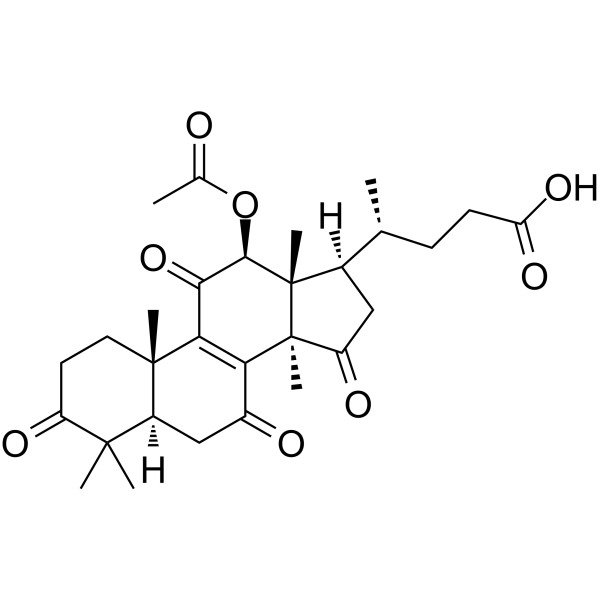
Lucidenic acid D is a highly oxidized triterpenoid with anti-inflammatory and antiviral activities. Lucidenic acid D attenuates lipopolysaccharide-induced release of proinflammatory cytokines and nitric oxide, reduces the expression of inducible nitric oxide synthase (iNOS) and cyclooxygenase-2 (COX-2), and inhibits skin inflammation. Lucidenic acid D suppresses 12-O-tetradecanoylphorbol-13-acetate (TPA)-induced expression of Epstein-Barr virus (EBV) early antigen and maintains the viability of Raji cells. Lucidenic acid D can be used in studies of cancer chemoprevention .
loading...
    loading...
Cat. No.: HY-W743654
CAS No.: 470-38-2
Target:  

Apoptosis

Research Areas:  

Cancer

Capsorubin is a carotenoid found in peppers with multiple biological activities. Capsorubin (167 μM) inhibits lipid peroxidation induced by 2,2'-azobis(2,4-dimethylvaleronitrile) (AMVN) in vitro. Capsorubin (1 μM) reduces UVB-induced DNA strand breaks and apoptosis in human dermal fibroblasts. Capsorubin also inhibits Epstein-Barr virus early antigen (EBV-EA) activation induced by phorbol 12-myristate 13-acetate in Raji cells, a marker of tumorigenesis.
loading...
    loading...
Cat. No.: HY-P990870

Research Areas:  

Inflammation/Immunology

Anti-CD19 Antibody (4G7) is an anti-human CD19 IgG1 monoclonal antibody. Anti-CD19 Antibody (4G7) reduces the killing effect of CAR T cells on Raji cells. Anti-CD19 Antibody (4G7) can be used for research on immunology. Anti-CD19 Antibody (4G7) is often used in flow cytometry. The recommend isotype control of Anti-CD19 Antibody (4G7): Mouse IgG1 kappa, Isotype Control (HY-P99977) .
loading...
    loading...
Cat. No.: HY-W743654R
CAS No.: 470-38-2
Research Areas:  

Cancer

Capsorubin (Standard) is the analytical standard of Capsorubin. This product is intended for research and analytical applications. Capsorubin is a carotenoid found in peppers with multiple biological activities. Capsorubin (167 μM) inhibits lipid peroxidation induced by 2,2'-azobis(2,4-dimethylvaleronitrile) (AMVN) in vitro. Capsorubin (1 μM) reduces UVB-induced DNA strand breaks and apoptosis in human dermal fibroblasts. Capsorubin also inhibits Epstein-Barr virus early antigen (EBV-EA) activation induced by phorbol 12-myristate 13-acetate in Raji cells, a marker of tumorigenesis.
loading...
    loading...
Cat. No.: HY-112608
CAS No.: 2244992-76-3
Purity:  98.04%
Target:  

PI3K

Research Areas:  

Cancer

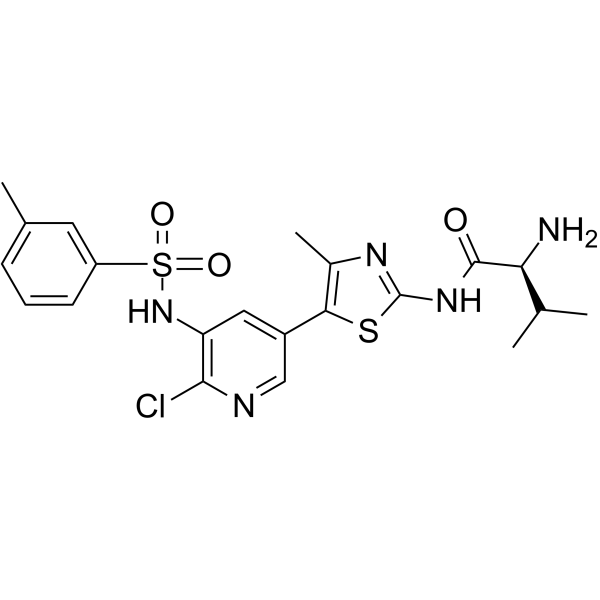
CHMFL-PI3KD-317 is a highly potent, selective and orally active PI3Kδ inhibitor, with an IC50 of 6 nM, and exhibits over 10-1500 fold selectivity over other class I, II and III PIKK family isoforms, such as PI3Kα (IC50, 62.6 nM), PI3Kβ (IC50, 284 nM), PI3Kγ (IC50, 202.7 nM), PIK3C2A (IC50, >10000 nM), PIK3C2B (IC50, 882.3 nM), VPS34 (IC50, 1801.7 nM), PI4KIIIA (IC50, 574.1 nM) and PI4KIIIB (IC50, 300.2 nM). CHMFL-PI3KD-317 inhibits PI3Kδ-mediated Akt T308 phosphorylation in Raji cells, with an EC50 of 4.3 nM. CHMFL-PI3KD-317 has antiproliferative effects on cancer cells .
loading...
    loading...
Cat. No.: HY-N19721
CAS No.: 514214-46-1
Brasimarin B is a 4-phenylcoumarin compound found in the stem bark of Calophyllum brasiliense. Brasimarin B inhibits TPA (HY-18739)-induced EBV-EA activation in Raji cells .
loading...
    loading...
Cat. No.: HY-N13723
CAS No.: 98665-09-9
Methyl lucidenate D is a selective inhibitor of Epstein-Barr virus early antigen (EBV-EA) activation with an IC50 of 290 mol ratio/32 pmol TPA. Methyl lucidenate D exerts potential anti-tumor promoting activity by inhibiting TPA-induced EBV-EA activation and maintains major Raji cell survival (70%) at effective concentrations. Methyl lucidenate D can be used in the field of cancer chemoprevention .
loading...
    loading...
Cat. No.: HY-N21920
CAS No.: 796062-77-6
Dehydrotrametenonic acid is a DNA topoisomerase II (DNA topoisomerase II) inhibitor with an IC50 of 37.5 μM. Dehydrotrametenonic acid inhibits DNA polymerase α and β, with IC50 values of 45.5 μM and 86.5 μM, respectively. Dehydrotrametenonic acid does not intercalate into DNA and exhibits a topoisomerase II inhibitory mechanism similar to that of an inhibitor. Dehydrotrametenonic acid suppresses the growth of NUGC-3 gastric cancer cells with an LD50 of 63.6 μM, and inhibits TPA-induced EBV-EA activation in Raji cells. Dehydrotrametenonic acid can be used in studies related to DNA replication, cell cycle and cancer .
loading...
    loading...

