



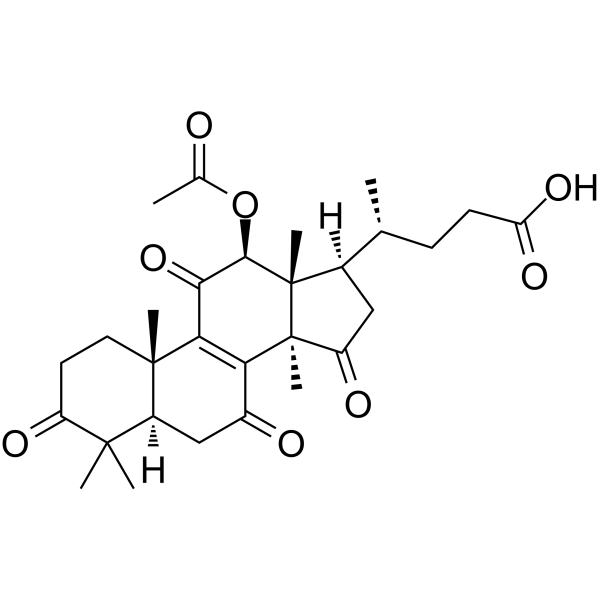
Lucidenic acid D

Based on 1 Customer Validation
Lucidenic acid D is a highly oxidized triterpenoid with anti-inflammatory and antiviral activities. Lucidenic acid D attenuates lipopolysaccharide-induced release of proinflammatory cytokines and nitric oxide, reduces the expression of inducible nitric oxide synthase (iNOS) and cyclooxygenase-2 (COX-2), and inhibits skin inflammation. Lucidenic acid D suppresses 12-O-tetradecanoylphorbol-13-acetate (TPA)-induced expression of Epstein-Barr virus (EBV) early antigen and maintains the viability of Raji cells. Lucidenic acid D can be used in studies of cancer chemoprevention.
연구목적의 판매만을 진행합니다. 환자를 대상으로 한 판매는 하지 않습니다.
- Purity : 99.41%
- CAS No.: 98665-16-8
- 화학식: C29H38O8
- 분자량:514.61
-
보관:
4°C, protect from light
* In solvent : -80°C, 6 months; -20°C, 1 month (protect from light)

To place orders, for customer services and technical support, please contact: MedChemExpress USA
Tel: 609-228-6898 E-mail: [email protected] [email protected]


-
 Biological Activity
-
Chemical Information
- Protocol
- 순도&문서
- References
-
 Help & FAQs




Biological Activity
제품 설명
Cellular Effect
|
Cell Line

|
Type | Value | Description | References |
|---|---|---|---|---|
| Raji | IC50 |
287 molar ratio
Compound: 5a
|
Inhibition of 12-O-tetradecanoylphorbol-13-acetate-induced EBV-early antigen activation in human Raji cells assessed per 32 pmol TPA by immunofluorescence technique
Inhibition of 12-O-tetradecanoylphorbol-13-acetate-induced EBV-early antigen activation in human Raji cells assessed per 32 pmol TPA by immunofluorescence technique
|
[PMID: 14695801] |
In Vitro
Lucidenic acid D (as methyl lucidenate D) is a new highly oxidized lanostane-type triterpenoid isolated from Ganoderma lucidum gills, with its structure elucidated using spectral evidence including mass spectrometry, 1H-NMR, and 13C-NMR[1].
Lucidenic acid D inhibits Epstein-Barr virus early antigen activation in Raji cells[2].
Lucidenic acid D (10, 50 μg/mL; 30 min) does not alter LPS-induced p38 or JNK phosphorylation in THP-1 cells[3].
Lucidenic acid D (50 μg/mL; 4 h) does not significantly enhance LPS-induced TNFα mRNA expression in THP-1 cells[3].
Lucidenic acid D2 (10-1000 mol ratio/TPA; 48 h) potently inhibits EBV-EA activation in Raji cells, with an IC50 of 287 mol ratio/TPA, and maintains 70% cell viability at the highest tested concentration[4].
MedChemExpress (MCE) has not independently confirmed the accuracy of these methods. They are for reference only.
-
Cell Line:Raji cells (EBV genome-carrying human lymphoblastoid cells)
-
Concentration:10-1000 mol ratio/TPA
-
Incubation Time:48 h
-
Result:Inhibited EBV-EA induction by 98% at 1000 mol ratio/TPA, with 70% Raji cell viability.
Inhibited EBV-EA induction by 73.9% at 500 mol ratio/TPA.
Inhibited EBV-EA induction by 26.2% at 100 mol ratio/TPA.
Inhibited EBV-EA induction by 3.9% at 10 mol ratio/TPA.
Reached an IC50 of 287 mol ratio/TPA for inhibition of EBV-EA induction.


Chemical Information
-
CAS No. 98665-16-8
-
Appearance Solid
-
분자량 514.61
-
화학식 C29H38O8
-
Color Off-white to yellow
-
SMILES
C[C@@]([C@@H]1OC(C)=O)([C@@](C2)([H])[C@H](C)CCC(O)=O)[C@](C(C(C[C@@]3([H])C4(C)C)=O)=C([C@]3(CCC4=O)C)C1=O)(C2=O)C
-
Synonyms
Lucidenic acid D2
-
Structure Classification
-
Initial Source
-
선적
Room temperature in continental US; may vary elsewhere.
-
보관
4°C, protect from light
* In solvent : -80°C, 6 months; -20°C, 1 month (protect from light)


순도&문서
-
Data Sheet (277 KB)
-
SDS (252 KB)
- English - EN (252 KB)
- Français - FR (252 KB)
- Deutsch - DE (252 KB)
- Norwegian - NO (252 KB)
- Español - ES (252 KB)
- Swedish - SV (252 KB)
- Italian - IT (252 KB)
- Korean - KR (252 KB)
- Portuguese - PT (252 KB)
-
Handling Instructions (2659 KB)
References
[2]. Zheng C, et al. A Review on the Sources, Structures, and Pharmacological Activities of Lucidenic Acids. Molecules. 2023;28(4):1756. Published 2023 Feb 12. [Content Brief]
[3]. Watanabe K, et al. Lucidenic acids-rich extract from antlered form of Ganoderma lucidum enhances TNFα induction in THP-1 monocytic cells possibly via its modulation of MAP kinases p38 and JNK. Biochem Biophys Res Commun. 2011;408(1):18-24. [Content Brief]
[4]. Iwatsuki K, et al. Lucidenic acids P and Q, methyl lucidenate P, and other triterpenoids from the fungus Ganoderma lucidum and their inhibitory effects on Epstein-Barr virus activation. J Nat Prod. 2003;66(12):1582-1585. [Content Brief]

Calculators
Concentration (start) × Volume (start) = Concentration (final) × Volume (final)


Lucidenic acid D Related Classifications
HY-107260 Related Classifications
 Powered by Bioz
Keywords
- Lucidenic acid D
- 98665-16-8
- Lucidenic acid D2
- Lucidenic acid D 2
- Lucidenic acid D-2
- NO Synthase
- COX
- anti-viral properties
- Epstein-Barr virus early antigen
- cyclo-oxygenase-2
- Ganoderma lucidum
- lipopolysaccharide
- Ganoderma sinense
- inducible nitric oxide synthase
- THP-1 cells
- anti-inflammatory properties
- Raji cells
- Inhibitor
- inhibitor
- inhibit