9 Results for "

bloodstream forms

" in MedChemExpress (MCE) Product Catalog:
Products (9)

9 Results for "bloodstream forms" in MCE Product Catalog:

12
12 Publications Verification
Art. -Nr.: HY-12054
CAS. Nr.: 422513-13-1
Reinheit:  98.89%
Forschungsgebiete:  

Cancer

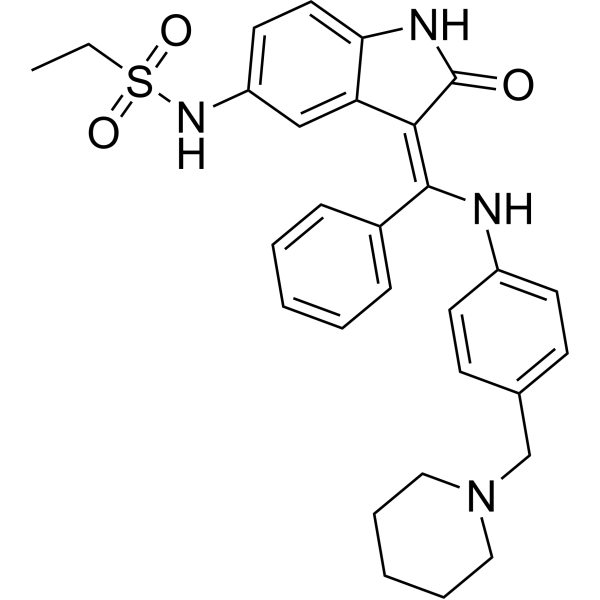
Hesperadin is an ATP competitive indolinone inhibitor of Aurora A and B. Hesperadin inhibits Aurora B with an IC50 of 250 nM. Hesperadin inhibits the growth of Trypanosoma brucei by blocking nuclear division and cytokinesis. Hesperadin also is a broad-spectrum influenza antiviral .
loading...
    loading...
5
5 Cited Publications
Art. -Nr.: HY-W011393
CAS. Nr.: 10030-52-1
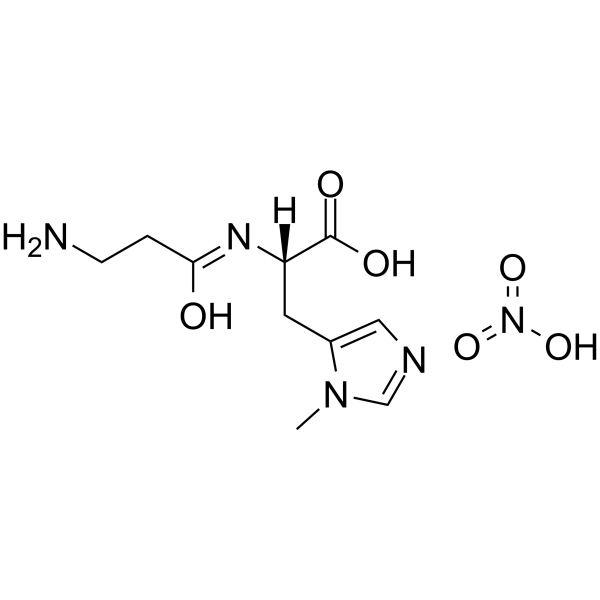
L-Anserine nitrate is a naturally occurring histidine-containing dipeptide that is found in vertebrate skeletal muscle and animal tissues. L-Anserine nitrate serves as a growth-promoting supplement in serum-free HMI-244 medium for bloodstream forms of Trypanosoma brucei and Trypanosoma evansi. L-Anserine nitrate supports the continuous in vitro proliferation of these parasites, and the proliferated parasites retain their morphological characteristics and infectivity to mice. L-Anserine nitrate can be used in studies of African trypanosomiasis .
loading...
    loading...
Art. -Nr.: HY-108860
CAS. Nr.: 130167-69-0
Reinheit:  ≥99.0%
Synonyms: PEG-L-asparaginase; Pegasparaginase
Forschungsgebiete:  

Inflammation/Immunology

Oncaspar (PEG-L-asparaginase; Pegasparaginase), a pegylated form of native Escherichia coli-derived L-asparaginase, breaks down the amino acid asparagine that are circulating in the bloodstream. Oncaspar plays an important role in acute lymphoblastic leukemia (ALL) through asparagine hydrolysis and activation of the integrated stress response (ISR) pathway .
loading...
    loading...
Art. -Nr.: HY-169728
CAS. Nr.: 378197-09-2
Target:  

Hexokinase Parasite

Forschungsgebiete:  

Infection

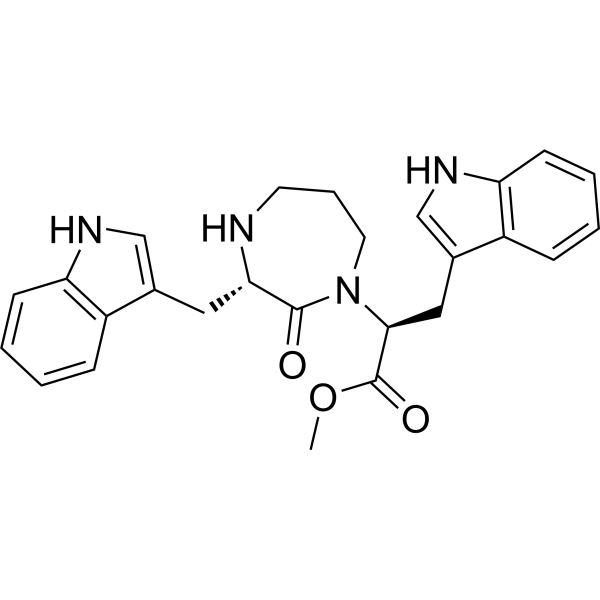
SID 24785302 is a hexokinase inhibitor with antiparasitic activity. SID 24785302 exhibits activity against T. brucei and Leishmania. SID 24785302 can be used for the research of mitochondrial DNA disorders and parasitic infection .
loading...
    loading...
Art. -Nr.: HY-155530
CAS. Nr.: 3052256-26-2
Target:  

Bacterial

Forschungsgebiete:  

Infection

PEX5-PEX14 PPI-IN-1 (Compound 8) is a PEX14-PEX5 PPI inhibitor. PEX5-PEX14 PPI-IN-1 disrupts the PEX5-TbPEX14 PPI with a Ki of 53 μM. PEX5-PEX14 PPI-IN-1 inhibits the bloodstream form of T. b. brucei (EC50: 5 μM) .
loading...
    loading...
Art. -Nr.: HY-12054A
Forschungsgebiete:  

Cancer

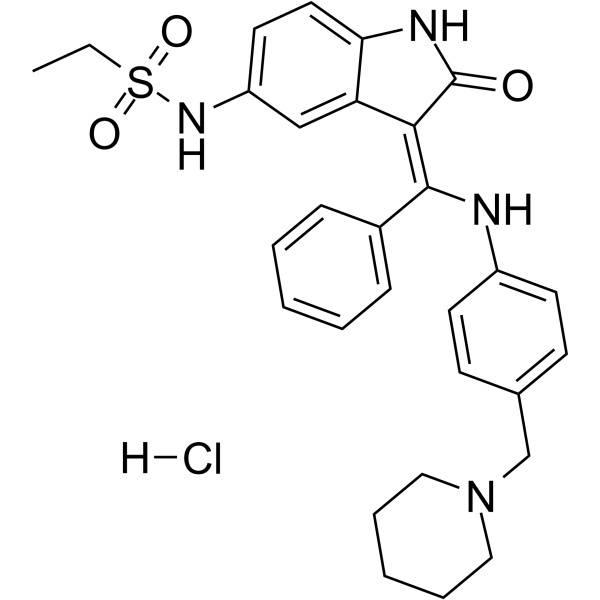
Hesperadin hydrochloride is an ATP competitive indolinone inhibitor of Aurora A and B. Hesperadin hydrochloride inhibits Aurora B with an IC50 of 250 nM .
loading...
    loading...
Art. -Nr.: HY-149985
Target:  

Parasite

Forschungsgebiete:  

Infection

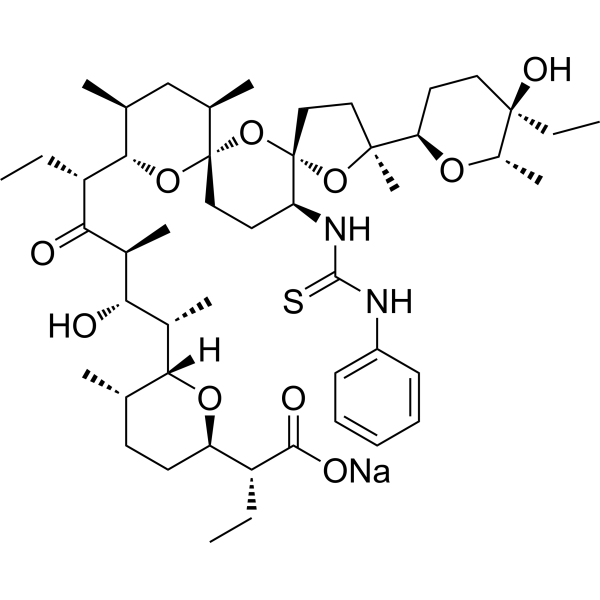
Antitrypanosomal agent 12 is a C20-phenylthiourea with trypanocidal and cytotoxic activities. Antitrypanosomal agent 12 shows antitrypanosomal activity with 50% growth inhibition (GI50) values of 0.22 μM. Antitrypanosomal agent 12 induces faster cell swelling in bloodstream-form trypanosomes than Salinomycin (HY-15597) .
loading...
    loading...
Art. -Nr.: HY-N19754
CAS. Nr.: 307503-97-5
Target:  

Parasite

Cladospirone B is a secondary metabolite of the endophytic fungus Lasiodiplodia theobromae. Cladospirone B exhibits trypanocidal activity, with a MIC of 17.8 µM against Trypanosoma brucei. Cladospirone B can be used in the research of African human trypanosomiasis (sleeping sickness) .
loading...
    loading...
Art. -Nr.: HY-L919
27,503 compounds

With the aging population and increasing competitive pressures, neurodegenerative diseases of the central nervous system (CNS) have become a serious medical challenge in modern society, including Parkinson's disease, Alzheimer's disease, brain tumors, and multiple sclerosis. However, the success rate of CNS drug development remains remarkably low, primarily due to the blood-brain barrier (BBB). The blood-brain barrier (BBB) is a semipermeable barrier structure that surrounds the microvasculature of the CNS. In capillaries, the wedged endothelial cells are tightly packed and wedge-shaped, lining the interior of the vessels to form extensive tight junctions. Along with a range of receptors, transporters, efflux pumps, and other cellular components, this barrier regulates the entry and exit of molecules between the bloodstream and the brain. The intact BBB blocks the passage of most blood-borne substances into the brain, preventing nearly 100% of large-molecule drugs and over 98% of small-molecule drugs from entering. Compared to non-CNS drugs, physicochemical properties such as hydrogen bonds, lipophilicity, and molecular weight significantly influence a compound's ability to cross the BBB. Using artificial intelligence (AI) algorithms to predict BBB permeability, a predicted value greater than 0.75 indicates that the compound has strong potential to cross the BBB, providing a promising starting point for CNS drug discovery.

