8 Results for "

cardiac electrical

" in MedChemExpress (MCE) Product Catalog:
Products (8)

8 Results for "cardiac electrical" in MCE Product Catalog:

Cat. No.: HY-129763
CAS No.: 90134-00-2
Purity:  ≥99.0%
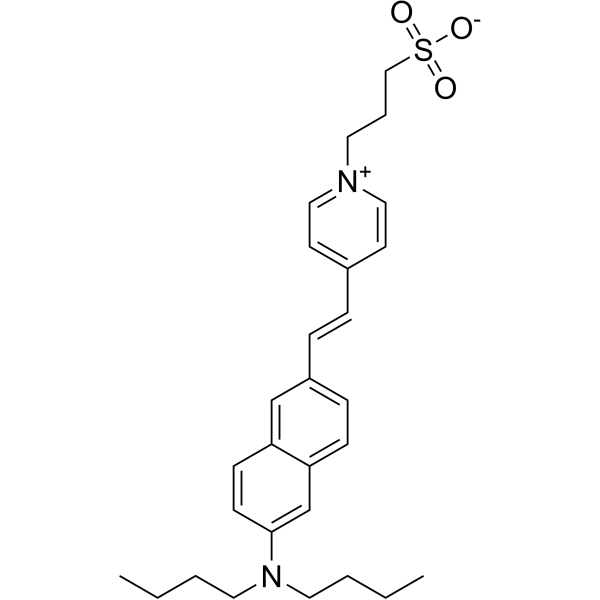
Di-4-ANEPPS is a voltage-sensitive dye that acts on voltage-gated ion channels (such as sodium channels) and inhibits sodium current, significantly reducing sodium current density, although specific values like IC50 remain unclear. It mainly binds to the voltage-sensitive regions on the cell membrane, changing its fluorescence properties to reflect membrane potential changes and thus affecting the function of ion channels to exert its activity. This substance can be used in cardiovascular research, such as the electrophysiology of cardiomyocytes, myocardial ischemia, and the effects of drugs on cardiomyocytes. It is of great value in evaluating drug cardiotoxicity and exploring the mechanisms of arrhythmias .
loading...
    loading...
Cat. No.: HY-A0236
CAS No.: 37640-71-4
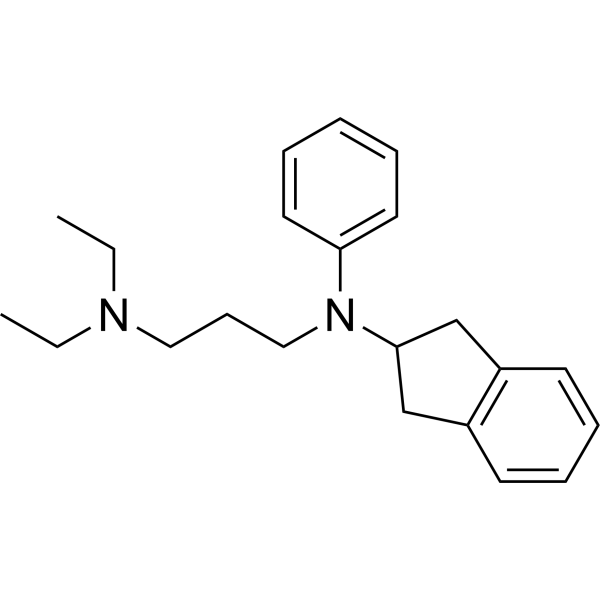
Aprindine is an Ib-class anti-arrhythmic agent. Aprindine mainly exerts its effect by blocking sodium channels (INa), thereby reducing the excitability and conduction velocity of cardiac muscle cells. Aprindine significantly inhibits delayed potassium currents, which helps to prolong the atrial effective refractory period (AERP) and inhibit the occurrence of atrial fibrillation. Aprindine can also regulate intracellular calcium ion concentration by inhibiting Na +/Ca 2+ exchange current (INCX), thereby further stabilizing cardiac electrical activity. Aprindine can be used for the study of atrial fibrillation (AF) and ventricular arrhythmias .
loading...
    loading...
Cat. No.: HY-A0236A
CAS No.: 33237-74-0
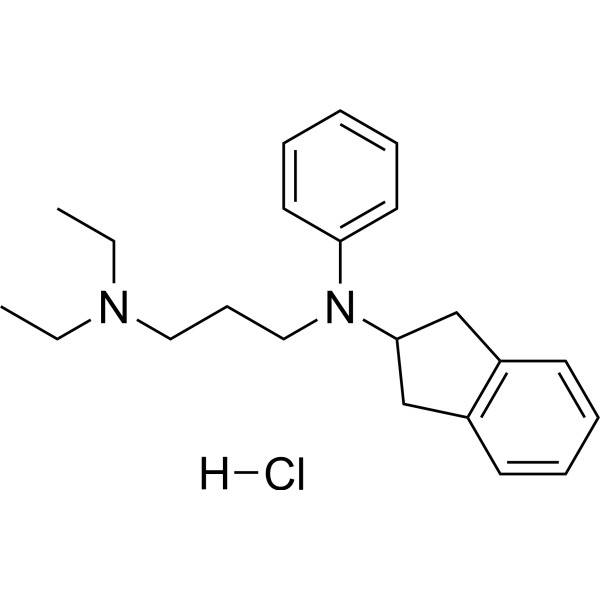
Aprindine hydrochloride is an Ib-class anti-arrhythmic agent. Aprindine hydrochloride mainly exerts its effect by blocking sodium channels (INa), thereby reducing the excitability and conduction velocity of cardiac muscle cells. Aprindine hydrochloride significantly inhibits delayed potassium currents, which helps to prolong the atrial effective refractory period (AERP) and inhibit the occurrence of atrial fibrillation. Aprindine hydrochloride can also regulate intracellular calcium ion concentration by inhibiting Na +/Ca 2+ exchange current (INCX), thereby further stabilizing cardiac electrical activity. Aprindine hydrochloride can be used for the study of atrial fibrillation (AF) and ventricular arrhythmias .
loading...
    loading...
Cat. No.: HY-177361
CAS No.: 68876-74-4
Target:  

Sodium Channel

Research Areas:  

Cardiovascular Disease

Zocainone is an antiarrhythmic agent. Zocainone blocks sodium channels in cardiac tissue, stabilizing the cardiac action potential and reducing abnormal electrical activity. Zocainone is promising for research of cardiac arrhythmias .
loading...
    loading...
Cat. No.: HY-171782
CAS No.: 90405-00-8
Target:  

Others

Research Areas:  

Cardiovascular Disease

Amidepin is a new type of antiarrhythmic compound. Amidepin has the activity of regulating cardiac electrical activity. The main regulatory mechanism of amidepin involves ion channel or receptor interaction. Amidepin can be used for the study of arrhythmias .
loading...
    loading...
Cat. No.: HY-184751
CAS No.: 58409-59-9
Research Areas:  

Cardiovascular Disease

Bucumolol is an orally active β-adrenergic receptor blocker. Bucumolol inhibits Renin release. Bucumolol exhibits activities including local anesthesia, antiarrhythmia, antihypertension, heart rate reduction, negative inotropy, cardiac action potential inhibition, and action potential duration shortening. Bucumolol does not increase cardiac electrical threshold, prolong atrial refractory period, or affect body weight in rodents. Bucumolol can be used in research related to arrhythmia and hypertension .
loading...
    loading...
Cat. No.: HY-A0236AR
CAS No.: 33237-74-0
Aprindine hydrochloride (Standard) is the analytical reference standard of Aprindine hydrochloride (HY-A0236A). This product is used for research and analytical applications. Aprindine hydrochloride is an Ib-class anti-arrhythmic agent. Aprindine hydrochloride mainly exerts its effect by blocking sodium channels (INa), thereby reducing the excitability and conduction velocity of cardiac muscle cells. Aprindine hydrochloride significantly inhibits delayed potassium currents, which helps to prolong the atrial effective refractory period (AERP) and inhibit the occurrence of atrial fibrillation. Aprindine hydrochloride can also regulate intracellular calcium ion concentration by inhibiting Na +/Ca 2+ exchange current (INCX), thereby further stabilizing cardiac electrical activity. Aprindine hydrochloride can be used for the study of atrial fibrillation (AF) and ventricular arrhythmias.
loading...
    loading...
Cat. No.: HY-184377
CAS No.: 166181-63-1
Synonyms: IQB-9302
Target:  

Potassium Channel

Research Areas:  

Others

Ipravacaine (IQB-9302) is a long-acting amide-based local anesthetic. Ipravacaine blocks open-state hKv1.5, with stereoselective, time-dependent and voltage-dependent inhibitory effects, and exerts stronger activity on the R (+) enantiomer. Ipravacaine blocks Kv2.1, Kv4.3 and HERG potassium channels. Ipravacaine induces negative chronotropic effects, increases mean arterial pressure, and exhibits vasodilatory effects at high concentrations .
loading...
    loading...

