



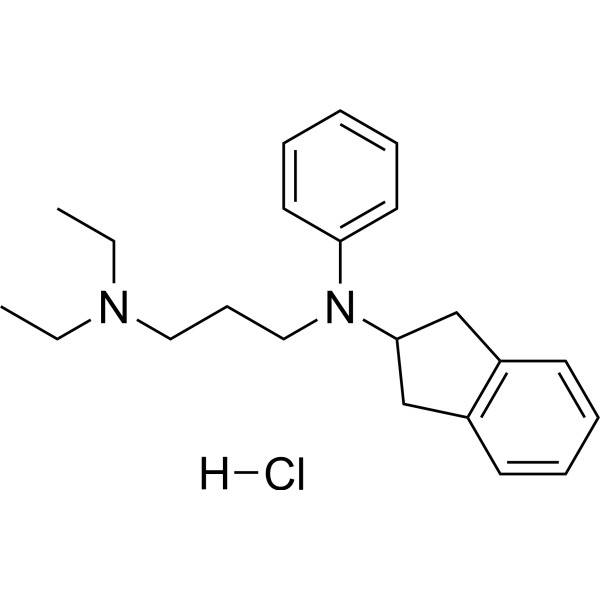
Aprindine hydrochloride

Based on 1 Customer Validation
Aprindine hydrochloride is an Ib-class anti-arrhythmic agent. Aprindine hydrochloride mainly exerts its effect by blocking sodium channels (INa), thereby reducing the excitability and conduction velocity of cardiac muscle cells. Aprindine hydrochloride significantly inhibits delayed potassium currents, which helps to prolong the atrial effective refractory period (AERP) and inhibit the occurrence of atrial fibrillation. Aprindine hydrochloride can also regulate intracellular calcium ion concentration by inhibiting Na+/Ca2+ exchange current (INCX), thereby further stabilizing cardiac electrical activity. Aprindine hydrochloride can be used for the study of atrial fibrillation (AF) and ventricular arrhythmias.
For research use only. We do not sell to patients.
- Purity : 98.96%
- CAS No.: 33237-74-0
- Formula: C22H31ClN2
- Molecular Weight:358.95
-
Storage:
4°C, sealed storage, away from moisture and light
* In solvent : -80°C, 6 months; -20°C, 1 month (sealed storage, away from moisture and light)

To place orders, for customer services and technical support, please contact: MedChemExpress USA
Tel: 609-228-6898 E-mail: [email protected] [email protected]


-
 Biological Activity
-
Chemical Information
-
Solvent & Solubility
- Purity & Documentation
- References
-
 Help & FAQs


All Calcium Channel Isoforms
More

Biological Activity
Description
In Vitro
Aprindine hydrochloride (0-128 μg/mL, 1 h-7 d) inhibits the proliferation of bone marrow cells and human lymphocytes with ED50s of 15.5 μg/mL and 8 μg/mL, and also inhibits the colony formation of normal human bone marrow CFU-C cells[1].
Aprindine hydrochloride (0-1000 μM) exhibits concentration-dependent inhibition on Na+/Ca2+ exchange current (INCX), and the inhibitory effects on both inward (IC50 = 51.8 μM, -100mV) and outward (IC50 = 48.8 μM, 50 mV) currents are similar, suggesting no significant voltage dependence in CCL39 cells[2].
Aprindine hydrochloride (0-40 μM) competes with KB-R7943 (HY-138947) and inhibits extracellular Ca2+ in CCL39 cells[2].
Aprindine hydrochloride (3 μM) significantly inhibits voltage-dependently rectifier K+ current (Ik), and has a slight effect on Ica and inward rectifier K+ current (Ik1) in guinea pig atrial muscle cells[3].
Aprindine hydrochloride (0-100 μM) inhibits the acetylcholine receptor-operated K+ current (Ik.Ach) induced by Carbachol (HY-B1208) and GTPγS (HY-137677B) with the IC50 values of 0.4 and 2.5 mM, respectively in guinea pig atrial muscle cells[3].
Aprindine hydrochloride (3 μM) inhibits the induction of atrial fibrillation (AF) by prolonging monophasic action potential (MAP) and effective refractory period (ERP) in isolated guinea pig heart[3].
Aprindine hydrochloride (0-500 μM) inhibits the calcium-binding protein-activated phosphodiesterase and Ca-ATPase activities in both isolated bovine brain tissue and human red blood cells with the IC50 values of 18 and 84 μM, respectively[4].
MedChemExpress (MCE) has not independently confirmed the accuracy of these methods. They are for reference only.
In Vivo
MedChemExpress (MCE) has not independently confirmed the accuracy of these methods. They are for reference only.
-
Animal Model:Warfarin-induced arrhythmia model in Hartley strain guinea pigs (male, 450-550 g)[5]
-
Dosage:5 mg/kg
-
Administration:Intravenous injection (i.v.), single dose
-
Result:Increased the threshold for arrhythmia by 90% and the threshold for ventricular fibrillation by 70%.


Chemical Information
-
CAS No. 33237-74-0
-
Appearance Solid-Liquid Mixture
-
Molecular Weight 358.95
-
Formula C22H31ClN2
-
Color Light yellow to brown
-
SMILES
CCN(CC)CCCN(C1CC2=C(C=CC=C2)C1)C3=CC=CC=C3.[H]Cl
-
Shipping
Room temperature in continental US; may vary elsewhere.
-
Storage
4°C, sealed storage, away from moisture and light
* In solvent : -80°C, 6 months; -20°C, 1 month (sealed storage, away from moisture and light)


Solvent & Solubility
In Vitro:
DMSO : 100 mg/mL (278.59 mM; Need ultrasonic; Hygroscopic DMSO has a significant impact on the solubility of product, please use newly opened DMSO)
Please refer to the solubility information to select the appropriate solvent. Once prepared, please aliquot and store the solution to prevent product inactivation from repeated freeze-thaw cycles.
Storage method and period of stock solution: -80°C, 6 months; -20°C, 1 month (sealed storage, away from moisture and light). When stored at -80°C, please use it within 6 months. When stored at -20°C, please use it within 1 month.
Please refer to the solubility information to select the appropriate solvent. Once prepared, please aliquot and store the solution to prevent product inactivation from repeated freeze-thaw cycles.
Storage method and period of stock solution: -80°C, 6 months; -20°C, 1 month (sealed storage, away from moisture and light). When stored at -80°C, please use it within 6 months. When stored at -20°C, please use it within 1 month.
Concentration (start) × Volume (start) = Concentration (final) × Volume (final)
In Vivo:
Select the appropriate dissolution method based on your experimental animal and administration route.
- For the following dissolution methods, please ensure to first prepare a clear stock solution using an In Vitro approach and then sequentially add co-solvents:
- To ensure reliable experimental results, the clarified stock solution can be appropriately stored based on storage conditions. As for the working solution for In Vivo experiments, it is recommended to prepare freshly and use it on the same day.
- The percentages shown for the solvents indicate their volumetric ratio in the final prepared solution. If precipitation or phase separation occurs during preparation, heat and/or sonication can be used to aid dissolution.
Add each solvent one by one: 10% DMSO 40% PEG300 5% Tween-80 45% Saline
Solubility: ≥ 5 mg/mL (13.93 mM); Clear solution
This protocol yields a clear solution of ≥ 5 mg/mL (saturation unknown).
Taking 1 mL working solution as an example, add 100 μL DMSO stock solution (50.0 mg/mL) to 400 μL PEG300, and mix evenly; then add 50 μL Tween-80 and mix evenly; then add 450 μL Saline to adjust the volume to 1 mL.
Preparation of Saline: Dissolve 0.9 g sodium chloride in ddH₂O and dilute to 100 mL to obtain a clear Saline solution.
Add each solvent one by one: 10% DMSO 90% (20% SBE-β-CD in Saline)
Solubility: ≥ 5 mg/mL (13.93 mM); Clear solution
This protocol yields a clear solution of ≥ 5 mg/mL (saturation unknown).
Taking 1 mL working solution as an example, add 100 μL DMSO stock solution (50.0 mg/mL) to 900 μL 20% SBE-β-CD in Saline, and mix evenly.
Preparation of 20% SBE-β-CD in Saline (4°C, storage for one week): 2 g SBE-β-CD powder is dissolved in 10 mL Saline, completely dissolve until clear.
In Vivo Dissolution Calculator
Please enter the basic information of animal experiments:
-
-
-
-
Recommended: Prepare an additional quantity of animals to account for potential losses during experiments.
Please enter your animal formula composition:
-
%DMSO +
Recommended: Keep the proportion of DMSO in working solution below 2% if your animal is weak.
-
%+
-
+%Tween-80 + +
-
%Saline +
The co-solvents required include: DMSO, . All of co-solvents are available by MedChemExpress (MCE). , Tween 80. All of co-solvents are available by MedChemExpress (MCE).
Working solution concentration: 0.22 mg/mL
Method for preparing stock solution: mg drug dissolved in μL DMSO. Stock solution concentration: mg/mL. * In solvent : -80°C, 6 months; -20°C, 1 month (sealed storage, away from moisture and light)
1. Take μL DMSO stock solution;
2. Add μL .
μL , mix evenly;
3. Then add μL Tween 80, mix evenly;
4. Then add μL
Please ensure that the stock solution in the first step is dissolved to a clear state, and add co-solvents in sequence. You can use ultrasonic heating (ultrasonic cleaner, recommended frequency 20-40 kHz), vortexing, etc. to assist dissolution.


Purity & Documentation
-
Data Sheet (277 KB)
-
SDS (393 KB)
- English - EN (393 KB)
- Français - FR (393 KB)
- Deutsch - DE (393 KB)
- Norwegian - NO (393 KB)
- Español - ES (393 KB)
- Swedish - SV (393 KB)
- Italian - IT (393 KB)
- Korean - KR (393 KB)
- Portuguese - PT (393 KB)
-
Handling Instructions (2659 KB)
References
[1]. M L De Bruin, et al . Anti-HERG activity and the risk of drug-induced arrhythmias and sudden death. Eur Heart J. 2005 Mar;26(6):590-7. [Content Brief]
[2]. Watanabe Y, et al. Inhibitory effect of aprindine on Na+/Ca2+ exchange current in guinea-pig cardiac ventricular myocytes. Br J Pharmacol. 2002 Jun;136(3):361-6. [Content Brief]
[3]. Y Ohmoto-Sekine, et al. Inhibitory effects of aprindine on the delayed rectifier K+ current and the muscarinic acetylcholine receptor-operated K+ current in guinea-pig atrial cells. Br J Pharmacol. 1999 Feb;126(3):751-61. [Content Brief]
[4]. Levine SN, Hollier B. Aprindine inhibits calmodulin-stimulated phosphodiesterase and Ca-ATPase activities. J Cardiovasc Pharmacol. 1983 Jan-Feb;5(1):151-6. [Content Brief]
[5]. Brooks RR, et al. Broad sensitivity of rodent arrhythmia models to class I, II, III, and IV antiarrhythmic agents. Proc Soc Exp Biol Med. 1989 Jun;191(2):201-9. [Content Brief]


Complete Stock Solution Preparation Table
Please refer to the solubility information to select the appropriate solvent. Once prepared, please aliquot and store the solution to prevent product inactivation from repeated freeze-thaw cycles.
Storage method and period of stock solution: -80°C, 6 months; -20°C, 1 month (sealed storage, away from moisture and light). When stored at -80°C, please use it within 6 months. When stored at -20°C, please use it within 1 month.
| Optional Solvent | Concentration Solvent Mass | 1 mg | 5 mg | 10 mg | 25 mg |
|---|---|---|---|---|---|
| DMSO | 1 mM | 2.7859 mL | 13.9295 mL | 27.8590 mL | 69.6476 mL |
| 5 mM | 0.5572 mL | 2.7859 mL | 5.5718 mL | 13.9295 mL | |
| 10 mM | 0.2786 mL | 1.3930 mL | 2.7859 mL | 6.9648 mL | |
| 15 mM | 0.1857 mL | 0.9286 mL | 1.8573 mL | 4.6432 mL | |
| 20 mM | 0.1393 mL | 0.6965 mL | 1.3930 mL | 3.4824 mL | |
| 25 mM | 0.1114 mL | 0.5572 mL | 1.1144 mL | 2.7859 mL | |
| 30 mM | 0.0929 mL | 0.4643 mL | 0.9286 mL | 2.3216 mL | |
| 40 mM | 0.0696 mL | 0.3482 mL | 0.6965 mL | 1.7412 mL | |
| 50 mM | 0.0557 mL | 0.2786 mL | 0.5572 mL | 1.3930 mL | |
| 60 mM | 0.0464 mL | 0.2322 mL | 0.4643 mL | 1.1608 mL | |
| 80 mM | 0.0348 mL | 0.1741 mL | 0.3482 mL | 0.8706 mL | |
| 100 mM | 0.0279 mL | 0.1393 mL | 0.2786 mL | 0.6965 mL |


Aprindine hydrochloride Related Classifications
HY-A0236A Related Classifications
 Powered by Bioz