1. Search Result
Search Result
Results for "

condensate

" in MedChemExpress (MCE) Product Catalog:

17

Inhibitors & Agonists

1

Biochemical Assay Reagents

3

Natural
Products

Cat. No. Product Name Target Research Areas Chemical Structure
  • HY-146331

    Bacterial Infection
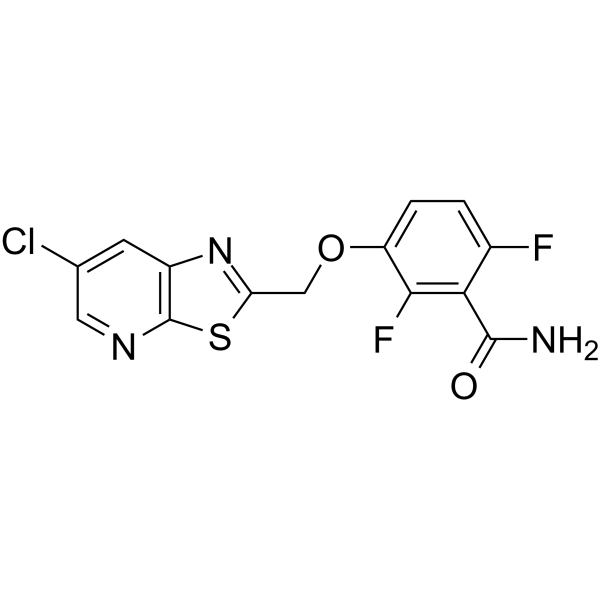
    PC190723 is a bacterial cell division protein FtsZ inhibitor (IC50 = 55 nM). PC 190723 prevents cell division. PC190723 has potent and selective bactericidal activity against staphylococci, including methicillin- and multi-drug-resistant Staphylococcus aureus. PC190723 induces nucleated assembly of Bs-FtsZ into single-stranded coiled protofilaments and polymorphic condensates. PC190723 can be studied in anti-bacterial infection research .
    PC190723
  • HY-175238

    ATP Synthase DNA/RNA Synthesis Neurological Disease Cancer
    KI-DX-014 is a DDX21 inhibitor with high RNA-binding inhibitory activity (IC50 of 3.31 μM). KI-DX-014 targets DDX21’s intrinsically disordered C-terminal domain, inhibits DDX21-structured RNA interaction, modulates DDX21’s RNA-dependent ATPase activity, and disrupts DDX21 biomolecular condensate formation. KI-DX-014 attenuates in vitro P-TEFb release from the 7SK snRNP complex, suppresses P-TEFb-dependent RNA polymerase II CTD phosphorylation, and induces developmental defects in zebrafish embryos. KI-DX-014 acts as a chemical probe for dissecting DDX21 functions in normal physiology and disease states. KI-DX-014 can be used for cancers and neurodegenerative disorders research .
    KI-DX-014
  • HY-174801

    Cyclic GMP-AMP Synthase Inflammation/Immunology
    XL-3156 is a cGAS inhibitor. XL-3156 occupies both allosteric and orthosteric sites simultaneously, and inhibits the interaction and phase separation between cGAS and DNA by stabilizing the closed conformation of the activation loop. XL-3156 can be used in the research of diseases such as autoimmune diseases and inflammation .
    XL-3156
  • HY-158082B

    Tetramethyl rhodamine isothiocyanate glucan, MW 40000

    Fluorescent Dye Others
    TRITC-dextran (Tetramethyl rhodamine isothiocyanate glucan), MW 40000 is a TRITC (HY-D0791)-labeled neutral 40 kDa fluorescent polysaccharide probe. TRITC-dextran, MW 40000 forms a membrane layer on the surface of protocells composed of protamine/folate condensates, and is used to assess membrane fluidity via fluorescence recovery after photobleaching. TRITC-dextran, MW 40000 can also be used to evaluate the anti-bacterial invasion ability and colloidal stability of coated condensates, as well as analyze the permeability of vascular and lymphatic endothelial cell layers .
    TRITC-dextran, MW 40000
  • HY-43515

    Endogenous Metabolite Metabolic Disease
    ESI1 is a small molecule epigenetic silencing inhibitor. ESI1 can trigger the formation of nuclear condensates of key lipid metabolism regulators SREBP1/2, concentrating transcriptional co-activators to drive lipid/cholesterol biosynthesis. ESI1 can promote myelin regeneration in demyelinated animal models and facilitate de novo myelination on regenerating CNS axons, reversing age-related declines in cognitive abilities .
    ESI1
  • HY-173679

    PROTACs PARP Interleukin Related STAT Integrin HSV VSV Infection Cancer
    RBN012811 is a highly selective PROTAC-based PARP14 degrader. RBN012811 forms a ternary complex with cereblon by binding to the NAD + site of PARP14, and mediates the specific degradation of PARP14 via the ubiquitin-proteasome pathway (IC50=10 nM). RBN012811 effectively depletes endogenous PARP14 in various cell lines and primary human macrophages, thereby downregulating IL-10 production and IFN-β mRNA levels, increasing phosphorylated STAT1 levels to enhance inflammatory signaling, and inhibiting interferon-induced ADPr condensate formation. RBN012811 also modulates viral replication, exhibiting increased HSV1 replication while reducing VSV replication. RBN012811 has important application value in research related to cancer and viral infections .
    RBN012811
  • HY-W089538

    Bacterial Infection
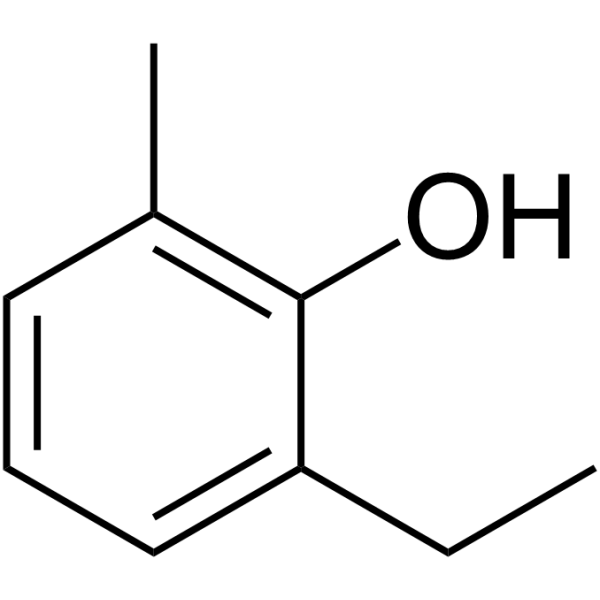
    2-Ethyl-6-methylphenol, an alkylphenol, is isolated form the tumorigenic neutral subfraction of cigarette smoke condensate. 2-Ethyl-6-methylphenol exhibits insecticidal and bactericidal activities .
    2-Ethyl-6-methylphenol
  • HY-118614

    Drug Metabolite Neurological Disease
    β-Nicotyrine is a metabolite of Nicotine.β-Nicotyrine, isolated from the leaves of Nicotiana tabacum plants and from cigarette smoke condensate, is a minor tobacco alkaloid .
    β-Nicotyrine
  • HY-156967

    MDM-2/p53 Cancer
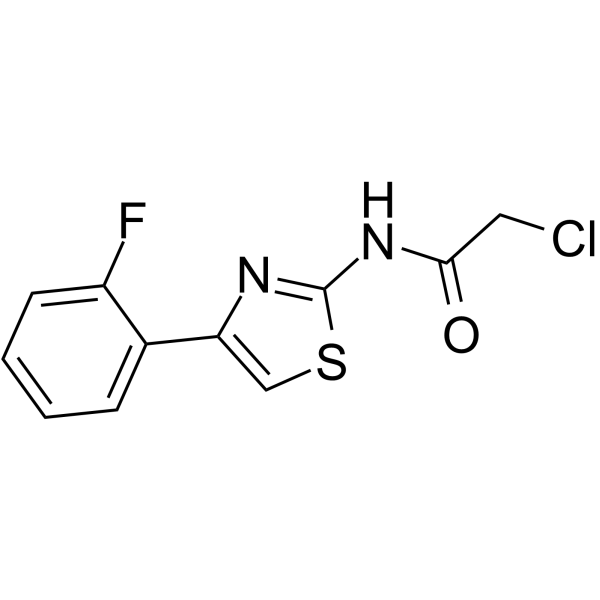
    BAY 1892005 is a regulator of p53 protein and acts on p53 condensates without causing mutant p53 reactivation .
    BAY 1892005
  • HY-W709825

    Others Infection
    (-)-Cyperene is a sesquiterpene hydrocarbon. (-)-Cyperene can be obtained from the n-hexane fraction of the smoke condensate of Goniothalamus andersonii. (-)-Cyperene can be used in the study of mosquitoes .
    (-)-Cyperene
  • HY-W004681

    6-Methyl-3-pyridinol

    Drug Intermediate Inflammation/Immunology
    6-Methyl-3-pyridinol (5-hydroxy-2-methylpyridine) is a starting compound for the synthesis of L-azatyrosine (HY-W048303). 6-Methyl-3-pyridinol can be isolated from cigarette smoke condensate. 6-Methyl-3-pyridinol aggravates Collagen-induced arthritis in mice .
    5-Hydroxy-2-methylpyridine
  • HY-169355

    PROTACs Epigenetic Reader Domain Cancer
    TrimTAC1 is a TRIM21-based PROTAC targeting BRD4. TrimTAC1 selectively degrads NUP98 FG-mEGFP-BRD4 BD2 nuclear condensates. TrimTAC1 does not degrade soluble mEGFP-BRD4 BD2 in A549 cells. (Pink: target protein ligand (+)-JQ-1 (HY-13030); Blue:E3 ligase ligand Acepromazine-OTs (HY-169356); Black: PROTAC linker (HY-W088456); E3 ligase ligand + linker: HY-169357) .
    TrimTAC1
  • HY-W089538R

    Reference Standards Bacterial Infection
    2-Ethyl-6-methylphenol, an alkylphenol, is isolated form the tumorigenic neutral subfraction of cigarette smoke condensate. 2-Ethyl-6-methylphenol exhibits insecticidal and bactericidal activities .
    2-Ethyl-6-methylphenol (Standard)
  • HY-168999

    Tomato Spotted Wilt Virus (TSWV) Infection
    TSWV-IN-2 (Compound Z9) is an inhibitor of TSWV N protein, with an EC50 of 65.3 μg/mL against TSWV. TSWV-IN-2 has broad-spectrum antiviral activity against plant viruses. TSWV-IN-2 targets the TSWV N protein, interferes with the formation of condensates between the N protein and RNA, and inhibits the replication of viral ribonucleoproteins .
    TSWV-IN-2
  • HY-132275

    Biochemical Assay Reagents Others
    After the Long trebler phosphoramidite is condensed by the triple condensate, three DNA branches begin to grow simultaneously with each step of the synthesis. Deblock of this construct gives rise to DNA containing a branching point. One arm (stem) is attached to the branch point with its 5'-end, and other arms (branches) are attached with their 3'-ends. Reverse amidites can be used to prepare constructs with different branch orientations.
    Long trebler phosphoramidite
  • HY-118614R

    Reference Standards Drug Metabolite Neurological Disease
    β-Nicotyrine (Standard) is the analytical standard of β-Nicotyrine. This product is intended for research and analytical applications. β-Nicotyrine is a metabolite of Nicotine.β-Nicotyrine, isolated from the leaves of Nicotiana tabacum plants and from cigarette smoke condensate, is a minor tobacco alkaloid .
    β-Nicotyrine (Standard)
  • HY-182893

    α-synuclein Reactive Oxygen Species (ROS) Tyrosine Hydroxylase Neurological Disease
    SK-129 is a blood-brain barrier-permeable inhibitor of α-synuclein (αS) oligomers with a Kd of 221 nM. SK-129 preferentially binds to neurotoxic αS oligomers over physiological αS monomers, inhibits αS aggregation, blocks the interaction and co-aggregation of αS with tau protein, and prevents the maturation of αS-tau condensates into amyloid aggregates. SK-129 reduces ROS production, rescues dopaminergic neuron degeneration, improves motor function, restores endogenous dopamine synthesis, increases the number of Tyrosine Hydroxylase-positive neurons, prevents brain histopathological changes, alleviates neuroinflammation, and improves survival rates in relevant models. SK-129 can be used in research related to Parkinson's disease (PD) and Lewy body dementia (LBD) .
    SK-129

Inquiry Online

Your information is safe with us. * Required Fields.

Salutation


Country or Region *

Applicant Name *


Organization Name *

Department *


Email Address *


Product Name *

Cat. No.


Requested quantity *

Phone Number *


Remarks

Inquiry Online

Inquiry Information

Product Name:
Cat. No.:
Quantity:
MCE Japan Authorized Agent:

