

1. Search Result
Search Result
Pathways Recommended: Metabolic Enzyme/Protease
Results for "

enzyme immobilization

" in MedChemExpress (MCE) Product Catalog:

22

Inhibitors & Agonists

7

Biochemical Assay Reagents

1

Isotope-Labeled Compounds

Cat. No. Product Name Target Research Areas Chemical Structure
  • HY-D0175
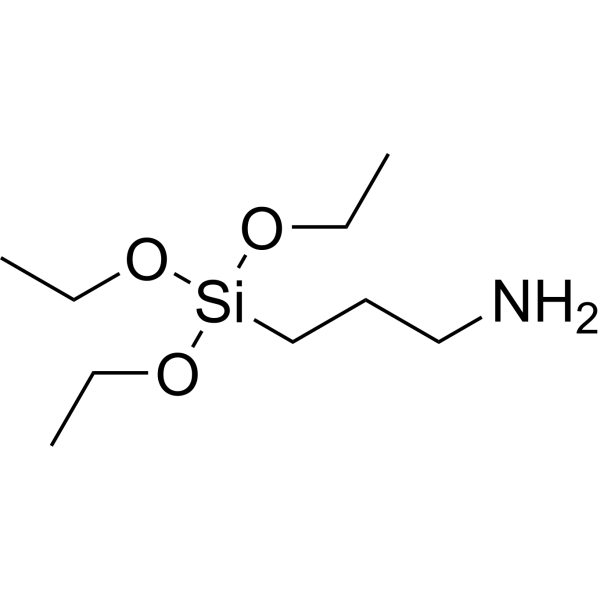
    3-Aminopropyltriethoxysilane
    2 Publications Verification

    γ-Aminopropyltriethoxysilane; APTES

    Biochemical Assay Reagents Others
    3-Aminopropyltriethoxysilane (APTES) acts as a strong glue to immobilize biomolecules such as antibodies and enzymes to silicon and silicon derivatives such as silicon nitride (Si3N4 )) on. 3-Aminopropyltriethoxysilane also acts as a spacer, providing biomolecules with more spatial freedom during immobilization for higher specific activity. 3-Aminopropyltriethoxysilane can form a more stable, sensitive, and highly biocompatible bioanalytical platform by immobilizing biomolecules onto some solid materials, electrode materials, nanomaterials, and nanocomposites .
    3-Aminopropyltriethoxysilane
  • HY-P2834

    PGA

    Biochemical Assay Reagents Others
    Penicillin amidase, E. coli (Immobilized) (PGA) is an amidohydrolase commonly used in industrial biocatalysis. Penicillin amidase, E. coli (Immobilized) serves as a starting material in the synthesis of semi-synthetic penicillins. Penicillin amidase, E. coli (Immobilized) promotes the production of semi-synthetic β-lactam antibiotics, participates in peptide synthesis, and catalyzes the formation of chiral compounds. Penicillin amidase, E. coli (Immobilized) is regulated by temperature and phenylacetic acid in E. coli. In free E. coli, it participates in the assimilation of aromatic compounds as a carbon source. Penicillin amidase, E. coli (Immobilized) is hypothesized to act as a scavenging enzyme for phenylacetyl-containing compounds in microbial metabolism and is associated with bacterial quorum sensing .
    Penicillin amidase, E. coli (Immobilized)
  • HY-W115727B

    PAM,Anion,Mw 18 million

    Biochemical Assay Reagents Others
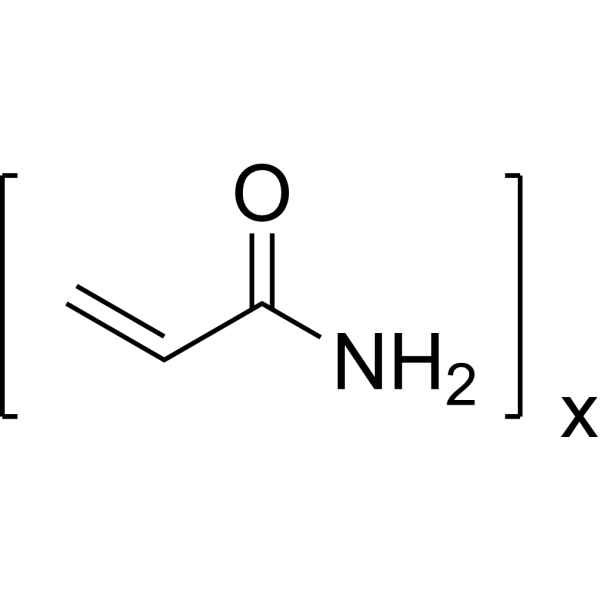
    Polyacrylamide,Anion,Mw 18 million (PAM,Anion,Mw 18 million) is a multifunctional high molecular weight anionic polyacrylamide copolymer. The anionic properties of Polyacrylamide,Anion,Mw 18 million enable it to be used as a flocculant to achieve charge neutralization and aggregation, while its high molecular weight properties provide viscoelastic properties for fluid applications. Polyacrylamide series materials can maintain enzyme activity in enzyme immobilization, act as drug carriers to achieve controlled release, serve as smart materials responding to temperature/pH stimuli, and be used for in vitro toxin adsorption and soft tissue filling through mechanisms such as physical entrapment, covalent binding or chemical crosslinking. Polyacrylamide finds applications in biomedical engineering, environmental management and industrial applications .
    Polyacrylamide,Anion,Mw 18 million
  • HY-W115727E

    PAM,average Mn 150000

    Biochemical Assay Reagents Others
    Polyacrylamide, average Mn 150000 (PAM, average Mn 150000) is a versatile, high-molecular-weight polyacrylamide copolymer. Polyacrylamide series materials can maintain enzyme activity in enzyme immobilization, act as drug carriers to achieve controlled release, serve as smart materials responding to temperature/pH stimuli, and be used for in vitro toxin adsorption and soft tissue filling through mechanisms such as physical entrapment, covalent binding or chemical crosslinking. Polyacrylamide finds applications in biomedical engineering, environmental management and industrial applications .
    Polyacrylamide,average Mn 150000
  • HY-W115727A

    PAM,Anion,Mw 14-16 million

    Biochemical Assay Reagents Others
    Polyacrylamide, Anion, Mw 14-16 million is a multifunctional high molecular weight anionic polyacrylamide copolymer. The anionic properties of Polyacrylamide, Anion, Mw 14-16 million enable it to be used as a flocculant to achieve charge neutralization and aggregation, while its high molecular weight properties provide viscoelastic properties for fluid applications. Polyacrylamide series materials can maintain enzyme activity in enzyme immobilization, achieve controlled release as a drug carrier, respond to temperature/pH stimulation as a smart material, and can also be used for in vitro toxin adsorption and soft tissue filling through mechanisms such as physical embedding, covalent bonding or chemical cross-linking. Polyacrylamide can be used in biomedical engineering, environmental management and industrial applications .
    Polyacrylamide,Anion,Mw 14-16 million
  • HY-W115727D

    PAM,average Mn 40000

    Biochemical Assay Reagents Others
    Polyacrylamide (PAM), average Mn 40000 is a versatile, high-molecular-weight polyacrylamide copolymer. Polyacrylamide series materials can maintain enzyme activity in enzyme immobilization, act as drug carriers to achieve controlled release, serve as smart materials responding to temperature/pH stimuli, and be used for in vitro toxin adsorption and soft tissue filling through mechanisms such as physical entrapment, covalent binding or chemical crosslinking. Polyacrylamide finds applications in biomedical engineering, environmental management and industrial applications .
    Polyacrylamide,average Mn 40000
  • HY-W115727C

    Acrylamide polymer,Nonionic,Mw 5-6 million

    Biochemical Assay Reagents Others
    Polyacrylamide (Acrylamide polymer),Nonionic,Mw 5-6 million is a multifunctional, high-molecular-weight nonionic polyacrylamide copolymer. Polyacrylamide-based materials can maintain enzyme activity in enzyme immobilization, act as drug carriers for controlled release, function as smart materials responsive to temperature/pH stimuli, and be applied in in vitro toxin adsorption and soft tissue filling, through action mechanisms such as physical entrapment, covalent binding or chemical crosslinking. Polyacrylamide finds applications in biomedical engineering, environmental management and industrial applications .
    Polyacrylamide,Nonionic,Mw 5-6 million
  • HY-W284558

    Biochemical Assay Reagents Others
    Sodium hexadecyl sulfate is a long-chain anionic surfactant. Sodium hexadecyl sulfate can act as an interface-regulating substance to form a soft layer on the surface of carbon nanotubes, guide proteins to adsorb in the correct orientation with active sites facing outward through electrostatic interactions, and significantly enhance the activity of immobilized enzymes. Sodium hexadecyl sulfate can replace or supplement SDS (HY-Y0316) in capillary gel electrophoresis (CGE) .
    Sodium hexadecyl sulfate
  • HY-P3190

    L-Arginine amidinase

    Endogenous Metabolite Metabolic Disease
    Arginase, Microorganism immobilized (L-Arginine amidinase) is an enzyme of the urea cycle. Arginase catalyzes the hydrolysis of L-arginine to L-ornithine and urea .
    Arginase, Microorganism (immobilized)
  • HY-E70312

    Endogenous Metabolite Others
    High-efficiency lipase,Candida antarctica (Immobilized on hydrophilic carrier) is a biocatalyst and a key enzyme in new biocatalyst technology. Enzyme engineering focuses on enhancing enzyme reaction kinetics, substrate selectivity, and activity under harsh conditions such as low or high pH. By introducing stimulus responsiveness to these enzyme modifications, dynamic control of activity is also possible .
    High-efficiency lipase,Candida antarctica (Immobilized on hydrophilic carrier)
  • HY-E70137

    Drug Intermediate Others
    AMG 118 Immobilized cephalosporin C acylase is an enzyme that catalyzes in immobilized form and is generally used in industrial catalytic production of the important pharmaceutical intermediate 7-aminocephalosporanic acid (7-ACA). It contains CPC acylase, a highly specialized beta-lactam acylase or peptidase that cleaves the amide bonds between beta-lactams .
    AMG 118 (Immobilized cephalosporin C acylase)
  • HY-P2929B

    Glycosidase Others
    PNGase F (Immobilized, Microspin) is a resin in which PNGase F (peptide N-glycosidase F) is covalently coupled to agarose beads, and it is used to remove N-glycans from antibodies, fusion proteins and other N-glycosylated proteins. The enzyme is recombinantly expressed in Escherichia coli, with its sequence derived from Flavobacterium meningsepticum .
    PNGase F (Immobilized, Microspin)
  • HY-131829

    6-AE-NAD+

    Biochemical Assay Reagents Others
    N6-(2-Aminoethyl)-NAD+ (6-AE-NAD+) is a NAD+ derivative commonly used in affinity chromatography. N6-(2-Aminoethyl)-NAD+ can be covalently linked to a PQQ (pyrroloquinoline quinone) (HY-100196) monolayer on an electrode surface for immobilizing NAD+-dependent enzymes such as lactate dehydrogenase (LDH) .
    N6-(2-Aminoethyl)-NAD+
  • HY-E70324

    Endogenous Metabolite Others
    Amoxicillin acylase (Immobilized) is a biocatalyst and a key enzyme in new biocatalyst technology. Enzyme engineering focuses on enhancing enzyme reaction kinetics, substrate selectivity, and activity under harsh conditions such as low or high pH. By introducing stimulus responsiveness to these enzyme modifications, dynamic control of activity is also possible .
    Amoxicillin acylase (Immobilized)
  • HY-E70322

    Endogenous Metabolite Others
    Cefaclor acylase (Immobilized) is a biocatalyst and a key enzyme in new biocatalyst technology. Enzyme engineering focuses on enhancing enzyme reaction kinetics, substrate selectivity, and activity under harsh conditions such as low or high pH. By introducing stimulus responsiveness to these enzyme modifications, dynamic control of activity is also possible .
    Cefaclor acylase (Immobilized)
  • HY-E70323

    Endogenous Metabolite Others
    Cephalexin acylase (Immobilized) is a biocatalyst and a key enzyme in new biocatalyst technology. Enzyme engineering focuses on enhancing enzyme reaction kinetics, substrate selectivity, and activity under harsh conditions such as low or high pH. By introducing stimulus responsiveness to these enzyme modifications, dynamic control of activity is also possible .
    Cephalexin acylase (Immobilized)
  • HY-E70320

    Endogenous Metabolite Others
    Cefadroxil acylase (Immobilized) is a biocatalyst and a key enzyme in new biocatalyst technology. Enzyme engineering focuses on enhancing enzyme reaction kinetics, substrate selectivity, and activity under harsh conditions such as low or high pH. By introducing stimulus responsiveness to these enzyme modifications, dynamic control of activity is also possible .
    Cefadroxil acylase (Immobilized)
  • HY-E70365A

    Biochemical Assay Reagents Inflammation/Immunology
    IdeS (Immobilized, Microspin) is a resin that covalently couples IdeS protease to agarose beads and cleaves IgG at specific sites to generate F(ab')2 and Fc fragments. After IdeS (Immobilized, Microspin) digestion, F(ab')2 and Fc fragments are obtained in the solution without IdeS enzyme.
    IdeS (Immobilized, Microspin)
  • HY-E70311

    Thermomyces lanuginosus lipase

    Endogenous Metabolite Others
    1,3-specific lipase,Bacillus lanolin (Immobilized)(Thermomyces lanuginosus lipase) is a high-efficiency biocatalyst, a lipase from Thermomyces lanuginosus. 1,3-specific lipase,Bacillus lanolin (Immobilized) can be conjugated to magnetic nanoparticles and coupled to the surface of Fe(3)O(4)-COOH to obtain better temperature resistance and pH resistance. The activity unit (U) of lipase is defined as the amount of enzyme that produces 1 μmol of fatty acid per minute under experimental conditions .
    1,3-specific lipase,Bacillus lanolin (Immobilized)
  • HY-W284558S

    Isotope-Labeled Compounds Biochemical Assay Reagents Others
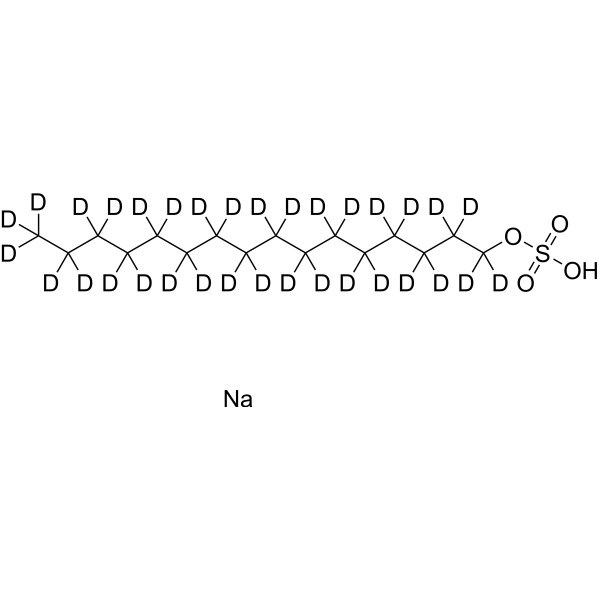
    Sodium hexadecyl sulfate-d33 is the deuterium labeled Sodium hexadecyl sulfate. Sodium hexadecyl sulfate is a long-chain anionic surfactant. Sodium hexadecyl sulfate can act as an interface-regulating substance to form a soft layer on the surface of carbon nanotubes, guide proteins to adsorb in the correct orientation with active sites facing outward through electrostatic interactions, and significantly enhance the activity of immobilized enzymes. Sodium hexadecyl sulfate can replace or supplement SDS (HY-Y0316) in capillary gel electrophoresis (CGE) .
    Sodium hexadecyl sulfate-d33
  • HY-E70321

    Endogenous Metabolite Others
    Cefradine acylase (Immobilized) is a biocatalyst and a key enzyme in new biocatalyst technology. Enzyme engineering focuses on enhancing enzyme reaction kinetics, substrate selectivity, and activity under harsh conditions such as low or high pH. By introducing stimulus responsiveness to these enzyme modifications, dynamic control of activity is also possible .
    Cefradine acylase (Immobilized)
  • HY-131829A

    6-AE-NAD+ sodium

    Biochemical Assay Reagents Others
    N6-(2-Aminoethyl)-NAD+ (6-AE-NAD+) sodium is a NAD+ derivative commonly used in affinity chromatography. N6-(2-Aminoethyl)-NAD+ sodium can be covalently linked to a PQQ (pyrroloquinoline quinone) (HY-100196) monolayer on an electrode surface for immobilizing NAD+-dependent enzymes such as lactate dehydrogenase (LDH) .
    N6-(2-Aminoethyl)-NAD+ sodium

Inquiry Online

Your information is safe with us. * Required Fields.

Salutation


Country or Region *

Applicant Name *


Organization Name *

Department *


Email Address *


Product Name *

Cat. No.


Requested quantity *

Phone Number *


Remarks

Inquiry Online

Inquiry Information

Product Name:
Cat. No.:
Quantity:
MCE Japan Authorized Agent:

