1. Search Result
Search Result
Results for "

ethanol dependence

" in MedChemExpress (MCE) Product Catalog:

8

Inhibitors & Agonists

2

Natural
Products

1

Isotope-Labeled Compounds

Cat. No. Product Name Target Research Areas Chemical Structure
  • HY-18101A
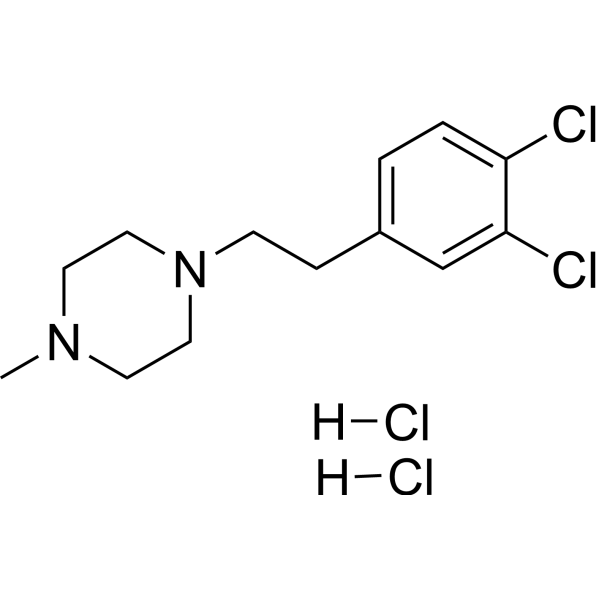
    BD-1063 dihydrochloride
    3 Publications Verification

    Sigma Receptor TRP Channel Neurological Disease
    BD-1063 dihydrochloride is a selective σ-1 receptor antagonist with inhibitory activity against TRPC5 and TRPM3. BD-1063 dihydrochloride exerts anti-hyperalgesic and anti-allodynic effects by inhibiting sustained calcium influx mediated by TRPC5 and TRPM3, and reverses the effects of Carrageenan (HY-125474). BD-1063 dihydrochloride also significantly reduces excessive ethanol self-administration behavior. BD-1063 dihydrochloride is widely used in studies on the mechanisms underlying neuropathic pain, inflammatory hyperalgesia, and alcohol abuse and dependence .
    BD-1063 dihydrochloride
  • HY-N9483

    7-Oxo-DHEA; 7-Ketodehydroepiandrosterone; 7-Oxodehydroepiandrosterone

    GABA Receptor Metabolic Disease
    7-Keto-DHEA binds to GABA Receptor, and reduces the ethanol intake in rats. 7-Keto-DHEA exhibits potential in investigation of alcohol dependence disorders .
    7-Keto-DHEA
  • HY-175275

    BEM

    MMP Lipoxygenase Reactive Oxygen Species (ROS) Neurological Disease Inflammation/Immunology Cancer
    10-Butyl Ether Minocycline (BEM), a Minocycline (HY-17412A) derivative, is an MMP-8 and MMP-9 inhibitor with IC50s of 69.4 µM and 47.0 µM, respectively. 10-Butyl Ether Minocycline suppresses LPS (HY-D1056)-induced microglial activation. 10-Butyl Ether Minocycline inhibits VEGF-induced endothelial cell migration and L-Glutamine (HY-N0390)-induced ROS levels. 10-Butyl Ether Minocycline significantly reduces alcohol consumption in the Chronic Intermittent Ethanol (CIE) mouse model of alcohol dependence. 10-Butyl Ether Minocycline can be used for the study of neuroimmune-inflammatory diseases and Alcohol use disorder (AUD) .
    10-Butyl Ether Minocycline
  • HY-122666

    GlyT Metabolic Disease
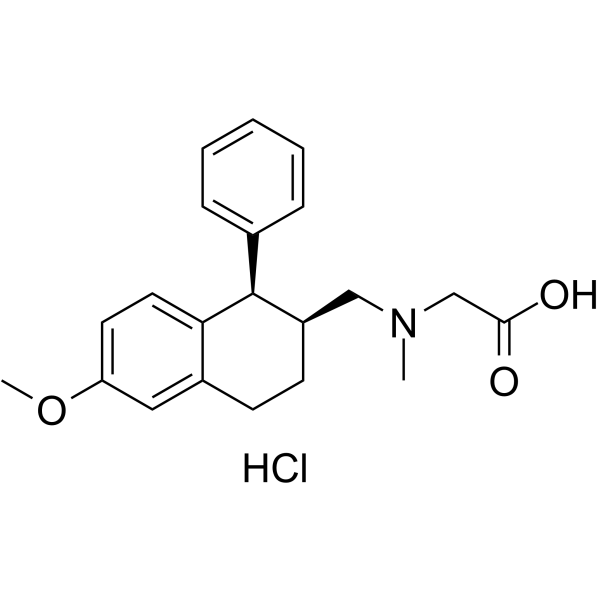
    Org 25935 is a potent and selective glycine transporter 1 protein (GlyT1) inhibitor with an IC50 value of 100 nM. Org 25935 can decrease ethanol (EtOH) intake and EtOH preference in rats, whereas water intake is unaffected. Org 25935 can be used for researching alcohol dependence or abuse .
    Org 25935
  • HY-N9483R

    7-Oxo-DHEA (Standard); 7-Ketodehydroepiandrosterone (Standard); 7-Oxodehydroepiandrosterone (Standard)

    GABA Receptor Reference Standards Metabolic Disease
    7-Keto-DHEA (Standard) (7-Oxo-DHEA (Standard)) is the analytical standard of 7-Keto-DHEA (HY-N9483). This product is intended for research and analytical applications. 7-Keto-DHEA binds to GABA Receptor, and reduces the ethanol intake in rats. 7-Keto-DHEA exhibits potential in investigation of alcohol dependence disorders .
    7-Keto-DHEA (Standard)
  • HY-18101

    Sigma Receptor TRP Channel Neurological Disease
    BD-1063 is a selective σ-1 receptor antagonist with inhibitory activity against TRPC5 and TRPM3. BD-1063 exerts anti-hyperalgesic and anti-allodynic effects by inhibiting sustained calcium influx mediated by TRPC5 and TRPM3, and reverses the effects of Carrageenan (HY-125474). BD-1063 also significantly reduces excessive ethanol self-administration behavior. BD-1063 is widely used in studies on the mechanisms underlying neuropathic pain, inflammatory hyperalgesia, and alcohol abuse and dependence .
    BD-1063
  • HY-18101S

    Isotope-Labeled Compounds Sigma Receptor TRP Channel Neurological Disease
    BD-1063-d8 dihydrochloride is the deuterium labeled BD1063 dihydrochloride (HY-18101A) . BD-1063 dihydrochloride is a selective σ-1 receptor antagonist with inhibitory activity against TRPC5 and TRPM3. BD-1063 dihydrochloride exerts anti-hyperalgesic and anti-allodynic effects by inhibiting sustained calcium influx mediated by TRPC5 and TRPM3, and reverses the effects of Carrageenan (HY-125474). BD-1063 dihydrochloride also significantly reduces excessive ethanol self-administration behavior. BD-1063 dihydrochloride is widely used in studies on the mechanisms underlying neuropathic pain, inflammatory hyperalgesia, and alcohol abuse and dependence .
    BD-1063-d8 dihydrochloride
  • HY-182601

    EAAT Interleukin Related Neurological Disease
    MC-100093 is an orally active, blood-brain barrier-permeable GLT-1 expression upregulator . MC-100093 upregulates the expression of GLT-1 and xCT in rats, and alleviates fentanyl-induced GLT-1 downregulation, IL-6 upregulation and motor hyperactivity. MC-100093 upregulates GLT-1 expression and enhances glutamate uptake in astrocyte-neuron co-culture systems. MC-100093 reduces ethanol consumption and preference, and exerts gender-specific antidepressant-like effects . MC-100093 can be used in studies related to fentanyl overdose, mood disorders and alcohol use disorders .
    MC-100093

Inquiry Online

Your information is safe with us. * Required Fields.

Salutation


Country or Region *

Applicant Name *


Organization Name *

Department *


Email Address *


Product Name *

Cat. No.


Requested quantity *

Phone Number *


Remarks

Inquiry Online

Inquiry Information

Product Name:
Cat. No.:
Quantity:
MCE Japan Authorized Agent:

