8 Results for "

intramolecular interactions

" in MedChemExpress (MCE) Product Catalog:
Products (8)

8 Results for "intramolecular interactions" in MCE Product Catalog:

5
5 Cited Publications
Cat. No.: HY-P1136
CAS No.: 1507930-57-5
Target:  

Gap Junction Protein

Research Areas:  

Cardiovascular Disease

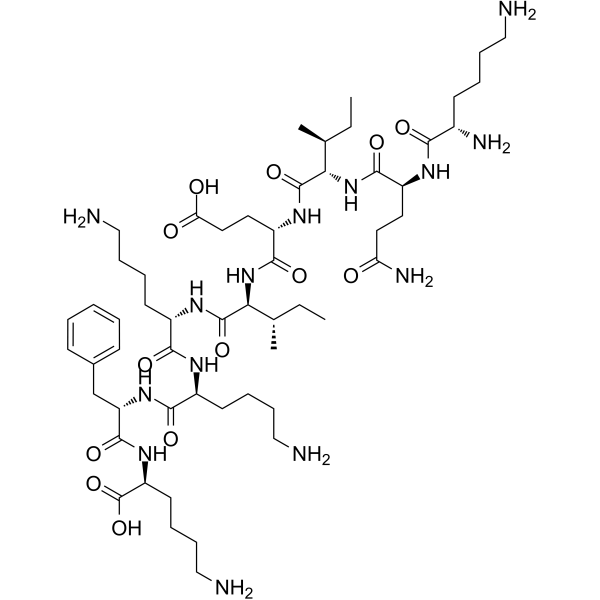
Gap19, a peptide derived from nine amino acids of the Cx43 cytoplasmic loop (CL), is a potent and selective connexin 43 (Cx43) hemichannel blocker. Gap19 inhibits hemichannels caused by preventing intramolecular interactions of the C-terminus (CT) with the CL. Gap19 is not blocking GJ channels or Cx40/pannexin-1 hemichannels. Gap19 has protective effects against myocardial .
loading...
    loading...
5
5 Cited Publications
Cat. No.: HY-P1136A
Target:  

Gap Junction Protein

Research Areas:  

Cardiovascular Disease

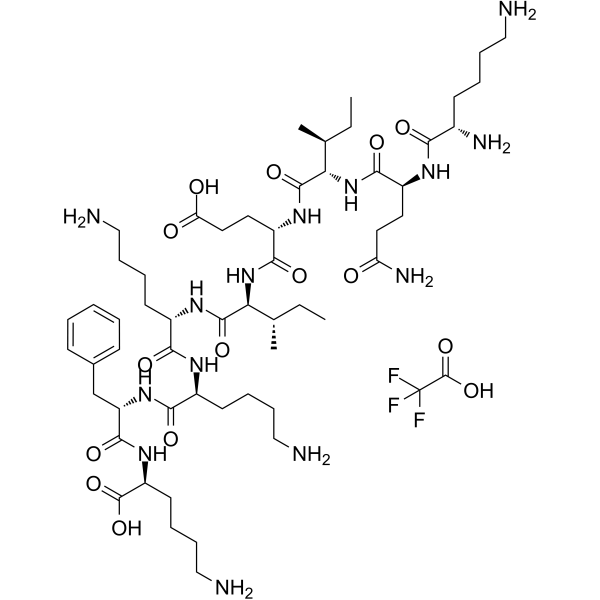
Gap19 TFA, a peptide derived from nine amino acids of the Cx43 cytoplasmic loop (CL), is a potent and selective connexin 43 (Cx43) hemichannel blocker. Gap19 TFA inhibits hemichannels caused by preventing intramolecular interactions of the C-terminus (CT) with the CL. Gap19 TFA is not blocking GJ channels or Cx40/pannexin-1 hemichannels. Gap19 TFA has protective effects against myocardial .
loading...
    loading...
Cat. No.: HY-112798
CAS No.: 1311174-68-1
Purity:  98.78%
Target:  

Apolipoprotein

Research Areas:  

Neurological Disease

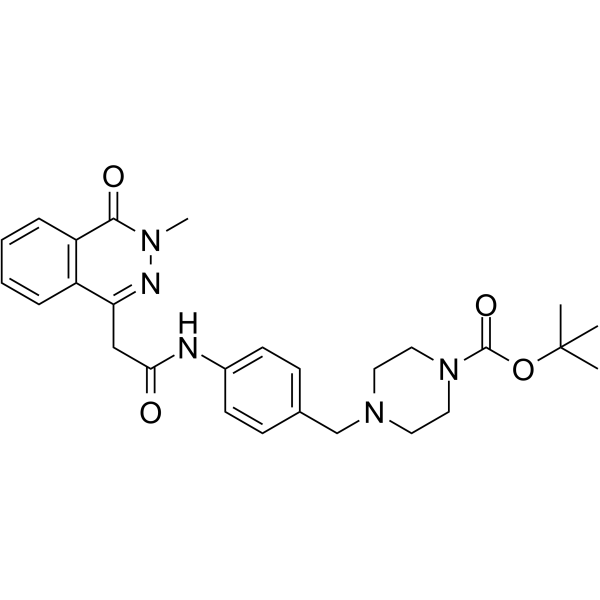
PH-002 is an inhibitor of apolipoprotein (apo) E4 intramolecular domain interaction in neuronal cells that could rescue impairments of mitochondrial motility and neurite outgrowth.
loading...
    loading...
Cat. No.: HY-W016814A
CAS No.: 499-12-7
Synonyms: NSC 7616
Target:  

Bacterial

Research Areas:  

Infection

Aconitic acid (NSC 7616) is an Antibacterial agent. Aconitic acid exerts dose-dependent inhibitory effects on Escherichia coli, Pseudomonas aeruginosa, Bacillus subtilis, and Staphylococcus aureus in vitro. Aconitic acid can be used in studies related to bacterial infections .
loading...
    loading...
Cat. No.: HY-D1470
CAS No.: 210832-86-3
Target:  

Fluorescent Dye

Research Areas:  

Others

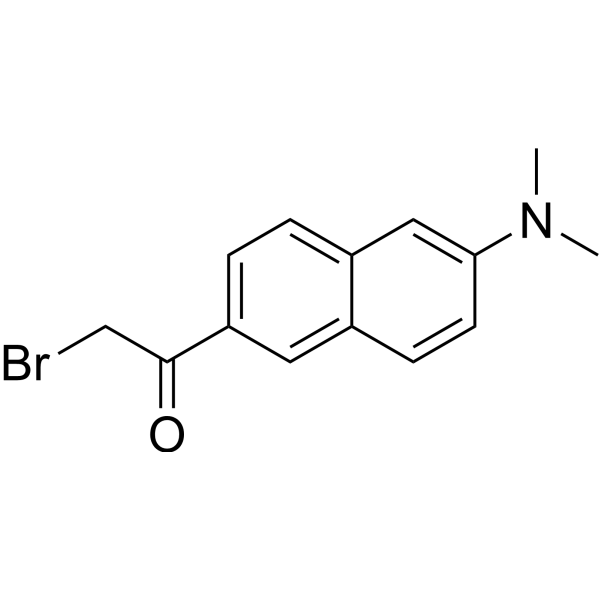
BADAN is a thiol-reactive, environment-sensitive fluorescent probe used for site-specific labeling of protein cysteine residues to detect protein topology, local polarity, protein-lipid interactions, and conformational changes. The bromoacetyl group of BADAN covalently binds to cysteine thiols, and its fluorescence originates from the intramolecular charge transfer (ICT) excited state. The emission peak position varies with the polarity of the surrounding medium: it blue-shifts to approximately 488 nm in nonpolar environments (such as the hydrophobic core of lipid bilayers) and red-shifts to approximately 496-507 nm in polar environments (such as aqueous phases), independent of enzymes, pH, or membrane potential. Ex = 380-402 nm; Em = 400-600 nm .
loading...
    loading...
Cat. No.: HY-112798S
PH-002-d8 is the deuterium labeled PH-002 (HY-112798). PH-002 is an inhibitor of apolipoprotein (apo) E4 intramolecular domain interaction in neuronal cells that could rescue impairments of mitochondrial motility and neurite outgrowth.
loading...
    loading...
Cat. No.: HY-D3430
PTPA-QM is a low-cytotoxicity protein probe that can be used for live-cell imaging and tissue section staining (Lys. Ex/Em = 385/615 nm). PTPA-QM can intercalate into the β-sheet layered structure of β-amyloid fibrils, form intermolecular interactions with amino acid residues, restrict intramolecular rotation and trigger fluorescence activation for imaging purposes. PTPA-QM is applicable to Alzheimer's disease-related research. Maximum excitation/emission wavelength: 448/605 nm .
loading...
    loading...
Cat. No.: HY-182588
CAS No.: 20905-50-4
Target:  

Bacterial HIV Dengue Virus

Research Areas:  

Infection

Circulin B is a macrocyclic plant cyclopeptide. Circulin B functions as a plant defense peptide and exhibits antibacterial and anti-HIV activities. Circulin B has high binding affinity for the envelope protein of dengue virus, showing potential anti-dengue virus activity. Circulin B can be used in studies related to dengue virus infection, human immunodeficiency virus infection and microbial infection .
loading...
    loading...

