6 Results for "

mouse sperm cells

" in MedChemExpress (MCE) Product Catalog:
Products (6)

6 Results for "mouse sperm cells" in MCE Product Catalog:

1
1 Cited Publications
Cat. No.: HY-NP0182
Synonyms: PNA (Biotinylated)
Peanut Agglutinin (PNA) Biotinylated is a biotinylated lectin that specifically recognizes and binds to the Galβ1-3GalNAc sequence, thereby targeting SPESP1 and TF blood group antigens. As an acrosome-specific marker, Peanut Agglutinin Biotinylated stains mouse spermatocytes and sperm acrosomes with high specificity, and this binding depends not only on SPESP1 but also recognizes other testicular acrosomal glycoproteins. Peanut Agglutinin Biotinylated accurately identifies TF antigens in Reed-Sternberg cells, histiocytosis X cells, and esophageal squamous cell carcinoma, without cross-reacting with non-specific cells. Peanut Agglutinin Biotinylated maintains staining stability in both B-5 and formalin fixatives, and serves as an important tool for the study of Hodgkin's disease, histiocytosis X, and various malignant tumors .
loading...
    loading...
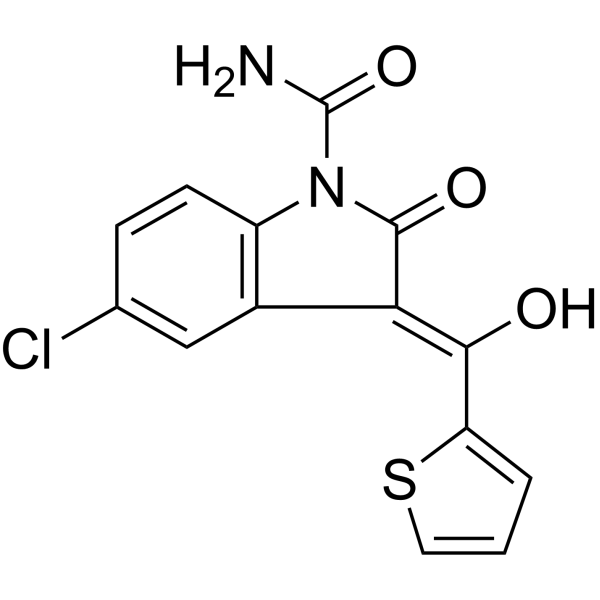
Cat. No.: HY-105028
CAS No.: 120210-48-2
Purity:  99.32%
Synonyms: CP-66248
Tenidap (CP-66248) is an orally active dual inhibitor of 5-LOX and COX with anti-inflammatory and immunomodulatory properties. Tenidap downregulates the expression of IL-1 receptors in chondrocytes, reduces the release of pro-inflammatory cytokines such as IL-1, IL-6 and TNF-α, and inhibits MMP production and cartilage degradation. Tenidap also blocks bone resorption and leukocyte adhesion to vascular endothelium, interferes with ion and pH changes associated with mouse sperm capacitation, and selectively enhances the activity of hKir2.3 channels (EC50=1.3 μM). Tenidap is applicable to research related to rheumatoid arthritis .
loading...
    loading...
Cat. No.: HY-136855
CAS No.: 652968-37-1
Purity:  95.00%
MitoPBN is a AMPK/SIRT3/PGC-1α axis modulator, reactive oxygen species scavenger and mitochondrial function enhancer. MitoPBN increases the phosphorylation level of AMPK, restores SIRT3 expression and reverses the down-regulation of PGC-1α, thereby promoting mitochondrial biogenesis. MitoPBN regulates glucose metabolism, reduces blood glucose by inhibiting hepatic gluconeogenesis and increasing hepatic glucose uptake, while scavenging mitochondrial superoxide anion/hydrogen peroxide, maintaining membrane potential and increasing ATP production. MitoPBN also reduces cell apoptosis, improves sperm motility, survival rate and membrane integrity, but may induce reductive stress in cryopreserved sperm at high concentrations. MitoPBN is widely applicable to research related to diabetes and type 2 diabetes .
loading...
    loading...
Cat. No.: HY-D3148
CAS No.: 1804107-88-7
Target:  

Fluorescent Dye

Research Areas:  

Others

TPE-Ph-In is a mitochondria-targeted voltage-sensitive probe that can be used for mitochondrial membrane potential detection, mitochondrial imaging of animal and plant cells and tissues, mouse sperm activity indication, and detection of mitochondrial membrane potential changes associated with early apoptosis. TPE-Ph-In is non-fluorescent in solution, but emits strong fluorescence when aggregated via restriction of intramolecular rotation/movement, and its fluorescence intensity is directly correlated with local probe concentration or mitochondrial membrane potential level. TPE-Ph-In can penetrate cell membranes, target mitochondria through charge-dependent accumulation, has low cytotoxicity and high photostability, and enables super-resolution imaging of plant mitochondrial fission, fusion and cristae structures. The excitation wavelengths of TPE-Ph-In include 450 nm, 488 nm, and 489 nm, while its emission wavelengths include 551-661 nm, 660 nm, and 694 nm. TPE-Ph-In can be used for studies on mitochondrial dysfunction associated with early apoptosis .
loading...
    loading...
Cat. No.: HY-184464
Target:  

PROTACs Ser/Thr Kinase

Research Areas:  

Endocrinology

PROTAC TSSK1 Degrader-2 is a cereblon-recruiting PROTAC degrader targeting TSSK1, with a DC50 of 10.8 nM and an IC50 of 56.8 nM against TSSK1. PROTAC TSSK1 Degrader-2 recruits the cereblon E3 ubiquitin ligase to induce proteasomal degradation of TSSK1. PROTAC TSSK1 Degrader-2 reduces the motility and in vitro fertilization capacity of mouse sperm. PROTAC TSSK1 Degrader-2 undergoes metabolic N-dealkylation and exhibits high efflux. PROTAC TSSK1 Degrader-2 can be used in studies related to male fertility .
loading...
    loading...
Cat. No.: HY-184428
Target:  

PROTACs Ser/Thr Kinase

Research Areas:  

Endocrinology

PROTAC TSSK1 Degrader-1 is a TSSK1 PROTAC degrader with a DC50 of 10.8 nM and an IC50 of 56.8 nM. PROTAC TSSK1 Degrader-1 reduces sperm motility and impairs in vitro fertilization capacity. PROTAC TSSK1 Degrader-1 undergoes metabolic N-dealkylation and exhibits high efflux properties. PROTAC TSSK1 Degrader-1 is applicable to studies related to male fertility .
loading...
    loading...

