1. Search Result
Search Result
Results for "

neuronal cell lines

" in MedChemExpress (MCE) Product Catalog:

7

Inhibitors & Agonists

1

Peptides

1

Natural
Products

Cat. No. Product Name Target Research Areas Chemical Structure
  • HY-12929

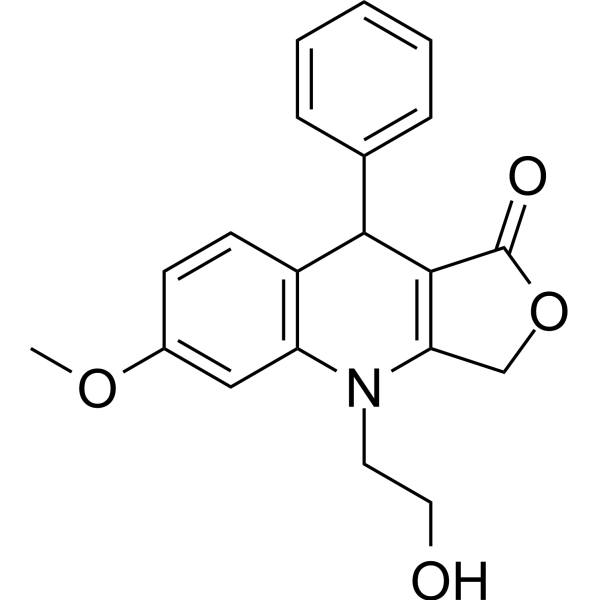
    SU093

    Pim Apoptosis Cancer
    NSC756093 (SU093) is a GBP1:PIM1 interaction inhibitor. NSC756093 binds to GBP1-PIM1 with a Kd of 38 nM. NSC756093 suppresses proliferation, reduces migration, induces G1 phase cell-cycle arrest, and increases apoptotic cell death in ovarian cancer cells. NSC756093 reduces cellular proteasomal activity, induces accumulation of ubiquitinated proteins, and restrains tumor progression and lung metastasis in murine ovarian cancer xenograft models. NSC756093 increases sensitivity of prostate cancer cells to Docetaxel (HY-B0011) and sensitizes GBP1-overexpressing ovarian cancer cells to Paclitaxel (HY-B0015). NSC756093 can be used for the research of prostate cancer and ovarian cancer .
    NSC756093
  • HY-N4246

    Aquaporin PKC Akt PI3K Apoptosis Monoamine Oxidase Pregnane X Receptor (PXR) Cardiovascular Disease Neurological Disease Inflammation/Immunology Cancer
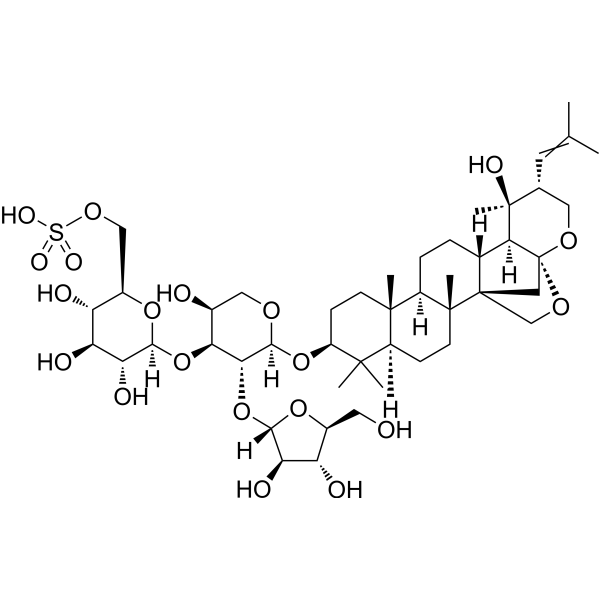
    Bacopaside I is an orally active aquaporin AQP1 inhibitor and PKC modulator with neuroprotective and anticancer activities. Bacopaside I specifically blocks the water channel and cGMP-gated ion channel activities of AQP1 without affecting AQP4, thereby inhibiting the migration of colon cancer cells expressing AQP1. Bacopaside I activates the Akt pathway by interacting with PI3K, specifically inhibits MAO-A, effectively alleviates neuron necrosis and apoptosis induced by oxygen-glucose deprivation, reduces oxidative stress, and regulates the surface expression of neuroreceptors. When combined with Bacopaside II (HY-N6016), Bacopaside I significantly reduces the viability, proliferation and invasion ability of breast cancer cells, and binds to the pregnane X receptor (PXR). Bacopaside I is applicable to the research of colon cancer, breast cancer, vascular dementia, cerebral ischemia and other related diseases .
    Bacopaside I
  • HY-P3840

    Mitosis Neurological Disease Cancer
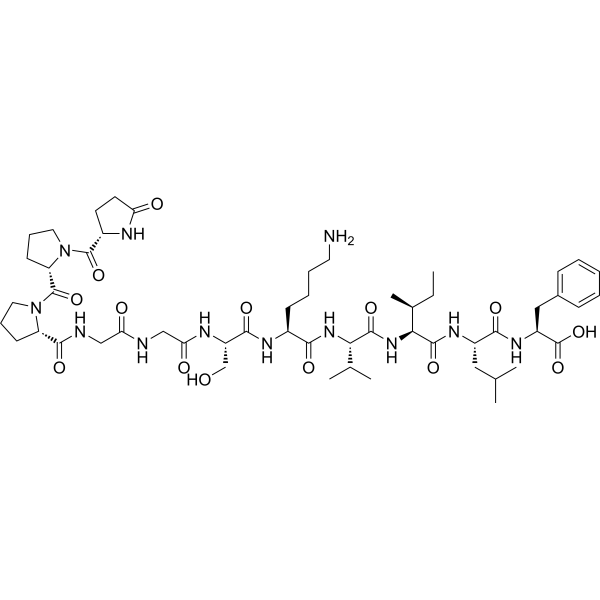
    Head activator neuropeptide is a mitogen for mammalian cell lines of neuronal or neuroendocrine origin. Head activator neuropeptide signals by binding GPR37 and stimulates cells to enter mitosis .
    Head activator neuropeptide
  • HY-14535

    Amyloid-β Neurological Disease
    SEN-1269 is a potent Aβ aggregation inhibitor. SEN-1269 blocks Aβ(1-42) aggregation and protects neuronal cell lines exposed to Aβ(1-42). SEN-1269 reduces the deficits in LTP and memory induced by Aβ oligomers. SEN-1269 can be used for the research of Alzheimer's disease .
    SEN-1269
  • HY-18956A

    (E/Z)-Sephin1 hydrochloride; (E/Z)-IFB-088 hydrochloride

    Phosphatase Neurological Disease
    (E/Z)-Icerguastat hydrochloride ((E/Z)-Sephin1 hydrochloride) is a selective inhibitor with activity that prolongs the phosphorylation effects of eIF2α. (E/Z)-Icerguastat hydrochloride protects cells from defects in proteostasis. (E/Z)-Icerguastat hydrochloride was shown to significantly extend the survival of infected prion mice in a mouse model. (E/Z)-Icerguastat hydrochloride effectively reduces PrPSc expression and prion sequence activity in various neuronal cell lines persistently infected with different prion strains .
    (E/Z)-Icerguastat hydrochloride
  • HY-179538

    Biochemical Assay Reagents Pim DYRK Cancer
    CSH-4044 can be isolated from fermented wheat germ extract. CSH-4044 is a unique benzothiazole compound. CSH-4044 can inhibit PIM3-driven BAD phosphorylation in pancreatic cancer cell lines as well as reducing DYRK1A-induced Tau phosphorylation in neuronal cells .
    CSH-4044
  • HY-182023

    Reactive Oxygen Species (ROS) GABA Receptor Neurological Disease
    Anticonvulsant agent 11 (Compound 8b) is an anticonvulsant agent. Anticonvulsant agent 11 exerts neuroprotective effects by enhancing cell viability and reducing ROS levels. Anticonvulsant agent 11 induces the expression of GABAA α1, resulting in neuronal hyperpolarization. Anticonvulsant agent 11 increases the number of neurite-bearing cells and the length of neurites. Anticonvulsant agent 11 exhibits dose-dependent anticonvulsant effects in mice. Anticonvulsant agent 11 can be used for the research of epilepsy .
    Anticonvulsant agent 11

Inquiry Online

Your information is safe with us. * Required Fields.

Salutation


Country or Region *

Applicant Name *


Organization Name *

Department *


Email Address *


Product Name *

Cat. No.


Requested quantity *

Phone Number *


Remarks

Inquiry Online

Inquiry Information

Product Name:
Cat. No.:
Quantity:
MCE Japan Authorized Agent:

