



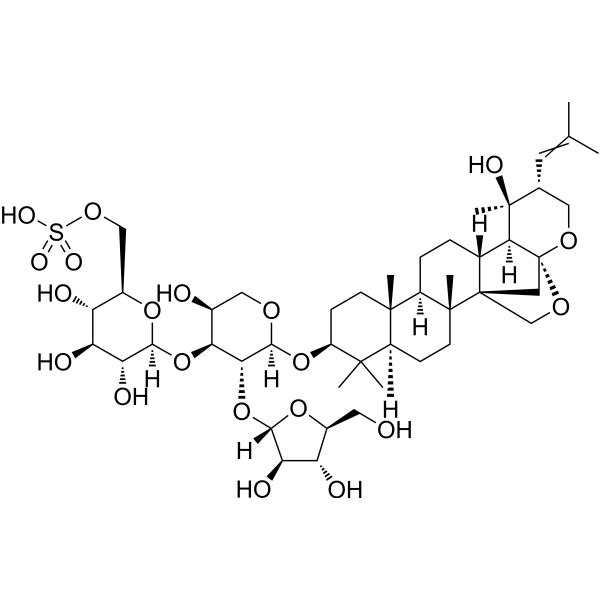
Bacopaside I

Based on 1 Customer Validation
Bacopaside I is an orally active aquaporin AQP1 inhibitor and PKC modulator with neuroprotective and anticancer activities. Bacopaside I specifically blocks the water channel and cGMP-gated ion channel activities of AQP1 without affecting AQP4, thereby inhibiting the migration of colon cancer cells expressing AQP1. Bacopaside I activates the Akt pathway by interacting with PI3K, specifically inhibits MAO-A, effectively alleviates neuron necrosis and apoptosis induced by oxygen-glucose deprivation, reduces oxidative stress, and regulates the surface expression of neuroreceptors. When combined with Bacopaside II (HY-N6016), Bacopaside I significantly reduces the viability, proliferation and invasion ability of breast cancer cells, and binds to the pregnane X receptor (PXR). Bacopaside I is applicable to the research of colon cancer, breast cancer, vascular dementia, cerebral ischemia and other related diseases.
For research use only. We do not sell to patients.
- Purity : 99.20%
- CAS No.: 382148-47-2
- Formula: C46H74O20S
- Molecular Weight:979.13
-
Storage:
4°C, protect from light
* In solvent : -80°C, 6 months; -20°C, 1 month (protect from light)

To place orders, for customer services and technical support, please contact: MedChemExpress USA
Tel: 609-228-6898 E-mail: [email protected] [email protected]


-
 Biological Activity
-
Chemical Information
-
Solvent & Solubility
- Protocols
- Purity & Documentation
- References
-
 Help & FAQs




Biological Activity
Description
IC50 & Target
|
MAO-A |
In Vitro
Bacopaside I (117-178 μM; 50 mins-2 h) potently and selectively inhibits AQP1-mediated osmotic water permeability in Xenopus laevis oocytes with an IC50 of 117 μM; Bacopaside I shows no activity against AQP4[1].
Bacopaside I (50-100 μM; 2 h) inhibits cGMP-dependent ion conductance of AQP1 in Xenopus laevis oocytes, and the blocking effect at 100 μM is stronger than that at 50 μM after 2 h of incubation[1].
Bacopaside I (48-50 μM; 24 h) inhibits the migration of HT29 colon cancer cells with high AQP1 expression, with an IC50 of 48 μM, and impairs the directional motility of the cells[1].
Bacopaside I (50-75 μM; 24 h) shows no cytotoxicity against HT29 colon cancer cells at concentrations up to 75 μM after 24 h of incubation[1].
Treatment with Bacopaside I (5-10 μM; 3-4 d) for 3 days reduces the proliferative activity of MDA-MB-231, T47D, MCF7 and BT-474 breast cancer cell lines; treatment for 4 days decreases the migratory capacity of breast cancer cell lines[2].
Combination treatment with Bacopaside I (5-10 μM; 24 h) and Bacopaside II reduces the transcript expression of AQP1 in MDA-MB-231 breast cancer cells, with an IC50 of 13 μM for inhibiting its activity[2].
Bacopaside I (administered at 5-25 μM for a total of 60 min, with treatment initiated before and maintained during 45 min of OGD) potently protects organotypic hippocampal slice cultures against OGD-induced neuronal injury by inhibiting apoptosis and necrosis, and the protective activity at 25 μM is superior to that at 5 μM[3].
Bacopaside I (administered at 25 μM before and during 45 minutes of OGD treatment, with a total intervention duration of 60 min) exerts neuroprotective effects against OGD-induced injury in organotypic hippocampal slice cultures. This effect depends on the PKC and PI3K/Akt signaling pathways, but is independent of the ERK signaling pathway or cholinergic receptor activation[3].
MedChemExpress (MCE) has not independently confirmed the accuracy of these methods. They are for reference only.
-
Cell Line:AQP1-high-expressing human HT29 colon cancer cells
-
Concentration:48 μM (IC50 for migration inhibition); 50 μM
-
Incubation Time:24 h
-
Result:Dose-dependently inhibited HT29 cell migration measured by wound closure, with an IC50 of 48 μM.
Significantly reduced HT29 cell migration into the wound area after 24 h incubation.
Induced compressed, non-directional movement trajectories and shorter mean total distance traveled by cells over 24 h compared to vehicle-treated cells.
-
Cell Line:MDA-MB-231, T47D, MCF7, BT-474 breast cancer cell lines
-
Concentration:IC50 values
-
Incubation Time:24 h
-
Result:Potently reduced cell viability with half maximal inhibitory concentrations (IC50) of 99 μM (95% CI 91-109) for MDA-MB-231, 89 μM (95% CI 73-109) for T47D, 83 μM (95% CI 79-87) for MCF7, and 59 μM (95% CI 56-63) for BT-474.
-
Cell Line:MDA-MB-231, T47D, BT-474 breast cancer cell lines
-
Concentration:5 μM (in combination with 2.5 μM or 5 μM Bacopaside II); 10 μM (in combination with 2.5 μM Bacopaside II)
-
Incubation Time:24 h
-
Result:Reduced AQP1 transcript expression by 1.8-fold relative to vehicle (p = 0.004) in MDA-MB-231 cells treated with 5 μM Bacopaside I + 2.5 μM Bacopaside II.
Reduced AQP1 transcript expression by 2.5-fold relative to vehicle (p < 0.0001) in MDA-MB-231 cells treated with 5 μM Bacopaside I + 5 μM Bacopaside II.
Showed no significant effect on AQP1 transcript expression in T47D or BT-474 cells.
-
Cell Line:MDA-MB-231 breast cancer cell line
-
Concentration:13 μM (in combination with 2.5 μM Bacopaside II)
-
Incubation Time:24 h
-
Result:Exhibited an IC50 of 13 μM (95% CI 10-16 μM) in combination with 2.5 μM Bacopaside II, representing a synergistic interaction with a combination index (CIx) of 0.270 (95% CI 0.240-0.301).
In Vivo
Bacopaside I (oral route) exerts neuroprotective effects in rats with cerebral ischemia-induced injury by reducing neurological deficits, infarct volume, and edema, and by normalizing brain ATP, antioxidant enzyme, ATPase, and MDA levels[4].
Bacopaside I exhibits antidepressant-like activity in CUMS-exposed mice by reversing hypothalamic-pituitary-adrenal (HPA) axis hyperactivity[4].
MedChemExpress (MCE) has not independently confirmed the accuracy of these methods. They are for reference only.
-
Animal Model:Swiss-albino mice[2]
-
Dosage:50 mg/kg
-
Administration:oral; daily; 7 days
-
Result:Showed no adverse effects.
- RNA extraction experimental
- Detection of Apoptosis
- TUNEL staining for apoptotic DNA fragmentation
- Annexin V plus membrane-impermeant dye apoptosis staining
- Cell migration
- ROS/oxidative-stress fluorescent staining
- Two-electrode voltage clamp in Xenopus oocytes
- Apoptosis Solutions
- Cell invasion
- Breast Cancer Modeling
- Cell Viability Determination by MTT Colorimetric Assay


Chemical Information
-
CAS No. 382148-47-2
-
Appearance Solid
-
Molecular Weight 979.13
-
Formula C46H74O20S
-
Color Off-white to light yellow
-
SMILES
C[C@]12[C@@]34[C@@](CC[C@]1([H])[C@@]5([C@@](C(C)([C@@H](O[C@@]6([H])[C@@H]([C@H]([C@@H](O)CO6)O[C@]7([H])O[C@@H]([C@@H](O)[C@H](O)[C@H]7O)COS(=O)(O)=O)O[C@]8([H])O[C@@H](CO)[C@H](O)[C@H]8O)CC5)C)([H])CC2)C)([H])[C@]9([H])[C@@](OC4)(OC[C@@H](C=C(C)C)[C@@]9(O)C)C3
-
Structure Classification
-
Initial Source
-
Shipping
Room temperature in continental US; may vary elsewhere.
-
Storage
4°C, protect from light
* In solvent : -80°C, 6 months; -20°C, 1 month (protect from light)


Solvent & Solubility
In Vitro:
DMSO : 100 mg/mL (102.13 mM; Need ultrasonic; Hygroscopic DMSO has a significant impact on the solubility of product, please use newly opened DMSO)
Please refer to the solubility information to select the appropriate solvent. Once prepared, please aliquot and store the solution to prevent product inactivation from repeated freeze-thaw cycles.
Storage method and period of stock solution: -80°C, 6 months; -20°C, 1 month (protect from light). When stored at -80°C, please use it within 6 months. When stored at -20°C, please use it within 1 month.
Please refer to the solubility information to select the appropriate solvent. Once prepared, please aliquot and store the solution to prevent product inactivation from repeated freeze-thaw cycles.
Storage method and period of stock solution: -80°C, 6 months; -20°C, 1 month (protect from light). When stored at -80°C, please use it within 6 months. When stored at -20°C, please use it within 1 month.
Concentration (start) × Volume (start) = Concentration (final) × Volume (final)
In Vivo:
Select the appropriate dissolution method based on your experimental animal and administration route.
- For the following dissolution methods, please ensure to first prepare a clear stock solution using an In Vitro approach and then sequentially add co-solvents:
- To ensure reliable experimental results, the clarified stock solution can be appropriately stored based on storage conditions. As for the working solution for In Vivo experiments, it is recommended to prepare freshly and use it on the same day.
- The percentages shown for the solvents indicate their volumetric ratio in the final prepared solution. If precipitation or phase separation occurs during preparation, heat and/or sonication can be used to aid dissolution.
Add each solvent one by one: 10% DMSO 40% PEG300 5% Tween-80 45% Saline
Solubility: ≥ 2.5 mg/mL (2.55 mM); Clear solution
This protocol yields a clear solution of ≥ 2.5 mg/mL (saturation unknown).
Taking 1 mL working solution as an example, add 100 μL DMSO stock solution (25.0 mg/mL) to 400 μL PEG300, and mix evenly; then add 50 μL Tween-80 and mix evenly; then add 450 μL Saline to adjust the volume to 1 mL.
Preparation of Saline: Dissolve 0.9 g sodium chloride in ddH₂O and dilute to 100 mL to obtain a clear Saline solution.
Add each solvent one by one: 10% DMSO 90% (20% SBE-β-CD in Saline)
Solubility: ≥ 2.5 mg/mL (2.55 mM); Clear solution
This protocol yields a clear solution of ≥ 2.5 mg/mL (saturation unknown).
Taking 1 mL working solution as an example, add 100 μL DMSO stock solution (25.0 mg/mL) to 900 μL 20% SBE-β-CD in Saline, and mix evenly.
Preparation of 20% SBE-β-CD in Saline (4°C, storage for one week): 2 g SBE-β-CD powder is dissolved in 10 mL Saline, completely dissolve until clear.
In Vivo Dissolution Calculator
Please enter the basic information of animal experiments:
-
-
-
-
Recommended: Prepare an additional quantity of animals to account for potential losses during experiments.
Please enter your animal formula composition:
-
%DMSO +
Recommended: Keep the proportion of DMSO in working solution below 2% if your animal is weak.
-
%+
-
+%Tween-80 + +
-
%Saline +
The co-solvents required include: DMSO, . All of co-solvents are available by MedChemExpress (MCE). , Tween 80. All of co-solvents are available by MedChemExpress (MCE).
Working solution concentration: 0.22 mg/mL
Method for preparing stock solution: mg drug dissolved in μL DMSO. Stock solution concentration: mg/mL. * In solvent : -80°C, 6 months; -20°C, 1 month (protect from light)
1. Take μL DMSO stock solution;
2. Add μL .
μL , mix evenly;
3. Then add μL Tween 80, mix evenly;
4. Then add μL
Please ensure that the stock solution in the first step is dissolved to a clear state, and add co-solvents in sequence. You can use ultrasonic heating (ultrasonic cleaner, recommended frequency 20-40 kHz), vortexing, etc. to assist dissolution.


Purity & Documentation
-
Data Sheet (292 KB)
-
SDS (252 KB)
- English - EN (252 KB)
- Français - FR (252 KB)
- Deutsch - DE (252 KB)
- Norwegian - NO (252 KB)
- Español - ES (252 KB)
- Swedish - SV (252 KB)
- Italian - IT (252 KB)
- Korean - KR (252 KB)
- Portuguese - PT (252 KB)
-
Handling Instructions (2659 KB)
References
[1]. Pei JV, et al. Differential Inhibition of Water and Ion Channel Activities of Mammalian Aquaporin-1 by Two Structurally Related Bacopaside Compounds Derived from the Medicinal Plant Bacopa monnieri. Mol Pharmacol. 2016;90(4):496-507. [Content Brief]
[2]. Palethorpe HM, et al. Bacopasides I and II Act in Synergy to Inhibit the Growth, Migration and Invasion of Breast Cancer Cell Lines. Molecules. 2019;24(19):3539. Published 2019 Sep 30. [Content Brief]
[3]. Le XT, et al. Protective effects of Bacopa monnieri on ischemia-induced cognitive deficits in mice: the possible contribution of bacopaside I and underlying mechanism. J Ethnopharmacol. 2015;164:37-45. [Content Brief]
[4]. Sekhar VC, et al. Insights Into the Molecular Aspects of Neuroprotective Bacoside A and Bacopaside I. Curr Neuropharmacol. 2019;17(5):438-446. [Content Brief]


Complete Stock Solution Preparation Table
Please refer to the solubility information to select the appropriate solvent. Once prepared, please aliquot and store the solution to prevent product inactivation from repeated freeze-thaw cycles.
Storage method and period of stock solution: -80°C, 6 months; -20°C, 1 month (protect from light). When stored at -80°C, please use it within 6 months. When stored at -20°C, please use it within 1 month.
| Optional Solvent | Concentration Solvent Mass | 1 mg | 5 mg | 10 mg | 25 mg |
|---|---|---|---|---|---|
| DMSO | 1 mM | 1.0213 mL | 5.1066 mL | 10.2131 mL | 25.5329 mL |
| 5 mM | 0.2043 mL | 1.0213 mL | 2.0426 mL | 5.1066 mL | |
| 10 mM | 0.1021 mL | 0.5107 mL | 1.0213 mL | 2.5533 mL | |
| 15 mM | 0.0681 mL | 0.3404 mL | 0.6809 mL | 1.7022 mL | |
| 20 mM | 0.0511 mL | 0.2553 mL | 0.5107 mL | 1.2766 mL | |
| 25 mM | 0.0409 mL | 0.2043 mL | 0.4085 mL | 1.0213 mL | |
| 30 mM | 0.0340 mL | 0.1702 mL | 0.3404 mL | 0.8511 mL | |
| 40 mM | 0.0255 mL | 0.1277 mL | 0.2553 mL | 0.6383 mL | |
| 50 mM | 0.0204 mL | 0.1021 mL | 0.2043 mL | 0.5107 mL | |
| 60 mM | 0.0170 mL | 0.0851 mL | 0.1702 mL | 0.4255 mL | |
| 80 mM | 0.0128 mL | 0.0638 mL | 0.1277 mL | 0.3192 mL | |
| 100 mM | 0.0102 mL | 0.0511 mL | 0.1021 mL | 0.2553 mL |


Bacopaside I Related Classifications
HY-N4246 Related Classifications
 Powered by Bioz
Keywords
- Bacopaside I
- 382148-47-2
- Aquaporin
- PKC
- Akt
- PI3K
- Apoptosis
- Monoamine Oxidase
- Pregnane X Receptor (PXR)
- Akt pathway
- Xenopus laevis oocytes
- neuronal necrosis
- protein kinase C (PKC)
- breast cancer cell lines
- AQP4
- colon cancer cells
- aquaporin-1 (AQP1)
- phosphoinositide 3-kinase (PI3K)
- HT29 colon cancer cells
- Inhibitor
- inhibitor
- inhibit