12 Results for "

protac building blocks

" in MedChemExpress (MCE) Product Catalog:
Products (12)

12 Results for "protac building blocks" in MCE Product Catalog:

Cat. No.: HY-W013021
CAS No.: 498-66-8
Norbornene is a cycloolefin and building block for synthesis of porous organic polymeric materials via metathesis, addition, and CANAL polymerization. Norbornene can also be used as an E3 ligase ligand for the synthesis of PROTAC, such as PROTAC HyTTD Degrader-1 (HY-181895) .
loading...
    loading...
Cat. No.: HY-60263
CAS No.: 110013-18-8
Target:  

PROTAC Linkers

Research Areas:  

Others

(3R)-3-Pyrrolidinemethanol is a molecular building block and also a PROTAC linker, which can be used for the synthesis of PROTACs, such as NRX-0492 (HY-153357).
loading...
    loading...
Cat. No.: HY-W248665A
CAS No.: 2616553-35-4
Target:  

Ligands for E3 Ligase

Research Areas:  

Others

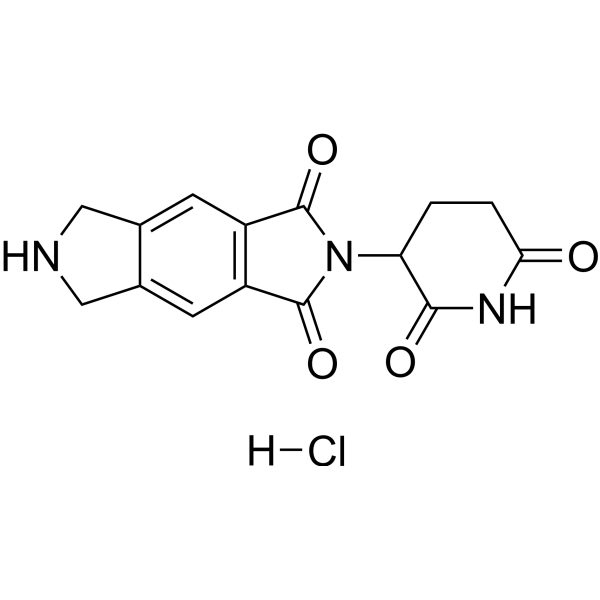
Thalidomide-pyrrolidine hydrochloride (Compound 18) is an E3 ligase ligand. Thalidomide-pyrrolidine serves as a building block for the synthesis of PROTAC ARD-1676 (HY-156111) .
loading...
    loading...
Cat. No.: HY-151791
CAS No.: 2300155-90-0
Target:  

ADC Linkers

Research Areas:  

Others

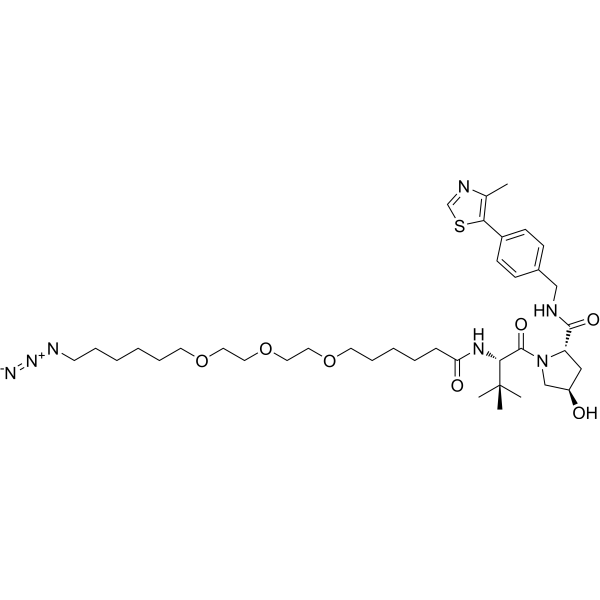
(S,R,S)-AHPC-C6-PEG3-butyl-N3 is a click chemistry reagent containing an azide group. (S,R,S)-AHPC-C6-PEG3-butyl-N3 serves as crosslinker-E3 ligase ligand conjugate, Click reactive protein degrader building block for PROTAC research, Template for synthesis of targeted protein degrader, VH032 conjugate . (S,R,S)-AHPC-C6-PEG3-butyl-N3 is a click chemistry reagent, it contains an Azide group and can undergo copper-catalyzed azide-alkyne cycloaddition reaction (CuAAc) with molecules containing Alkyne groups. It can also undergo strain-promoted alkyne-azide cycloaddition (SPAAC) reactions with molecules containing DBCO or BCN groups.
loading...
    loading...
Cat. No.: HY-160555
CAS No.: 2349429-71-4
Research Areas:  

Cancer

(S,R,S)-AHPC-CO-C9-NH2 is a Von Hippel-Lindau (VHL) amino building block that can be used to synthesize E3 ligase ligands required for PROTACs.
loading...
    loading...
Cat. No.: HY-160555A
CAS No.: 2376139-50-1
Research Areas:  

Cancer

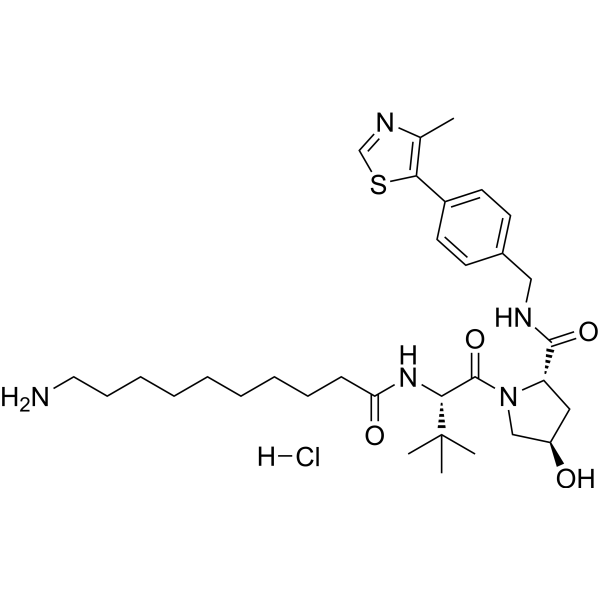
(S,R,S)-AHPC-CO-C9-NH2 (hydrochloride) is a von Hippel-Lindau (VHL) amino building block that can be used to synthesize E3 ligase ligands required for PROTACs..
loading...
    loading...
Cat. No.: HY-W595111
CAS No.: 2259851-45-9
Target:  

Drug Intermediate

Research Areas:  

Others

3-((4-(Piperazin-1-yl)phenyl)amino)piperidine-2,6-dione hydrochloride is a molecular building block, which can be used for the synthesis of other bioactive compounds such as PROTACs.
loading...
    loading...
Cat. No.: HY-W591352
CAS No.: 1950635-17-2
Target:  

Ligands for E3 Ligase

Research Areas:  

Cancer

Thalidomide-5-(C6-amine) is a PROTAC building block that contains an E3 ligase ligand substituted with a terminal amine group. The amine group can react with NHS ester group or carboxylic acid in the presence of EDC or HATU.
loading...
    loading...
Cat. No.: HY-182371
CAS No.: 3076613-24-3
BRD4 ligand 15 (compound 5) is a BRD4 ligand and alkyne-modified chalcone derivative, which serves as a building block for the synthesis of BRD4-targeting PROTAC TKP-5 (HY-182370) .
loading...
    loading...
Cat. No.: HY-135997
CAS No.: 3037417-28-7
Target:  

Ligands for E3 Ligase

Research Areas:  

Others

IAP ligand 12 is a IAP recruiting molecule and also a building block for the synthesis of IAP-CRBN heterodimer-targeted chimeric degrading molecules (PROTACs). IAP ligand 12 can be used to synthesize the IAP degrader TD-1092 (HY-151966) .
loading...
    loading...
Cat. No.: HY-W591353
CAS No.: 2550398-08-6
Research Areas:  

Cancer

Thalidomide-5-(PEG2-amine) is a PROTAC building block that contains an E3 ligase ligand substituted with a terminal amine group. The amine group can react with NHS ester group or carboxylic acid in the presence of EDC or HATU. The PEG spacer improves water solubility.
loading...
    loading...
Cat. No.: HY-L258
432 compounds

In modern medicinal chemistry and chemical biology research, alkyne (-C≡C-) structures play an important role in click chemistry, bioorthogonal labeling, and the construction of functional molecules due to their unique linear geometry and high reactivity. In particular, driven by the development of copper-catalyzed azide-alkyne cycloaddition (CuAAC) and copper-free click reactions (SPAAC), terminal alkyne groups have become important “chemical handles” for building complex biomolecular systems.

The MCE Alkyne Compound Library contains 432 compounds designed for the construction of click chemistry reaction systems and the development of diverse functional molecules. In drug discovery, these structures serve as key reactive sites that can efficiently undergo click reactions with azide groups, enabling modular assembly of PROTAC molecules, construction of ADC linkers, and rapid synthesis of bioorthogonal labeling probes. In addition, alkyne groups exhibit high stability, mild reaction conditions, and excellent biocompatibility, allowing them to maintain reactivity in complex biological environments. This contributes to improved efficiency and controllability in drug development, making them indispensable chemical building blocks in modern drug design and functional molecular engineering.

  • 1

