10 Results for "

protoplasts

" in MedChemExpress (MCE) Product Catalog:
Products (10)

10 Results for "protoplasts" in MCE Product Catalog:

Cat. No.: HY-B2220A
CAS No.: 9012-54-8
Research Areas:  

Others

Cellulase R-10 from Trichoderma Vride is an enzyme mixture that includes cellulase, hemicellulase, pectinase and protease, etc. Cellulase R-10 from Trichoderma Vride can act on the 1,4-β-D-glucosidic bonds in cellulose, catalyzing the hydrolysis of cellulose molecules and generating cellulose oligosaccharides, cellulose di-saccharides and glucose. Cellulase R-10 from Trichoderma Vride can be used in combination with lyase R-10 to break down the cell walls of plants, preparing protoplasts. Cellulase R-10 from Trichoderma Vride is widely applied in plant cell hybridization research .
loading...
    loading...
Cat. No.: HY-126224
CAS No.: 85186-71-6
Research Areas:  

Others

Driselase, Basidiomycetes sp, a complex mixt. of wall-digesting enzymes, is a specific commercial fungal protoplasting enzyme preparation. Driselase can be used in combination with lyase to promote protoplast formation in fungi. Driselase is by far the most potent of the enzymes tested for polysaccharide digestion and greatly increases both tensile and indentation compliances, yet it does not induce wall creep, even after 6 h of digestion .
loading...
    loading...
Cat. No.: HY-E70396
CAS No.: 9033-35-6
Research Areas:  

Others

Pectolyase Y-23, A. japonicus is a protoplast isolation reagent that degrades pectin. Pectolyase Y-23, A. japonicus breaks down pectin in the cell walls of broccoli cotyledons to release protoplasts .
loading...
    loading...
Cat. No.: HY-N1033
CAS No.: 140631-27-2
Research Areas:  

Infection

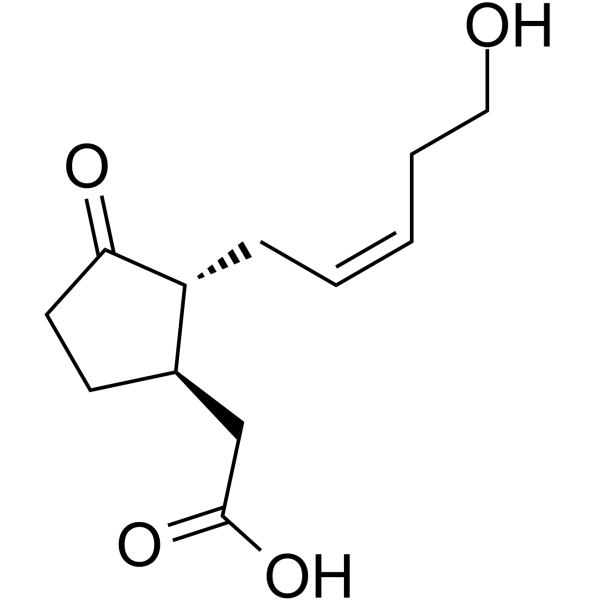
12-Hydroxyjasmonic acid is a metabolite of Jasmonic acid (HY-122464A) and an inducer of defense responses. 12-Hydroxyjasmonic acid can be isolated from potato leaflets. During the response of sugar beet plants to Cercospora beticola infection, 12-Hydroxyjasmonic acid is released through deglycosylation of its glucoside form and participates in the Jasmonic acid-mediated defense signaling pathway. 12-Hydroxyjasmonic acid mediates changes in source-sink relationships during pathogen infection, prioritizing the activation of defense processes over growth processes. 12-Hydroxyjasmonic acid serves as a substrate for salicylic acid Glycosyltransferases in tobacco and rice. 12-Hydroxyjasmonic acid can induce leaflet closure in Samanea saman. 12-Hydroxyjasmonic acid acts as a potato tuber-inducing substance. 12-Hydroxyjasmonic acid does not induce protoplast shrinkage in extensor motor cells of Samanea saman. 12-Hydroxyjasmonic acid can be used in studies related to brown spot disease .
loading...
    loading...
Cat. No.: HY-172190
MS Medium is a basic medium for plant tissue culture. MS Medium has a high concentration of inorganic salts and is suitable for plant protoplast, cell and tissue culture .
loading...
    loading...
Cat. No.: HY-179187
NT Medium is a balanced culture medium mainly used for tobacco protoplast culture.
loading...
    loading...
Cat. No.: HY-179188
DPD Medium is mainly used for tissue culture and protoplast culture of woody plants, especially trees.
loading...
    loading...
Cat. No.: HY-N14222
CAS No.: 153540-55-7
Epopromycin A inhibits the cell wall synthesis of lettuce protoplasts, thereby exhibiting herbicidal activity. Epopromycin A exhibits cytotoxicity in B16 melanoma cell with an IC50 of 0.003 µg/mL .
loading...
    loading...
Cat. No.: HY-N14236
CAS No.: 153540-56-8
Epopromycin B inhibits the cell wall synthesis of lettuce protoplasts, thereby exhibiting herbicidal activity. Epopromycin B exhibits cytotoxicity in B16 melanoma cell with an IC50 of 0.003 µg/mL .
loading...
    loading...
Cat. No.: HY-W747508
CAS No.: 58814-86-1
Target:  

Fungal Antibiotic

Research Areas:  

Infection

Aculeacin A is a β-1,3-glucan synthase inhibitor. Aculeacin A is an antifungal antibiotic. Aculeacin A inhibits cell wall glucan synthesis in growing yeast cells, induces cell lysis, osmotic fragility, cell aggregation and abnormal cell morphology, without affecting the synthesis of proteins, nucleic acids or mannan. Aculeacin A acts only on growing yeast cells and has a narrow antifungal spectrum, mainly targeting Candida and Torulopsis species. Aculeacin A shows reduced activity in human serum and exhibits a paradoxical dose-response pattern. Aculeacin A has an inoculum effect against some Candida albicans strains, and its activity is pH-stable. Aculeacin A can be used in studies of fungal infections, such as those caused by Candida, Torulopsis and other species .
loading...
    loading...

