



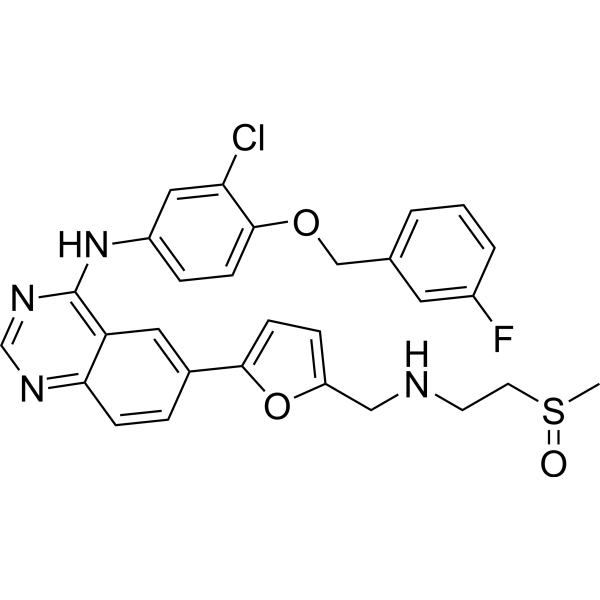
Selatinib
Based on 1 publication(s) in Google Scholar
Selatinib is an orally active EGFR and HER2 tyrosine kinase inhibitor with IC50 values of 13.0 nM and 8.5 nM, respectively. Selatinib undergoes oxidative metabolism in vivo to produce Lapatinib (HY-50898). Selatinib inhibits the growth of breast, gastric and ovarian tumors. Selatinib can be used in research related to gastric cancer, breast cancer and ovarian cancer.
For research use only. We do not sell to patients.
- Purity : 98.56%
- CAS No.: 1275595-86-2
- Formula: C29H26ClFN4O3S
- Molecular Weight:565.06
-
Storage:
4°C, protect from light
* In solvent : -80°C, 6 months; -20°C, 1 month (protect from light)

To place orders, for customer services and technical support, please contact: MedChemExpress USA
Tel: 609-228-6898 E-mail: [email protected] [email protected]


-
 Biological Activity
-
Chemical Information
-
Solvent & Solubility
- Protocols
- Purity & Documentation
- References
-
 Help & FAQs


Publications Citing Use of MedChemExpress (MCE) Selatinib
MoreAll EGFR Isoforms
More

Biological Activity
Description
IC50 & Target
[1]|
EGFR 13 nM (IC50) |
HER2 8.5 nM (IC50) |
In Vitro
Selatinib (serial dilution concentrations; 1 h) potently inhibits the tyrosine kinase activity of purified EGFR, with an IC50 of 13 nM[2].
Selatinib (serial gradient dilution; 1 h) potently inhibits the tyrosine kinase activity of purified HER-2, with an IC50 of 8.5 nM[2].
Selatinib (serial dilution concentrations; 72 h) inhibits the proliferation of gastric adenocarcinoma NCI-N87 cells, with an IC50 of 29.4 nM[2].
Selatinib (serial dilution concentrations; 72 h) potently inhibits the proliferation of breast cancer BT-474 cells, with an IC50 of 22.5 nM, and its activity is significantly higher than that of Lapatinib (HY-50898)[2].
MedChemExpress (MCE) has not independently confirmed the accuracy of these methods. They are for reference only. Further protocols information, click here.
-
Cell Line:human gastric adenocarcinoma NCI-N87 cells
-
Concentration:Serially diluted concentrations
-
Incubation Time:72 h
-
Result:Inhibited NCI-N87 cell proliferation with an IC50 of 29.4 nM.
-
Cell Line:human breast carcinoma BT-474 cells
-
Concentration:Serially diluted concentrations
-
Incubation Time:72 h
-
Result:Inhibited BT-474 cell proliferation with an IC50 of 22.5 nM, which was significantly more active than lapatinib (P < 0.05).
Parmacokinetics
| Species | Dose | Route | Tmax | Cmax | AUC0-t | AUC0-∞ | MRT | T1/2 | Bioavailability |
|---|---|---|---|---|---|---|---|---|---|
| Rat[2] | 100 mg/kg | p.o. | 3.5 h | 8881 ng/mL | 50,299 ng·h/mL | 53,236 ng·h/mL | 5.38 h | 2.32 h | 187 % |
In Vivo
Selatinib (200 mg/kg; p.o.; daily; 21 days) inhibits SK-OV-3 ovarian xenograft tumor growth by 85.7% with no observed overt toxicity[2].
MedChemExpress (MCE) has not independently confirmed the accuracy of these methods. They are for reference only.
-
Animal Model:BALB/c athymic (female, 4-6 weeks old)[2]
-
Dosage:200 mg/kg
-
Administration:p.o.; daily; 28 days
-
Result:Achieved a 94.8% tumor growth inhibition rate.
Induced significant tumor regression in all 6 treated mice.
Caused no overt toxicity (hematuria, bloody stool) or weight loss.
-
Animal Model:BALB/c athymic (female, 4-6 weeks old)[2]
-
Dosage:200 mg/kg
-
Administration:p.o.; daily; 21 days
-
Result:Achieved an 85.7% tumor growth inhibition rate.
Induced significant tumor regression in 2 of the treated mice.
Caused no overt toxicity (hematuria, bloody stool) or weight loss.
Clinical Trial
| NCT Number | Sponsor | Condition | Start Date |
Phase

|
|---|---|---|---|---|
| NCT01329991 | Plexxikon| | 2011-05 | PHASE1 |


Chemical Information
-
CAS No. 1275595-86-2
-
Appearance Solid
-
Molecular Weight 565.06
-
Formula C29H26ClFN4O3S
-
Color Yellow to orange
-
SMILES
O=S(C)CCNCC1=CC=C(O1)C2=CC3=C(N=CN=C3C=C2)NC4=CC=C(C(Cl)=C4)OCC5=CC=CC(F)=C5
-
Shipping
Room temperature in continental US; may vary elsewhere.
-
Storage
4°C, protect from light
* In solvent : -80°C, 6 months; -20°C, 1 month (protect from light)


Publications (1)
-
Journal Impact Factor
-
Most Recent


Solvent & Solubility
In Vitro:
DMSO : 100 mg/mL (176.97 mM; Need ultrasonic; Hygroscopic DMSO has a significant impact on the solubility of product, please use newly opened DMSO)
Please refer to the solubility information to select the appropriate solvent. Once prepared, please aliquot and store the solution to prevent product inactivation from repeated freeze-thaw cycles.
Storage method and period of stock solution: -80°C, 6 months; -20°C, 1 month (protect from light). When stored at -80°C, please use it within 6 months. When stored at -20°C, please use it within 1 month.
Please refer to the solubility information to select the appropriate solvent. Once prepared, please aliquot and store the solution to prevent product inactivation from repeated freeze-thaw cycles.
Storage method and period of stock solution: -80°C, 6 months; -20°C, 1 month (protect from light). When stored at -80°C, please use it within 6 months. When stored at -20°C, please use it within 1 month.
Concentration (start) × Volume (start) = Concentration (final) × Volume (final)

Protocols
-
Breast Cancer Modeling
Breast cancer is a heterogeneous cancer, and it has been distinguished into four subtypes: luminal A, luminal B, HER2-positive and basal-like. Molecular mutations, epigenetic alterations, hormone exposure and immune microenvironment are related to the progression of breast cancer.


Purity & Documentation
-
Data Sheet (282 KB)
-
SDS (393 KB)
- English - EN (393 KB)
- Français - FR (393 KB)
- Deutsch - DE (393 KB)
- Norwegian - NO (393 KB)
- Español - ES (393 KB)
- Swedish - SV (393 KB)
- Italian - IT (393 KB)
- Korean - KR (393 KB)
- Portuguese - PT (393 KB)
-
Handling Instructions (2659 KB)
References
[1]. Wang MN, et al. First-in-human, phase I single-ascending-dose study of the safety, pharmacokinetics, and relative bioavailability of selatinib, a dual EGFR-ErbB2 inhibitor in healthy subjects. Invest New Drugs. 2020;38(6):1826-1835. [Content Brief]
[2]. Zhang L, et al. Discovery of a potent dual EGFR/HER-2 inhibitor L-2 (selatinib) for the treatment of cancer. Eur J Med Chem. 2013;69:833-841. [Content Brief]


Complete Stock Solution Preparation Table
Please refer to the solubility information to select the appropriate solvent. Once prepared, please aliquot and store the solution to prevent product inactivation from repeated freeze-thaw cycles.
Storage method and period of stock solution: -80°C, 6 months; -20°C, 1 month (protect from light). When stored at -80°C, please use it within 6 months. When stored at -20°C, please use it within 1 month.
| Optional Solvent | Concentration Solvent Mass | 1 mg | 5 mg | 10 mg | 25 mg |
|---|---|---|---|---|---|
| DMSO | 1 mM | 1.7697 mL | 8.8486 mL | 17.6972 mL | 44.2431 mL |
| 5 mM | 0.3539 mL | 1.7697 mL | 3.5394 mL | 8.8486 mL | |
| 10 mM | 0.1770 mL | 0.8849 mL | 1.7697 mL | 4.4243 mL | |
| 15 mM | 0.1180 mL | 0.5899 mL | 1.1798 mL | 2.9495 mL | |
| 20 mM | 0.0885 mL | 0.4424 mL | 0.8849 mL | 2.2122 mL | |
| 25 mM | 0.0708 mL | 0.3539 mL | 0.7079 mL | 1.7697 mL | |
| 30 mM | 0.0590 mL | 0.2950 mL | 0.5899 mL | 1.4748 mL | |
| 40 mM | 0.0442 mL | 0.2212 mL | 0.4424 mL | 1.1061 mL | |
| 50 mM | 0.0354 mL | 0.1770 mL | 0.3539 mL | 0.8849 mL | |
| 60 mM | 0.0295 mL | 0.1475 mL | 0.2950 mL | 0.7374 mL | |
| 80 mM | 0.0221 mL | 0.1106 mL | 0.2212 mL | 0.5530 mL | |
| 100 mM | 0.0177 mL | 0.0885 mL | 0.1770 mL | 0.4424 mL |


Selatinib Related Classifications
HY-116437 Related Classifications
 Powered by Bioz