



SRT 1720 monohydrochloride (Standard)
SRT 1720 (monohydrochloride) (Standard) is the analytical standard of SRT 1720 (monohydrochloride). This product is intended for research and analytical applications. SRT 1720 monohydrochloride is a selective and orally active activator of SIRT1 with an EC50 of 0.10 μM, and shows less potent activities on SIRT2 and SIRT3.
For research use only. We do not sell to patients.
- Purity : 98%
- CAS No.: 2060259-60-9
- Formula: C25H24ClN7OS
- Molecular Weight:506.02
-
Storage:
Please store the product under the recommended conditions in the Certificate of Analysis.


To place orders, for customer services and technical support, please contact: MedChemExpress USA
Tel: 609-228-6898 E-mail: [email protected] [email protected]


-
 Product Information
-
Chemical Information
- Purity & Documentation
-
 Help & FAQs



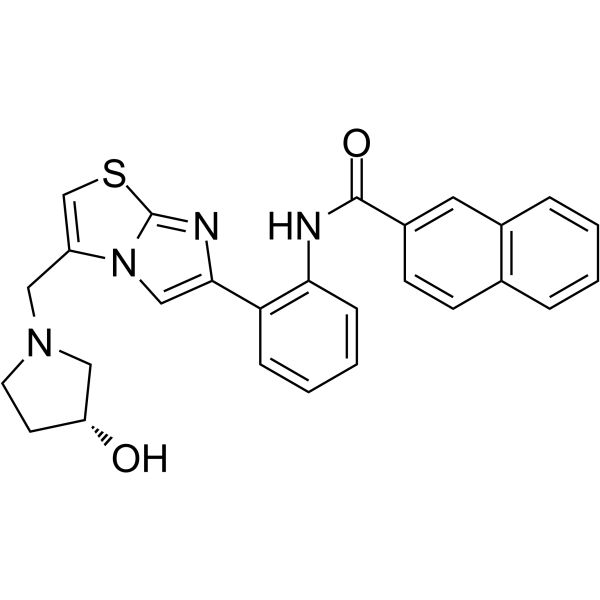


Product Information
Information
Application
The compound is the grade of analytical standard, which is the reference standard supplied assay. It is commonly used in qualitative, quantitative and methodological research experiments in HPLC, GC and MS.


Chemical Information
-
CAS No. 2060259-60-9
-
Molecular Weight 506.02
-
Formula C25H24ClN7OS
-
SMILES
O=C(C1=NC2=CC=CC=C2N=C1)NC3=C(C=CC=C3)C4=CN5C(CN6CCNCC6)=CSC5=N4.Cl
-
Shipping
Room temperature in continental US; may vary elsewhere.
-
Storage
Please store the product under the recommended conditions in the Certificate of Analysis.


Purity & Documentation
References
[1]. Milne JC et al. Small molecule activators of SIRT1 as therapeutics for the treatment of type 2 diabetes. Nature. 2007 Nov 29;450(7170):712-6 [Content Brief]
[2]. Baur JA, et al. Are sirtuins viable targets for improving healthspan and lifespan?,Nat Rev Drug Discov. 2012 Jun 1;11(6):443-61 [Content Brief]
[3]. Yao H, et al. SIRT1 protects against emphysema via FOXO3-mediated reduction of premature senescence in mice.,J Clin Invest. 2012 Jun 1;122(6):2032-45. [Content Brief]
[4]. Gao D, et al. Activation of SIRT1 Attenuates Klotho Deficiency-Induced Arterial Stiffness and Hypertension by Enhancing AMP-Activated Protein Kinase Activity. Hypertension. 2016 Nov;68(5):1191-1199. [Content Brief]
[5]. Lahusen TJ, et al. SRT1720 induces lysosomal-dependent cell death of breast cancer cells. Mol Cancer Ther. 2015 Jan;14(1):183-92. [Content Brief]

Calculators
Concentration (start) × Volume (start) = Concentration (final) × Volume (final)


SRT 1720 monohydrochloride (Standard) Related Classifications
HY-15145R Related Classifications
 Powered by Bioz