



TMDJ-035

Based on 1 Customer Validation
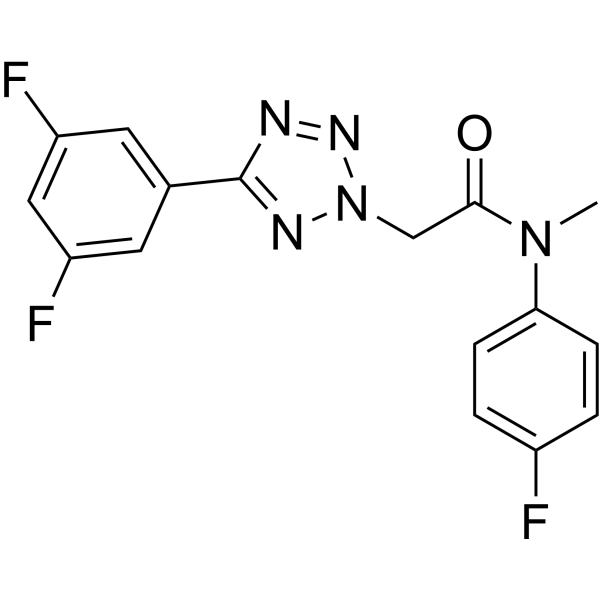
TMDJ-035 is a high-affinity, selective RyR2 inhibitor with an EC50 of 0.0130 μM. TMDJ-035 reduces RyR2 protein expression without affecting action potential-induced Ca2+ transients. TMDJ-035 decreases ATP content and intracellular Ca2+ levels. TMDJ-035 inhibits arrhythmias in a CPVT mouse model carrying mutant RyR2s. TMDJ-035 has no effect on electrocardiogram parameters or cardiac systolic function. TMDJ-035 exacerbates heart failure in mouse myocardial infarction models and hypoxic cardiomyocytes by altering cardiac function, causing tissue damage, promoting inflammatory infiltration, collagen deposition, and changes in Myosin heavy chain/actin expression. TMDJ-035 can be used in studies related to heart failure, catecholaminergic polymorphic ventricular tachycardia, and arrhythmias.
For research use only. We do not sell to patients.
- Purity: 99.92%
- CAS No.: 2681302-83-8
- Formula: C16H12F3N5O
- Molecular Weight:347.29
-
Storage:Powder -20°C, 3 years ; In solvent -80°C, 6 months , -20°C, 1 month

To place orders, for customer services and technical support, please contact: MedChemExpress USA
Tel: 609-228-6898 E-mail: [email protected] [email protected]


-
 Biological Activity
-
Chemical Information
-
Solvent & Solubility
- Purity & Documentation
- References
-
 Help & FAQs


All Calcium Channel Isoforms
More

Biological Activity
Description
In Vitro
TMDJ-035 reverses the beneficial effects of CACNB4 overexpression in cardiomyocytes of hypoxic mice by reducing intracellular Ca2+ and ATP levels and altering the expression of myocardial contraction-related proteins[1].
TMDJ-035 potently inhibits RyR2 with an IC50 of approximately 15 nM, and suppresses Ca2+ waves and calcium sparks in isolated cardiomyocytes without affecting action potential-induced Ca2+ transients[2].
TMDJ-035 potently inhibits wild-type RyR2 in HEK293 cells expressing R-CEPIA1er, with an EC50 value of 0.0130 μM[3].
TMDJ-035 (0.01-30 μM) exhibits high selectivity for RyR2; in HEK293 cells expressing R-CEPIA1er, it shows no inhibitory activity against wild-type RyR1 or RyR3 even at concentrations as high as 30 μM[3].
MedChemExpress (MCE) has not independently confirmed the accuracy of these methods. They are for reference only.
In Vivo
TMDJ-035, a high-affinity and selective RyR2 inhibitor, effectively suppresses arrhythmias caused by RyR2 hyperactivation in CPVT model mice without impairing ECG parameters or cardiac contractile function at effective doses[2].
MedChemExpress (MCE) has not independently confirmed the accuracy of these methods. They are for reference only.
-
Animal Model:C57BL/6 (8-week-old male, SPF grade, myocardial infarction induced by left anterior descending coronary artery ligation + AAV-mediated CACNB4 overexpression)[1]
-
Dosage:0.1 mg/kg
-
Administration:daily; 1 week prior to myocardial infarction modeling
-
Result:Significantly reduced RyR2 protein expression in heart tissue.
Increased LVIDd and LVIDs, decreased EF% and FS% compared to the MI+OE-CACNB4+DMSO group.
Increased myocardial fiber coagulation necrosis and inflammatory cell infiltration compared to the MI+OE-CACNB4+DMSO group.
Increased collagen fiber deposition compared to the MI+OE-CACNB4+DMSO group.
Increased BNP protein expression compared to the MI+OE-CACNB4+DMSO group.
Reduced ATP content and Ca2+ fluorescence intensity in heart tissue compared to the MI+OE-CACNB4+DMSO group.


Chemical Information
-
CAS No. 2681302-83-8
-
Appearance Solid
-
Molecular Weight 347.29
-
Formula C16H12F3N5O
-
Color White to off-white
-
SMILES
FC1=CC(F)=CC(C2=NN(CC(N(C3=CC=C(F)C=C3)C)=O)N=N2)=C1
-
Shipping
Room temperature in continental US; may vary elsewhere.
-
Storage
Powder -20°C 3 years In solvent -80°C 6 months -20°C 1 month


Solvent & Solubility
In Vitro:
DMSO : 100 mg/mL (287.94 mM; Need ultrasonic; Hygroscopic DMSO has a significant impact on the solubility of product, please use newly opened DMSO)
Please refer to the solubility information to select the appropriate solvent. Once prepared, please aliquot and store the solution to prevent product inactivation from repeated freeze-thaw cycles.
Storage method and period of stock solution: -80°C, 6 months; -20°C, 1 month. When stored at -80°C, please use it within 6 months. When stored at -20°C, please use it within 1 month.
Please refer to the solubility information to select the appropriate solvent. Once prepared, please aliquot and store the solution to prevent product inactivation from repeated freeze-thaw cycles.
Storage method and period of stock solution: -80°C, 6 months; -20°C, 1 month. When stored at -80°C, please use it within 6 months. When stored at -20°C, please use it within 1 month.
Concentration (start) × Volume (start) = Concentration (final) × Volume (final)
In Vivo:
Select the appropriate dissolution method based on your experimental animal and administration route.
- For the following dissolution methods, please ensure to first prepare a clear stock solution using an In Vitro approach and then sequentially add co-solvents:
- To ensure reliable experimental results, the clarified stock solution can be appropriately stored based on storage conditions. As for the working solution for In Vivo experiments, it is recommended to prepare freshly and use it on the same day.
- The percentages shown for the solvents indicate their volumetric ratio in the final prepared solution. If precipitation or phase separation occurs during preparation, heat and/or sonication can be used to aid dissolution.
In Vivo Dissolution Calculator
Please enter the basic information of animal experiments:
-
-
-
-
Recommended: Prepare an additional quantity of animals to account for potential losses during experiments.
Please enter your animal formula composition:
-
%DMSO +
Recommended: Keep the proportion of DMSO in working solution below 2% if your animal is weak.
-
%+
-
+%Tween-80 + +
-
%Saline +
The co-solvents required include: DMSO, . All of co-solvents are available by MedChemExpress (MCE). , Tween 80. All of co-solvents are available by MedChemExpress (MCE).
Working solution concentration: 0.22 mg/mL
Method for preparing stock solution: mg drug dissolved in μL DMSO. Stock solution concentration: mg/mL.
1. Take μL DMSO stock solution;
2. Add μL .
μL , mix evenly;
3. Then add μL Tween 80, mix evenly;
4. Then add μL
Please ensure that the stock solution in the first step is dissolved to a clear state, and add co-solvents in sequence. You can use ultrasonic heating (ultrasonic cleaner, recommended frequency 20-40 kHz), vortexing, etc. to assist dissolution.


Purity & Documentation
-
Data Sheet (277 KB)
-
SDS (251 KB)
- English - EN (251 KB)
- Français - FR (251 KB)
- Deutsch - DE (251 KB)
- Norwegian - NO (251 KB)
- Español - ES (251 KB)
- Swedish - SV (251 KB)
- Italian - IT (251 KB)
- Korean - KR (251 KB)
- Portuguese - PT (251 KB)
-
Handling Instructions (2659 KB)
References
[1]. Jiang S, et al. CACNB4 attenuates cardiac dysfunction by regulating calcium and ATP levels via interaction with RyR2. Eur J Med Res. 2025;30(1):1071. Published 2025 Nov 5. [Content Brief]
[3]. Ishida R, et al. A potent and selective cis-amide inhibitor of ryanodine receptor 2 as a candidate for cardiac arrhythmia treatment. Eur J Med Chem. 2023;262:115910. [Content Brief]


Complete Stock Solution Preparation Table
Please refer to the solubility information to select the appropriate solvent. Once prepared, please aliquot and store the solution to prevent product inactivation from repeated freeze-thaw cycles.
Storage method and period of stock solution: -80°C, 6 months; -20°C, 1 month. When stored at -80°C, please use it within 6 months. When stored at -20°C, please use it within 1 month.
| Optional Solvent | Concentration Solvent Mass | 1 mg | 5 mg | 10 mg | 25 mg |
|---|---|---|---|---|---|
| DMSO | 1 mM | 2.8794 mL | 14.3972 mL | 28.7944 mL | 71.9859 mL |
| 5 mM | 0.5759 mL | 2.8794 mL | 5.7589 mL | 14.3972 mL | |
| 10 mM | 0.2879 mL | 1.4397 mL | 2.8794 mL | 7.1986 mL | |
| 15 mM | 0.1920 mL | 0.9598 mL | 1.9196 mL | 4.7991 mL | |
| 20 mM | 0.1440 mL | 0.7199 mL | 1.4397 mL | 3.5993 mL | |
| 25 mM | 0.1152 mL | 0.5759 mL | 1.1518 mL | 2.8794 mL | |
| 30 mM | 0.0960 mL | 0.4799 mL | 0.9598 mL | 2.3995 mL | |
| 40 mM | 0.0720 mL | 0.3599 mL | 0.7199 mL | 1.7996 mL | |
| 50 mM | 0.0576 mL | 0.2879 mL | 0.5759 mL | 1.4397 mL | |
| 60 mM | 0.0480 mL | 0.2400 mL | 0.4799 mL | 1.1998 mL | |
| 80 mM | 0.0360 mL | 0.1800 mL | 0.3599 mL | 0.8998 mL | |
| 100 mM | 0.0288 mL | 0.1440 mL | 0.2879 mL | 0.7199 mL |


TMDJ-035 Related Classifications
HY-149662 Related Classifications
 Powered by Bioz