



TrxR-IN-4
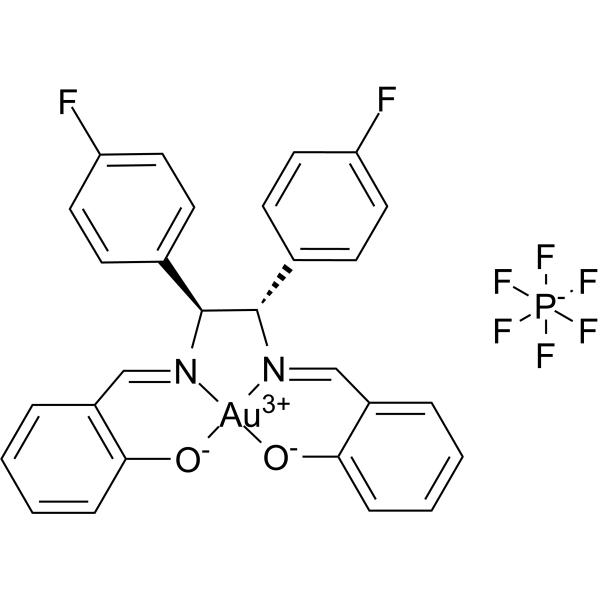
TrxR-IN-4 is a thioredoxin reductase (TrxR) inhibitor with a rat IC50 of 0.37 μM. TrxR-IN-4 inhibits TrxR activity, elevates reactive oxygen species (ROS) and induces apoptosis. TrxR-IN-4 mediates endoplasmic reticulum stress and induces mitochondrial dysfunction. TrxR-IN-4 can be used for the research of hepatocellular carcinoma.
Nur für Forschungszwecke. Wir verkaufen nicht an Patienten.
- CAS. Nr.: 2414906-32-2
- Formel: C28H20AuF8N2O2P
- Molecular Weight:796.40
-
Speicherung:
Please store the product under the recommended conditions in the Certificate of Analysis.

To place orders, for customer services and technical support, please contact: MedChemExpress USA
Tel: 609-228-6898 E-mail: [email protected] [email protected]


-
 Biologische Aktivität
-
Chemical Information
- Protokoll
- Reinheit & Dokumentation
- Verweise
-
 Help & FAQs




Biologische Aktivität
Beschreibung
In Vitro
TrxR-IN-4 (Compound 1b) (0.125-2 μM) potently inhibits purified rat liver TrxR with an IC50 of 0.37 μM[1].
TrxR-IN-4 (72 h) potently inhibits the proliferation of HepG2, SMMC-7721, and Hep3B human hepatocellular carcinoma cells with IC50 values of 5.40 μM, 10.05 μM, and 10.89 μM respectively, shows lower potency against MCF-7 and HT-29 cancer cells, and exhibits selective toxicity toward tumor cells over normal LO2 liver cells[1].
TrxR-IN-4 (0.5-10 μM; 24 h) inhibits intracellular TrxR activity in HepG2 human hepatocellular carcinoma cells with an IC50 of 6.51 μM, and dose-dependently reduces TrxR mRNA and protein expression[1].
TrxR-IN-4 (2.5-10 μM; 24-72 h) induces G2/M phase cell cycle arrest in HepG2 human hepatocellular carcinoma cells after 72 h of treatment, and reduces the expression of Cyclin A and CDK2 proteins at 10 μM after 24 h of treatment[1].
TrxR-IN-4 (2.5-10 μM; 24-72 h) dose-dependently induces apoptosis in HepG2 human hepatocellular carcinoma cells after 72 h of treatment, and upregulates pro-apoptotic proteins AIF, cytochrome c, and cleaved-PARP/PARP after 24 h of treatment[1].
TrxR-IN-4 (2.5-10 μM; 24 h) dose-dependently elevates reactive oxygen species levels, increases ROS-endoplasmic reticulum colocalization, and activates endoplasmic reticulum stress via upregulation of CHOP and Calnexin in HepG2 human hepatocellular carcinoma cells[1].
MedChemExpress (MCE) has not independently confirmed the accuracy of these methods. They are for reference only.
-
Cell Line:HepG2
-
Concentration:2.5 μM; 5 μM; 10 μM
-
Incubation Time:24 h
-
Result:Dose-dependently reduced TrxR mRNA expression.
-
Cell Line:HepG2
-
Concentration:2.5 μM; 5 μM; 10 μM
-
Incubation Time:24 h
-
Result:Dose-dependently reduced TrxR protein expression.
-
Cell Line:HepG2
-
Concentration:2.5 μM; 5 μM; 10 μM
-
Incubation Time:24 h
-
Result:Dose-dependently reduced TrxR protein expression.
-
Cell Line:HepG2
-
Concentration:2.5 μM; 5 μM; 10 μM
-
Incubation Time:24 h
-
Result:Elevated intracellular ROS levels.
Dose-dependently increased cell death.
-
Cell Line:HepG2
-
Concentration:2.5 μM; 5 μM; 10 μM
-
Incubation Time:72 h
-
Result:Dose-dependently increased the proportion of HepG2 cells accumulated in the G2/M phase.
-
Cell Line:HepG2
-
Concentration:2.5 μM; 5 μM; 10 μM
-
Incubation Time:24 h
-
Result:Significantly reduced the expression of G2/M phase-related proteins Cyclin A and CDK2 at 10 μM.
Upregulated the expression of pro-apoptotic proteins AIF, cytochrome c, and cleaved-PARP/PARP.
Upregulated the expression of CHOP and Calnexin.
In Vivo
MedChemExpress (MCE) has not independently confirmed the accuracy of these methods. They are for reference only.
-
Animal Model:ICR (male, 4-week-old, 18-22 g, chronic liver injury induced by CCl4 injection)[1]
-
Dosage:20 mg/kg
-
Administration:i.p.; daily; 2 weeks
-
Result:Significantly ameliorated liver tissue morphological changes observed via H&E staining.
Reduced collagen accumulation in liver tissue detected by Masson's and Sirius red staining.
Decreased serum levels of liver injury factors ALT, AST, and LDH compared to the CCl4 model group.
Reduced NFκB expression, decreased TNFα and IL-1b levels to suppress inflammatory cell infiltration.
Significantly lowered TrxR expression and serum TrxR levels in CCl4-injured liver tissue.
Showed no toxicity in mouse hearts, spleens, lungs, or kidneys at this dose.


Chemical Information
-
CAS. Nr. 2414906-32-2
-
Molecular Weight 796.40
-
Formel C28H20AuF8N2O2P
-
SMILES
FC(C=C1)=CC=C1[C@@H]2[N]3=CC(C=CC=C4)=C4[O-][Au+3]35[O-]C6=CC=CC=C6C=[N]5[C@H]2C7=CC=C(F)C=C7.F[P-](F)(F)(F)(F)F
-
Versand
Room temperature in continental US; may vary elsewhere.
-
Speicherung
Please store the product under the recommended conditions in the Certificate of Analysis.


Reinheit & Dokumentation
Verweise

Calculators
Konzentration (Stammlösung) × Volumen (Stammlösung) = Konzentration (Ziellösung) × Volumen (Ziellösung)


TrxR-IN-4 Related Classifications
HY-146350 Related Classifications
 Powered by Bioz