



UCM-13207

Based on 1 Customer Validation
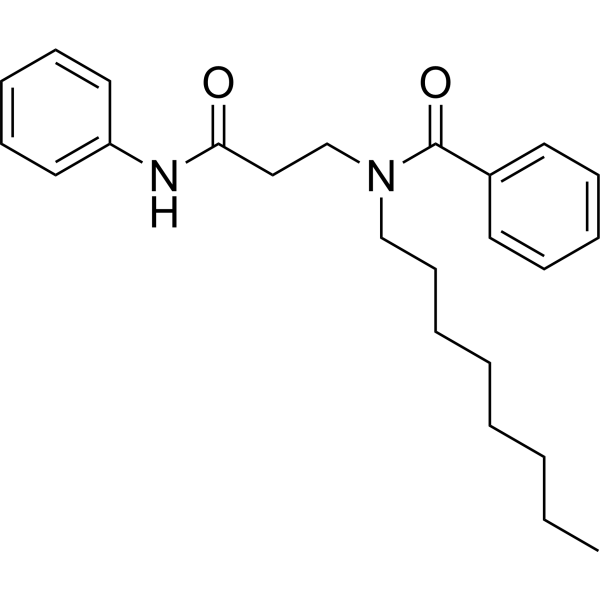
UCM-13207 is a selective isoprenylcysteine carboxylmethyltransferase (ICMT) inhibitor with a human IC50 of 1.4 μM and human Ka of 7.2 μM. UCM-13207 modulates progerin localization, stability, and levels, reduces DNA damage, increases cellular viability, and decreases tissue senescence. UCM-13207 can be used for the research of Hutchinson−Gilford progeria syndrome.
For research use only. We do not sell to patients.
- Purity : 99.61%
- CAS No.: 1621536-10-4
- Formula: C24H32N2O2
- Molecular Weight:380.52
-
Storage:Pure form -20°C, 3 years , 4°C, 2 years ; In solvent -80°C, 6 months , -20°C, 1 month

To place orders, for customer services and technical support, please contact: MedChemExpress USA
Tel: 609-228-6898 E-mail: [email protected] [email protected]


-
 Biological Activity
-
Chemical Information
-
Solvent & Solubility
- Protocols
- Purity & Documentation
- References
-
 Help & FAQs




Biological Activity
Description
In Vitro
UCM-13207 inhibits recombinant human ICMT with an IC50 of 1.4 μM[1].
UCM-13207 (0.01-50 μM; 72 h) does not induce significant toxicity in Lmna+/+ mouse fibroblasts at concentrations up to 10 μM[1].
UCM-13207 (0-10 μM; 72 h) dose-dependently preserves viability in LmnaG609G/G609G progeroid mouse fibroblasts, with maximal efficacy at 2 μM after 72 h incubation[1].
UCM-13207 (10 μM; 14 days) increases the proliferation rate of LmnaG609G/G609G progeroid mouse fibroblasts to near wild-type levels[1].
UCM-13207 (2 μM; 24 days) increases the proliferation rate of human HGPS fibroblasts[1].
UCM-13207 (2 μM; 17 days) delocalizes progerin from the nuclear rim and reduces total progerin levels in human HGPS fibroblasts[1].
UCM-13207 (2 μM; 14 days) reduces progerin levels to ~50% of vehicle-treated LmnaG609G/G609G progeroid mouse fibroblasts[1].
UCM-13207 (2 μM; 14 days) increases pAkt levels and reduces DNA damage marker pH2AX levels in LmnaG609G/G609G progeroid mouse fibroblasts[1].
UCM-13207 (2 μM; 14 days) reduces progerin levels in LmnaG609G/G609G progeroid mouse fibroblasts via the proteasome degradation pathway[1].
UCM-13207 (2 μM; 10 days) increases pAkt levels and reduces DNA damage marker pH2AX levels in human HGPS fibroblasts[1].
UCM-13207 (2 μM; 15 days) reduces senescence-associated β-galactosidase activity in human HGPS fibroblasts[1].
MedChemExpress (MCE) has not independently confirmed the accuracy of these methods. They are for reference only.
-
Cell Line:Lmna+/+ mouse fibroblasts
-
Concentration:0.01 μM; 0.2 μM; 0.5 μM; 2 μM; 10 μM; 25 μM; 50 μM
-
Incubation Time:72 h
-
Result:Showed no appreciable cellular toxicity at concentrations up to 10 μM, with viability remaining above 90% at these doses.
Exhibited significant toxicity only at 25 μM and 50 μM.
-
Cell Line:LmnaG609G/G609G progeroid mouse fibroblasts
-
Concentration:0.01 μM; 0.2 μM; 0.5 μM; 2 μM; 10 μM
-
Incubation Time:72 h
-
Result:Preserved viability in a dose-dependent manner, with the maximal protective effect observed at 2 μM.
Showed significantly higher viability at 2 μM and 10 μM compared to lower concentrations.
-
Cell Line:LmnaG609G/G609G progeroid mouse fibroblasts
-
Concentration:10 μM
-
Incubation Time:14 days
-
Result:Increased population doubling values almost to the level of Lmna+/+ wild-type mouse fibroblasts, with a statistically significant difference compared to vehicle-treated progeroid cells.
-
Cell Line:human Hutchinson-Gilford Progeria Syndrome (HGPS) fibroblasts
-
Concentration:2 μM
-
Incubation Time:24 days
-
Result:Significantly increased population doubling values compared to vehicle-treated HGPS fibroblasts, with a statistically significant difference.
-
Cell Line:human HGPS fibroblasts
-
Concentration:2 μM
-
Incubation Time:17 days
-
Result:Induced significant delocalization of progerin from the nuclear rim to the nucleoplasm, with an average ~36% reduction in nuclear rim progerin intensity vs vehicle.
Decreased total progerin protein levels compared to vehicle-treated cells, with statistically significant differences.
-
Cell Line:LmnaG609G/G609G progeroid mouse fibroblasts
-
Concentration:2 μM
-
Incubation Time:14 days
-
Result:Reduced relative progerin levels to ~50% of vehicle-treated cells, with a statistically significant difference (P=0.049).\nIncreased relative pAkt levels to near wild-type Lmna+/+ cell levels, with a statistically significant difference.
Reduced relative pH2AX levels compared to vehicle-treated progeroid cells, with a statistically significant difference.
-
Cell Line:LmnaG609G/G609G progeroid mouse fibroblasts
-
Concentration:2 μM; 2 μM plus 25 nM Bafilomycin A (HY-100558); 2 μM plus 5 μM MG-132 (HY-13259)
-
Incubation Time:14 days
-
Result:Reversed the reduction in progerin levels induced by UCM-13207 via treatment with the proteasome inhibitor MG-132, but not via the lysosome inhibitor Bafilomycin A.
Restored relative progerin levels to ~90% of vehicle-treated cells with MG-132 co-treatment.
-
Cell Line:human HGPS fibroblasts
-
Concentration:2 μM
-
Incubation Time:10 days
-
Result:Significantly increased relative pAkt levels compared to vehicle-treated HGPS cells, with a statistically significant difference .
Significantly reduced relative pH2AX levels compared to vehicle-treated HGPS cells, with a statistically significant difference .
In Vivo
MedChemExpress (MCE) has not independently confirmed the accuracy of these methods. They are for reference only.
-
Animal Model:C57BL/6 LmnaG609G/G609G knock-in mice (both male and female; 6 weeks old at treatment start)[1]
-
Dosage:40 mg/kg
-
Administration:i.p.; 5 times per week
-
Result:Extended mean survival to 173 days (vs. 134 days for vehicle controls).
Increased maximum survival from 164 to 194 days.
Increased minimum survival from 110 to 158 days.
Significantly improved body weight at all tested ages.
Increased serum glucose levels and grip strength close to wild-type control values.
Slightly improved lordokyphosis.
Significantly increased thymus weight and increased spleen size.
Reduced progerin signal intensity and increased the number of vascular smooth muscle cells (VSMCs) in aortic arch tissue.
Reduced progerin signal intensity in endocardial tissue.
Decreased global tissue senescence (assessed by SA β-galactosidase activity) in liver and kidney.
Reduced heart fibrosis and microvascular cell loss.


Chemical Information
-
CAS No. 1621536-10-4
-
Appearance Oil
-
Molecular Weight 380.52
-
Formula C24H32N2O2
-
Color Colorless to light yellow
-
SMILES
O=C(CCN(CCCCCCCC)C(C1=CC=CC=C1)=O)NC2=CC=CC=C2
-
Shipping
Room temperature in continental US; may vary elsewhere.
-
Storage
Pure form -20°C 3 years 4°C 2 years In solvent -80°C 6 months -20°C 1 month


Solvent & Solubility
In Vitro:
DMSO : 100 mg/mL (262.80 mM; Need ultrasonic; Hygroscopic DMSO has a significant impact on the solubility of product, please use newly opened DMSO)
Please refer to the solubility information to select the appropriate solvent. Once prepared, please aliquot and store the solution to prevent product inactivation from repeated freeze-thaw cycles.
Storage method and period of stock solution: -80°C, 6 months; -20°C, 1 month. When stored at -80°C, please use it within 6 months. When stored at -20°C, please use it within 1 month.
Please refer to the solubility information to select the appropriate solvent. Once prepared, please aliquot and store the solution to prevent product inactivation from repeated freeze-thaw cycles.
Storage method and period of stock solution: -80°C, 6 months; -20°C, 1 month. When stored at -80°C, please use it within 6 months. When stored at -20°C, please use it within 1 month.
Concentration (start) × Volume (start) = Concentration (final) × Volume (final)
In Vivo:
Select the appropriate dissolution method based on your experimental animal and administration route.
- For the following dissolution methods, please ensure to first prepare a clear stock solution using an In Vitro approach and then sequentially add co-solvents:
- To ensure reliable experimental results, the clarified stock solution can be appropriately stored based on storage conditions. As for the working solution for In Vivo experiments, it is recommended to prepare freshly and use it on the same day.
- The percentages shown for the solvents indicate their volumetric ratio in the final prepared solution. If precipitation or phase separation occurs during preparation, heat and/or sonication can be used to aid dissolution.
Add each solvent one by one: 10% DMSO 40% PEG300 5% Tween-80 45% Saline
Solubility: ≥ 2.5 mg/mL (6.57 mM); Clear solution
This protocol yields a clear solution of ≥ 2.5 mg/mL (saturation unknown).
Taking 1 mL working solution as an example, add 100 μL DMSO stock solution (25.0 mg/mL) to 400 μL PEG300, and mix evenly; then add 50 μL Tween-80 and mix evenly; then add 450 μL Saline to adjust the volume to 1 mL.
Preparation of Saline: Dissolve 0.9 g sodium chloride in ddH₂O and dilute to 100 mL to obtain a clear Saline solution.
In Vivo Dissolution Calculator
Please enter the basic information of animal experiments:
-
-
-
-
Recommended: Prepare an additional quantity of animals to account for potential losses during experiments.
Please enter your animal formula composition:
-
%DMSO +
Recommended: Keep the proportion of DMSO in working solution below 2% if your animal is weak.
-
%+
-
+%Tween-80 + +
-
%Saline +
The co-solvents required include: DMSO, . All of co-solvents are available by MedChemExpress (MCE). , Tween 80. All of co-solvents are available by MedChemExpress (MCE).
Working solution concentration: 0.22 mg/mL
Method for preparing stock solution: mg drug dissolved in μL DMSO. Stock solution concentration: mg/mL.
1. Take μL DMSO stock solution;
2. Add μL .
μL , mix evenly;
3. Then add μL Tween 80, mix evenly;
4. Then add μL
Please ensure that the stock solution in the first step is dissolved to a clear state, and add co-solvents in sequence. You can use ultrasonic heating (ultrasonic cleaner, recommended frequency 20-40 kHz), vortexing, etc. to assist dissolution.


Purity & Documentation
-
Data Sheet (283 KB)
-
SDS (252 KB)
- English - EN (252 KB)
- Français - FR (252 KB)
- Deutsch - DE (252 KB)
- Norwegian - NO (252 KB)
- Español - ES (252 KB)
- Swedish - SV (252 KB)
- Italian - IT (252 KB)
- Korean - KR (252 KB)
- Portuguese - PT (252 KB)
-
Handling Instructions (2659 KB)
References


Complete Stock Solution Preparation Table
Please refer to the solubility information to select the appropriate solvent. Once prepared, please aliquot and store the solution to prevent product inactivation from repeated freeze-thaw cycles.
Storage method and period of stock solution: -80°C, 6 months; -20°C, 1 month. When stored at -80°C, please use it within 6 months. When stored at -20°C, please use it within 1 month.
| Optional Solvent | Concentration Solvent Mass | 1 mg | 5 mg | 10 mg | 25 mg |
|---|---|---|---|---|---|
| DMSO | 1 mM | 2.6280 mL | 13.1399 mL | 26.2798 mL | 65.6996 mL |
| 5 mM | 0.5256 mL | 2.6280 mL | 5.2560 mL | 13.1399 mL | |
| 10 mM | 0.2628 mL | 1.3140 mL | 2.6280 mL | 6.5700 mL | |
| 15 mM | 0.1752 mL | 0.8760 mL | 1.7520 mL | 4.3800 mL | |
| 20 mM | 0.1314 mL | 0.6570 mL | 1.3140 mL | 3.2850 mL | |
| 25 mM | 0.1051 mL | 0.5256 mL | 1.0512 mL | 2.6280 mL | |
| 30 mM | 0.0876 mL | 0.4380 mL | 0.8760 mL | 2.1900 mL | |
| 40 mM | 0.0657 mL | 0.3285 mL | 0.6570 mL | 1.6425 mL | |
| 50 mM | 0.0526 mL | 0.2628 mL | 0.5256 mL | 1.3140 mL | |
| 60 mM | 0.0438 mL | 0.2190 mL | 0.4380 mL | 1.0950 mL | |
| 80 mM | 0.0328 mL | 0.1642 mL | 0.3285 mL | 0.8212 mL | |
| 100 mM | 0.0263 mL | 0.1314 mL | 0.2628 mL | 0.6570 mL |


UCM-13207 Related Classifications
HY-149708 Related Classifications
 Powered by Bioz
Keywords