



ω-Hexatoxin-Hv1a
ω-Hexatoxin-Hv1a (ω-ACTX-Hv1; ω-Atracotoxin-HV1) is an orally active insecticidal neurotoxin containing an inhibitor cystine knot motif and a selective calcium channel inhibitor. ω-Hexatoxin-Hv1a blocks L-type voltage-dependent Ca2+ channels and reduces intracellular calcium ion concentration, thereby decreasing apoptosis, necroptosis and oxidative stress, and promoting cell recovery and energy level elevation. ω-Hexatoxin-Hv1a causes larval paralysis and death by impairing neurotransmission in the central nervous system of insects. It shows high injectable toxicity against insects of multiple orders, but exhibits weak oral toxicity. ω-Hexatoxin-Hv1a is widely applicable to studies related to ischemia-reperfusion injury, atopic dermatitis, and ischemic injury of cardiomyocytes and neurons.
商品は「研究用試薬」です。人や動物の医療用・臨床診断用・食品用の製品ではありません。
研究用途以外に使用した場合、当社は一切の責任を負いかねます。
- CAS 番号: 193981-10-1
- 分子式: C162H247N49O61S6
- 分子量:4049.38
-
保管条件:
Please store the product under the recommended conditions in the Certificate of Analysis.

To place orders, for customer services and technical support, please contact: MedChemExpress USA
Tel: 609-228-6898 E-mail: [email protected] [email protected]


-
 生物活性
生物活性
-
化学情報
- プロトコル
- 純度とドキュメンテーション
- 参考文献
-
 Help & FAQs


Calcium Channel アイソフォーム固有の製品をすべて表示
More

生物活性
製品説明
IC50 & Target
|
L-type calcium channel |
体外実験
ω-Hexatoxin-Hv1a (10-50 nM; 3 h of reperfusion) inhibits ischemia/reperfusion-induced apoptosis, suppresses ischemia/reperfusion-induced necrosis, alleviates intracellular calcium overload, and promotes the recovery of cell index in CHO-K1 epithelial cells[1].
Recombinant ω-Hexatoxin-Hv1a (100-200 ng) retains immunoreactivity after fusion with GNA, which is confirmed by Western blotting analysis of 200 ng and 100 ng loaded samples of the intact Hv1a/GNA fusion protein[2].
ω-Hexatoxin-Hv1a (10-50 nM; 18 h) blocks AC-1001 H3-induced apoptosis in CHO-K1 cells in a dose-dependent manner in vitro. At 50 nM (18 h incubation), it reduces the apoptosis level to that of the control group, while 10 nM used alone does not alter the baseline apoptosis level[3].
MedChemExpress (MCE) has not independently confirmed the accuracy of these methods. They are for reference only.
-
Cell Line:CHO-K1 Chinese hamster ovary epithelial cells
-
Concentration:10 nM; 50 nM
-
Incubation Time:3 h (reperfusion)
-
Result:Maintained CHO-K1 cell apoptosis levels at the normal condition level at 50 nM.
Showed no effect on apoptosis at 10 nM.
Maintained necrosis levels at the normal condition level at both 10 nM and 50 nM.
Reduced intracellular calcium ion concentration during reperfusion to levels correlating with reduced apoptosis and necrosis at both 10 nM and 50 nM.
Caused the cell index to return to pre-reperfusion values within 1 h of reperfusion start at both 10 nM and 50 nM, compared to the no-toxin group which returned to normal levels only after 5 h.
-
Cell Line:CHO-K1
-
Concentration:10 nM (alone); 10-50 nM (co-treated with AC-1001 H3 peptide)
-
Incubation Time:18 h (all conditions)
-
Result:Exhibited apoptosis level statistically identical to the control group when used alone at 10 nM for 18 h.
Decreased apoptosis level compared to AC-1001 H3 peptide alone when co-treated at 10 nM for 18 h.
Showed a dose-dependent reduction in AC-1001 H3-induced apoptosis at 10, 30, 50 nM for 18 h, with 50 nM resulting in apoptosis level statistically indistinguishable from the control group.
体内実験
ω-Hexatoxin-Hv1a (9.6 μg per larva; p.o.; daily; 4 days) alone via daily sucrose droplets has no insecticidal activity against fifth stadium Mamestra brassicae larvae[2].
MedChemExpress (MCE) has not independently confirmed the accuracy of these methods. They are for reference only.
-
Animal Model:Mamestra brassicae (fifth stadium, 40-70 mg)[2]
-
Dosage:46 μg/g insect; 92 μg/g insect; 184 μg/g insect
-
Administration:injection
-
Result:Caused 20% mortality at 72 hours post-injection at 46 μg/g insect.
Caused 80% mortality at 72 hours post-injection at 92 μg/g insect.
Caused 90% mortality at 72 hours post-injection at 184 μg/g insect.
Induced paralysis in larvae injected with doses of 46 μg/g insect and above.
Significantly reduced survival compared to controls (P<0.001).
-
Animal Model:Mamestra brassicae (fifth stadium)[2]
-
Dosage:9.6 μg per larva (daily, total 38.4 μg per larva)
-
Administration:p.o.; daily; 4 days
-
Result:Showed no reduction in larval growth compared to the BSA control group.
Showed no reduction in survival compared to the BSA control group.
Resulted in all larvae surviving to pupation, with no evidence of reduced feeding or paralysis.
- Detection of Apoptosis
- TUNEL staining for apoptotic DNA fragmentation
- Annexin V plus membrane-impermeant dye apoptosis staining
- Cell recovery
- ROS/oxidative-stress fluorescent staining
- TPA/Croton Oil Ear Edema and Dermatitis
- Calcium Spark Assay
- Apoptosis Solutions
- Repeated-Dose Oral Toxicity Study
- Ca2+ Staining Technique
- Standard Mammalian Cell Line Thawing and Recovery


化学情報
-
CAS 番号 193981-10-1
-
分子量 4049.38
-
分子式 C162H247N49O61S6
-
別名
ω-ACTX-Hv1; ω-Atracotoxin-HV1
-
配列
Ser-Pro-Thr-Cys-Ile-Pro-Ser-Gly-Gln-Pro-Cys-Pro-Tyr-Asn-Glu-Asn-Cys-Cys-Ser-Gln-Ser-Cys-Thr-Phe-Lys-Glu-Asn-Glu-Asn-Gly-Asn-Thr-Val-Lys-Arg-Cys-Asp (Disulfide bridge:Cys4-Cys18, Cys11-Cys22, Cys17-Cys36)
-
シーケンスの短縮
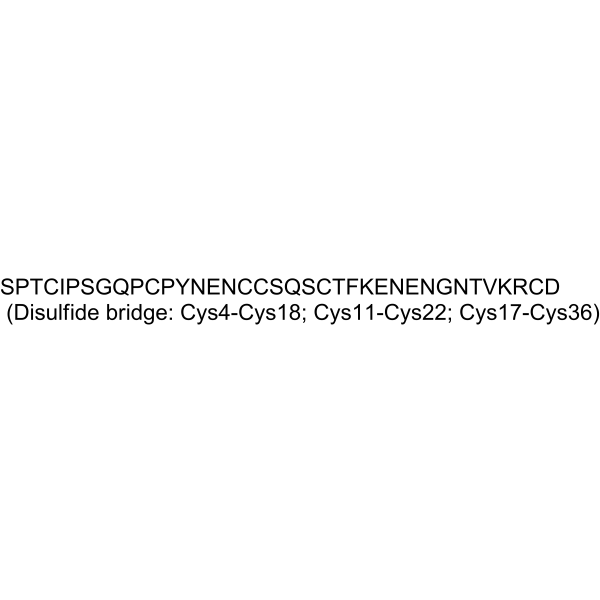
SPTCIPSGQPCPYNENCCSQSCTFKENENGNTVKRCD (Disulfide bridge:Cys4-Cys18, Cys11-Cys22, Cys17-Cys36)
-
輸送条件
Room temperature in continental US; may vary elsewhere.
-
保管条件
Please store the product under the recommended conditions in the Certificate of Analysis.


純度とドキュメンテーション
参考文献
[1]. Iurova EV, et al. Effect of the Peptide Calcium Channel Blocker ω-hexatoxin-Hv1a on Cell Death during Ischemia/Reperfusion in vitro. Sovrem Tekhnologii Med. 2023;15(1):21-27. [Content Brief]
[2]. Fitches EC, et al. Fusion to snowdrop lectin magnifies the oral activity of insecticidal ω-Hexatoxin-Hv1a peptide by enabling its delivery to the central nervous system. PLoS One. 2012;7(6):e39389. [Content Brief]
[3]. Iurova E, et al. Arthropod toxins inhibiting Ca2+ and Na+ channels prevent AC-1001 H3 peptide-induced apoptosis. J Pept Sci. 2021;27(1):e3288. [Content Brief]

Calculators
濃度 (開始) × 体積 (開始) = 濃度 (終了) × 体積 (終了)


ω-Hexatoxin-Hv1a 関連分類
HY-P5142 関連分類
 Powered by Bioz
Keywords
- ω-Hexatoxin-Hv1a
- 193981-10-1
- ω-ACTX-Hv1
- ω-Atracotoxin-HV1
- Insecticide
- Calcium Channel
- Apoptosis
- Necroptosis
- voltage-gated calcium channels
- mammalian voltage-gated calcium channels
- insect voltage-gated calcium channels
- CHO-K1 cells
- atopic dermatitis
- insect larvae
- epithelial cells
- central nervous system ganglionic neural transmission
- ischemic and reperfusion injury
- inhibitor cystine knot motif
- Inhibitor
- inhibitor
- inhibit